
RFID + Magnetic Stripe Combo Cards
RFID + Magstripe Combo Card
Legacy Reader Bridge

Quick answer
An RFID magstripe combo card pairs a 13.56 MHz chip with an ISO/IEC 7811 HiCo 2750 Oe magnetic stripe on one ISO/IEC 7810 ID-1 card body. Both rails work independently, so hospitality, campus, and enterprise estates issue one credential while doors, elevators, vending, and POS readers migrate at their own pace. Chip options span MIFARE Classic, DESFire EV3, NTAG, and HID iCLASS; typical hospitality migrations run 18-36 months.
- One ISO/IEC 7810 ID-1 card body carries a 13.56 MHz RFID chip (MIFARE Classic 1K / DESFire EV3 / NTAG / HID iCLASS) plus an ISO/IEC 7811-6 HiCo 2750 Oe (or 4000 Oe) magnetic stripe — both rails active simultaneously with no RF interference.
- Designed for the mid-migration estate: hospitality PMS layers (Opera, Mews, Cloudbeds) and campus-card platforms (CBORD, Transact, Atrium) stay untouched while some readers run magstripe and others run RFID.
- Full factory pre-encoding (UID + Track 1/2/3) with per-card CSV manifest, or blank dual-rail stock for front-desk dual-encode in one print pass on HID Fargo / Magicard / Evolis / Entrust / Zebra printers.
Used in these industries
Deployments where this product is referenced on our industry landing pages.

At a glance
Use these short answers to decide whether this page matches the project before moving into the detail.
Why a combo card exists
Large hospitality / campus / enterprise estates run mixed fleets during multi-year renovation cycles — some doors, elevators, vending units, POS terminals, or parking la...
Magnetic-stripe standards and coercivity choice
ISO/IEC 7811-2 (LoCo stripe, ~300 Oe), 7811-6 (HiCo stripe, ~2750 Oe typical, up to 4000 Oe for high-durability), 7811-7 (high-coercivity high-density) and 7811-8 (the 6...
Next step
Ready to move forward? Start your inquiry to get specific answers for this project.
Request a quote for RFID + magstripe combo cards- Magnetic-stripe track structure
-
- ISO/IEC 7813 defines Track 1 (Alphanumeric, 79 chars, IATA financial format), Track 2 (Numeric, 40 chars, ABA financial format) and Track 3 (ISO/IEC 4909, 107 chars, read-write). Hospitality and campus programmes typically encode site-specific data on Track 2 and/or Track 3.
- Proud Tek encodes any combination of tracks at the factory or ships blank stripes for front-desk / card-office encoding. Track-3 read-write usage is where legacy campus cashless-payment and laundry-credit programmes still live.
- RFID chip matrix
-
- MIFARE Classic 1K / 4K — the legacy hospitality and access-control default, paired with ISO/IEC 14443-A at 13.56 MHz.
- MIFARE DESFire EV2 / EV3 — AES-128 secure tier, recommended when the RFID side is also carrying high-value access (luxury hospitality, regulated gaming, enterprise HQ).
- MIFARE Ultralight EV1 / C — disposable / single-issue combo for events, single-stay hospitality, or transit day-passes.
- NTAG 213 / 216 — NFC-Forum Type 2 for phone-readable marketing or loyalty payload alongside the magstripe.
- HID iCLASS SE / SEOS compatible — enterprise access-control ecosystems where the magstripe is retained for legacy POS or elevator head-ends.
- Physical construction and durability
-
- ISO/IEC 7810 ID-1 geometry (85.60 × 53.98 mm, 0.76-0.84 mm thickness depending on stripe lamination tier); ISO/IEC 10373-1 / 10373-2 test methods for flex, torsion, UV, and magnetic-stripe durability.
- PVC core with PET/ABS laminate is the standard; PET-only or PC (polycarbonate) is specified for higher-temperature environments (vehicle dashboards, sunlit kiosks) and for longer guaranteed life (5-7 years under hospitality wear patterns).
- Encoding workflow
-
- Desktop encoders from HID Fargo, Magicard, Evolis, Entrust, and Zebra support dual-rail encoding in one pass: magstripe tracks + RFID chip programmed simultaneously during print.
- Factory pre-encoding is available for bulk issuance — UID allocation + magstripe payload delivered per-card with a CSV manifest for import into the PMS, card-office ERP, or access-control database.
- Hospitality PMS and campus-card compatibility
-
- Hospitality PMS: Oracle Opera Cloud, Mews, Cloudbeds, Infor HMS, Protel — all integrate at the lock/head-end layer and are agnostic to card-source supplier.
- Campus card platforms: CBORD, Transact (formerly Blackboard), Atrium, Heartland OneCard — accept combo cards with ISO/IEC 14443-A chip + ISO/IEC 7811-2 HiCo stripe. Factory manifests ship with both UID and track-data columns to simplify import.
- Printing and personalisation
-
- Full-colour offset (CMYK + Pantone spot, ISO 12647-2 process control) for runs from 1,000 cards; UV digital at 600-1200 dpi for short runs; dye-sublimation retransfer at the front desk for variable-data (guest name, room, check-in date).
- Spot UV, hot-foil stamp, embossed numbering, signature panel, hologram overlay — all compatible with combo construction provided the stripe area retains the unlaminated read surface.
- Payment-card adjacency (PCI awareness)
-
- When Track-2 data on the combo card is used for cashless-payment on a campus card or loyalty stored-value programme, PCI-DSS v4.0 segmentation rules apply to the issuance, encoding, and handling systems that touch that track.
- Combo cards used purely for facility access / hospitality room keys (no PAN, no cardholder data) fall outside PCI scope; the distinction matters during tender response and integrator scoping.
- Lifecycle and migration economics
-
- Typical magnetic-to-RFID transition runs 18-36 months across a hospitality portfolio or 24-48 months across a university campus; combo cards absorb the cost of the mid-transition period where both rails must be supported.
- At steady state (post-migration) the combo card is re-issued as RFID-only, saving the ~USD 0.05-0.10 per-card stripe cost once the magstripe-only reader base is fully retired.
- Supply chain and MOQ
-
- Standard MOQ 1,000 for custom-printed combo cards; blank stock (Classic 1K + HiCo 2750) dispatches in 2-3 business days. Custom production lands in 5-7 business days at 1,000-10,000 units and scales to 1,000,000+ with scheduled call-off.
- Dual-source procurement (OEM for new-platform certification, factory-direct for steady-state replacement) applies to combo cards exactly as it does to RFID-only cards.
- Environmental and end-of-life
-
- FSC-certified paperboard jackets, r-PET card cores, and PLA substrates are supported where ESG reporting (EU ESPR, LEED, Green Key) requires documented recycled or bio-based content; operators typically call these out at tender stage.
- At end of life the magstripe is degaussed and the PVC core routed to the local recycling stream; DESFire EV3 chips are zeroised via factory re-encode when cards are decommissioned in bulk.
Commercial terms
- MOQ
- Varies by SKU — stock items from 100 pcs; custom production typically 200-1,000 pcs
- Lead time
- Production 2-3 weeks after artwork and encoding sign-off; reorders on a 3-4 week cycle
- Samples
- Free samples and RF test report with every order; courier at customer cost
- Payment
- 50% T/T deposit, 50% before shipment; Net 30/60 for established accounts; LC for large orders
- Shipping
- FOB Shenzhen / Yantian; DHL, FedEx or EMS air freight; sea LCL / FCL for volume
- Response
- Itemized quote within one business day, Mon-Fri (UTC+8)
Why combo cards exist — the migration arithmetic
Every reader-estate migration has an awkward middle act: the lobby doors went RFID in the renovation, the parking barrier and the vending bank still want a stripe swiped, and no guest wants to carry two cards about it. The combo card is the one credential both reader generations agree on. Still weighing the end state itself? The RFID vs magnetic hotel key card comparison closes that half of the decision.
- A combo card is the only credential that lets an operator run two reader generations on one estate without issuing duplicate cards or forcing a single-day cutover.
- The typical hospitality portfolio transition runs 18-36 months; campus card migrations run 24-48 months — both horizons where a dual-rail card is cheaper than the support cost of parallel issuance.
- Post-migration, combo stock is retired in favour of RFID-only; the per-card ~USD 0.05-0.10 stripe premium disappears at that point and the same chip SKU continues to ship.
Inside the card — two rails, zero crosstalk
One ISO/IEC 7810 body, two entirely different physics. The chip talks to readers by inductive coupling at 13.56 MHz; the stripe stores flux reversals that a swipe head reads by contact. They do not share a wire, a frequency, or an opinion — which is why one card serves both fleets without either rail noticing the other.
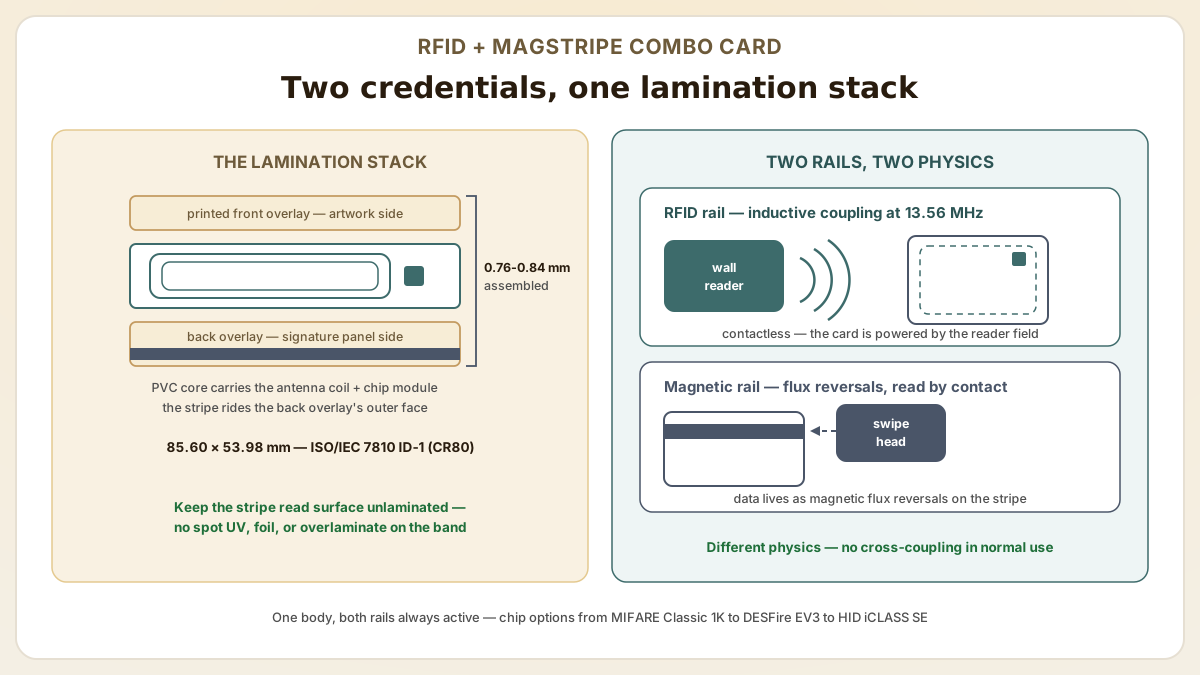
- Lamination stack: printed front overlay, PVC core carrying the embedded antenna coil and chip module, back overlay with the HiCo stripe panel and optional signature panel.
- The stripe is a lamination feature, not an electronic one — it pairs with any chip in the matrix, from MIFARE Classic 1K to DESFire EV3 to HID iCLASS SE.
- Finishes stay off the stripe: spot UV, hot-foil, and hologram overlays are combo-compatible provided the stripe area keeps its unlaminated read surface.
- ISO/IEC 10373-1 / 10373-2 test methods cover flex, torsion, UV exposure, and stripe survivability — the combo body qualifies as one construction, not two.
The full specification — chip options, stripe grades, track formats
Procurement reads tables, not adjectives, so here is the whole card in one: RFID rail up top, magnetic rail in the middle, commercial terms at the bottom. For what actually gets written onto the chip and tracks at issuance, the hotel key card encoding guide walks the full workflow.
| Attribute | Value | Notes |
|---|---|---|
| Card body | ISO/IEC 7810 ID-1 — 85.60 × 53.98 mm | Standard CR80 geometry; fits existing badge printers, holders and wallets — magnetic encoding needs a printer with an ISO/IEC 7811 encoder head |
| Thickness | 0.76-0.84 mm | Varies with stripe lamination tier |
| RFID rail | 13.56 MHz, ISO/IEC 14443-A | Contactless side — electrically independent of the stripe |
| Chip options | MIFARE Classic 1K / 4K · MIFARE DESFire EV3 · MIFARE Ultralight C · NTAG 213 / 216 · HID iCLASS SE / SEOS-compatible | Spec the chip for the post-migration estate; DESFire EV3 carries AES-128 for secure tiers |
| Stripe grades | HiCo 2750 Oe (default) · HiCo 4000 Oe (high-use) · LoCo 300 Oe (disposable) | HiCo per ISO/IEC 7811-6; LoCo per ISO/IEC 7811-2 |
| Track 1 | 79 alphanumeric characters at 210 bpi | IATA format per ISO/IEC 7813 |
| Track 2 | 40 numeric characters at 75 bpi | ABA format — the track most legacy hospitality and campus head-ends read |
| Track 3 | 107 numeric characters at 210 bpi, read-write | ISO/IEC 4909; where legacy campus stored-value and laundry-credit balances live |
| Materials | PVC core + PET/ABS laminate; PC for high-temperature duty | PC covers vehicle dashboards and sunlit kiosks with 5-7 year service life |
| Durability testing | ISO/IEC 10373-1 / 10373-2 methods | Flex, torsion, UV, and magnetic-stripe survivability |
| Encoding | Factory pre-encode (UID + Track 1/2/3 + CSV manifest) or desktop dual-encode in one print pass | HID Fargo, Magicard, Evolis, Entrust, Zebra supported |
| MOQ & stock | 1,000 custom-printed; blank dual-rail stock ships in 2-3 business days | Pre-encoding no-charge at ≥5,000 units |
| Lead time | 5-7 business days at 1,000-10,000 units | Scales to 1,000,000+ cards with scheduled call-off |
HiCo vs LoCo — coercivity, failure modes, and where each fits
Coercivity, measured in oersteds, is a stripe's stubbornness: how strong a magnetic field must be before the encoding surrenders. LoCo gives in to a handbag clasp; HiCo holds out for the encoder that wrote it. Pick by how long the card has to survive the real world, not by the per-card delta.
LoCo (300 Oe) — low-cost, short-lifecycle
- ~USD 0.02-0.04 per-card stripe cost
- Demagnetises near handset magnets, magnetic wallet closures, other cards
- Front-desk re-encoding events drive support labour
- Fits single-visit / disposable use (day-pass, event badge, one-night hotel)
- ISO/IEC 7811-2 coercivity class
HiCo (2750 or 4000 Oe) — hospitality / enterprise default
- ~USD 0.05-0.10 per-card stripe cost
- Resists handset magnets, wallet clasps, lanyard-stack interaction
- 5-year service life under hospitality wear patterns
- Standard for returning-guest, member, and employee programmes
- ISO/IEC 7811-6 coercivity class; the 4000 Oe high-density tier is ISO/IEC 7811-7
The per-card economics of the bridge period
The stripe costs a nickel or a dime per card right up until it saves you from running two credential programmes in parallel — duplicate issuance, duplicate support, duplicate lost-card churn. This is the whole business case, in one number and four bullets.
- Combo MIFARE Classic 1K + HiCo 2750 Oe at MOQ 5,000: typical per-card USD 0.25-0.40 printed both sides.
- Combo MIFARE DESFire EV3 + HiCo 2750 Oe at MOQ 5,000: typical per-card USD 0.55-0.90 printed both sides.
- Pre-encoding (UID + magstripe tracks + CSV manifest): no-charge at ≥5,000 units.
- Signature panel, hot-foil, spot UV, and embossed numbering add USD 0.03-0.15 per card depending on finish stack.
The migration playbook — one estate, two reader fleets
No estate migrates over a weekend, and nobody budgets for a flag-day cutover that goes perfectly. Below is how hospitality and campus operators actually run it. If the RFID side must land on an existing lock platform, start from the Assa Abloy-compatible card page; once the spec is frozen, put the artwork through custom card printing.
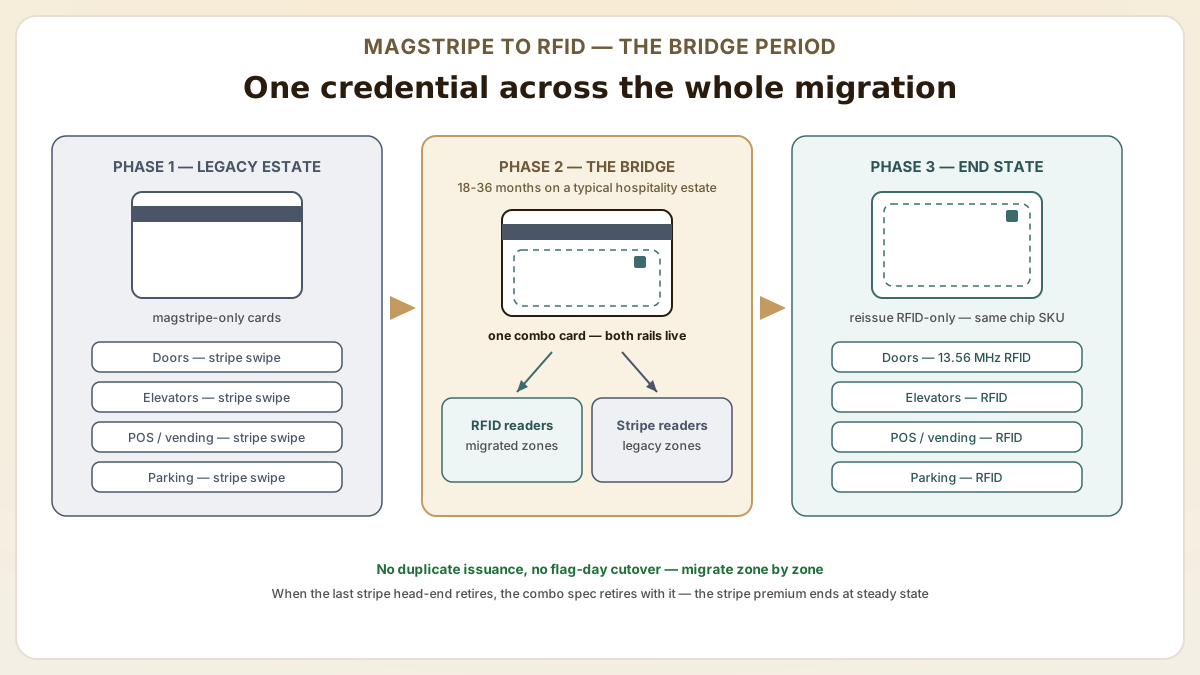
- Audit the reader estate first: list every door, elevator, POS, vending unit, and parking head-end by rail — magstripe, RFID, or both.
- Spec the chip for the end state, not the legacy fleet — the RFID rail outlives the stripe by design.
- Issue combo stock at natural reissue points: guest checkout cycles, card-office renewals, new-hire batches.
- Migrate reader zones in renovation order; a combo credential keeps working on both sides of every phase boundary.
- Write the sunset clause: when the last magstripe head-end retires, reorder the same chip SKU as RFID-only and pocket the stripe premium.
From bank cards 1969 to all-RFID 2030 — why the magstripe is still here
The magstripe has been declared dead roughly once a decade since 1994 and has attended every one of its own funerals. The timeline explains both the longevity and the scheduled exit.
- 1969
IBM engineer Forrest Parry prototypes the first magnetic stripe on a plastic card, using Scotch Tape and a flat-iron — the lineage that every magstripe descends from.
- 1971
ISO work on what becomes ISO/IEC 7811 begins; Track 1 / Track 2 / Track 3 formats are standardised through the mid-1970s and dominate card payments, access and transit for decades.
- 1994
NXP (then Philips) launches MIFARE Classic 1K; ISO/IEC 14443 Type A is standardised, giving a second rail for access control at 13.56 MHz that will eventually eclipse magstripe for room keys and campus access.
- 2015
EMV liability shift in the U.S. drives payment cards to chip-and-PIN / chip-and-signature; magstripe continues as the fallback rail and remains ubiquitous on hospitality and campus installed bases.
- 2019
MIFARE DESFire EV3 releases with AES-128 + per-card key diversification (NXP AN10922); hospitality and enterprise migrations accelerate, but the legacy magstripe reader estate takes years to retire.
- 2022-2025
Mobile key (BLE + NFC HCE) scales alongside physical cards; some operators adopt "RFID + mobile + magstripe fallback" as the three-rail model during the tail of the transition.
- 2026 Today
From buyer conversations across hospitality-legacy-PMS, university-multi-system, healthcare-legacy-badge, transit-interim, and enterprise-migration programmes converge on combo-card issuance for the 18-36 month bridge, with an explicit sunset clause that retires the stripe once the last legacy reader is decommissioned.
Useful next pages
Use these linked product, guide and comparison pages to keep the next click specific and practical.
Related card products
Chips that pair with the combo construction and the hospitality / campus programme guides.
FAQ
Does the magnetic stripe interfere with the RFID chip on the same card?
No. The magstripe is a passive flux-reversal data carrier; the RFID chip communicates via 13.56 MHz ISO/IEC 14443 coupling. Different physical rails, no cross-coupling in normal use. Tens of millions of dual-technology cards ship annually to hospitality, campus, and enterprise programmes without interference.
Should I specify HiCo or LoCo magnetic stripe?
HiCo (2750 Oe, ISO/IEC 7811-6, or 4000 Oe for high-use airline/transit) is the default for any returning-user credential — hospitality keys, employee badges, campus cards — because it resists demagnetisation from handset magnets, magnetic wallet closures, and lanyard-stack interaction. LoCo (300 Oe, ISO/IEC 7811-7) is only appropriate for disposable / single-visit cards (event badges, single-night stays) where the lower cost and shorter durability are acceptable.
Can the same combo card be encoded by both our existing magstripe encoder and our RFID encoder?
Yes. Standard desktop encoders from HID Fargo, Magicard, Evolis, Entrust, and Zebra support dual-rail encoding in one pass — magstripe tracks and RFID chip programmed simultaneously during print. Proud Tek also offers factory pre-encoding with per-card CSV manifest for bulk issuance scenarios where the operator wants cards arriving ready-to-issue.
Which hospitality and campus platforms does this combo card work with?
On the hospitality side: Oracle Opera Cloud, Mews, Cloudbeds, Infor HMS, Protel — all integrate at the lock / head-end layer and are card-source-agnostic. On the campus side: CBORD, Transact (formerly Blackboard), Atrium, and Heartland OneCard accept any ISO/IEC 14443-A chip + ISO/IEC 7811-compliant stripe. Factory manifests ship with UID and track-data columns aligned to each platform's import format.
When should we stop ordering combo stock and move to RFID-only?
When the last legacy magstripe reader in the estate is decommissioned. Typical hospitality portfolios reach that point 18-36 months into a renovation cycle; universities 24-48 months. At that point the combo spec is retired and the same chip SKU ships as RFID-only, saving the ~USD 0.05-0.10 per-card stripe premium.
Is a combo card with Track 2 data in PCI DSS scope?
Only if the track carries payment data. A combo card used purely as a room key or facility credential — no PAN, no cardholder data — falls outside PCI DSS scope. When Track 2 or Track 3 carries stored-value or cashless-payment data on a campus or loyalty programme, PCI DSS v4.0 applies to the issuance, encoding, and handling systems that touch that track; agree the scope boundary with your integrator at tender stage, not after deployment.
What artwork restrictions does the magnetic stripe add to card printing?
The stripe band must keep an unlaminated, unobstructed read surface: no embossing, spot UV, hot-foil, or hologram overlay across the stripe area, and bleeds run under it rather than around it. Everything else in the finish stack — full-colour offset, UV digital, dye-sublimation retransfer personalisation, signature panels, embossed numbering elsewhere on the card — coexists with the combo construction. Have artwork preflighted against the stripe keep-out zone before committing a print run.
Sources & references
Primary standards, OEM datasheets and regulatory documents cited by this article. All URLs were verified on the access date shown below.
- ISO/IEC 7811-2:2018 — Identification cards — Recording technique — Part 2: Magnetic stripe: Low coercivity
Low-coercivity (~300 Oe) stripe part — the disposable / single-visit tier on combo cards. Defines the recording technique and track densities used on all three tracks.
- ISO/IEC 7810 — Identification cards — Physical characteristics
ID-1 (CR80) form-factor geometry that every combo card conforms to.
- ISO/IEC 7813 — Identification cards — Financial transaction cards
Track 1 / Track 2 character-count and format spec used by campus payment, loyalty stored-value, and legacy hospitality amenity-billing track layouts.
- ISO/IEC 14443-1..4 — Identification cards — Proximity cards
The 13.56 MHz RFID air interface that MIFARE Classic / DESFire / Ultralight / HID iCLASS SE operate over on the combo card's RFID rail.
- ISO/IEC 10373-1 — Test methods for identification cards
Durability and magstripe-survivability test methodology used in hospitality / campus lifecycle QA.
- NXP MIFARE Classic 1K (MF1ICS50) product data sheet
Legacy RFID rail baseline for hospitality combo-card deployments.
- NXP MIFARE DESFire EV3 product data sheet
AES-128 option for combo cards on secure-tier hospitality, campus, and enterprise deployments.
- PCI DSS v4.0 — Payment Card Industry Data Security Standard
Applies when combo-card Track-2 data carries cashless-payment or loyalty stored-value information — scoping reference for tender response and integrator boundaries.
- Oracle Opera Cloud Hospitality PMS — integration overview
Reference for how card-supplier choice remains decoupled from PMS integration on hospitality combo-card programmes.
- Forrest Parry and the invention of the magnetic-stripe card (IBM archives)
Historical reference anchoring the magstripe timeline back to 1969 and the lineage of the rail the combo card supports.
- ISO/IEC 7811-6:2018 — Identification cards — Recording technique — Part 6: Magnetic stripe: High coercivity
High-coercivity part behind the 2750 Oe default stripe; ISO/IEC 7811-7 covers the high-coercivity high-density tier.
- Magnetic Stripe Card Standards (PN 99800004) — track formats, densities and ISO 7811 part map
Encoder-vendor reference: Track 1 — 210 bpi, 79 alphanumeric (IATA); Track 2 — 75 bpi, 40 numeric (ABA); Track 3 — 210 bpi, 107 numeric (ISO/IEC 4909); 0.110 in track width.
Proud Tek is a Shenzhen-based RFID & NFC manufacturer supplying hotel chains, transit operators, event venues and retail brands worldwide. Every order includes free samples, RF testing and dedicated project support.
Get a Quick Quote
Tell us about your project and we'll respond within one business day. Fields marked (asterisk) are required.