
Custom-Printed 13.56 MHz NFC Cards
Custom-Printed NFC Cards
Full-Color CMYK

Quick answer
Custom-printed 13.56 MHz NFC cards start at MOQ 100 (UV digital) or 500 (CMYK offset) and ship 10-15 working days after artwork sign-off, chip encoding included. Offset runs carry exact Pantone spot colors for volume brand programs; UV digital handles short runs and per-card variable data such as unique QR codes and serial numbers. Available with NTAG 213, NTAG 215, NTAG 216, MIFARE Classic, and MIFARE DESFire chips on PVC, PET, or eco-friendly substrates — ordered directly from Proud Tek's ISO 9001-certified Shenzhen factory.
- Full-color CMYK offset and digital printing on ISO/IEC 14443A-compliant 13.56 MHz NFC cards with chip encoding included in every order.
- Choose from NTAG 213, NTAG 215, NTAG 216, MIFARE Classic 1K/4K, or MIFARE DESFire EV2/EV3 chips — all operating at the 13.56 MHz high-frequency band.
- Low MOQ of 500 pieces with free design proofing, sample kits, and global DDP/FOB shipping from Shenzhen, under an ISO 9001:2015 quality system (certificate 98026Q00274R000).
Used in these industries
Deployments where this product is referenced on our industry landing pages.

At a glance
Use these short answers to decide whether this page matches the project before moving into the detail.
Card body and form factor
ISO/IEC 7810 ID-1 dimensions 85.60 × 53.98 × 0.76 mm with radiused corners; ISO/IEC 10373-1 defines the mechanical, thermal and flex test methods that a printed card bod...
13.56 MHz operating standard
ISO/IEC 14443 Type A or Type B proximity card operating at 13.56 MHz, 1-10 cm read range. NFC Forum Type 2 / Type 4 chips are readable by NFC-enabled phones in reader mo...
Next step
Ready to move forward? Start your inquiry to get specific answers for this project.
Request a quote for custom-printed NFC cards- Printing process — offset lithography
-
- Four-colour CMYK offset at 175-200 lpi screen ruling, 2540 dpi plate resolution, running on sheet-fed presses calibrated to ISO 12647-2 process control.
- Economical from 500 cards up; Pantone PMS spot-colour plates are added where brand equity depends on an exact colour match that CMYK cannot reach.
- ICC profile (ISO 15076) is supplied with every artwork proof so colour behaviour is predictable from screen to plate to finished card.
- Printing process — UV digital and dye-sub
-
- UV-cured digital inkjet at 600-1200 dpi for short runs (100-500 cards) and variable data: sequential numbers, unique QR codes, personalised names, individualised loyalty IDs.
- Dye-sublimation retransfer (Fargo HDP, Zebra ZXP, Matica XID) for single-card on-demand issuance where a print head is embedded in the reception workflow.
- Artwork and proofing
-
- Accepted formats: AI, PDF/X-4, high-resolution TIFF at 300 dpi+; bleed 3 mm per side; safety margin 3 mm; total artwork area 91.60 × 59.98 mm including bleed.
- Soft proof (PDF), hard proof (inkjet match print) and pre-production sample are the three approval gates before plate burn or RIP.
- Finishing — surface finishes
-
- Gloss laminate is the default high-shine finish; matte laminate diffuses reflection for a premium soft-touch feel; anti-scratch laminate extends outdoor and wallet life.
- Spot UV coating adds a raised gloss accent to a logo or icon; textured overlays (linen, sandstone) give tactile differentiation against commodity plastic.
- Finishing — security and embellishment
-
- Hot foil stamping in gold, silver, copper, holographic or custom foil for ultra-premium membership tiers and luxury brand activations.
- Embossing and indent printing (tipping) deliver raised characters for names or card numbers; scratch-off panels hide activation codes; hologram overlays add anti-counterfeit depth.
- Optional functional features
-
- ISO/IEC 7811 HiCo (2750 Oe) or LoCo (300 Oe) magnetic stripe for legacy mag-swipe stacks that still need to run in parallel with the NFC tap.
- Signature panel for handwritten signature cards; barcodes (Code 39, Code 128, QR) printed to ISO/IEC 15416 print-quality grade A/B for reliable scanning.
- Chip selection aligned to use case
-
- NTAG213 (144 B) — URL / vCard tap cards for lightweight marketing; NTAG216 (888 B) — multi-record NDEF, Wi-Fi provisioning, longer vCard payloads.
- MIFARE Classic 1K — the installed-base default for access control, time attendance and campus one-cards (legacy, sector-key security).
- MIFARE DESFire EV3 — AES-128 encryption, key diversification per NXP AN10922, the modern high-security tier for transit, corporate and government ID.
- Dual-interface (contact chip + 13.56 MHz) is available where EMV or PKI contact interfaces are required in the same card body.
- Chip encoding and personalisation
-
- In-factory encoding: UID registration, NDEF URL programming, MIFARE sector-key configuration, DESFire AES key diversification, barcode-to-UID mapping.
- Personalisation data delivered as a CSV / Excel manifest; hash-verified on each card and packaged with a match-report for audit.
- Regulatory and material compliance
-
- RoHS 3 (EU 2015/863) and REACH SVHC declarations on every shipment; CPSIA (16 CFR Part 1501) on cards destined for children's programmes.
- Packaging compliance: EU 94/62/EC packaging directive, Prop 65 California labels where relevant, FSC-certified outer packaging on request.
- Production flow and lead time
-
- Standard flow: artwork approval → pre-press proof → plate burn or RIP → sheet print → collation → lamination → punch → chip encoding → visual QC → packing.
- Lead time 10-15 working days after artwork sign-off for 500-10,000 card runs; 7-10 days for UV digital short runs with variable data.
Commercial terms
- MOQ
- Varies by SKU — stock items from 100 pcs; custom production typically 200-1,000 pcs
- Lead time
- Production 2-3 weeks after artwork and encoding sign-off; reorders on a 3-4 week cycle
- Samples
- Free samples and RF test report with every order; courier at customer cost
- Payment
- 50% T/T deposit, 50% before shipment; Net 30/60 for established accounts; LC for large orders
- Shipping
- FOB Shenzhen / Yantian; DHL, FedEx or EMS air freight; sea LCL / FCL for volume
- Response
- Itemized quote within one business day, Mon-Fri (UTC+8)
Why 13.56 MHz is the standard frequency for NFC cards
Everything on this page bends to your brand — substrate, finish, chip, artwork out to the very edge. One number never moves: 13.56 MHz, the frequency every NFC phone and HF reader on the planet has already agreed to speak. Here is why the only spec you cannot customize is the one doing the heavy lifting.
- 13.56 MHz is the universal operating frequency defined by ISO/IEC 14443 and ISO/IEC 15693 standards, ensuring compatibility with virtually every NFC-enabled smartphone, reader, and access control system worldwide.
- At 13.56 MHz, NFC cards deliver reliable read distances of 1-10 cm, which provides the close-proximity security required for access control, cashless payment, and identity verification applications.
- All major chip families for smart cards operate at 13.56 MHz, including the NXP NTAG series, MIFARE family, Infineon SLE series, and Sony FeliCa, giving buyers a full range of memory and security options.
- Custom printing on 13.56 MHz NFC cards transforms a functional smart card into a branded touchpoint, reinforcing brand identity every time a cardholder taps for access, payment, or engagement.
Print specification snapshot
Four numbers before any brochure prose — what it takes to start a run, how sharp it prints, and how long the press makes you wait. For the per-card math behind them, see the RFID card cost guide.
Custom printing options for your NFC cards
The plain-language tour before the deep tables: what “fully custom” actually covers on a working NFC card — and none of it touches the electronics.
- CMYK offset printing for orders above 500 pieces delivers photographic quality at the lowest per-card cost, with exact Pantone color matching available on request.
- UV digital printing enables short runs from 100 cards with variable data. Unique QR codes, sequential numbering, or individualized names directly on the card surface.
- Finishing upgrades include spot UV coating, holographic foil stamping, matte or gloss lamination, embossed numbering, and signature panel overlays to match your brand guidelines.
- Both single-sided and dual-sided printing are supported, with the antenna and chip embedded invisibly within the card body so the print area is uninterrupted.
Print process comparison — offset vs UV digital vs dye-sub retransfer
Choosing a print process is less a matter of taste than of run size — with a color-fidelity clause for brands that police their Pantone. The panel below settles most quotes in one read; the full in-house capability list, including screen printing and security inks, lives on the card printing service page.
Offset lithography (volume brand-launch)
- Ideal run size 500 to 1,000,000+ cards; lowest per-unit cost at volume.
- Resolution 175–200 lpi with 2540 dpi plate — the photographic-print benchmark.
- Pantone PMS spot plates available — exact brand-colour match where CMYK cannot reach.
- Variable data is not supported — every card in the run prints from the same plate.
- Best fit: brand-launch, membership bulk issuance, retail-packaging activation cards.
UV digital and dye-sub retransfer (short run / variable)
- UV digital inkjet run size 100–5,000; dye-sub retransfer run size 1–500 on-demand.
- Resolution 600–1200 dpi (UV) or 300 dpi edge-to-edge (dye-sub retransfer).
- Variable data per card — sequential numbers, unique QR codes, personalised names.
- Pantone PMS is simulated via CMYK; exact spot-colour match is not achievable.
- Best fit: conference badges, event access, variable-QR loyalty, in-house issuance bureau.
Print process specifications and minimums
Six processes run in-house, and each earns its keep on a different job. Read the MOQ column as the honest gatekeeper: below it, setup costs own the invoice; above it, the process disappears into the per-card price. Wood and metal bodies bring their own marking physics — see the standard RFID wood card for what a laser does to grain.
| Process | MOQ / run size | Output | Best fit |
|---|---|---|---|
| CMYK offset lithography | MOQ 500; economical to 1,000,000+ | 175-200 lpi screens from 2540 dpi plates; exact Pantone spot plates | Brand launches, bulk membership, retail activation runs |
| UV digital inkjet | MOQ 100; sweet spot 100-5,000 | 600-1200 dpi; white ink on dark or transparent bodies; Pantone simulated in CMYK | Short runs, prototypes, per-card variable data |
| Dye-sub retransfer | 1-500, printed on demand | 300 dpi edge-to-edge | On-site issuance, single-card reprints, badges |
| Screen printing | [OWNER-CONFIRM: screen-print MOQ] | Opaque white ink and metallic overlay effects | Transparent or dark card bodies, metallic brand accents |
| Thermal transfer personalization | Add-on pass on any run | Names, photos, barcodes, sequential numbers per card | Badges, student IDs, per-holder membership data |
| Laser engraving | Wood and metal bodies [OWNER-CONFIRM: engraving MOQ] | Permanent mark; no ink to wear off | Wood and metal cards, wear-proof serialization |
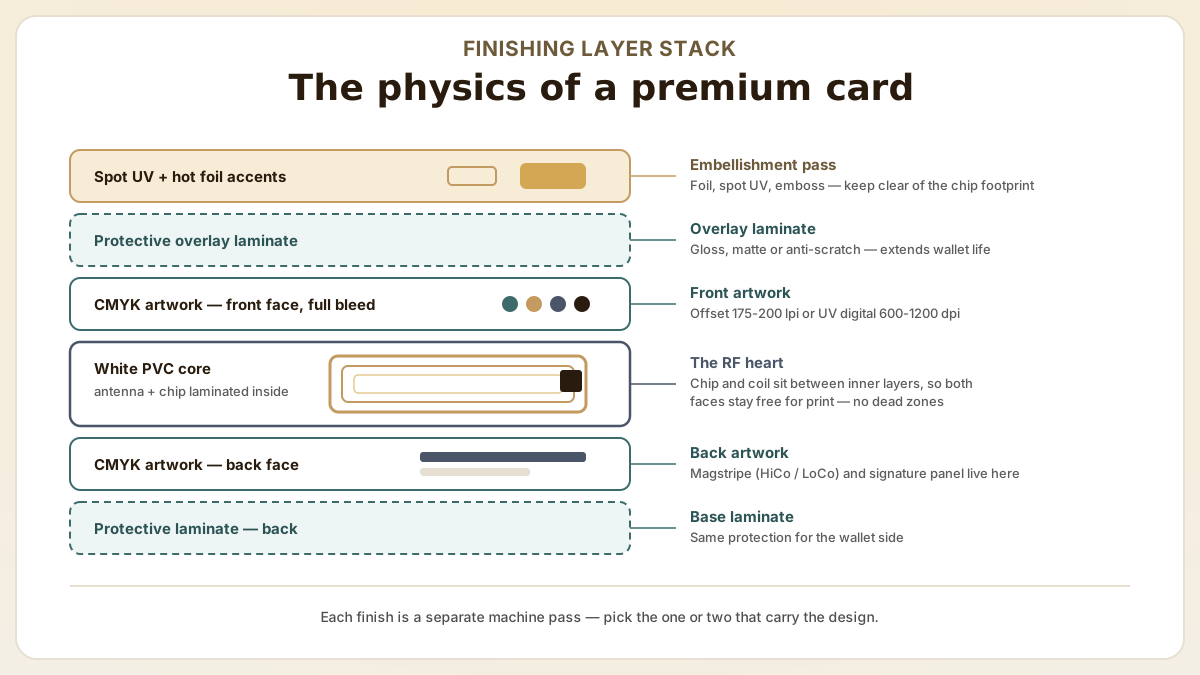
Finishing layer stack — the physics of a premium card
A finished card is a sandwich: the printed story inside, the tactile one outside. Each finish below is a separate pass through a separate machine, so the smart move is choosing the one or two that carry the design — not stacking all eight like a procurement dare. And if your readers still swipe, the RFID + magnetic stripe combo card runs both rails on one body.
| Finish | What it does | Where it earns its cost |
|---|---|---|
| Gloss / matte / anti-scratch laminate | Default shine, soft-touch feel, or extended wallet life | Every card; anti-scratch for outdoor and daily-tap use |
| Spot UV coating | Raised gloss accent over a logo or icon | Logo-led designs on matte backgrounds |
| Hot foil stamping | Gold, silver, copper, holographic or custom foil | Top-tier membership, luxury brand activations |
| Embossing / indent tipping | Raised or indented characters for names and numbers | Payment-style ID, VIP numbering |
| Scratch-off panels | Conceals activation codes until first use | Gift cards, prepaid loyalty |
| Hologram overlays | Anti-counterfeit visual depth | Security-sensitive credentials |
| Magnetic stripe, HiCo 2750 Oe or LoCo 300 Oe | Legacy swipe lane running in parallel with the NFC tap | Hotel stacks, legacy POS migrations |
| Signature panel | Handwritten identification field | Banking-style and sign-on-issue programs |
Artwork handoff: files that sail through prepress
Most print delays are artwork delays, and all of them are cheaper to fix at handoff than at the proof stage. The table below is the entire checklist — meet it and your file goes straight to proof; miss it and prepress returns a free correction pass rather than a surprise. For the long-form discipline (finish stacks, sign-off chains, numbering rules), borrow the hotel key card artwork checklist — hotels made every artwork mistake first, so you don't have to.
| Requirement | Specification |
|---|---|
| File formats | Adobe Illustrator (AI) or press-ready PDF/X-4 preferred; layered PSD, CDR, and 300 dpi+ TIFF accepted |
| Resolution | 300 dpi minimum at final card size — web-resolution logos are the most common rejection |
| Bleed | 3 mm on all four sides: supply 91.60 × 59.98 mm total artwork for the 85.60 × 53.98 mm ID-1 card |
| Safe area | Keep text and logos 3 mm inside the trim line, clear of the corner-rounding path |
| Color mode | CMYK working space; call out Pantone spot references separately for exact matching |
| Fonts | Converted to outlines, so rendering never depends on the prepress workstation |
| Chip and antenna zones | Full-bleed print is fine on both faces — the inlay sits between inner layers; keep foil and emboss clear of the chip footprint (the free artwork check flags this) |
From sign-off to loading dock: the production flow
Between “approved” and “on a pallet” sits a fixed sequence with three approval gates, and the gates are where changes cost nothing — after plate burn, they cost a run. Chip data rides the same line: encoding happens in-house before final QC, so the printed card and its payload never travel separately. The data side of that handshake is covered on the card encoding service page.
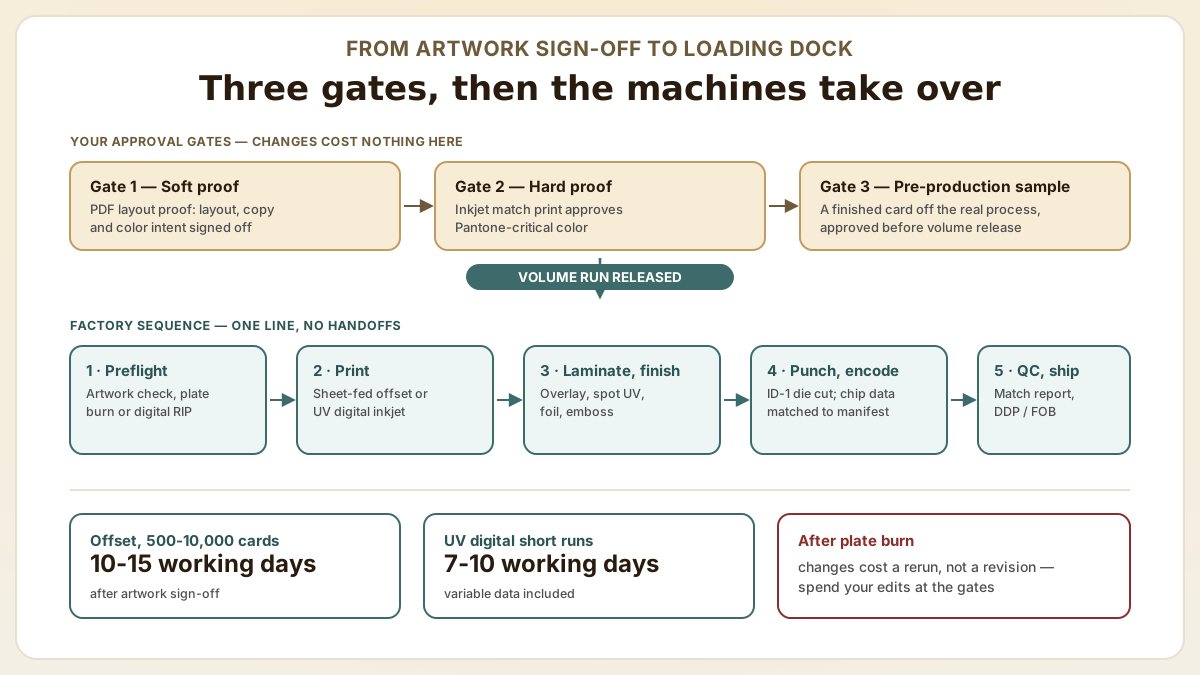
- Gate 1 — soft proof (PDF): layout, copy and color intent signed off before any plate is made.
- Gate 2 — hard proof (inkjet match print): physical color approval for Pantone-critical work.
- Gate 3 — pre-production sample: a finished card off the real process, approved before the volume run is released.
Chip options and encoding services
The artwork gets the tap; the silicon decides what happens next. Choose by workload rather than spec-sheet maximalism — the NTAG 213 vs 215 vs 216 comparison settles the marketing-card question in one table, and factory pre-encoding means cards arrive ready to tap, not ready to configure.
- NTAG 213 (144 bytes). Ideal for NFC business cards, marketing tags, and lightweight data exchange where a URL or vCard is stored on chip.
- NTAG 216 (888 bytes). Expanded memory for multi-record NDEF messages, longer URLs, or Wi-Fi provisioning payloads.
- MIFARE Classic 1K — the most widely deployed chip for access control, time attendance, and campus card systems with sector-based security.
- MIFARE DESFire EV3 — AES-128 encrypted chip for high-security applications including transit, corporate access, and government ID programs.
- Proud Tek provides pre-encoding services including UID registration, NDEF URL programming, MIFARE sector key configuration, and custom data structure writing.
Milestones in NFC card custom printing
Custom-printed NFC cards feel like a 2020s product, but the standards stack under your artwork took four decades to line up. The short version:
- 1985 — ISO/IEC 7810 ID-1
ID-1 card standard (85.60 × 53.98 × 0.76 mm) locks the physical form factor that every printed NFC card ships in today.
- 1997 — ISO/IEC 14443
13.56 MHz proximity card operating standard is published, establishing the frequency and protocol that NFC phones would later adopt.
- 2004 — NFC Forum founded
NDEF and tap-interoperability specifications are drafted; printed NFC cards become a credible consumer-facing touchpoint.
- 2013–2015 — NTAG 213/215/216
NXP's NTAG 21x family scales 13.56 MHz tap-card manufacturing to billions of units a year; price of a printed NFC card falls below USD 0.30 at volume.
- 2018 — iPhone XS Background Tag Reading
Apple ships always-on NFC reading on iPhone XS. Printed NFC cards become a viable replacement for QR-only membership and business cards.
- 2020 — Apple Business Connect / Google Wallet maturity
Digital wallet pass provisioning over NFC tap matures; printed NFC cards now double as wallet-provisioning vehicles.
- 2024 — NTAG424 DNA SUN authentication
Mass-deployable authenticated tap (dynamic URL with AES signature) reaches printed card form factor at commodity prices.
- 2026 — Today
Proud Tek ships custom-printed NFC cards with CMYK offset + UV digital + hot-foil + DESFire EV3 / NTAG424 DNA encoding as a single purchase order. One artwork brief covers brand-launch welcome kits, hotel key artwork, membership programmes, conference badge runs and visitor-ID cards alike.
Useful next pages
Use these linked product, guide and comparison pages to keep the next click specific and practical.
Explore related NFC card products
Browse specific chip types to match your project requirements and application.
Proven in production
How this card performs at multi-site scale, not just on the spec sheet.
FAQ
What is the minimum order quantity for custom-printed 13.56 MHz NFC cards?
Proud Tek's MOQ for offset-printed NFC cards is 500 pieces. For UV digital printing with variable data, we can accommodate orders as low as 100 cards. Free samples with your custom artwork are available before production.
Can you print full-color artwork on both sides of the NFC card without affecting chip performance?
Yes. The NFC antenna and chip are laminated between inner PVC layers, so both the front and back surfaces are available for full-bleed CMYK printing. The print process does not interfere with the 13.56 MHz signal or the card's read range.
Which 13.56 MHz NFC chip should I choose for my project?
For simple NFC tap-to-URL or digital business cards, NTAG 213 is the most cost-effective option. For access control and campus systems, MIFARE Classic 1K is the industry standard. For applications requiring encrypted security such as transit or government ID, MIFARE DESFire EV3 provides AES-128 authentication. Our team can recommend the right chip based on your specific use case.
How does the proofing process work before mass production?
Every custom-print order passes up to three approval gates: a soft proof (PDF layout proof) settles layout, copy, and color intent; a hard proof (inkjet match print) settles color for Pantone-critical work; and a pre-production sample validates the finished card before the volume run is released. Nothing prints at volume until sign-off, and artwork corrections with re-proofs are handled at no charge until approval.
How long does production take after artwork approval?
Offset runs of 500-10,000 custom-printed NFC cards ship 10-15 working days after artwork sign-off; UV digital short runs with variable data ship in 7-10 working days. Chip encoding and visual QC happen inside those windows, and DDP or FOB shipping from the Shenzhen factory is quoted per destination.
What artwork files do you accept for NFC card printing?
Adobe Illustrator (AI) and press-ready PDF/X-4 files are preferred; high-resolution TIFF at 300 dpi or above is accepted. Supply 3 mm bleed per side (91.60 × 59.98 mm total artwork for the 85.60 × 53.98 mm ID-1 card), keep critical elements 3 mm inside the trim line, work in CMYK with Pantone spot references called out separately, and convert fonts to outlines. A free artwork check flags issues before proofing.
Can you encode the chips and print matching card numbers in the same run?
Yes. Encoding and printed serialization run as one factory workflow: supply a CSV or Excel manifest and each card's printed number, QR code, or barcode is matched to its encoded chip data, hash-verified per card, and shipped with a match report for audit.
Can you match exact Pantone brand colors on printed NFC cards?
Offset runs reproduce exact Pantone shades with dedicated spot-color plates. UV digital runs simulate Pantone references through calibrated CMYK, which lands close but is not an exact match — for color-critical programs, choose offset and approve a hard proof before the run.
Sources & references
Primary standards, OEM datasheets and regulatory documents cited by this article. All URLs were verified on the access date shown below.
- ISO/IEC 7810:2019 — Identification cards — Physical characteristics
ID-1 card dimensions 85.60 × 53.98 × 0.76 mm — the form factor every printed NFC card ships in.
- ISO/IEC 10373-1:2020 — Test methods for ID cards
Mechanical, thermal, flex and print-adhesion test methods that a printed card must pass.
- ISO/IEC 14443-1:2018 — Proximity cards at 13.56 MHz
13.56 MHz operating frequency, Type A / Type B protocol, 1-10 cm close-coupling interface.
- ISO 12647-2:2013 — Process control for graphic technology / offset
Defines tone-value, colorimetric and process-control requirements for four-colour CMYK offset printing.
- ISO/IEC 15416:2016 — Bar code print quality test specification
Print-quality grade A-F framework used to specify scannable barcodes on printed NFC cards.
- ISO 15076-1:2010 — ICC profile specification
ICC colour-management profile format used for screen-to-press colour predictability.
- ISO 15930-7:2010 — PDF/X-4 press-ready data exchange
Defines the PDF/X-4 press-ready file format requested in the artwork requirements — complete exchange of printing data using PDF 1.6.
Proud Tek is a Shenzhen-based RFID & NFC manufacturer supplying hotel chains, transit operators, event venues and retail brands worldwide. Every order includes free samples, RF testing and dedicated project support.
Get a Quick Quote
Tell us about your project and we'll respond within one business day. Fields marked (asterisk) are required.