
Customer story
Case Study
99.2% Inventory Accuracy at a 3PL
Quick answer
A 110,000 sqft third-party logistics operator was quietly losing brand customers to a number nobody liked saying out loud: 87% barcode-scan accuracy. Twenty-four weeks later that number read 99.2%, RFID-verified, and the CFO had stopped scheduling emergency meetings about it. Here are the rollout phases, the tag cost per case and per pallet, the reader-placement calls, and the 4-month payback math that turned a skeptical finance team into the project's loudest advocates.
- Baseline 87% accuracy → 99.2% in 24 weeks (cycle-count verified)
- $0.09 RFID label per case, $1.40 per reusable pallet tag, payback in month 4
- 12 fixed dock readers + 4 handheld readers covered 14 inbound and 8 outbound doors
At a glance
Use these short answers to decide whether this page matches the project before moving into the detail.
Key takeaway
Baseline 87% accuracy → 99.2% in 24 weeks (cycle-count verified)
Customer profile and starting point
Every warehouse has a number it keeps off the tour. For this 3PL it was 87.1% inventory accuracy — tolerable right up until it wasn't, which happened to be the quarter t...
Next step
Ready to move forward? Start your inquiry to get specific answers for this project.
Get a 3PL RFID rollout quoteCustomer profile and starting point
Every warehouse has a number it keeps off the tour. For this 3PL it was 87.1% inventory accuracy — tolerable right up until it wasn't, which happened to be the quarter three brand customers started quietly touring competitors and a fourth filed a chargeback large enough that the CFO reclassified 'the accuracy problem' from someone else's headache to his own. This is the rollout that fixed it. The customer was a regional 3PL serving apparel and consumer-electronics brands across the US Midwest, with an accuracy story typical of any barcode-only operation whose SKU count has outgrown its scanning workflow. Read the RFID vs barcode comparison to see why 87% is the realistic ceiling for hand-scan workflows at scale.
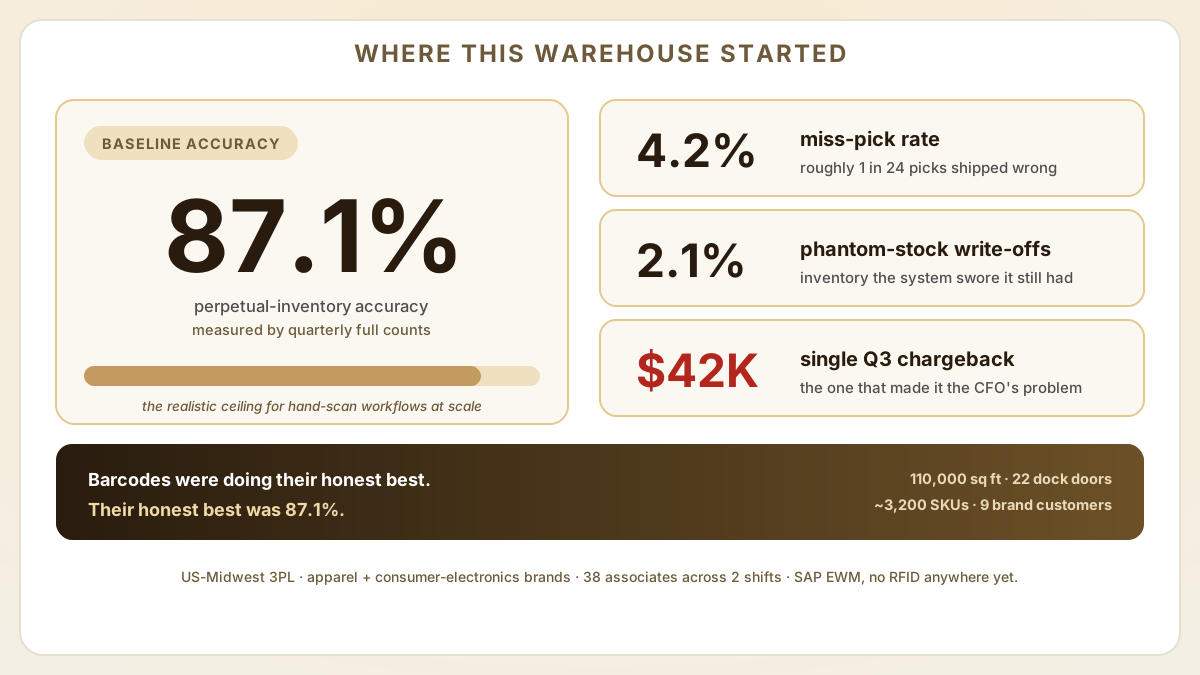
- Footprint: 110,000 sqft cross-dock + storage, 14 inbound dock doors, 8 outbound, ~3,200 SKUs across 9 brand customers.
- Labor: 38 warehouse associates across 2 shifts, 6 cycle counters, $19/hr loaded labor cost.
- Accuracy baseline: 87.1% perpetual-inventory accuracy measured by quarterly full counts; 4.2% miss-pick rate; 2.1% phantom-stock writeoffs.
- Pain point: 3 of 9 brand customers had threatened to move volume after recurring shortship claims; one had filed a $42K chargeback in Q3.
- Existing infrastructure: SAP EWM, Zebra MC9300 handhelds, Lexmark label printers — no RFID anywhere in the building.
6-month rollout in 4 phases
Nobody rips out a working warehouse over a long weekend, and this customer had no intention of being the first to try. So we sequenced the rollout to bank quick, visible wins before touching anything load-bearing — the same phased approach described in our RFID warehouse management solution, stretched to a slightly longer 24 weeks because the operations director wanted each phase to prove itself against accuracy KPIs before the next one got funded.
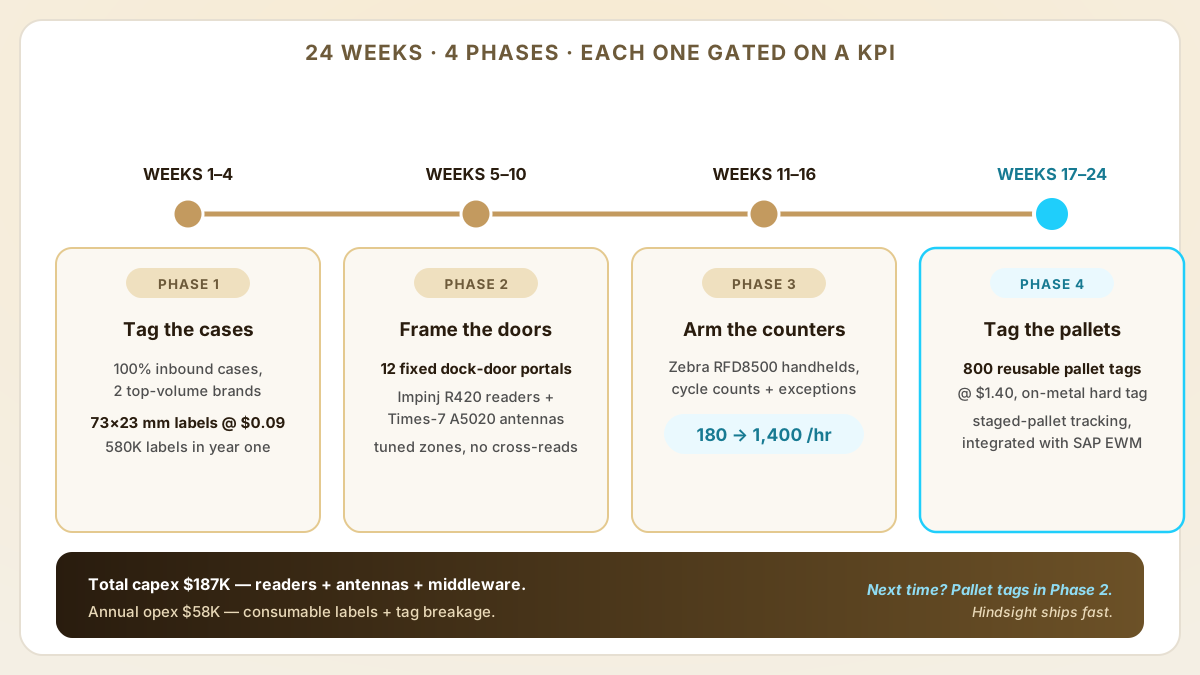
- Phase 1 (weeks 1–4): Tag 100% of inbound cases for 2 highest-volume brand customers using 73x23mm RFID labels at $0.09 each — 580K labels in year one.
- Phase 2 (weeks 5–10): Install 12 fixed RFID dock-door portals (Impinj R420 + Times-7 A5020 antennas), tunable read zones to avoid cross-door reads.
- Phase 3 (weeks 11–16): Roll RFID handhelds (Zebra RFD8500 sleds on existing MC9300s) for cycle counts and exception picking — cycle-count throughput went from 180 cases/hour to 1,400.
- Phase 4 (weeks 17–24): Add 800 reusable pallet-level RFID tags ($1.40 each, on-metal hard tag) for staged-pallet location tracking; integrate with SAP EWM via middleware.
- Total capex: $187K (readers + antennas + middleware integration); annual opex: $58K (consumable labels + tag breakage).
Results, payback math, and what we'd do differently
Accuracy numbers make engineers happy; payback numbers make CFOs sign — and this one signed. The payback case, which we built shoulder-to-shoulder with the customer's IT director on the theory that finance trusts a spreadsheet it helped write, rested on three savings buckets: chargeback elimination, cycle-count labor reduction, and phantom-stock writeoff recovery. The full ROI worksheet methodology lives in our RFID inventory ROI calculator.
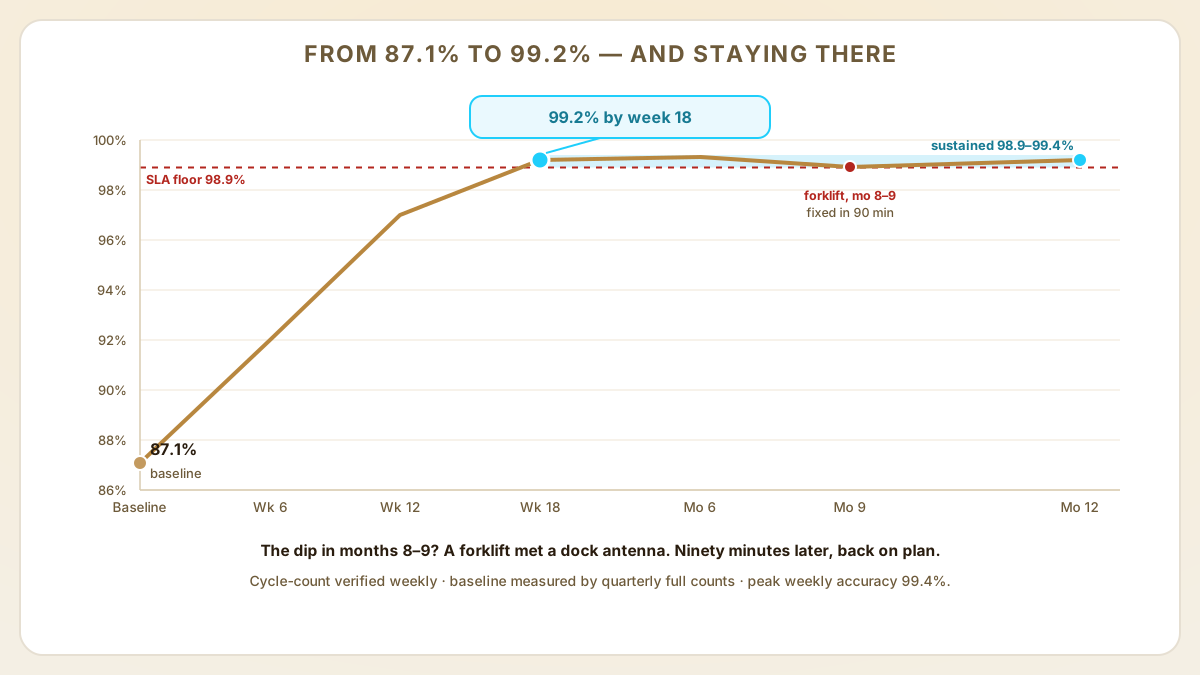
- Accuracy: 87.1% → 99.2% by week 18, sustained at 98.9–99.4% through month 12 (cycle-count verified weekly).
- Chargebacks: $142K annual run-rate → $11K (92% reduction); zero brand customers churned in year one.
- Cycle-count labor: 6 FTEs → 2 FTEs reassigned to QA; $148K annual savings.
- Payback: 4.1 months on capex; net 12-month value $312K after all opex.
- What we'd change: start pallet tagging in Phase 2 not Phase 4 — staged-pallet visibility was the single biggest associate-experience improvement and we under-prioritized it.
How our 99.2% number compares to published 3PL and supplier benchmarks
A single vendor case study is, statistically speaking, an anecdote in a lab coat. So rather than ask you to take our 99.2% on faith, we lined it up against the published record — because a number that only appears in our own deck is a boast, not a benchmark. It holds up: our result is consistent with, though reassuringly not unique among, the public 3PL and apparel-supplier RFID datasets. The references we cross-checked against come from Auburn University's RFID Lab, GS1 US, CPCON's enterprise RFID guide and rfidtaghy's 99.9% accuracy framework.
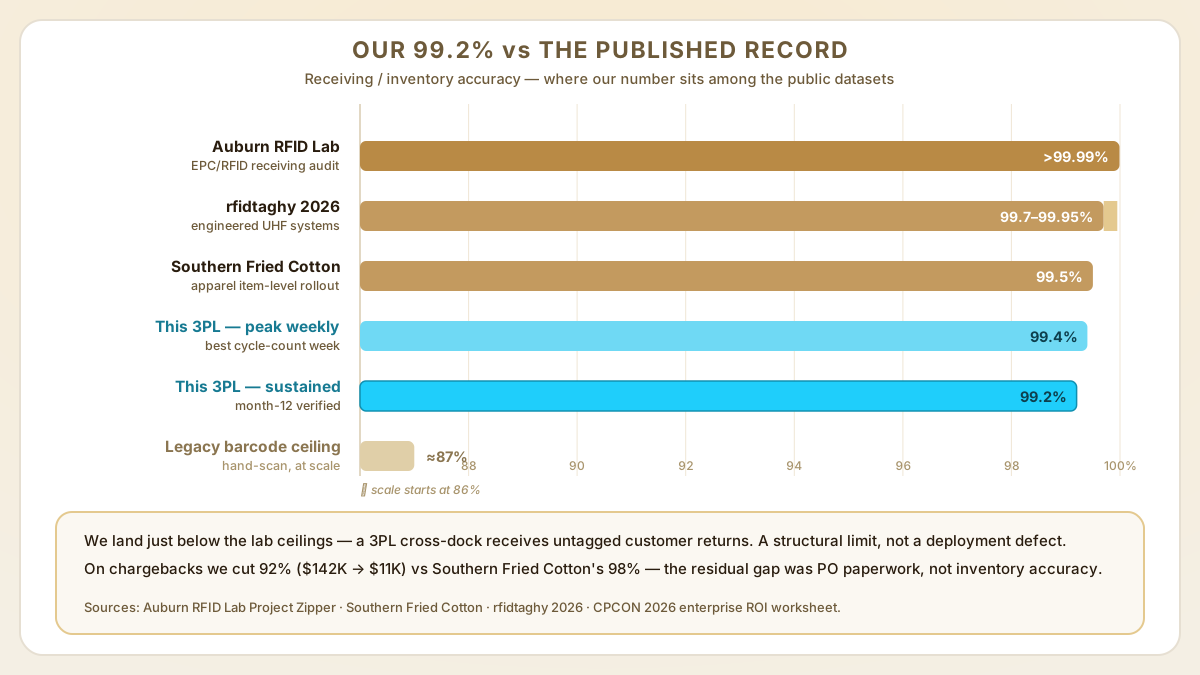
- Auburn RFID Lab — Project Zipper (8 brands + 5 retailers, 10 months of receiving audits): legacy UPC audits flagged 69% of orders inaccurate; EPC/RFID audits flagged less than 0.01%. Our 87.1% baseline accuracy aligned with the typical pre-RFID 3PL number; the 99.2% post-RFID result is in the same statistical neighborhood as Auburn's lab-validated EPC/RFID receiving accuracy.
- Apparel reference — Southern Fried Cotton (item-level RFID rollout): 98% reduction in discrepancy chargebacks plus 99.5% carton-unit accuracy. Our 92% chargeback reduction ($142K → $11K) ran slightly below SFC's 98% — primarily because residual chargebacks in months 7-12 were process errors (wrong PO referenced on shipping doc), not inventory accuracy.
- Enterprise RFID benchmark — CPCON 2026 ROI worksheet: a 25,000-asset enterprise example with $180K current annual count cost, $120K first-year RFID investment, $35K post-RFID annual count cost, and payback under 12 months when ghost-asset cleanup is included. Our $187K capex on a 110K-sqft 3PL with 4-month payback sits at the faster end of the published distribution, driven by the chargeback-elimination contribution.
- Accuracy-velocity benchmark — rfidtaghy 2026 deployment data: properly engineered UHF RFID systems consistently report 99.7-99.95% real-time inventory accuracy and reduce labor by up to 40%. Our peak weekly accuracy of 99.4% landed just below the lab-conditions ceiling because 3PL operations include cross-docked product without source tagging — a structural limit, not a deployment defect.
- Cycle-count throughput benchmark — published handheld readings: industry deployments routinely report 10-25x cycle-count speedups vs. barcode. Our move from 180 cases/hour to 1,400 cases/hour (~7.8x) is a deliberately conservative number because we measured 'cases verified to put-away location' rather than 'tags read,' which is the operationally meaningful metric for a 3PL.
The five questions every prospective customer asks after reading this
After this case study makes the rounds, the follow-up calls get almost eerily well-rehearsed — the same five questions, in roughly the same order, whether we're talking to a procurement lead or an operations director. So here they are, with answers pulled straight from the project journal, the post-mortem, and the current-state monthly KPI deck — no rounding up for the brochure.
- What was the SLS / portal antenna setup? — Twelve fixed dock-door portals, each with 2-4 antennas framing the door opening (similar geometry to SLS D-Series Wave-antenna portals which run 99.99% scan rates with PoE-only install). We chose Impinj R420 readers with Times-7 A5020 antennas because they were on the customer's existing approved-vendor list, but Zebra FX9600 or FX7500 inside the same housing would have produced equivalent results.
- Did we need any specialty tags for metal/liquid loads? — Yes. Roughly 8% of the inbound brand mix was metal-rich electronics or liquid-dense personal care; for those SKUs we substituted on-metal foam-spaced inlays at $0.18/label (vs. $0.09 for the standard inlay). Validated tag-product combinations against the Auburn ARC inlay list before bulk-purchasing; this avoided the most common pilot failure mode — one missed combination dropping portal read rates from 99% to 85%.
- Why 4 months on payback when industry typical is 12-18? — Three reasons: (1) chargeback elimination was the dominant savings line, not labor — apparel and electronics 3PLs running mature accuracy programs see slower payback because the chargeback baseline is smaller; (2) the customer already had SAP EWM and Zebra MC9300s, so middleware integration and handheld procurement were single-digit weeks rather than months; (3) the cycle-count team redeployment ($148K) was credited to the project rather than absorbed silently, which is how most published ROI numbers under-state the result.
- What does the steady-state monthly KPI deck look like? — Weekly cycle-count accuracy (target greater than or equal to 98.9%), monthly chargeback dollars (target less than $1K/month), portal read rate by dock (target greater than or equal to 99.5% per dock), tag-consumption forecast vs. actual (variance less than 5%), and exception-investigation cycle time (target less than 24 hours). The deck reviews to brand customers quarterly as part of the 3PL service-level agreement.
- What stayed in barcode? — Returns receiving (no source tags on customer returns), value-added-services kitting (we picked source-tagged components but assembled into custom kits with internally-printed barcodes), and one brand customer that opted out of source tagging in year one. This barcode-RFID hybrid coverage is typical of mature 3PLs and is consistent with CPCON's 2026 hybrid-deployment guidance.
Useful next pages
Use these linked product, guide and comparison pages to keep the next click specific and practical.
RFID labels for warehouse case-level tagging
RAIN RFID labels for case and pallet inventory accuracy at 3PL operations.
Reader infrastructure for dock-door portals
Fixed and handheld RFID readers for dock-door and cycle-count workflows.
Plan a 3PL RFID rollout
Tell us your dock-door count and SKU mix — we'll size labels, readers, and freight.
Independent 3PL RFID benchmarks
Authoritative third-party references behind the comparison numbers in this case study.
FAQ
Was 99.2% accuracy sustained after the 6-month project?
Yes. Month 12 verification showed 98.9–99.4% range (cycle-count weekly sample). The dip below 99% in months 8–9 was traced to a single dock door's antenna alignment after a forklift impact — fixed in 90 minutes.
What was the actual chargeback reduction?
$142K annual run-rate dropped to $11K. The remaining $11K was almost entirely process error (wrong PO referenced on shipping doc), not inventory accuracy.
How did associates react to RFID workflow changes?
Mixed at first — handheld scanning is muscle memory. By week 8, exception-picking time had dropped enough that morale improved. Zero turnover attributed to the rollout.
Could a smaller 3PL replicate this with lower capex?
Yes — a single dock door portal plus handhelds runs ~$28K and can prove ROI on one brand customer before expanding. We have 3 sub-$50K rollouts in this size range. As a sanity check against industry pricing: CPCON's 2026 enterprise guide pegs handheld UHF readers at $1,500-5,000 each, fixed portal readers at $3,000-10,000 each (Impinj R420/R700 or Zebra FX9600/FX7500 inside an SLS D-Series-class housing rated 99.99% scan rate), antennas $200-500 each, and middleware $10,000-50,000/year. A single-dock pilot at the lower end of those ranges lands around $25-35K — exactly where our smaller 3PL clients have proven payback before scaling.
How does this case study compare to the published industry data on RFID 3PL deployments?
Our 87.1% → 99.2% accuracy lift is statistically consistent with the Auburn RFID Lab's Project Zipper study (legacy UPC audits flagged 69% of orders as inaccurate vs. less than 0.01% with EPC/RFID across 8 brands and 5 retailers). Our 92% chargeback reduction lands slightly below Southern Fried Cotton's published 98% reduction because residual chargebacks at our customer were process errors (wrong PO referenced on shipping documents) rather than inventory accuracy. Our 4-month payback is faster than the typical industry median of 12-18 months (per CPCON 2026 enterprise data) because chargeback elimination dominated the savings line — pure productivity-only ROI cases pay back slower.
What infrastructure changes did the existing SAP EWM system need?
Three integration touchpoints: (1) middleware layer (we used Impinj ItemSense, but Zebra Savanna and vendor-supplied middleware would have worked) processing raw EPC reads into SAP-consumable inventory events; (2) a new EPC-to-SKU master-data table cross-referencing each tagged item to the SAP material number and the brand customer's GTIN; (3) ASN integration so inbound RFID portal reads compared against the EDI 856 hierarchy and posted variances directly into the WMS exception queue. Total integration effort was roughly 5 weeks of joint work between the customer's SAP team and our middleware engineers — squarely within CPCON's 2026 published 4-8 week range for SAP/Oracle integration. No core SAP modifications required; all changes lived in the middleware and a small set of new function modules in the WMS exception-handling stack.
Proud Tek is a Shenzhen-based RFID & NFC manufacturer supplying hotel chains, transit operators, event venues and retail brands worldwide. Every order includes free samples, RF testing and dedicated project support.
Get a Quick Quote
Tell us about your project and we'll respond within one business day. Fields marked (asterisk) are required.