
RFID Inventory ROI
RFID Inventory ROI Calculator
Savings Math
Quick answer
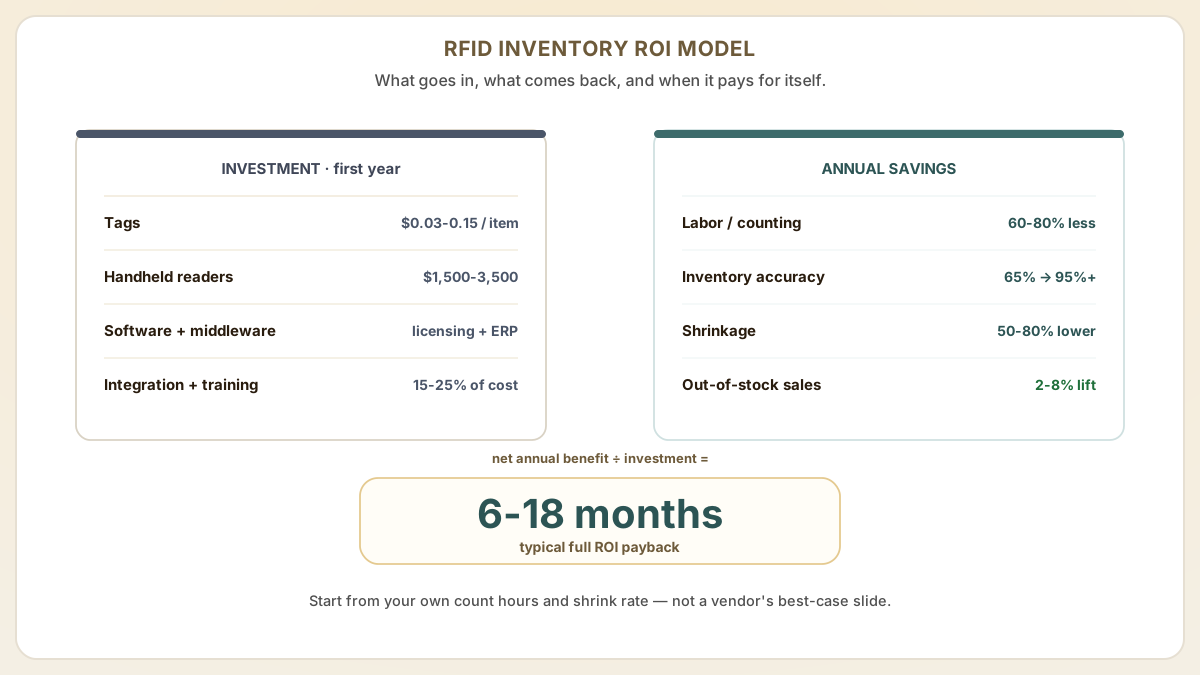
RFID inventory systems typically reach ROI payback in 6-18 months, once labor, accuracy, shrinkage and sales-recovery savings beat the deployment cost. The math only convinces a CFO when it starts from your own count hours and shrink rate, not a vendor's best-case slide: labor savings of 60-80%, accuracy climbing from 65% to 95%+, and 2-8% recovered sales, set against tag, reader, software and integration cost.
- Labor cost savings of 60-80%. RFID inventory counting takes a fraction of the time required for manual or barcode-based counting, directly reducing labor costs for cycle counts and annual inventories.
- Inventory accuracy improvement from 65% to 95%+ — RFID-enabled stock visibility reduces out-of-stocks, overstocks and phantom inventory, recovering 2-8% of lost revenue for retail operations.
- Typical payback period of 6-18 months — most retail and warehouse RFID implementations achieve full payback within the first year through combined labor, shrinkage and sales lift benefits.
At a glance
Use these short answers to decide whether this page matches the project before moving into the detail.
Key takeaway
Labor cost savings of 60-80%. RFID inventory counting takes a fraction of the time required for manual or barcode-based counting, directly reducing labor costs for cycle counts and annual inventories.
What are the key ROI components for RFID inventory systems?
Every RFID vendor's ROI calculator reaches the same conclusion: buy RFID, ideally before the quarter closes. That is not analysis — it is a sales brochure with a spreads...
Next step
Ready to move forward? Start your inquiry to get specific answers for this project.
Get a custom RFID ROI analysisWhat are the key ROI components for RFID inventory systems?
Every RFID vendor's ROI calculator reaches the same conclusion: buy RFID, ideally before the quarter closes. That is not analysis — it is a sales brochure with a spreadsheet stapled to it. A number a finance team will actually sign off on starts from your own operation and counts only the savings that survive a review: labor, accuracy, shrinkage, and recovered sales. Here is what belongs in that model, and what to leave out.
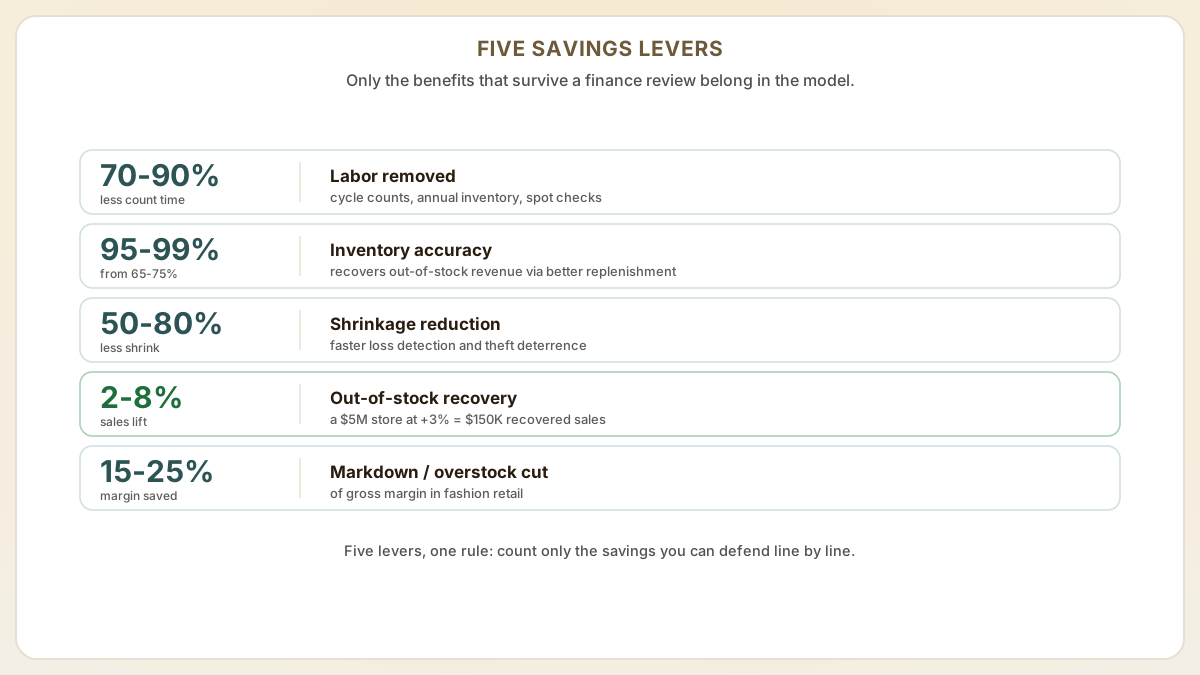
- Labor cost reduction: calculate current hours spent on inventory counts (cycle counts, annual physical inventory, spot checks) multiplied by fully loaded labor cost. RFID typically reduces counting time by 70-90%, yielding direct payroll savings.
- Inventory accuracy value: the gap between current inventory accuracy (typically 65-75% at SKU/location level for non-RFID retailers) and RFID accuracy (95-99%) represents recoverable revenue from reduced out-of-stocks and better replenishment.
- Shrinkage reduction: RFID item-level visibility reduces shrinkage by 50-80% in retail environments by enabling faster detection of loss events and deterring theft through real-time inventory awareness.
- Out-of-stock revenue recovery. Retailers using RFID report 2-8% sales lifts from improved on-shelf availability. For a location doing $5M in annual revenue, even a 3% improvement represents $150K in recovered sales.
- Overstock and markdown reduction. Accurate inventory data reduces over-ordering and enables better allocation, cutting excess inventory markdowns that typically consume 15-25% of gross margin in fashion retail.
What costs go into your RFID ROI model?
The cost side of an RFID model is shorter than the savings side and far more likely to be understated. Five line items carry it — tags, readers, software, integration, and the ongoing spend everyone forgets until year two — and the figure below stacks them from the cheapest per unit to the one that quietly dominates the first-year budget. Get these right and the ROI is defensible; leave one out and finance will find it for you.
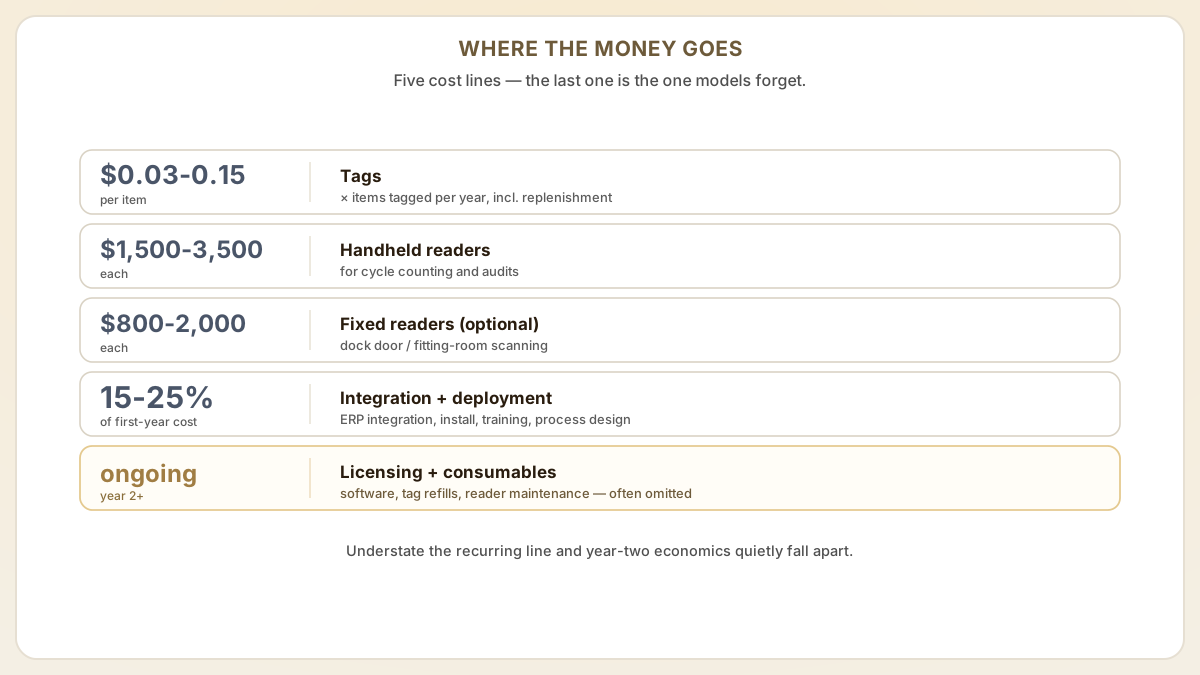
- Tag cost: per-unit UHF RFID tag cost ranges from $0.03-0.15 depending on volume, inlay type and form factor. Multiply by the number of items tagged annually, including replenishment tags for new inventory.
- Reader hardware: handheld RFID readers ($1,500-3,500 per unit) for inventory counting, plus optional fixed readers ($800-2,000 per unit) for automated dock door or fitting room scanning.
- Software and middleware: RFID inventory management software licensing, including middleware for tag data processing, integration with existing ERP/WMS, and analytics dashboards.
- Integration and deployment: professional services for system configuration, ERP integration, reader installation, staff training and process design. Typically 15-25% of total first-year hardware and software cost.
- Ongoing costs: annual software licensing, tag consumables for new inventory, reader maintenance and replacement, and periodic system optimization as operations evolve.
How do you handle industry benchmark data for ROI modeling?
Industry benchmarks are useful right up until someone applies an apparel-retail sales lift to a cold-storage warehouse. Treat them as a sanity check on your own measurements, not a substitute for them, and match the benchmark to your sector before anyone quotes it in a board deck. The chart below plots the published payback band for each sector, so you anchor to the right vertical instead of the most flattering one.
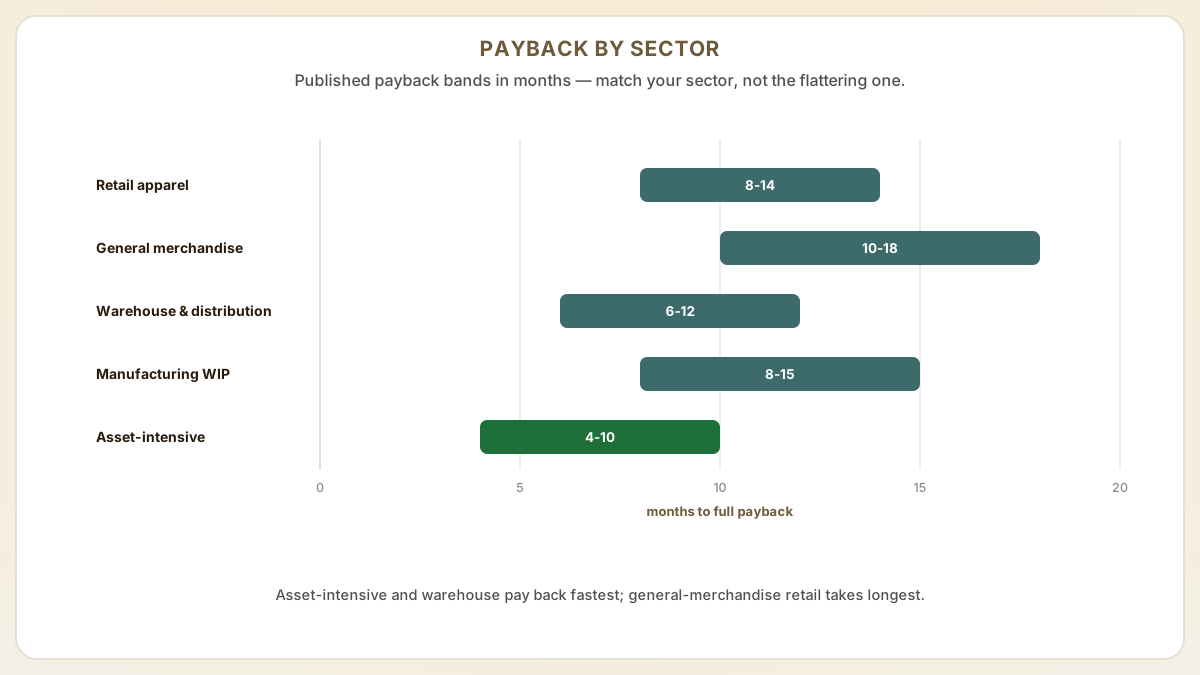
- Retail apparel — 3-8% sales lift from improved on-shelf availability, 50-70% reduction in inventory counting labor, 15-25% shrinkage reduction. Average payback period: 8-14 months.
- General merchandise retail — 2-5% sales improvement, 60-80% counting time reduction, improved order accuracy reducing DC returns. Average payback period: 10-18 months.
- Warehouse and distribution — 25-40% reduction in receiving and shipping verification time, 99.5%+ picking accuracy, 15-30% improvement in dock-to-stock cycle time. Average payback period: 6-12 months.
- Manufacturing WIP tracking — 20-30% reduction in work-in-progress search time, real-time production visibility, 10-20% improvement in production throughput. Average payback period: 8-15 months.
- Asset-intensive industries — 70-90% reduction in asset audit time, 15-25% improvement in asset utilization, significant reduction in lost/ghost assets. Average payback period: 4-10 months.
What does a worked-example ROI calculation actually look like?
Vendor ROI tools often skip the inputs and show only the output. Below is the canonical worked example finance teams use to sanity-check vendor proposals — modeled on the structure CPCON publishes for enterprise deployments and the rfidtaghy 99.9% accuracy framework, with line items every controller will recognize.
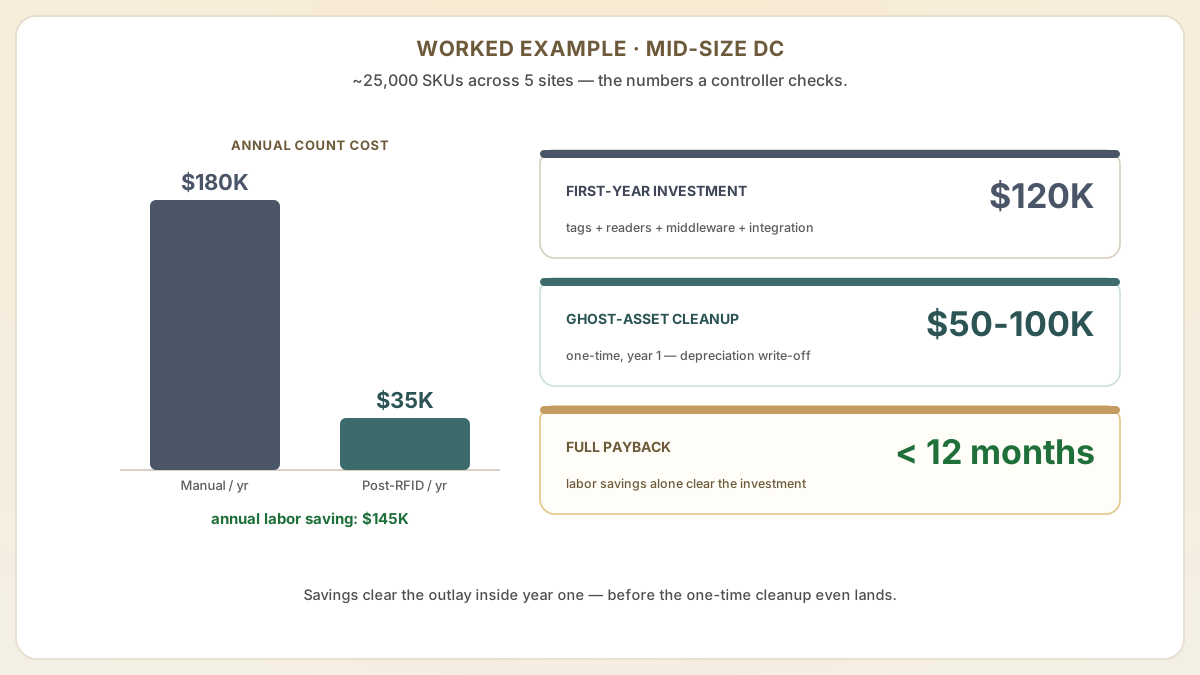
- Inputs to capture first (DON'T skip): annual cycle-count hours, fully loaded labor cost per hour, current inventory accuracy %, current shrinkage %, current out-of-stock revenue impact, ghost-asset % from a sample audit, capex budget, write-off horizon. Without these inputs the output is a guess; with them the model survives an audit committee meeting.
- Worked example (mid-size DC, ~25,000 SKUs across 5 sites): current annual count cost $180K (CPCON 2026 reference); RFID first-year investment $120K (tags + readers + middleware + integration); post-RFID annual count cost $35K; annual labor savings $145K. Add ghost-asset/depreciation cleanup of $50-100K and the payback compresses to under 12 months. Industry midpoint payback per CPCON's enterprise dataset is 12-18 months.
- Apparel-retailer benchmark (Auburn Project Zipper / GS1 US): legacy receiving audits flag 69% of orders as inaccurate vs. less than 0.01% with RFID — chargeback elimination plus 2-8% sales lift from improved on-shelf availability is the apparel canonical ROI; the apparel mandate wave (Walmart, Target, Macy's, Nordstrom, Kohl's) is built on these same numbers.
- 3PL benchmark (Southern Fried Cotton apparel case): 98% chargeback reduction and 99.5% carton-unit accuracy from a single item-level RFID rollout; 3PL ROI models should treat avoided chargebacks as a separate revenue-recovery line because they often dwarf the labor savings.
- What the model usually gets wrong: under-estimating tag consumption growth (new SKU velocity), over-estimating in-house integration capacity (budget 4-8 weeks per ERP per CPCON), and ignoring change-management cost (training, parallel-run, exception handling typically 10-15% of capex).
What are the most common ROI overstatements that fail the CFO sanity check?
Consultant-grade ROI presentations get torn apart in finance review when they assume best-case savings stacked on best-case timelines. The five failure modes below are the ones a sharp controller checks first — filter your model against each before you present it, because the finance team certainly will. A model that survives its own worst case is the one that gets funded.
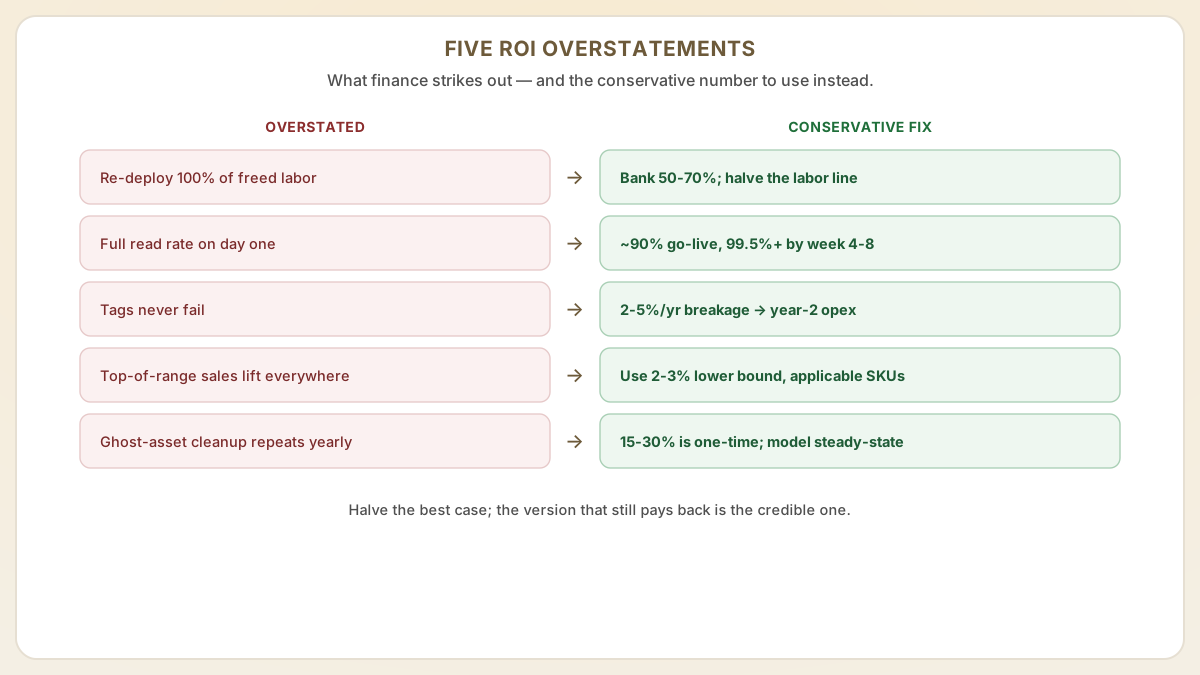
- Stacking labor savings 100%: if you save 80% of cycle-count labor, you cannot also re-deploy 100% of that labor to value-add work — most operations re-absorb only 50-70% of freed hours into productive tasks. Halve the labor-savings line for the conservative case.
- Assuming day-one read rates: portal accuracy ramps from ~90% on go-live to 99.5%+ after 4-8 weeks of antenna-tuning per the SLS D-Series and rfidtaghy commissioning playbooks. Don't claim full chargeback elimination in month 1.
- Ignoring tag breakage and re-tagging: pallet tags and reusable on-metal tags have failure rates of 2-5% per year from forklift impact and chemical exposure. Build re-tagging consumables into year-2+ opex.
- Inflating sales lift on retail models: the 2-8% out-of-stock sales lift from RFID is well-documented but not additive across all categories — it concentrates in fashion and high-velocity SKUs. Apply the lift only to applicable categories and use the lower bound (2-3%) for the conservative case.
- Forgetting depreciation/ghost-asset cleanup is one-time: removing 15-30% ghost assets from the register is a year-one event; it does not repeat annually. Treat it as a one-time benefit and compute the steady-state model separately so the chart doesn't show a phantom permanent uplift.
Useful next pages
Use these linked product, guide and comparison pages to keep the next click specific and practical.
Get started with RFID inventory tracking
Tags and hardware for inventory management deployments.
Independent ROI references
Authoritative sources behind the benchmark numbers and worked examples in this article.
FAQ
How quickly does RFID inventory pay for itself?
Most retail RFID implementations achieve full payback within 6-18 months. The primary drivers are labor savings from faster inventory counting (typically 70-90% time reduction) and revenue recovery from improved stock visibility (2-8% sales lift). High-value retail categories like electronics and luxury goods often see payback in under 6 months due to higher per-unit value and greater shrinkage impact.
What is a realistic inventory accuracy improvement with RFID?
Non-RFID retailers typically have 65-75% inventory accuracy at the SKU/location level. RFID deployments consistently achieve 95-99% accuracy through frequent automated counting, real-time visibility and elimination of manual scanning errors. This accuracy improvement is the foundation of the sales lift benefit, as higher accuracy drives better replenishment and fewer out-of-stock events.
How much does it cost per item to deploy RFID for inventory?
The per-item tag cost ranges from $0.03 for basic UHF RFID labels in high volume to $0.10-0.15 for specialty tags (anti-metal, small form factor, hang tags). When you include amortized reader hardware, software and integration costs, the all-in per-item cost is typically $0.05-0.20 for the first year. This cost is offset by per-item savings from reduced labor, shrinkage and improved sales.
What hardware budget should I plan for a single-DC RFID inventory pilot?
Total for a single-site pilot typically lands at $50K-200K depending on dock-door count and software scope. A representative single-DC pilot scoping baseline (per CPCON 2026 enterprise pricing): 1-2 handheld UHF readers at $1,500-5,000 each, 2-4 fixed dock-door portals at $3,000-10,000 each (Impinj R420/R700 or Zebra FX9600/FX7500 inside an SLS D-Series or comparable Wave-antenna housing rated 99.99% scan rate), 4-12 antennas at $200-500 each, middleware/software platform $10,000-50,000/year, and professional services $20,000-100,000 for site survey, install, integration and training. Pilot results in 4-6 weeks per rfidtaghy commissioning data; full facility rollout 10-14 weeks.
When should I plan for a phased rollout vs. a single big-bang deployment?
Phased rollouts are the default — single-step big-bang deployments are the leading cause of stalled RFID projects per CPCON's 2026 implementation analysis and IntelliStride's 3PL deployment write-ups. A practical phasing template: Phase 1 (months 0-3) — receiving dock and one cycle-count zone; Phase 2 (months 3-6) — putaway and bin verification; Phase 3 (months 6-9) — picking accuracy and pack-out verification; Phase 4 (months 9-12) — yard management and outbound docks. Each phase should produce a measurable accuracy or labor delta before the next phase starts; this gives finance evidence for the next capex tranche and lets operations digest one workflow change at a time. Big-bang is reserved for greenfield warehouses or post-acquisition consolidations where the legacy workflow is already disrupted.
Sources & references
Primary standards, OEM datasheets and regulatory documents cited by this article. All URLs were verified on the access date shown below.
- Project Zipper — RFID reaches near-100% order accuracy (69% legacy vs <0.01% RFID)
GS1 US / Auburn RFID Lab 10-month study: legacy ASN audits recorded order inaccuracy 69% of the time vs less than 0.01% with EPC/RFID.
- Auburn University RFID Lab
Independent research institute on the RFID business case and ROI methodology in retail and supply chain.
Proud Tek is a Shenzhen-based RFID & NFC manufacturer supplying hotel chains, transit operators, event venues and retail brands worldwide. Every order includes free samples, RF testing and dedicated project support.
Get a Quick Quote
Tell us about your project and we'll respond within one business day. Fields marked (asterisk) are required.