
Industrial RFID
How RFID Cuts Warehouse Inventory Shrinkage
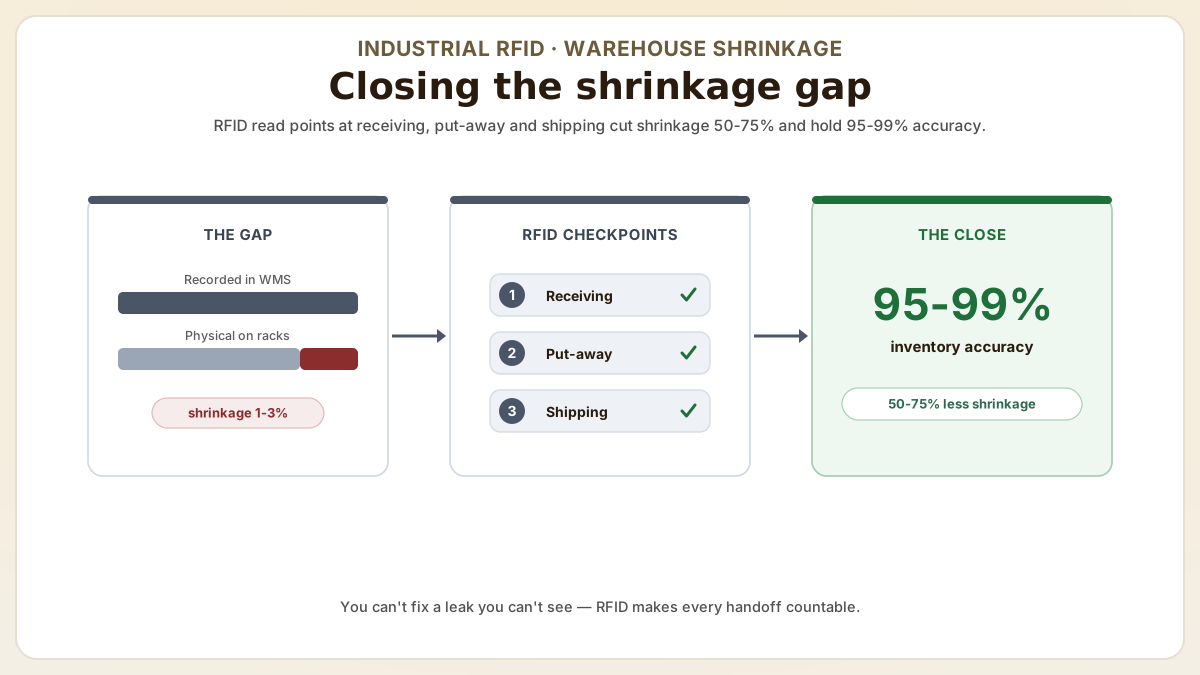
Quick answer
RFID-enabled receiving, put-away and shipping verification cuts warehouse inventory shrinkage 50-75% and lifts inventory accuracy to 95-99%, closing the 1-3% annual gap between recorded stock and physical inventory that quietly drains distribution centers.
- Warehouse inventory shrinkage averages 1-3% of inventory value annually, driven by receiving errors, misplaced stock, internal theft, and administrative processing mistakes.
- RFID-enabled receiving, put-away, and shipping verification catches discrepancies at each handoff point, preventing shrinkage from compounding across the supply chain.
- Facilities deploying UHF RFID for item-level tracking report 50-75% reduction in shrinkage rates and 95-99% inventory accuracy compared to 65-85% with barcode-only systems.
At a glance
Use these short answers to decide whether this page matches the project before moving into the detail.
Key takeaway
Warehouse inventory shrinkage averages 1-3% of inventory value annually, driven by receiving errors, misplaced stock, internal theft, and administrative processing mistakes.
What causes warehouse inventory shrinkage?
Shrinkage is the inventory equivalent of a slow leak: nothing dramatic happens on any given day, and then the annual count lands and the numbers on the screen turn out t...
Next step
Ready to move forward? Start your inquiry to get specific answers for this project.
Get RFID labels for warehouse inventoryWhat causes warehouse inventory shrinkage?
Shrinkage is the inventory equivalent of a slow leak: nothing dramatic happens on any given day, and then the annual count lands and the numbers on the screen turn out to have been quietly lying for months. Nobody watched a single item leave; the spreadsheet simply insists you own more than the racks can produce. The causes are rarely cinematic — far more stock is lost to a mistyped quantity or a pallet parked in the wrong aisle than to anyone slipping out a loading-dock door. Naming where the gap actually comes from is the first step to closing it.
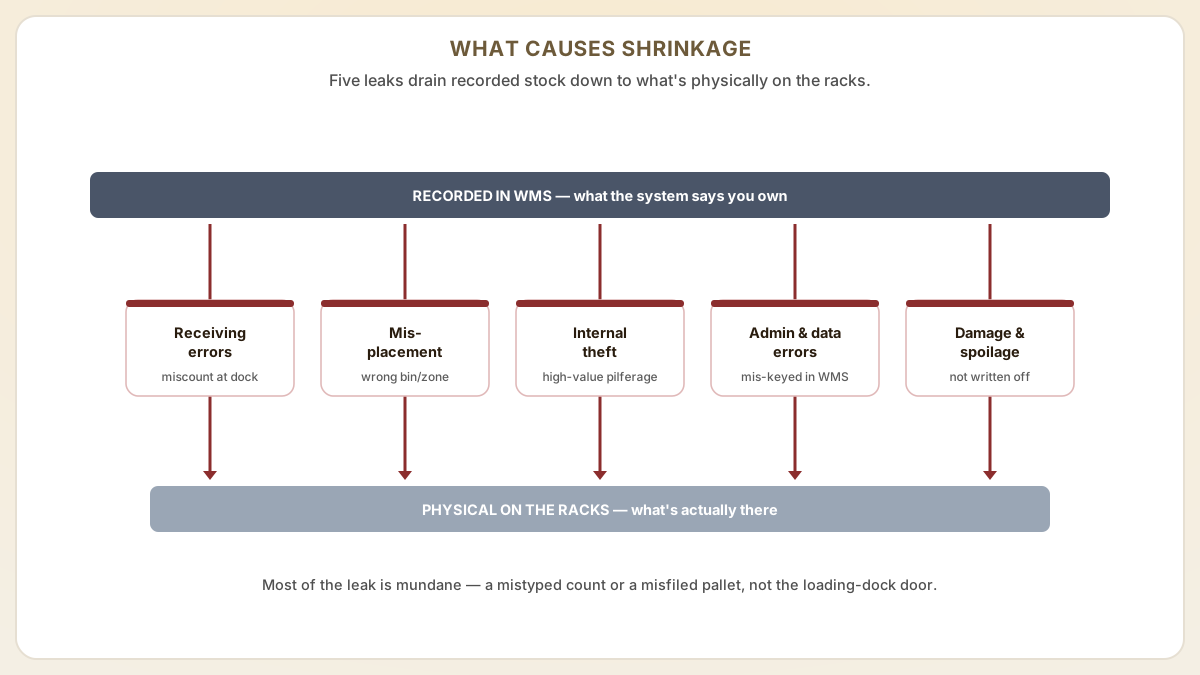
- Receiving errors: shipments counted incorrectly at the dock, damaged goods not documented, or supplier shortages not flagged during inbound processing result in phantom inventory that the WMS shows as in stock but does not physically exist.
- Misplacement: items put away in the wrong bin, shelf, or zone become unfindable by pickers, effectively lost until the next full physical inventory count (which may be months away). Misplacement accounts for a large portion of shrinkage in warehouses with manual put-away processes.
- Internal theft and pilferage: while uncomfortable to discuss, internal theft is a documented cause of warehouse shrinkage, particularly for high-value or easily concealed items that pass through many hands during receiving, storage, and shipping.
- Administrative and data-entry errors: incorrect quantities keyed into the WMS, duplicate receipts, missed cycle counts, and system-integration glitches between ERP and WMS create data discrepancies that manifest as shrinkage during physical audits.
- Damage and spoilage: items damaged during handling or storage that are not properly written off remain in the system as available inventory, contributing to the gap between recorded and physical stock.
How RFID technology reduces each shrinkage category
RFID doesn't fight shrinkage in the abstract; it stations a checkpoint at each handoff where stock actually goes missing, so a discrepancy surfaces at the dock or the pick face instead of during next quarter's count. Each control below maps to one of the leak points named above — and to a deeper walkthrough in our RFID asset tracking guide.
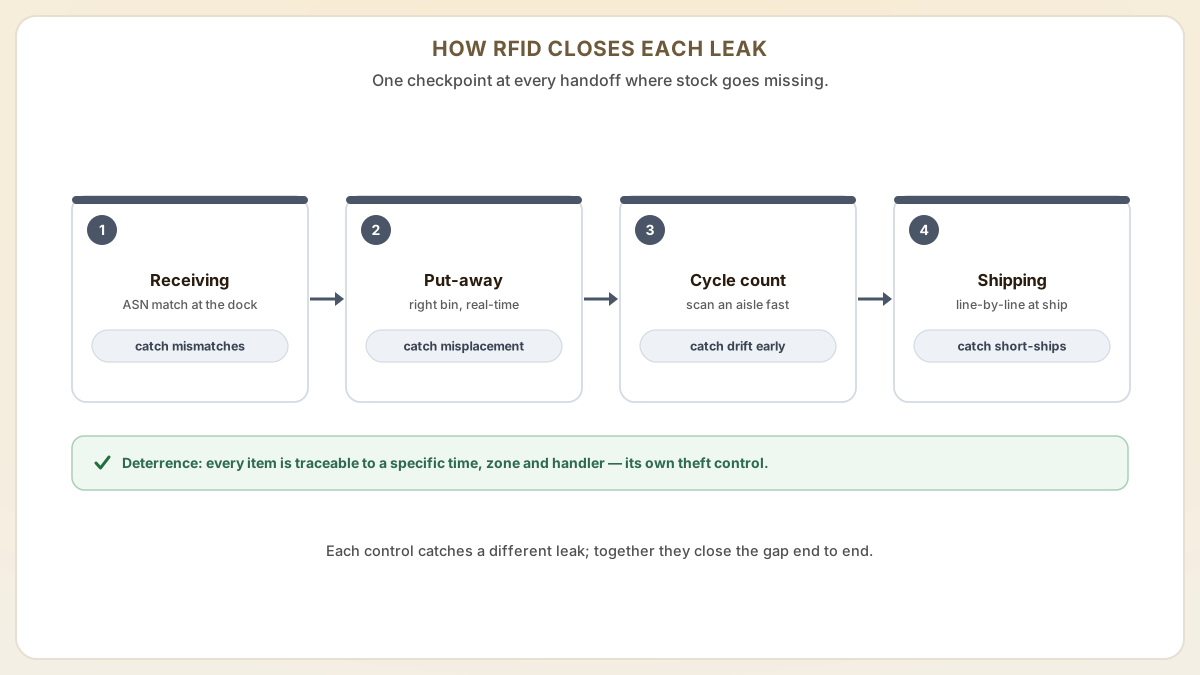
- RFID receiving verification: as pallets and cartons pass through a UHF RFID portal at the dock door, every tagged item is automatically counted and compared against the advance shipping notice (ASN). Discrepancies are flagged instantly, not discovered weeks later.
- RFID-guided put-away: handheld RFID readers confirm each item is placed in the correct bin or zone by cross-referencing the item's EPC with the location tag, so misplacement is caught in real time, not during the next audit.
- Cycle count automation: UHF RFID enables perpetual cycle counting where a handheld reader scans an entire aisle of inventory in minutes without opening boxes or touching individual items. This frequency of counting catches discrepancies before they compound.
- Shipping verification: every outbound order is RFID-verified at the shipping station, confirming that the correct items and correct quantities are in each carton before the truck leaves the dock. Short ships and wrong-item errors drop to near zero.
- Deterrence effect: the knowledge that every item is individually tracked from receiving to shipping creates a strong deterrent against internal theft, as any missing item can be traced to a specific time, zone, and handling event.
How do you handle getting started with RFID for shrinkage reduction?
You don't tag the entire building on day one — that's how pilots die in committee. The fastest payback comes from pointing RFID at the categories and choke points that bleed the most, proving the model, then widening coverage. The onramp below is the order most warehouses actually follow.
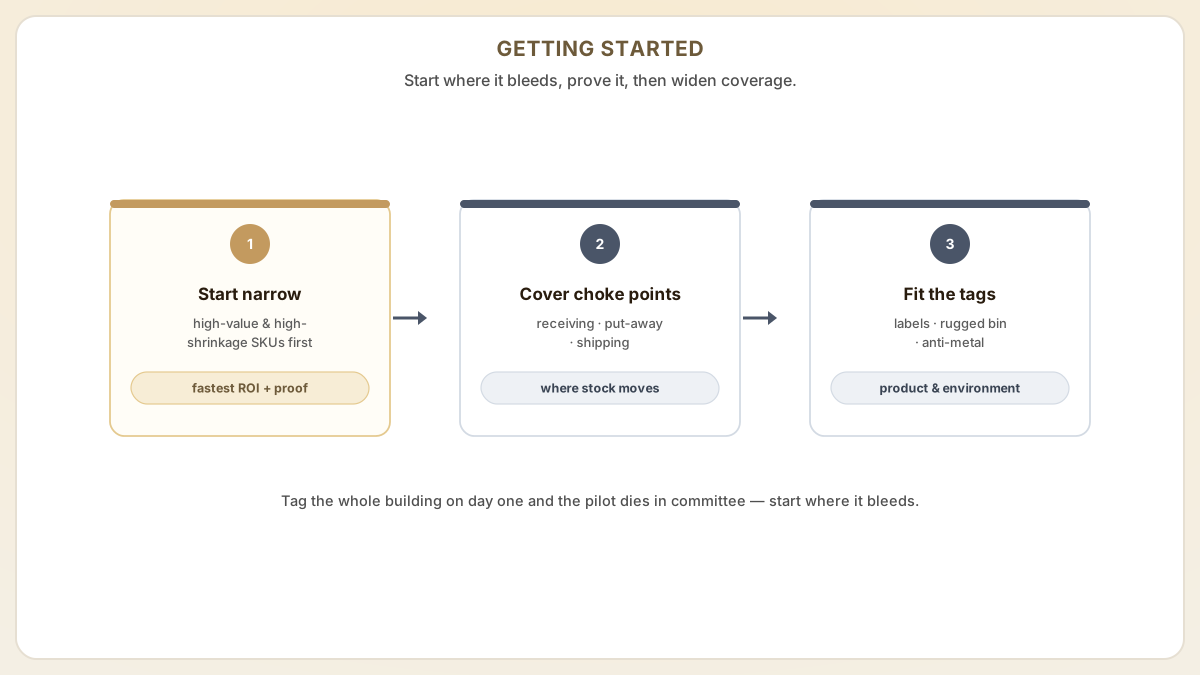
- Start with high-value or high-shrinkage product categories rather than tagging everything. This delivers the fastest ROI and provides a proof of concept for broader RFID deployment.
- Implement RFID at key transition points (receiving dock, put-away zone, shipping station) where inventory changes hands and shrinkage most commonly occurs.
- Select UHF RFID labels or tags appropriate for your product types. Printable RFID labels for cartons and cases, rugged tags for reusable bins and totes, and anti-metal tags for metal-shelved environments.
- Proud Tek supplies UHF RFID labels and tags in the exact form factors needed for warehouse deployment, pre-encoded with your EPC data structure and ready for application at your facility.
2026 3PL shrinkage benchmark tiers — where does your warehouse stand?
APS Fulfillment's published 2026 3PL shrinkage benchmarks give an objective scoring framework for evaluating warehouse and 3PL performance. Combined with Red Stag's analysis of 150 US 3PLs, the data lets you position your facility against industry tiers rather than against gut feel.
- Leading 3PLs report shrinkage rates below 0.01% — equivalent to 99.993% accuracy. This is achievable only with continuous-read RFID on inbound, put-away and outbound zones plus disciplined cycle counting.
- RFID labor savings: industry data cites 10-15% reduction in inventory-related labor hours, with cycle counts that took 8 hours of staff time now completing in 30-45 minutes. The labor recovery often exceeds the tag cost saving in steady state.
- 5-year ROI comparison: RFID systems deliver ~300% ROI over 5 years against ~100% for barcode-only operations of comparable scale, with payback in 12-18 months at $500K+ annual shrinkage exposure.
- Real-world case: a Midwest apparel chain reduced shrinkage from 2.1% to 1.2% via RFID rollout; on $50M revenue this translated to $450K annual savings — well above the $200-350K typical RFID program cost at that scale.
- Cross-tier upgrade path: most warehouses moving from 'industry average' (~1.44%) to 'best-in-class' (under 0.5%) do so by adding RFID on inbound + shipping zones first (highest shrinkage event density), then layering put-away verification once team workflow stabilizes.
| Tier | Annual shrinkage rate | Operational profile |
|---|---|---|
| Elite (top decile) | Under 0.1% | High-security automated 'ghost warehouse'; full RFID coverage on inbound/outbound; tight SOPs |
| Best-in-class | 0.1-0.5% | RFID-enabled receiving + shipping; cycle counts weekly; experienced team |
| Industry average | 1.44% | Across 150 US 3PLs (Red Stag 2026); barcode-mostly with limited RFID |
| Median e-commerce 3PL | 0.65% | Across 500 e-commerce brands; mixed barcode/RFID |
| Underperforming | Over 1.5% | Manual processes; no RFID; quarterly counts; high staff turnover |
How does retailer-mandate RFID change warehouse shrinkage economics?
When a warehouse or DC ships into Walmart, Target, Macy's, Kohl's or another mandate retailer, supplier-side tagging shifts the shrinkage-control opportunity. The same RFID tag that satisfies the retail mandate becomes free shrinkage infrastructure for the upstream warehouse — meaning warehouses serving mandate retailers have a materially better RFID business case than warehouses without that demand pull. See our Walmart RFID mandate guide for the compliance side of the same tag.
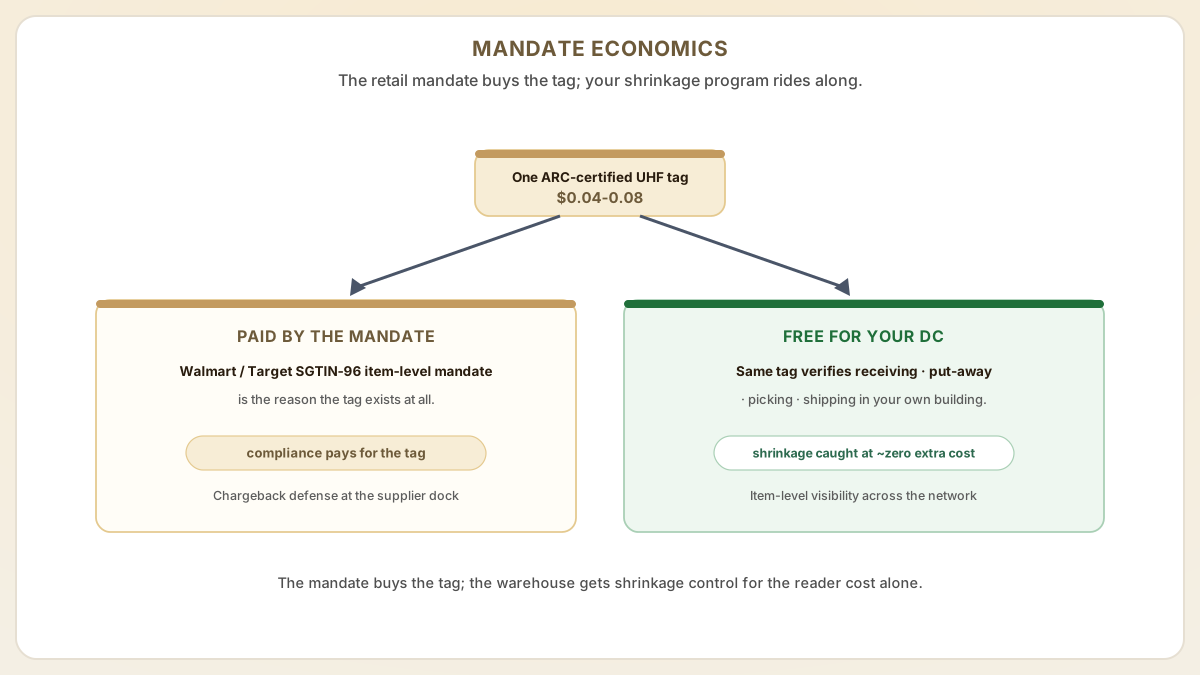
- Tag amortization across compliance + ops: a $0.04-0.08 ARC-certified UHF inlay applied to satisfy Walmart or Target SGTIN-96 mandates also enables receiving, put-away, picking and shipping verification in your own DC. The retail mandate pays for the tag; warehouse ops gets the shrinkage benefit at near-zero incremental cost.
- Receiving-dock chargeback double-defense: pre-shipment tunnel readers at the supplier dock catch ASN mismatches before truck departure (Walmart audits weekly; chargebacks $2-5/unit). The same reader also catches inbound supplier mistakes when goods enter your warehouse — turning a compliance defense into a procurement defense.
- Put-away zone audit using EPCIS 2.0: GS1's EPCIS 2.0 standard captures a 'received at zone X by operator Y at time Z' event for every tag read. This event log becomes the SOX-defensible put-away audit trail and the forensic evidence for shrinkage investigation when stock counts disagree with the WMS.
- Pick verification at shipping station: outbound RFID portals at the dock door reconcile picked items against the order line-by-line. Industry integrators report short-ship and wrong-item errors dropping to near zero once outbound RFID verification is mature, which is the single largest shrinkage category for many third-party logistics operators.
- Cross-DC item-level visibility: for multi-DC operators, item-level UHF RFID coupled with EPCIS event sharing makes 'where is unit X right now' answerable across the network. This collapses the time-to-detect on shrinkage events from quarterly to within-day.
What does the latest data say about warehouse shrinkage and RFID payback?
Warehouse shrinkage is less publicly reported than retail-store shrinkage, but multiple industry sources converge on consistent ranges. Anchoring the business case to credible benchmarks (rather than vendor pitch decks) is what gets CFO approval.
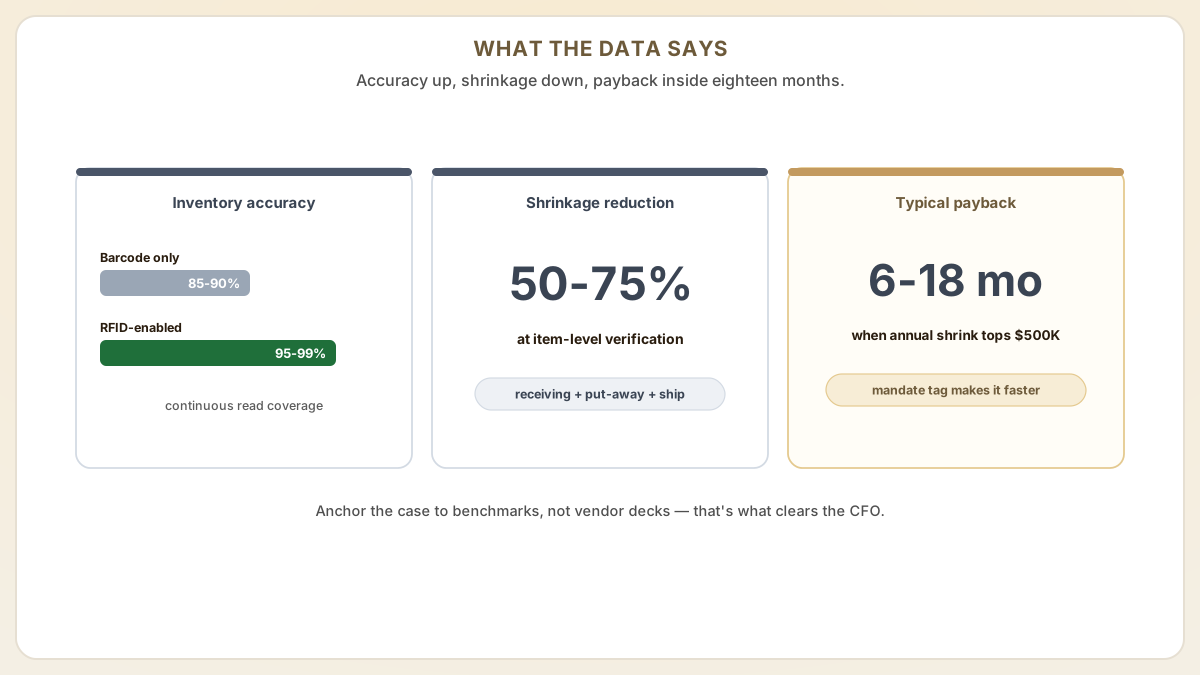
- Macro shrinkage rate: most warehouse and DC operations see 1-3% of inventory value annually as shrinkage from receiving errors, misplacement, theft, administrative errors and damage. The exact rate depends on commodity value density, employee count and supplier discipline.
- Industry RFID benchmarks: warehouses see up to 25% shrinkage / theft reduction with RFID integration (per industry integrators); some sources cite 50-75% reduction at item level with full receiving+put-away+shipping verification. Real-world cases include a tier-1 cable producer who reportedly reduced $1.4M annual shrinkage to near-zero via UHF RFID metal tags.
- Accuracy uplift: barcode-only operations typically run 85-90% inventory accuracy; RFID-enabled DCs reach 95-99% with continuous read coverage, per industry integrators (SATO, Lowry, Datascan benchmarks).
- Payback envelope: 6-18 months is the typical RFID payback range for warehouses where annual shrinkage exceeds $500K. Below that threshold the business case is harder unless retail-mandate compliance also drives the program — in which case the RFID infrastructure is paid for by the mandate and shrinkage becomes additive ROI.
- ORC and external pressure: with NRF reporting $112B annual US retail shrinkage and rising organized retail crime, retailers are pushing supply-chain partners to harden inventory verification at every node — the upstream pressure on warehouses to deploy RFID is intensifying.
Useful next pages
Use these linked product, guide and comparison pages to keep the next click specific and practical.
Warehouse RFID products
Explore RFID labels and tags for warehouse inventory management.
3PL benchmark references
Independent 2026 3PL shrinkage benchmark and labor-savings data sources.
Standards and shrinkage data
Authoritative external sources for warehouse RFID standards and retail shrink benchmarks.
FAQ
What ROI can I expect from RFID for shrinkage reduction?
Most warehouses see positive ROI within 6-18 months of RFID deployment. If your annual inventory shrinkage is $500,000 and RFID reduces it by 50%, the $250,000 annual savings far exceeds the cost of RFID tags, readers, and software integration. The ROI is fastest when starting with high-value, high-shrinkage categories.
Do I need to tag every item in my warehouse to reduce shrinkage?
No. Targeting the top 20% of SKUs by value or shrinkage rate typically addresses 80% of the shrinkage problem. Many warehouses start with RFID on their highest-value categories and expand to lower-value items as the system proves its value and infrastructure is in place.
Can RFID integrate with our existing WMS?
Yes. All major WMS platforms (SAP EWM, Manhattan Associates, Oracle WMS, Blue Yonder) support RFID integration through standard middleware. The RFID reader writes EPC data into the same data structures your WMS uses for barcode scanning, so the integration is straightforward for your IT team or systems integrator.
If we already ship to Walmart or Target, how does that change our warehouse RFID case?
Materially. Walmart and Target item-level mandates put $0.04-0.08 ARC-certified UHF tags on the inventory anyway. That tag is now essentially free shrinkage infrastructure for your DC — you only need to invest in receiving, put-away and shipping reader infrastructure, not in tags. Most warehouses serving multi-mandate retailers see RFID payback inside 6-12 months once the supplier-tag base reaches 70%+ coverage.
What 3PL shrinkage rate should we benchmark against in 2026?
APS Fulfillment's 2026 framework defines four tiers: Elite (under 0.1%, high-security automated 'ghost warehouse'), Best-in-class (0.1-0.5% with RFID-enabled receiving/shipping), Industry average (1.44% per Red Stag's 2026 analysis of 150 US 3PLs; median 0.65% across 500 e-commerce brands), and Underperforming (over 1.5%). Leading 3PLs report shrinkage as low as 0.01% (99.993% accuracy). The benchmark to use depends on your customer profile: brand-direct shippers expect Elite or Best-in-class performance with chargeback contracts at 0.5%; commodity 3PLs serving low-margin e-commerce can defend Industry-average performance. Most warehouses moving from Industry-average to Best-in-class do so by deploying RFID at inbound and shipping zones first (highest shrinkage event density), then layering put-away verification once workflow stabilizes.
How do EPCIS 2.0 events help in shrinkage investigation?
EPCIS 2.0 (the GS1 standard for serialized event data) captures every RFID read as a structured event: 'EPC X observed at location Y by reader Z at timestamp T, action verb received/picked/shipped'. When a stock count disagrees with the WMS, the EPCIS event log lets investigators replay every touchpoint of every missing item — collapsing investigation time from days to hours and producing a SOX-defensible audit trail finance can rely on.
Sources & references
Primary standards, OEM datasheets and regulatory documents cited by this article. All URLs were verified on the access date shown below.
Proud Tek is a Shenzhen-based RFID & NFC manufacturer supplying hotel chains, transit operators, event venues and retail brands worldwide. Every order includes free samples, RF testing and dedicated project support.
Get a Quick Quote
Tell us about your project and we'll respond within one business day. Fields marked (asterisk) are required.