
Industrial RFID
How RFID Ends Manual Inventory Counting Errors
Quick answer
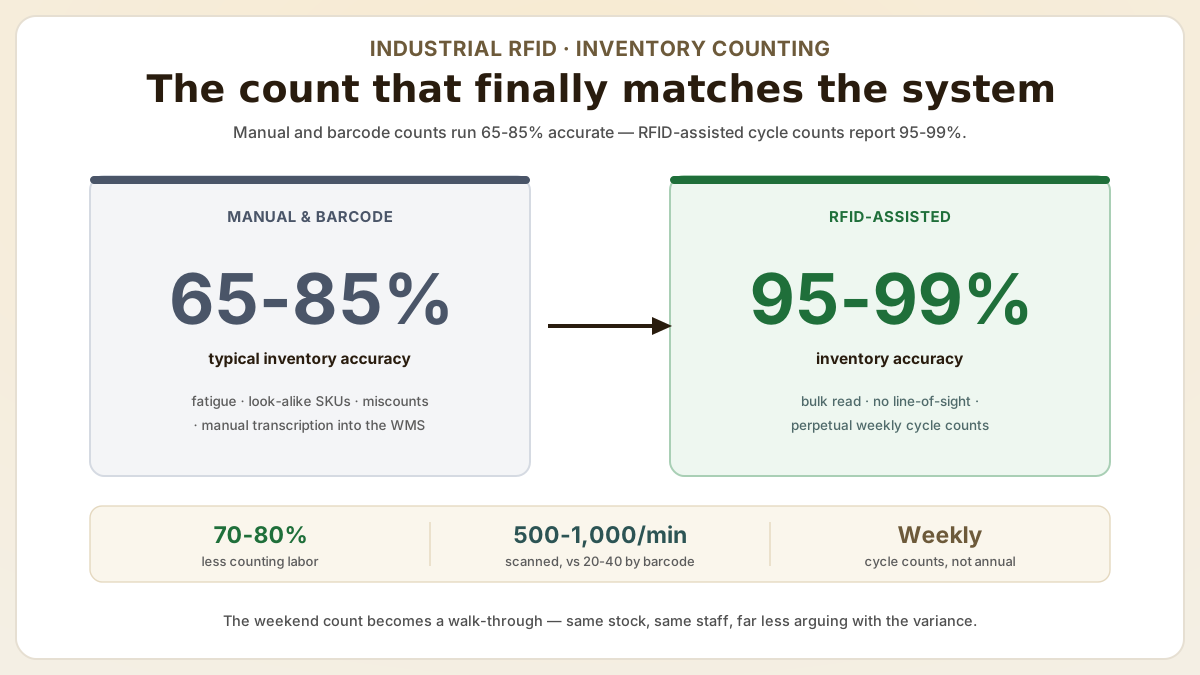
Manual and barcode inventory counts top out at 65-85% accuracy; facilities that move to RFID-assisted cycle counts report 95-99% and cut counting labor 70-80%. This guide traces where the miscounts actually come from — fatigue, look-alike SKUs, transcription slips — and what independent published audits say RFID recovers.
- Manual counting and barcode scanning achieve 65-85% inventory accuracy at best, with errors caused by human fatigue, visual miscounts, missed items, and data entry mistakes.
- UHF RFID enables bulk scanning of hundreds of items per minute without opening boxes, moving stock, or individually scanning each item. A single person counts an entire warehouse zone in minutes.
- Facilities that switch from manual counting to RFID-assisted cycle counts report 95-99% inventory accuracy and 70-80% reduction in counting labor hours.
At a glance
Use these short answers to decide whether this page matches the project before moving into the detail.
Key takeaway
Manual counting and barcode scanning achieve 65-85% inventory accuracy at best, with errors caused by human fatigue, visual miscounts, missed items, and data entry mistakes.
Why manual inventory counting produces errors
Every operations manager knows the annual ritual: the warehouse goes dark for a weekend, a small army arrives with clipboards, and on Monday the count still doesn't matc...
Next step
Ready to move forward? Start your inquiry to get specific answers for this project.
Get RFID labels for inventory countingWhy manual inventory counting produces errors
Every operations manager knows the annual ritual: the warehouse goes dark for a weekend, a small army arrives with clipboards, and on Monday the count still doesn't match the system — so someone quietly 'adjusts' the variance and everyone agrees not to bring it up until next year. Manual counting doesn't drift because people are careless; it drifts because the method asks a tired human to do a machine's job. Five predictable failure points do most of the damage, and they compound:
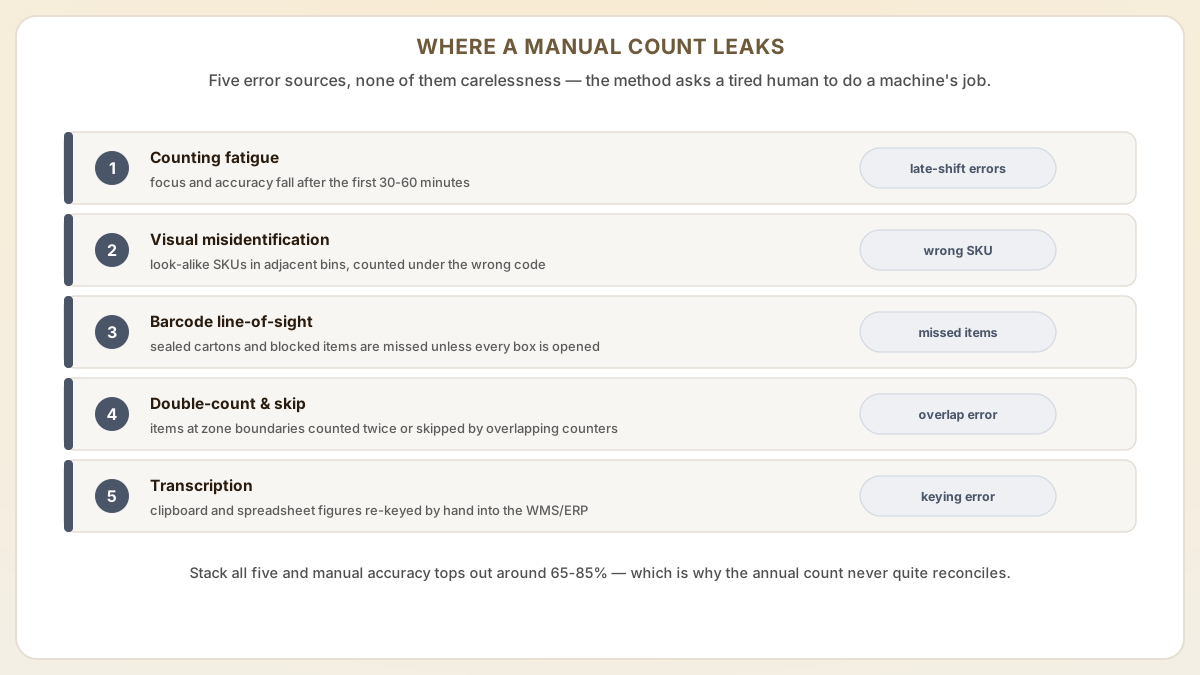
- Counting fatigue: warehouse workers counting hundreds or thousands of items lose focus and accuracy after the first 30-60 minutes. Error rates increase progressively as a shift progresses, with the last hours of a count being the least reliable.
- Visual misidentification: similar-looking products in adjacent bins are frequently miscounted or counted under the wrong SKU. Without scanning each item's identifier, visual counting relies on label reading that is error-prone in dimly lit or densely packed storage areas.
- Barcode scanning limitations: while better than pure visual counting, barcode scanning requires line-of-sight and individual item handling. Items behind other items, items facing the wrong direction, and items in sealed cartons are missed unless every container is opened and every item rotated.
- Double-counting and skip errors. When multiple counters work the same zone, items at zone boundaries are frequently counted twice or skipped entirely. Without a real-time system of record, there is no safeguard against these overlap errors.
- Transcription mistakes: data collected on clipboards or spreadsheets must be manually entered into the WMS/ERP system. Each keystroke is an opportunity for transposition errors, wrong quantities, and miskeyed SKU numbers.
How RFID transforms inventory counting
RFID counts by radio instead of by eye: one reader pass tallies every tagged item in range at once, so a handheld at walking speed clears 500-1,000 items a minute where a barcode gun manages 20-40. That single change — reading in bulk, through packaging, with no line-of-sight — is what turns a weekend count into a coffee break. Four properties do the work:
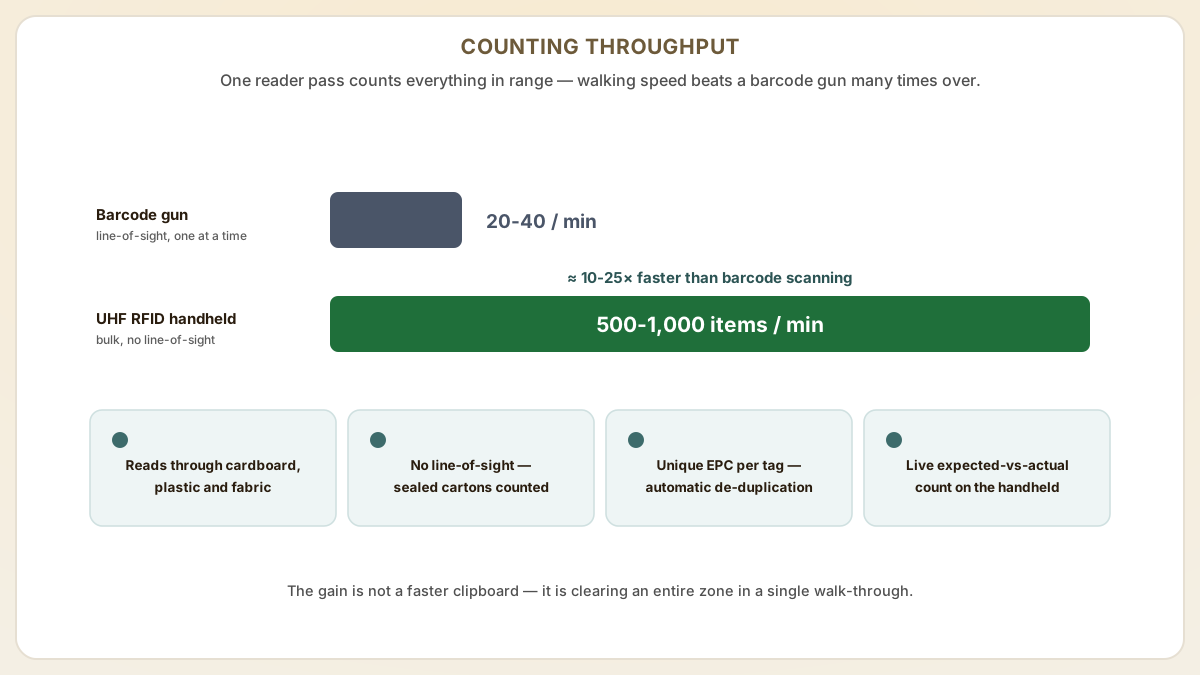
- Bulk reading: a single UHF RFID reader pass counts every tagged item within its field simultaneously. A handheld reader wielded at walking speed can inventory 500-1,000 items per minute, compared to 20-40 items per minute with barcode scanning.
- No line-of-sight required. RFID reads through cardboard, plastic, and fabric. Sealed cartons, stacked bins, and items facing the wrong way are all counted without opening, moving, or individually handling any stock.
- Automatic de-duplication: each RFID tag has a globally unique identifier (EPC), so the system inherently prevents double-counting. An item scanned twice in overlapping zones registers as a single count in the database.
- Real-time accuracy display. As the RFID reader scans, the expected versus actual count updates live on the handheld screen. Discrepancies are visible immediately, not discovered during post-count data reconciliation.
- Perpetual cycle counting: because RFID counting is so fast, facilities can count every zone every week instead of doing a single annual physical inventory. Continuous counting catches errors and shrinkage within days, not months.
How do you transition from manual counting to RFID?
Moving off manual counts is a three-phase rollout, not a rip-and-replace — and each phase earns its keep before the next begins, which is where the savings actually come from. Tag the stock that matters, put readers in your counters' hands, then change the cadence from annual to perpetual:
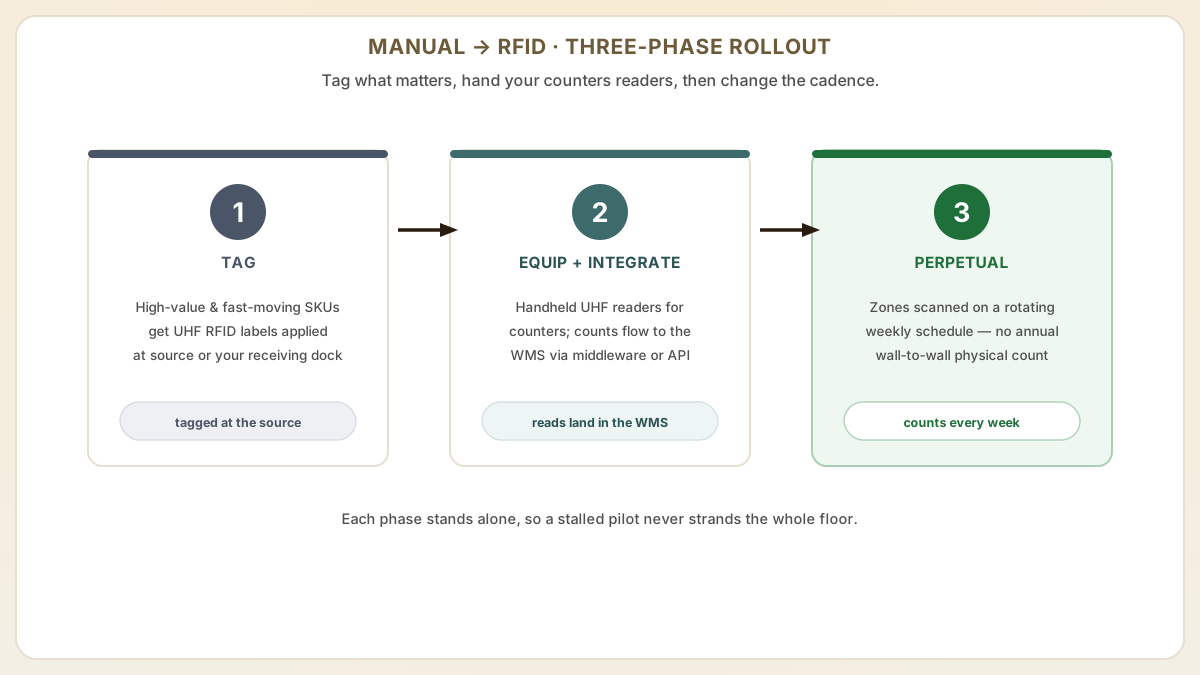
- Phase 1: Tag high-value or fast-moving SKUs with UHF RFID labels at the source (manufacturer or distribution center) or at your receiving dock.
- Phase 2: Equip counting staff with handheld UHF RFID readers and integrate the count data into your existing WMS via standard middleware or API connectors.
- Phase 3: Implement perpetual cycle counting by dividing the facility into zones and scanning each zone on a rotating weekly schedule, eliminating the need for annual wall-to-wall physical counts.
- Proud Tek provides UHF RFID labels in roll format for high-speed application, pre-encoded with your EPC data structure and compatible with all major RFID handheld readers and WMS platforms.
What do third-party benchmarks actually say about manual count error rates?
Generic 'manual counts are 65-85% accurate' claims float around the industry, but the underlying research is specific and citable. Use these published numbers when you build the CFO pitch — they hold up in audit committee discussions in a way that vendor marketing decks do not. Five independent studies, side by side:
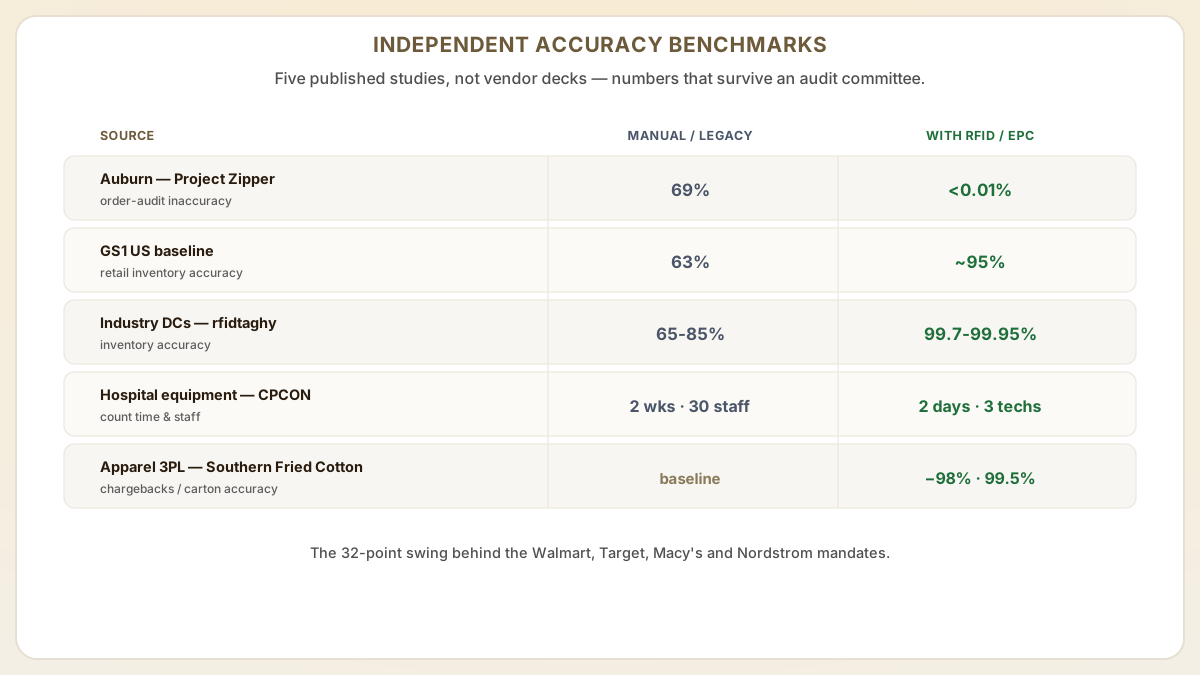
- Auburn University RFID Lab — Project Zipper (8 brands + 5 retailers, 10 months of audits): legacy UPC/barcode receiving audits recorded order inaccuracy 69% of the time, while EPC/RFID audits recorded inaccuracy in less than 0.01% of orders. Director Justin Patton publicly described the gap as 'much, much higher than expected.' This is the cleanest published benchmark for the manual-count error problem.
- GS1 US baseline study (cited by Walmart's RFID program): item-level RFID lifts retail inventory accuracy from a 63% manual-count baseline to ~95% — the same 32-point swing that drives the Walmart, Target, Macy's and Nordstrom mandates.
- RFID industry analysis (rfidtaghy 2026): high-volume distribution centers running manual counts and barcode scans typically yield 65-85% accuracy, while properly engineered UHF RFID systems consistently report 99.7-99.95% real-time inventory accuracy and reduce labor by up to 40%.
- Healthcare benchmark (CPCON enterprise RFID guide 2026): a hospital that previously needed two weeks and 30 staff members to physically count medical equipment completed the same task in two days with three technicians after RFID — a 75-95% reduction in count time that translates directly into payroll and operational-disruption savings.
- 3PL chargeback evidence (Southern Fried Cotton apparel case): item-level RFID at a contract manufacturer reduced discrepancy chargebacks by 98% and lifted carton-unit accuracy to 99.5% — concrete proof that manual-count errors are not a 'cost of doing business' but a controllable defect.
What are the most common mistakes warehouses make replacing manual counts with RFID?
RFID failure modes during transition are predictable. Avoiding them in the design phase is the difference between a 12-month payback and a stalled pilot. The patterns below come from competitor failure-mode write-ups (rfidtaghy, CPCON, IntelliStride) and our own field deployments. Five failure modes account for most stalled pilots:
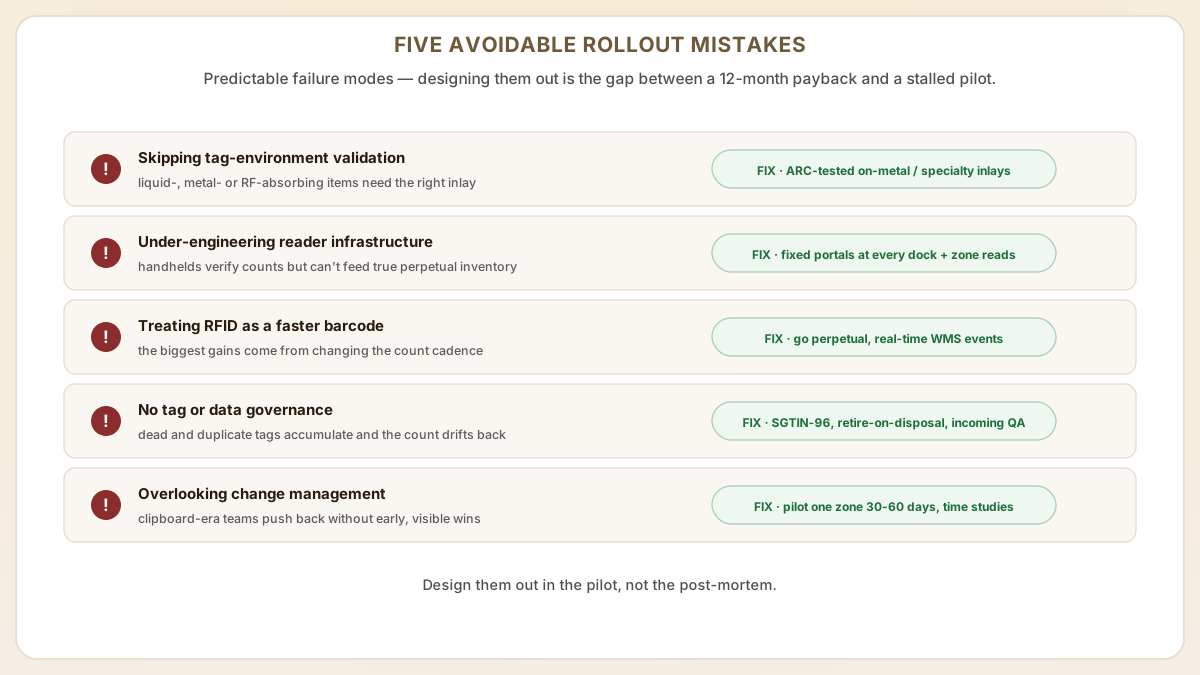
- Skipping tag-environment validation: not every UHF inlay reads reliably on every product. Liquid-dense (beverage), metal-rich (electronics), or RF-absorbing (carbon black, certain composites) items need on-metal or specialty inlays. Auburn RFID Lab and Walmart both publish ARC-tested inlay lists; specifying generic ISO 18000-6C labels for a metal SKU and discovering the read failure during pilot is the most expensive avoidable mistake.
- Under-engineering reader infrastructure: a handheld-only deployment can verify cycle counts but cannot generate the dock-door event stream needed for true perpetual inventory. Plan for fixed-portal coverage at every receiving and shipping dock, plus zone-transition reads on the WIP path; SLS D-Series and similar Wave-antenna portals deliver 99.99% scan rates with PoE-only install.
- Treating RFID as a barcode replacement only: the largest accuracy gains come from changing the count cadence (perpetual cycle vs. quarterly wall-to-wall), not from making the same workflow faster. Plan the WMS integration so RFID events land as inventory updates in real time rather than batch CSV uploads.
- No tag/data governance: tags need EPC encoding standards (SGTIN-96 with your GS1 prefix), retire-on-disposal procedures, and physical-tag QA on incoming label rolls. Without governance, dead or duplicate tags accumulate and the system drifts back toward manual reconciliation.
- Overlooking change management: per CPCON's 2026 enterprise guide and IntelliStride's 3PL deployment playbook, field teams accustomed to clipboards push back without early demonstrations of time savings. Pilot one zone for 30-60 days, capture before/after time studies, and let the operators who used the handheld present internally.
Useful next pages
Use these linked product, guide and comparison pages to keep the next click specific and practical.
RFID inventory counting products
Explore RFID labels and tags that enable automated inventory counts.
Independent inventory accuracy benchmarks
Authoritative third-party sources for the manual-count error and RFID accuracy claims used in this article.
FAQ
How much faster is RFID counting compared to barcode scanning?
RFID counting is typically 10-25 times faster than individual barcode scanning. A warehouse zone that takes 4 hours to barcode-scan can be RFID-counted in 15-30 minutes. This speed advantage enables frequent cycle counting that was impractical with barcode or manual methods.
Can RFID counting work alongside our existing barcode system?
Yes. During the transition, printable RFID labels carry both a barcode and embedded RFID chip. Items can be counted via RFID or barcode scan, with both methods updating the same WMS inventory record. This allows a phased rollout without disrupting existing barcode-dependent processes.
What accuracy improvement can we realistically expect from RFID?
Organizations transitioning from manual or barcode-only counting to RFID typically see inventory accuracy improve from 65-85% to 95-99%. The exact improvement depends on RFID tag placement quality, reader coverage, and process compliance, but the 95% floor is consistently achievable in well-implemented deployments. Auburn University's Project Zipper field study (8 brands, 5 retailers, 10 months of receiving audits) measured EPC/RFID order inaccuracy at less than 0.01% versus 69% for legacy UPC barcode workflows — the practical ceiling for RFID-verified counts is essentially zero error in well-engineered systems.
How long does the cycle-count workflow change take to roll out?
Most organizations move through the manual-to-RFID cycle-count transition in 8-16 weeks for a single facility. CPCON's 2026 enterprise RFID implementation guide pegs a typical schedule at 4-6 weeks for planning and site assessment, 4-8 weeks for a pilot of 500-2,000 tagged assets, and 8-20 weeks for the full rollout including WMS integration. Expect a 60-day stabilization period after go-live where exception rates fall as tag-placement issues, dead spots and process gaps are resolved. Run RFID counts in parallel with the legacy method for at least one full inventory cycle so finance has a clean cutover audit trail.
Sources & references
Primary standards, OEM datasheets and regulatory documents cited by this article. All URLs were verified on the access date shown below.
- Supply Chain Dive — RFID can achieve near 100% order accuracy, study says
GS1 US + Auburn Project Zipper receiving-audit study behind the legacy-versus-EPC/RFID order-accuracy gap; source of the Justin Patton quote.
- Auburn University RFID Lab
Project Zipper datasets and the ARC-approved inlay list referenced in this article.
Proud Tek is a Shenzhen-based RFID & NFC manufacturer supplying hotel chains, transit operators, event venues and retail brands worldwide. Every order includes free samples, RF testing and dedicated project support.
Get a Quick Quote
Tell us about your project and we'll respond within one business day. Fields marked (asterisk) are required.