
RFID vs. Manual Counting
RFID vs. Manual Counting
What You Save
Quick answer
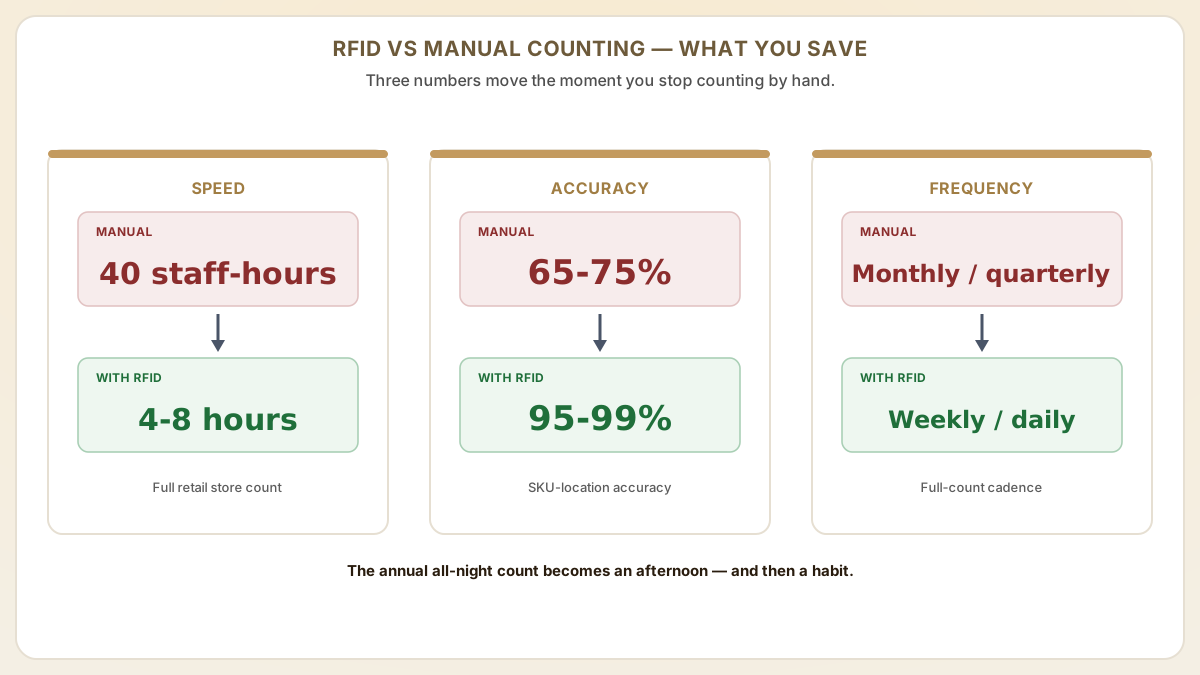
RFID inventory counting cuts cycle times 70-90% and lifts SKU-location accuracy from 65-75% to 95-99% versus manual barcode or clipboard counts — turning the annual all-night count into an afternoon. This guide covers the time, accuracy, ROI-timeline and CFO-model math.
- Speed advantage: a full retail store inventory that takes 40 staff-hours with manual counting can be completed in 4-8 hours with RFID handheld readers, scanning hundreds of tags per second without line-of-sight.
- Accuracy leap: manual counting typically achieves 65-75% SKU-location accuracy. RFID counting consistently delivers 95-99% accuracy by eliminating missed items, double-counts and transcription errors.
- Frequency unlocked: the speed of RFID makes weekly or even daily full-store counts practical, replacing the monthly or quarterly counts that manual methods limit you to.
At a glance
Use these short answers to decide whether this page matches the project before moving into the detail.
Key takeaway
Speed advantage: a full retail store inventory that takes 40 staff-hours with manual counting can be completed in 4-8 hours with RFID handheld readers, scanning hundreds of tags per second without line-of-sight.
How do time compare?
Ask anyone who has run a physical inventory and they will describe the same night: the store closed, the lights half-on, a crew with clipboards and handheld scanners wor...
Next step
Ready to move forward? Start your inquiry to get specific answers for this project.
Request RFID inventory demoHow do time compare?
Ask anyone who has run a physical inventory and they will describe the same night: the store closed, the lights half-on, a crew with clipboards and handheld scanners working aisle by aisle, and a manager doing arithmetic well past midnight that everyone already suspects is wrong. Manual counting is slow not because the people are slow, but because every item has to be found, aimed at, and written down — three chances to get it wrong, repeated across the entire store. The whole RFID pitch is that it changes the unit of work from per-item to per-second.
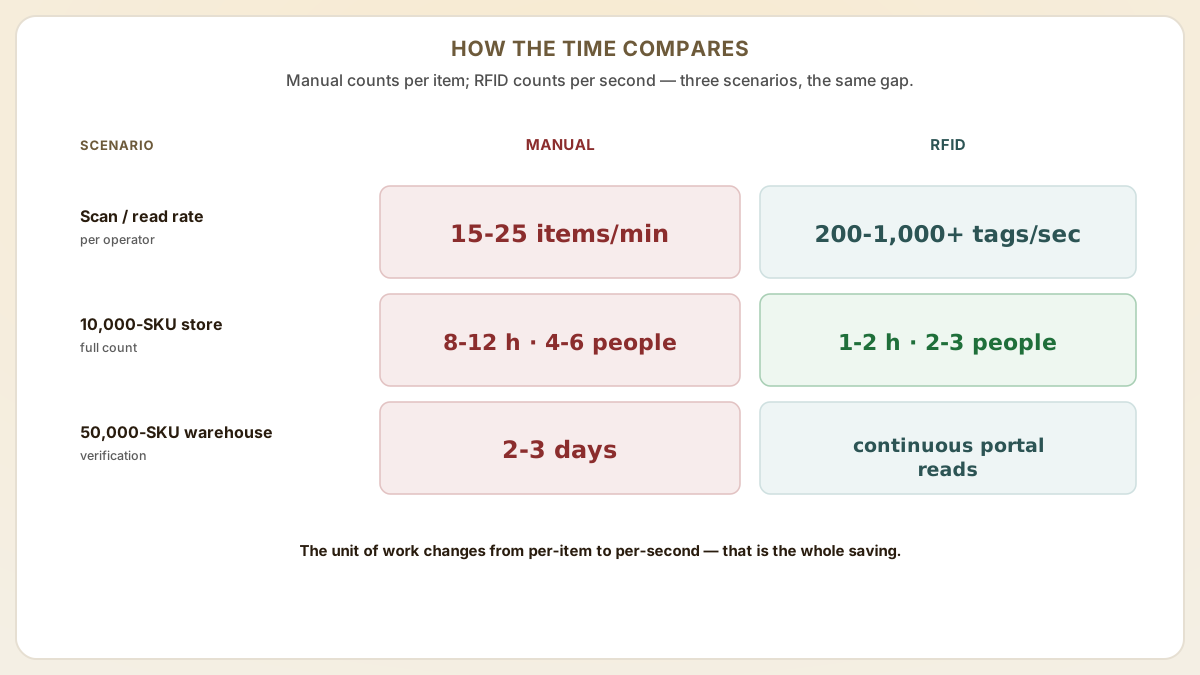
- Manual barcode scanning: each item requires individual line-of-sight scanning. A skilled operator scans 15-25 items per minute, meaning a 10,000-SKU store takes 8-12 hours with a team of 4-6 counters.
- RFID handheld counting: a single person with an RFID handheld reader walks through aisles reading 200-1,000+ tags per second. The same 10,000-SKU store is counted in 1-2 hours by 2-3 people.
- Warehouse pallet counts: manual forklift-and-scan verification of a 50,000-SKU warehouse takes 2-3 days. RFID portal readers at dock doors provide continuous automated counting, eliminating the need for periodic full counts.
- Cycle count frequency: manual constraints limit most businesses to monthly or quarterly full counts. RFID's speed enables weekly or daily full counts, providing near-real-time inventory visibility without operational disruption.
- After-hours vs. during operations: manual counts often require store closures or after-hours overtime. RFID counting is fast enough to conduct during normal operations without disrupting customers or workflows.
What's the accuracy comparison and business impact?
Speed is the headline, but accuracy is where manual counting quietly loses money all year — not in one dramatic failure, but in a thousand small ones nobody reconciles until the annual count. The errors manual counting introduces are individually tiny and collectively expensive.
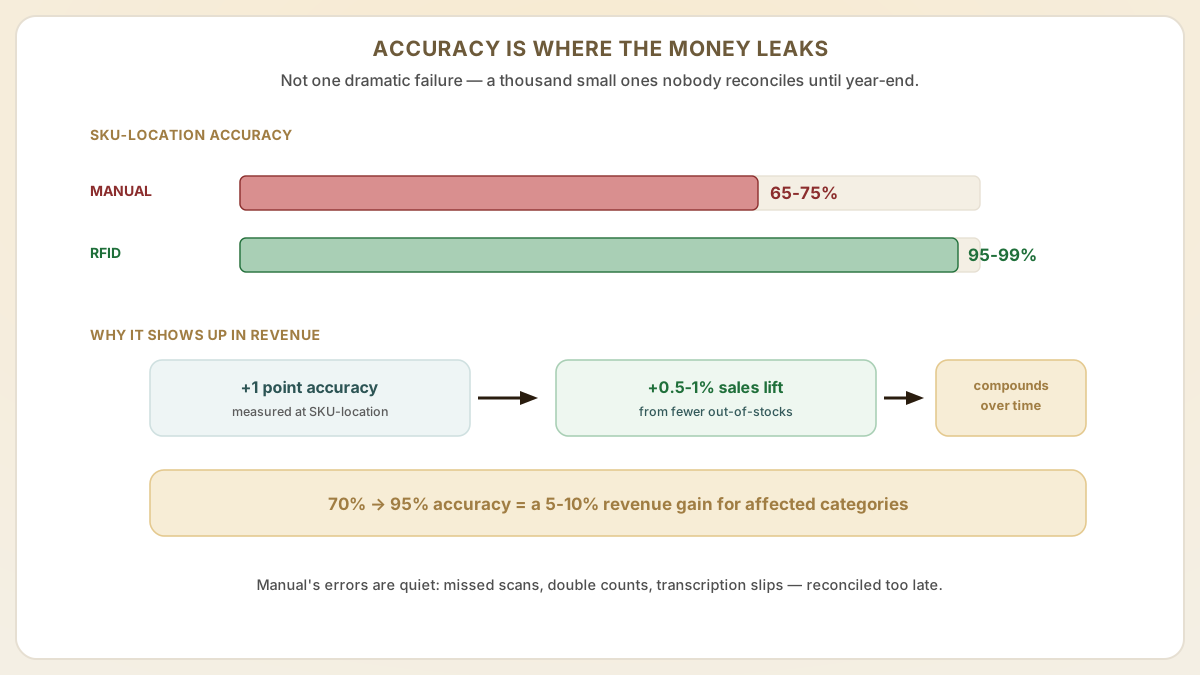
- Manual accuracy baseline: industry studies consistently show 65-75% inventory accuracy at the SKU/location level for manual-count environments, with some retailers as low as 50% for fast-moving categories.
- RFID accuracy results: organizations deploying RFID report 95-99% SKU-location accuracy, with the improvement sustained over time as counting frequency increases and data quality compounds.
- Revenue impact of accuracy. Every 1% improvement in inventory accuracy generates approximately 0.5-1% sales lift through reduced out-of-stocks. Moving from 70% to 95% accuracy can represent a 5-10% revenue gain for affected categories.
- Error types eliminated: RFID eliminates missed scans (items behind other items), double scans, wrong-location recording, transcription errors and the fatigue-driven mistakes that increase during long manual counting sessions.
- Exception-based management: high-accuracy RFID data enables exception-based inventory management, where staff investigate only discrepancies rather than counting everything, further reducing labor requirements.
What's the realistic ROI timeline for RFID inventory?
RFID inventory programs almost never break even in the first quarter — and the projects that promised that to the CFO are the ones that get killed. These five timeline benchmarks set honest expectations.
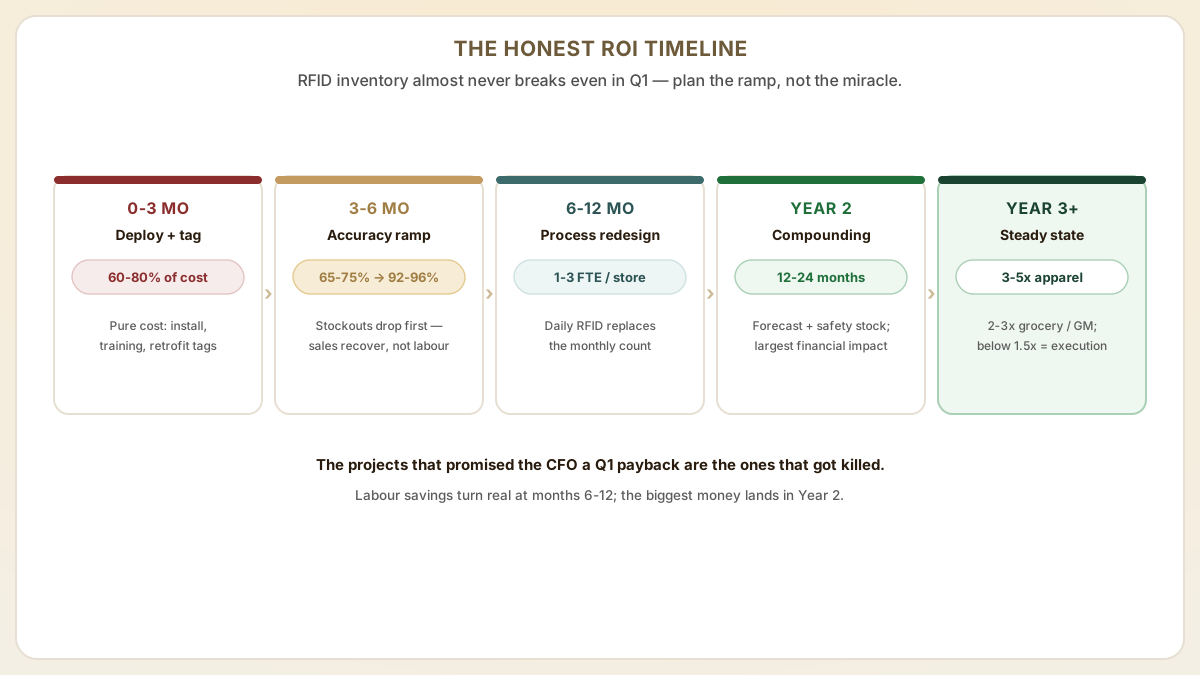
- Months 0-3 (deployment + tagging): pure cost. Hardware install, staff training, retrofit tagging of existing inventory. Expect 60-80% of program cost concentrated in this phase.
- Months 3-6 (accuracy ramp): inventory accuracy climbs from 65-75% baseline to 92-96%. Stockout rate drops first, before labor savings — the financial impact shows up as recovered sales, not yet as headcount changes.
- Months 6-12 (process redesign): cycle-count cadence changes from monthly physical to daily RFID. This is when labor savings (typically 1-3 FTE per store) become real and visible in monthly reports.
- Year 2 (compounding): forecast accuracy improves from RFID-confirmed sell-through data, reducing safety stock and markdowns. This is the largest financial impact but takes 12-24 months to materialize.
- Year 3+ (steady-state ROI): mature deployments routinely report 3-5x annual ROI in apparel and 2-3x in grocery/general merchandise. Programs that fail to clear 1.5x by Year 3 indicate execution issues, not RFID limitations.
Industry-by-industry benchmarks — where RFID counting actually delivers the largest delta
The 'RFID is 10x faster than manual counting' generalisation hides huge variance by industry. The published case studies below give the realistic delta for each major vertical so buyers can model their specific scenario instead of relying on vendor averages.
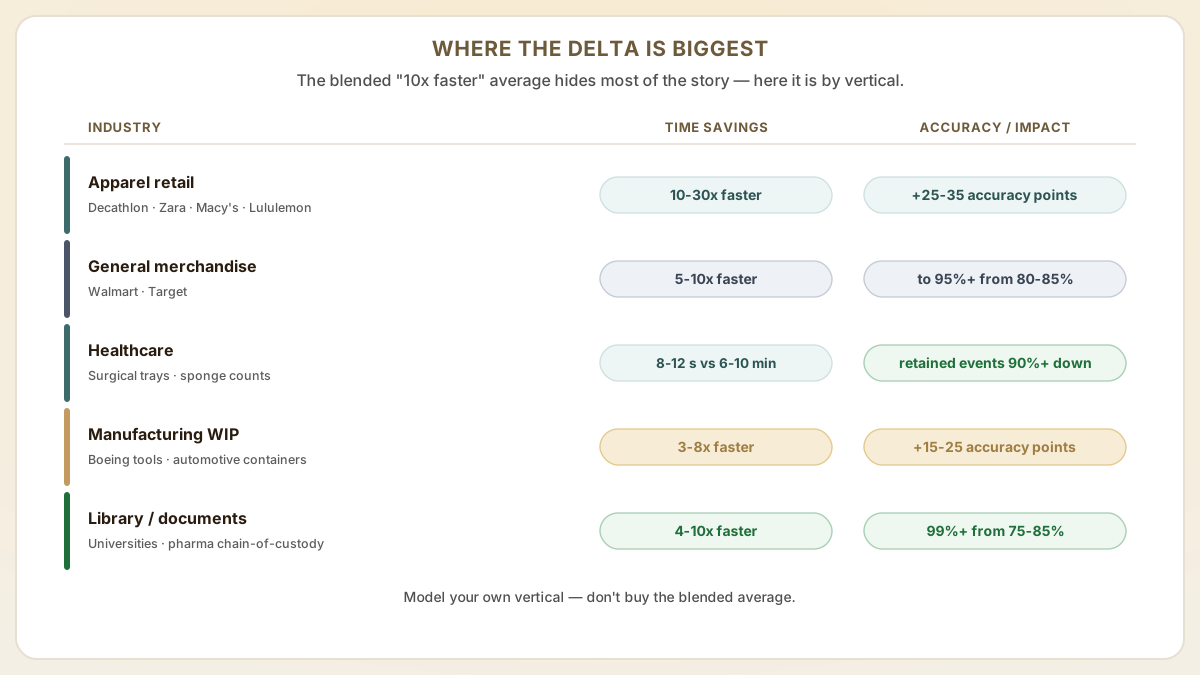
- Apparel retail (the gold standard) — Decathlon: 40-hour manual count reduced to 1.5 hours per 4,000 sqm store, 99% accuracy from 65-75% manual baseline. Inditex/Zara: every-night cycle count of 8K-15K garments takes 30-45 min vs 4-6 hours pre-RFID. Macy's: in-store inventory accuracy improved from 65% to 95%+, out-of-stocks down 10-15%, sales up 4-6%. Lululemon: 98% accuracy with <12-month payback. Time savings 10-30x; accuracy improvement 25-35 percentage points.
- General merchandise & hardlines — Walmart: inventory accuracy rose from 65% to 95%+ across 50K+ SKUs in mandated categories; out-of-stocks fell 50%, contributing to 1-3% sales lift in tagged categories per Auburn University RFID Lab studies. Target: 50% reduction in out-of-stock for RFID-tagged categories. Time savings 5-10x; accuracy 95%+ from 80-85% baseline.
- Healthcare and surgical instrument tracking — Surgical sponge counts (RFID-enabled per FDA AORN-recommended protocols) reduce retained-foreign-body events 90%+. RFID surgical instrument trays count 80-120 instruments in 8-12 seconds vs 6-10 minutes manually. Hospital linen counts shift from once-monthly to daily with no added labour. Healthcare ROI dominated by patient safety and litigation reduction, not just labour.
- Manufacturing WIP and tool inventory — Boeing tool tracking: 15-20% reduction in tool loss, 30% labour reduction on tool-room transactions. Automotive returnable container tracking: 25-40% reduction in container loss, 20-30% reduction in last-mile inventory variance. Tool counting time savings 3-8x; accuracy improvement 15-25 percentage points.
- Library and document tracking — University and public library RFID: book check-in/out time reduced 60-80%, annual inventory of 500K-2M items completed in days vs months. Pharmaceutical document chain-of-custody: 100% audit trail vs paper-log gaps. Time savings 4-10x; accuracy 99%+ from 75-85% manual baseline.
Building a defensible labour-and-accuracy ROI model your CFO will sign
Vendor ROI calculators routinely overestimate by 2-3x because they assume 100% RFID adoption from day one and ignore exception handling. A CFO-grade model has to build in three friction layers: ramp time, mixed-tagged inventory during phased rollout, and exception rate. Below is the four-line model that finance teams actually accept.
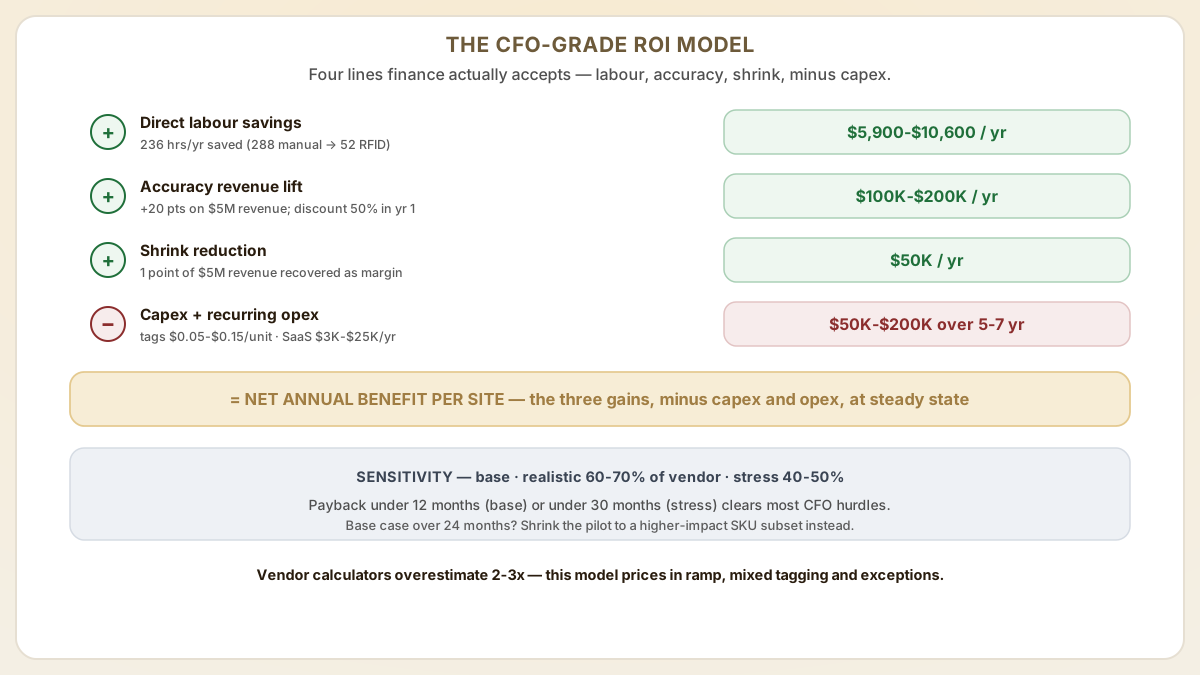
- Line 1 — Direct labour savings — Hours-per-cycle-count baseline (e.g. 24 hours x 12 counts/year = 288 hours/year manual) minus RFID hours-per-cycle-count (e.g. 2 hours x 26 counts/year if you double frequency = 52 hours/year). Net labour saving 236 hours/year. At loaded labour cost $25-$45/hour = $5,900-$10,600/year. Apply 60-80% during ramp year 1 (not all SKUs tagged, exception rate higher), 90-100% steady state from year 2.
- Line 2 — Inventory accuracy revenue lift — Inventory accuracy improvement (e.g. 75% to 95%, +20 percentage points) translates to fewer out-of-stocks. Industry benchmarks suggest 1-2% sales uplift per 10 percentage points of accuracy gain in retail/distribution. At $5M annual category revenue and +20 points accuracy = $100K-$200K annual revenue uplift. Conservative finance teams discount this 50% in year 1.
- Line 3 — Shrink reduction — Inventory shrink reduction typically 0.5-1.5 percentage points after RFID rollout. At $5M revenue and 1 point shrink reduction = $50K/year recovered margin. Use audited shrink baseline from prior year's inventory reconciliation.
- Line 4 — Capex amortisation and recurring opex — Spread initial $50K-$200K hardware + integration over 5-7 years (RFID hardware lifecycle). Add annual tag spend ($0.05-$0.15 x annual unit volume) and SaaS opex ($3K-$25K/year). Subtract from gross savings to get net annual benefit.
- Sensitivity ranges that get past finance review — Run base case (vendor numbers), realistic case (60-70% of vendor numbers), and stress case (40-50% of vendor numbers). If base case payback is <12 months and stress case is <30 months, the project clears most CFO hurdles. If base case is >24 months, refine the use case (smaller pilot, higher-impact SKU subset) rather than try to sell a marginal ROI.
Useful next pages
Use these linked product, guide and comparison pages to keep the next click specific and practical.
Start RFID inventory counting
Tags for retail and warehouse inventory deployments.
RFID counting research and case studies
Auburn University RFID Lab and major retailer case studies on inventory accuracy and ROI.
FAQ
How many items can an RFID reader scan per second?
Modern UHF RFID handheld readers can identify 200-1,000+ unique tags per second depending on the reader model and tag population density. Fixed overhead readers in warehouse portals can process even higher volumes. This speed means a person walking through a store aisle reads every tagged item on nearby shelves in real time, with no need to aim at or touch individual products.
Does RFID counting still require staff or is it fully automated?
RFID inventory counting typically combines automated and human elements. Handheld counting requires 1-3 staff members to walk the store or warehouse, but they move at walking speed rather than scanning each item. Fixed readers at doors and ceilings can provide fully automated zone-level counting, but most deployments use handheld readers for the detailed SKU-location counts needed for replenishment accuracy.
What happens to items without RFID tags during an RFID count?
Items without RFID tags are invisible to the RFID count. Successful RFID inventory management requires that all items being tracked carry RFID tags. For retail deployments, this means source tagging by suppliers or in-store tag application for all merchandise. Organizations typically start with one category (apparel is most common) and expand to additional categories as the ROI is proven.
Won't staff resist RFID because they fear it eliminates their jobs?
Not when framed as workflow improvement rather than labour replacement. Decathlon, Lululemon and Macy's all retained the same store-associate headcount but redirected the time savings (from cycle counting and back-room sorting) into customer-facing service, online order fulfilment and visual merchandising. The 80-90% labour saved on inventory tasks goes to higher-value activity, not headcount cuts. Communicate this explicitly during rollout: 'RFID counts the boxes so you can help the customers.' In manufacturing, the same logic applies — RFID does the audit-trail recording so technicians spend less time on paperwork and more on the actual repair or build. Cases where RFID rollout failed almost always involve poor change management rather than the technology itself.
How does RFID handle items that are missing tags or have damaged tags during a count?
Modern RFID workflow assumes 1-3% of items will have missing or damaged tags at any given time. Three handling patterns address this. First, exception list — the cycle-count app produces an 'expected but not read' list of items the WMS thinks are present but the RFID sweep didn't see; staff investigate each one (re-scan with handheld, look behind shelves, retag if found, write off if confirmed lost). Second, hybrid scan workflow — when an item is found without a working tag, scan its barcode (most retail items still carry one), apply a fresh RFID tag, and update the WMS in one transaction. Third, periodic full physical count (annually or semi-annually) reconciles the entire inventory and re-baselines accuracy — RFID daily/weekly counts maintain the baseline between physical reconciliations.
Sources & references
Primary standards, OEM datasheets and regulatory documents cited by this article. All URLs were verified on the access date shown below.
Proud Tek is a Shenzhen-based RFID & NFC manufacturer supplying hotel chains, transit operators, event venues and retail brands worldwide. Every order includes free samples, RF testing and dedicated project support.
Get a Quick Quote
Tell us about your project and we'll respond within one business day. Fields marked (asterisk) are required.