RFID vs Barcode Comparison
RFID vs Barcode
Which to Choose for Tracking
Quick answer
RFID and barcodes both identify items, but the underlying physics is profoundly different. Barcodes require line-of-sight optical scanning one item at a time, while UHF RFID uses radio backscatter to read hundreds of items simultaneously through cardboard, plastic and fabric with no line of sight needed. That single capability difference cascades into every downstream decision: scan speed, inventory accuracy, labor cost, infrastructure budget, environmental durability and unit-level traceability. This comparison walks through where RFID earns its price premium, where barcodes remain the smart choice, how to evaluate total cost of ownership rather than sticker price, and how many operations deploy both technologies together on the same label for a belt-and-suspenders approach.
- Where chip-family migration is on the roadmap, speed — UHF RFID reads 1,000+ items per minute with no line of sight; handheld barcode scanning handles 30-40 items per minute and requires direct visual alignment with each label.
- Accuracy: RFID-enabled cycle counts achieve 95-99.5% inventory accuracy versus 65-85% for manual barcode processes, driven almost entirely by eliminated missed scans and reduced human counting error.
- Cost: printed barcode labels cost fractions of a cent; passive UHF RFID inlays cost $0.03-$0.08 at volume and hard tags $0.10-$0.50+, so low-value low-turnover items rarely justify RFID on unit economics alone.
At a glance
Use these short answers to decide whether this page matches the project before moving into the detail.
Next step
Ready to narrow the options? Start a conversation with the details from this comparison.
Discuss RFID for your applicationKey differences between RFID and barcode technology
- Read mechanism: barcodes are decoded by an optical scanner that must see the printed pattern within a narrow field of view and depth of focus. Passive UHF RFID tags receive radio energy from a reader (860-960 MHz) and modulate that energy back with their stored EPC data, a technique called backscatter that works through cardboard, plastic, fabric, glass and human bodies.
- Line of sight: barcodes require unobstructed visual alignment. A crumpled, dirty, faded, or poorly printed barcode fails to scan. RFID needs no visual contact at all; the tag can be inside a sealed carton or under a shrink-wrapped pallet layer.
- Scan speed: a handheld barcode scanner reads one item every 1-2 seconds under ideal conditions (30-40 items per minute in practice, much less when operators must pick items up and orient them). A UHF RFID reader anti-collision protocol (EPC Gen2 / ISO 18000-63) singulates hundreds of tags simultaneously, producing 500-1,000+ reads per second in retail and warehouse field tests.
- Data capacity: a standard UPC/EAN barcode encodes 12-13 digits (the product SKU), a Code 128 barcode up to 80 alphanumeric characters, a QR code a few kilobytes of static printed data. A UHF RFID tag holds a 96-bit or 128-bit EPC identifier plus 32-1024 bits of user memory that can be updated in the field dozens of times over the tag's lifecycle.
- Durability: printed labels degrade from UV exposure (6-24 months outdoor life for thermal transfer on paper), moisture (water-damaged labels unreadable), abrasion and industrial chemicals. Encapsulated RFID tags in polycarbonate, PPS, ABS or epoxy survive 5-10 years of industrial washing, autoclave sterilization or outdoor asset tracking.
- Unique identity: a barcode typically identifies the product class (SKU) and is identical on every unit of that product. An RFID tag carries a factory-programmed Tag ID plus a serialized EPC, making every single physical item distinguishable. Essential for unit-level serialization, authentication and recall traceability.
- Infrastructure cost: a wired laser barcode scanner costs $100-$500, a rugged image-based scanner $500-$1,500. A handheld UHF RFID reader starts at $1,500-$3,500, a fixed dock-door portal $3,500-$8,000 plus antennas and mounting, and an overhead retail ceiling array $15,000-$60,000 per store. RFID is a fundamentally more capital-intensive deployment.
Speed, accuracy and labor — where RFID pays for itself
- Retail cycle counts: a 15,000 SKU apparel store typically counted weekly with barcode requires 18-24 labor hours per count. An RFID handheld sweep of the same store completes in 45-90 minutes with a single associate, enabling daily or twice-weekly counts instead of quarterly.
- Warehouse receiving: a pallet of 48 cases scanned one box at a time with a barcode gun takes 4-6 minutes. A dock-door RFID portal reads all 48 cases as the forklift drives through in under 3 seconds, and the WMS reconciles the expected ASN against the actual received EPCs automatically.
- Inventory accuracy improvement: published RFID ROI studies (Auburn University RFID Lab, GS1) consistently report inventory accuracy jumps from 63-75% (barcode baseline) to 95-99.5% (post-RFID), with the biggest driver being elimination of 'phantom inventory' items the system thinks are in stock but are actually missing.
- Out-of-stock reduction. Retailers deploying item-level RFID at scale report 20-40% reductions in on-shelf out-of-stocks, directly translating to 1.5-4% top-line sales uplift on affected SKUs.
- Labor redirection rather than elimination. RFID rarely eliminates headcount in practice. Instead, hours previously spent counting get redirected to customer service, visual merchandising or exception handling. The business case must value that time redeployment, not just count eliminated hours.
- ROI timelines: for high-turnover apparel, cosmetics and accessories retail, published RFID payback periods fall in the 9-18 month range. For low-velocity industrial distribution, 18-36 months is more typical. Food and grocery remains longer due to very thin item margins.
Where barcodes remain the economically rational choice
- Sub-dollar unit economics. When an item sells for $0.50-$2.00 with a 15-25% gross margin, even a $0.04 RFID inlay consumes a meaningful fraction of per-unit profit. Candy, stationery, produce and commodity grocery still tag with barcode labels costing fractions of a cent.
- Single-item transactional scans. Supermarket checkout, shipping label verification and document filing all scan one item at a time in a controlled flow where barcode speed is more than sufficient and the operator visually confirms the scan. RFID's bulk-read advantage is irrelevant.
- Liquid-dense and metal-dense products. Canned beverages, bottled water cases, metal hardware bins and electrical components create severe signal attenuation for UHF RFID. On-metal tags and liquid-tolerant inlays exist but add $0.15-$0.40 per tag, often erasing the ROI.
- Mature stable barcode deployments. An organization with decades of barcode workflow, trained staff, integrated WMS and satisfactory accuracy should not migrate without a clear incremental business case. The transition itself (reader install, data model changes, tag commissioning, staff retraining) costs $50,000-$500,000+ per facility.
- Customer-facing scan interactions. Barcodes and QR codes work on any smartphone camera worldwide. RFID (specifically NFC) works only on NFC-equipped smartphones. If universal consumer reach is the goal, printed optical codes win on reach.
- Regulated pharmaceutical environments: while RFID is expanding in pharma, the DSCSA serialization standard remains barcode-anchored (2D DataMatrix) for the foreseeable future, and many sterile medical workflows still prefer optical codes with visual operator confirmation.
Using RFID and barcode together on the same label
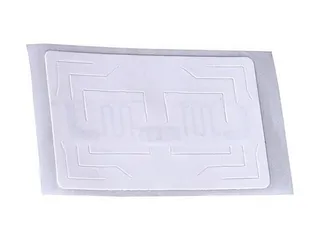
- Dual-technology labels: the most common RFID retail apparel deployment uses a combination label that carries a printed thermal-transfer barcode on the front and an embedded UHF inlay inside the paper substrate. The label is issued, printed and applied through the same workflow as a traditional barcode label, with the RFID encoding happening in the printer at the moment of print-apply.
- Data synchronization: the GTIN-14 encoded in the barcode and the EPC serialized identifier encoded in the RFID tag are linked in the ERP/WMS so that scanning either channel resolves to the same item record. The SGTIN-96 EPC format embeds the company prefix and item reference derived from the GTIN.
- Fallback readability: if a retail store's RFID infrastructure is not yet installed, the label still functions as a barcode. If a barcode is damaged by a dropped pallet, the RFID tag still reads. This redundancy is one of the underappreciated benefits of dual technology.
- Point of sale resilience. High-throughput POS lanes continue scanning barcodes; loss-prevention EAS gates and back-of-house cycle counts use the RFID side of the same label. Neither workflow needs to change behavior.
- Incremental cost: a combination UHF RFID + barcode label runs $0.04-$0.10 compared to $0.005-$0.015 for barcode only. For garments, accessories and footwear retailing at $15-$100, the delta is under 0.5% of retail.
- Source-tagged supply chain. The vendor, not the retailer, applies the combination label at the factory ('source tagging'). By the time cartons reach the DC, every item is already RFID-enabled with no retailer labor.
Infrastructure and total cost of ownership
- Barcode infrastructure: wired USB laser scanners ($100-$300), cordless Bluetooth 2D imagers ($300-$700), rugged warehouse handhelds ($1,500-$3,500), fixed conveyor scanners ($3,000-$8,000). Thermal transfer printers for label production add $800-$4,500 per unit.
- RFID infrastructure: handheld UHF readers ($1,500-$3,500), fixed 4-port readers with antennas ($3,500-$8,000 per portal), overhead retail arrays ($15,000-$60,000 per zone), print-encode applicators ($8,000-$25,000). Software integration, middleware and RFID-enabled WMS modules add $50,000-$500,000+ at enterprise scale.
- Tag cost curve: barcode label cost is essentially linear with volume and already at the cost floor. RFID tag cost has fallen from $0.40 (2010) to $0.03-$0.05 (2026) at high volume and continues compressing, which steadily expands the categories where RFID unit economics work.
- Software and data: RFID generates orders of magnitude more read events than barcode. WMS, ERP and analytics platforms need filtering (duplicate reads within N seconds are collapsed), business rules (a read at Dock Door 3 means 'received') and storage. Many organizations are surprised by the middleware cost, not the hardware.
- Training and change management. Barcode operation is muscle memory after 15 minutes. RFID workflow (sweep pattern, antenna orientation, reader signal strength, understanding why metal shelves read poorly) takes 2-4 hours of training and weeks of reinforcement. Budget accordingly.
- Maintenance: both technologies need label/tag replenishment. RFID readers have longer replacement cycles (5-8 years) than barcode scanners (3-5 years) but when they fail the per-unit replacement cost is higher.
Decision framework — a practical 60-minute evaluation
- Step 1 — unit value. If your item's fully loaded contribution margin is under $1, barcode remains the default. If it is over $5, RFID is worth serious analysis.
- Step 2 — scan cardinality. If your workflow scans items one at a time at human speed (checkout, document filing, shipping), barcode is sufficient. If you scan batches of 20+ items or need to count hundreds of items quickly (cycle count, receiving, picking verification), RFID earns its cost.
- Step 3 — environment. If labels must survive laundry, autoclave, outdoor weather, chemical exposure or abrasion for more than 12 months, encapsulated RFID hard tags outlast printed barcodes dramatically.
- Step 4 — serialization requirement. If regulators, brand protection, recall traceability or warranty tracking require every physical unit to be uniquely identifiable, only RFID (or a serialized 2D barcode with active image-based imaging) provides that at scale.
- Step 5 — automation ambition. If you want hands-free reads at dock doors, conveyor belts, security exits or smart shelves, RFID is the only realistic technology. Barcodes always require a camera pointed at a visible label.
- Step 6 — existing investment. If you have a healthy barcode operation hitting 90%+ accuracy and the business is not asking for unit-level data, do not migrate. Augment with RFID where it solves a specific pain point (high-shrink categories, high-cycle-count SKUs).
- Step 7 — pilot before scaling. A 90-day pilot in one zone or store catches 80% of the surprises (metal interference, read-rate tuning, data-volume explosion) at 5% of the full rollout cost.
Common RFID deployment patterns for former barcode-only operations
- Retail apparel: source-tagged combination labels at the factory, overhead ceiling arrays at the store for passive counts, handheld scanners for cycle counts, EAS-integrated exit gates. 9-15 month payback is the published norm.
- Warehouse and 3PL — dock-door portals for receive and ship verification, handheld scanners for put-away and picking confirmation, fixed conveyor readers for sortation, yard-management fixed readers at gates. Labor savings on receiving accuracy are typically the largest ROI line.
- Manufacturing WIP: encapsulated hard tags on returnable totes, fixtures and kanban carriers, read at station milestones to drive MES logic. Tags survive 3-7 years; cost amortizes across hundreds of cycles.
- Healthcare asset tracking: wristbands and equipment tags enable patient-location accuracy, sterile-asset par management and surgical-kit verification. Barcode remains primary for medication scanning (BCMA) where operator confirmation is required.
- Textile rental and laundry. PPS and silicone encapsulated laundry tags survive 200+ industrial wash cycles. The linen rental industry has essentially transitioned from barcode tracking to RFID for per-cycle counting accuracy.
- Event credentials and access. Wristbands and cards with NFC or UHF replace barcode tickets entirely for multi-day events where each attendee must be uniquely identifiable, tap to pay, and enter zones repeatedly.
Useful next pages
Use these linked product, guide and comparison pages to keep the next click specific and practical.
RFID product solutions
Explore RFID tags and labels for tracking applications.
Read deeper — chip selection and solutions
Understand the chip families and solution playbooks behind RFID rollouts.
Compare related tracking technologies
Decide between RFID and adjacent identification technologies.
FAQ
Can RFID and barcode be used together on the same item?
Yes, and this is the dominant pattern in retail apparel rollouts. Combination labels embed a UHF RFID inlay inside a thermal-transfer paper label so the same physical tag carries both a printed barcode and an RFID transponder. The barcode number is encoded into the RFID tag memory at print-encode time so either channel resolves to the same item record. If the RFID infrastructure is not installed yet or a reader fails, the barcode still scans. If the barcode is damaged by handling, the RFID still reads. This redundancy is a major reason the combination format has become the industry default for GS1 source-tagged apparel.
Is RFID more accurate than barcode for inventory?
Yes, and the improvement is dramatic. Published field studies (Auburn University RFID Lab, GS1 US) consistently measure inventory accuracy moving from 63-85% under manual barcode cycle counts to 95-99.5% after item-level RFID deployment. The improvement comes from three mechanisms. Elimination of missed scans (the RFID reader captures every tag in range without operator visual verification), reduction of human counting error on large quantities, and dramatically higher count frequency (daily or twice-weekly RFID sweeps replace quarterly or weekly barcode counts) so drift from the system of record is caught faster.
How much more does RFID cost compared to barcode?
Label cost: a printed barcode label runs $0.001-$0.015 depending on substrate and print method. A paper UHF RFID combination label runs $0.03-$0.08 at high retail volumes. Encapsulated hard tags for industrial assets are $0.25-$8.00+ depending on housing and chip. Reader infrastructure: barcode scanners are $100-$1,500 per unit, RFID handheld readers $1,500-$3,500, and fixed RFID portals $3,500-$8,000+. Software and middleware add another layer. However, labor savings from faster cycle counts plus accuracy gains driving reduced out-of-stocks and shrink typically deliver 9-18 month payback for retail apparel and 18-36 months for industrial distribution.
Do RFID tags work through cardboard and packaging?
Yes, and this is one of RFID's core advantages over barcode. Passive UHF RFID signals (860-960 MHz) pass through cardboard, paperboard, most plastics, fabric, glass, wood and human tissue with modest attenuation. A reader can count all items inside a sealed carton without opening it, verify the contents of a palletized shipment as the forklift passes through a dock-door portal, or sweep a back-of-house stockroom with a handheld reader without touching any items. Metal and water are the two challenging materials. They absorb and reflect UHF signals, requiring on-metal tags, specialized inlay designs or alternative frequencies for reliable reads.
What inventory accuracy improvement should we realistically expect?
For retail apparel starting from a typical 65-78% cycle-count accuracy baseline, the well-documented post-RFID target is 95-99% on a daily count cadence. For warehouse and 3PL receiving, the jump is from 92-96% (already strong with barcode) to 99-99.8%. Smaller in absolute terms but meaningful for exception-cost reduction. For manufacturing WIP with encapsulated hard tags on returnable carriers, near-100% real-time location is achievable. The gap between your baseline and the RFID ceiling is the operational value; measure both before and after for 60-90 days to quantify it accurately.
What about QR codes. Are they a middle ground between barcode and RFID?
Not really: QR codes are a variant of optical 2D barcode and share every optical limitation (line of sight, visual quality, one-at-a-time scanning). They hold more data than 1D barcodes and are readable by any smartphone camera, which makes them excellent for consumer-facing interactions (menus, product info, event check-in) but they do not give you RFID's bulk read, through-packaging scan or unique item identity. For consumer outreach on top of an RFID inventory system, pairing NFC + QR on the same label is a popular approach. See our dedicated RFID vs QR code comparison for the full analysis.
When should we pilot RFID instead of rolling out company-wide?
Always pilot first. A 90-day pilot in one store or one DC zone with 2,000-10,000 tagged items catches 80% of the surprises (metal shelving interference, antenna placement tuning, WMS data model gaps, staff workflow friction, tag damage rates) at 3-8% of the full rollout cost. Define 3-5 measurable success metrics up front (inventory accuracy delta, cycle count time reduction, OOS rate change, exception rate at receiving) and review them weekly during the pilot. Only commit to enterprise rollout after the pilot demonstrates the projected improvement is real in your specific operating conditions.
Sources & references
Primary standards, OEM datasheets and regulatory documents cited by this article. All URLs were verified on the access date shown below.
- GS1 General Specifications
Canonical specification for GS1 barcodes (GTIN, SSCC, GLN) and data structures; anchors the barcode side of this comparison.
- ISO/IEC 15420 — Information technology — Automatic identification and data capture techniques — EAN/UPC bar code symbology
International standard for the EAN/UPC 1D barcode used at point-of-sale and referenced in the optical-symbology section.
- ISO/IEC 15416 — Bar code print quality test specification — Linear symbols
Print-quality grading standard cited for 1D barcode decode-success rate discussions.
- ISO/IEC 16022 — Data Matrix bar code symbology specification
2D Data Matrix symbology standard cited for small-footprint optical encoding used in pharma and industrial marking.
- ISO/IEC 18004 — QR Code bar code symbology specification
QR Code standard cited in the consumer 2D-barcode comparison section.
- ISO/IEC 18000-63:2021 — Parameters for air interface communications at 860 MHz to 960 MHz Type C
Underlying UHF RFID air-interface standard referenced as the RFID side of this comparison.
- GS1 EPC Tag Data Standard (TDS) 2.1
Encoding reference for SGTIN-96 showing how RFID extends the GTIN-based barcode identifier to unique-item serialization.
Proud Tek is a Shenzhen-based RFID & NFC manufacturer supplying hotel chains, transit operators, event venues and retail brands worldwide. Every order includes free samples, RF testing and dedicated project support.
Get a Quick Quote
Tell us about your project and we'll respond within one business day. Fields marked (asterisk) are required.