The short answer
Choose NFC when a person should act deliberately with their own phone: open a review page, check that a product is genuine, save a contact or start pairing a device. Choose Bluetooth LE when a system must know where people or things are without anyone acting: indoor positioning, room-level asset location, sensor readings, or proximity prompts in an app your users already run.
To count or find many items hands-free without a battery on each, the usual passive option is UHF RFID: UHF RFID labels are read in bulk, without line of sight, by a fixed or handheld reader.
Many projects that start with "NFC or Bluetooth?" end up using both. Proud Tek manufactures NFC tags and UHF labels, not Bluetooth beacons.
How each technology works
NFC is a centimetre-range link in which the phone powers a battery-free tag; BLE is a radio, usually battery-powered, that broadcasts over metres to any listening app.
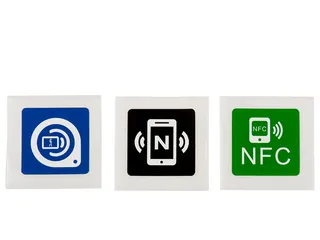
NFC (near field communication) is a form of high-frequency RFID at 13.56 MHz with a typical range of up to about 2 cm, according to the NFC Forum. The phone's field wakes the tag's chip, which returns a stored NDEF record (NFC Data Exchange Format): a web address, a contact card or text.
Bluetooth comes in two forms. Bluetooth Classic (BR/EDR) is the radio behind wireless speakers, headphones and in-car audio; Bluetooth LE is the low-power radio used by beacons and for positioning (Bluetooth SIG). This page compares NFC tags with BLE beacons. Both Bluetooth forms use the 2.4 GHz band (2400 to 2483.5 MHz); the Bluetooth SIG puts reliable range anywhere from under a metre to over a kilometre, depending on radio, transmit power, antenna and walls. A beacon is a small BLE transmitter that repeats a short advertisement carrying an identifier that an app on the phone interprets; in Apple's iBeacon format, a 128-bit UUID plus 16-bit major and minor values.
NFC and BLE side by side
NFC wins on intent, upkeep and app-free access; BLE wins on range, hands-free presence and continuous data.
| Criterion | NFC tag | BLE beacon |
|---|---|---|
| User action | A deliberate tap: the phone is held to the tag | None: an app on the phone picks up the beacon while in range |
| Working distance | A few centimetres | Room scale, set by transmit power, antenna and walls |
| Power | None on the tag; energy comes from the phone's field | Usually a battery; life depends on transmit power and advertising interval |
| App needed | No, for a web link; NFC must be switched on | Yes: an installed app with Bluetooth on and permission to scan |
| Data exchange | One short read of a stored record, such as a URL or a signed dynamic URL (NTAG213 holds 144 bytes) | A repeated broadcast identifier, or an app connection for ongoing data |
| Upkeep | None beyond physical damage | Batteries, configuration, firmware and fleet monitoring |
| Location information | Where the tag is, when tapped | Proximity from signal strength; finer positioning needs extra hardware |
| Copy resistance | Static URL copyable; NTAG 424 DNA verifiable | Standard broadcasts are public and can be imitated |
| Cost drivers | Chip, antenna, label or card body, printing, encoding | Radio module, battery, housing, installation, platform and app |
What happens on the customer's phone
An NFC web link works on current phones without any app; a beacon works only through your app.
iPhone: iPhone XS and later read NFC tags in the background and show a notification that opens the link; a locked phone asks to be unlocked first, and reading pauses while the camera or Apple Pay Wallet is in use and in airplane mode (Apple Core NFC).
Android: phones look for tags while unlocked, unless NFC is switched off. From Android 16 a web-link tag opens as an ordinary link; Android 17 first shows an "open link" notification (Android NFC basics).
Bluetooth beacons: iOS delivers beacon events only to an app the user has authorised for location monitoring (Apple). Apps targeting Android 12 or later must request the runtime BLUETOOTH_SCAN permission, plus location permission if they use scans to work out where the phone is (Android). Google's Nearby Notifications, which surfaced beacon content with no app install, ended on 6 December 2018. Without your app, a beacon cannot reach your audience.
Google review cards: NFC, not Bluetooth
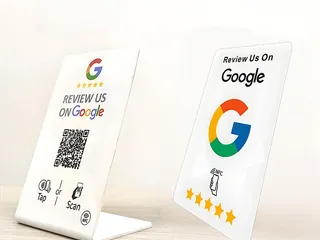
A review card or table stand should be an NFC tag with a printed QR code: the customer taps, the review page opens, and nothing on the counter needs charging. A Bluetooth version would need your own app on every customer's phone.
Google Maps' user-generated content policy prohibits offering incentives for reviews, selectively asking only happy customers, or pressuring customers to review while on the premises. The card should open the same public page for everyone, and staff should invite, not push. Three points matter in bulk:
- One link per location. Each Google Business Profile has its own review link, so each location needs its own encoded card.
- NTAG213, locked. NTAG213 is enough for a review link. Anyone with an NFC app can rewrite a writable card on a public counter, so lock it once the link is verified, or use NTAG213's 32-bit password protection if you must re-encode later.
- Your own redirect. A short link on your domain that forwards to Google lets you count taps and change the destination without touching the chip.
Security: NTAG 424 DNA versus beacon spoofing
Neither a plain NFC tag nor a standard beacon proves anything by itself, but NFC offers chips designed to prove they are genuine; a standard beacon broadcasts its identity in the clear.
A plain NFC tag such as NTAG213 stores a URL that any NFC phone can read and anyone can copy to another tag: fine for a review link, useless for authentication. NTAG 424 DNA adds AES-128 cryptography and what NXP calls SUN (Secure Unique NFC) message authentication: when configured, each read adds encrypted identifier and counter data and a cryptographic code to the URL, which your server checks, rejecting counters it has already seen. Your integrator sets the verification policy, including how to treat messages captured but never submitted.
Standard beacon frames such as Eddystone-UID are, in Google's words, public one-way signals, and an iBeacon repeats fixed UUID, major and minor values that any BLE-capable iOS device can advertise. Anyone who records a fixed identifier can imitate it, so it should never unlock anything valuable on its own. Eddystone-EID rotates an encrypted identifier that only a registered resolver can map back, though Google noted a real-time relay can still defeat it; Google's own resolver shut down on 1 April 2021, so EID now needs one that you or your beacon vendor run.
Where each one fits
Use NFC wherever a person acts with their own phone, and BLE where a system must sense presence or position without a tap.
- Google review cards and stands: NFC with a QR code; see Google review NFC cards.
- Product authentication: an NTAG 424 DNA label with server-side verification.
- Smart posters, packaging and instructions: an NTAG213 label with a link you control; for digital product passports, see our DPP guide.
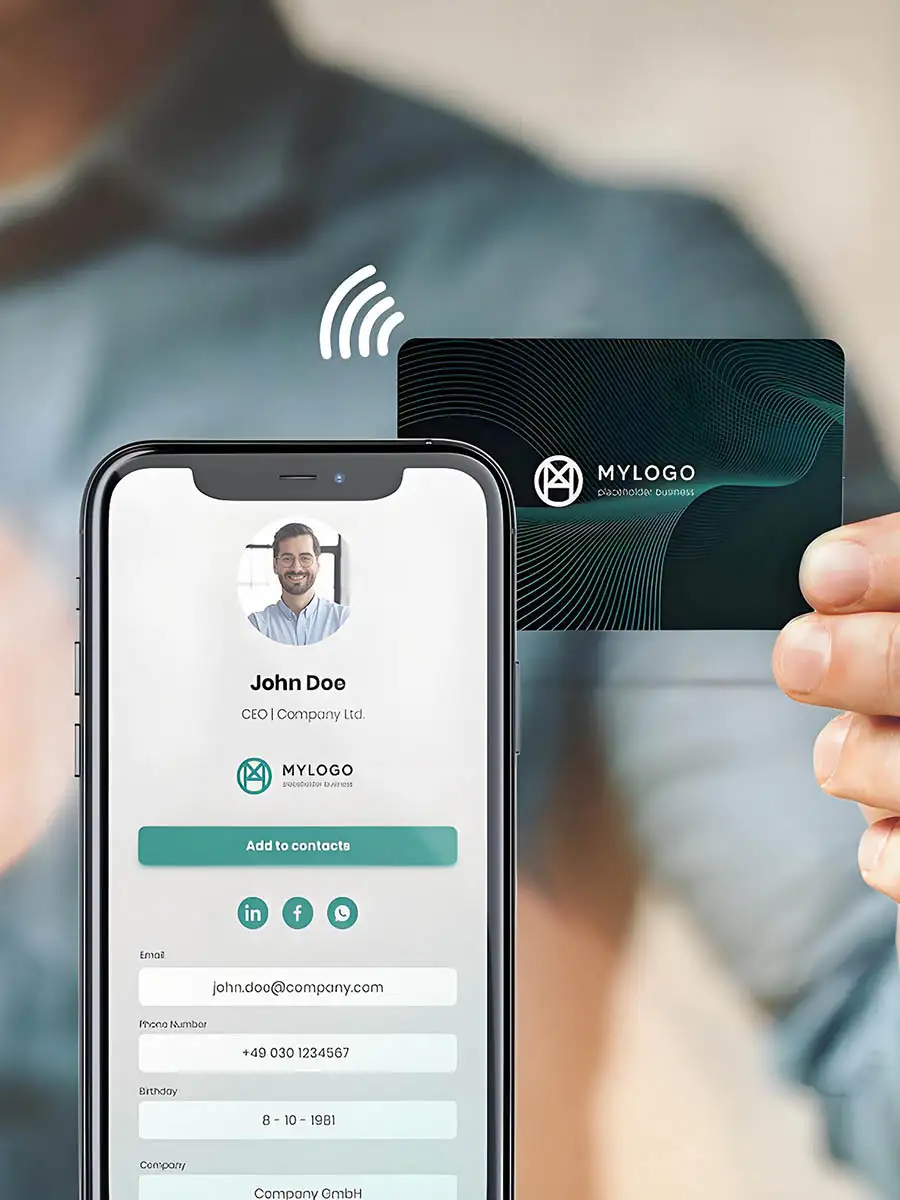
- Business cards: NFC; see NFC business card programmes.
- Door access: whether a phone opens a door over NFC or Bluetooth depends on the reader and credential platform, so ask the reader maker. New installations usually also issue a 13.56 MHz card or fob such as MIFARE DESFire, which we manufacture; see key fobs for access control. We do not supply readers or mobile-credential platforms.
- Indoor positioning and wayfinding: BLE. iBeacon ranging reports only far, near or immediate, not a precise distance; finer positioning uses Direction Finding or Channel Sounding (Bluetooth Core 6.0) on compatible hardware.
- Locating mobile equipment: BLE tags on the few high-value items that must be found in real time; passive UHF RFID labels swept with a handheld reader for periodic audits of the rest, the split our healthcare page describes (see also RFID inventory tracking). We make the UHF labels; readers and software come from your integrator.
- Sensor data over time: BLE. An NFC tag answers only when tapped.
When to combine NFC and Bluetooth
Use NFC to start something and Bluetooth to carry it on: the tap supplies intent, Bluetooth supplies range and a continuous connection.
Tap to pair. The NFC Forum's Connection Handover specification defines how NFC sets up a Bluetooth or Wi-Fi connection, so a tap replaces a speaker's pairing menu. Send the handover record you need and we confirm whether we write it or supply blank tags for your line.
NFC beside beacons. An NFC label on each beacon opens its record for installers; NFC tags at beacon-served exhibits reach visitors without the app.
What Proud Tek supplies, and what it does not
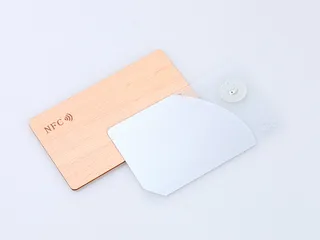
Proud Tek has manufactured RFID and NFC products in Shenzhen since 2008. We make NTAG213/215/216 labels, NTAG 424 DNA labels, NFC cards, Google review cards and NFC business cards, encoded through our encoding service, and supply desktop NFC reader/writers for encoding and testing.
We do not supply BLE beacons or asset tags, beacon platforms, mobile apps, indoor positioning systems, or the server that verifies NTAG 424 DNA messages; those come from a Bluetooth vendor or your integrator. For a quote, send us:
- What the tap should open: one URL, a per-piece URL list, or an NTAG 424 DNA SUN setup whose keys and verification server are yours or your integrator's.
- Format and surface: label size, card or stand, and what it is fixed to; flag metal.
- Quantity: total pieces and distinct links.
- Locking and artwork: locked or writable, and your print files.
Published 2026-09-26 · Updated 2026-09-28