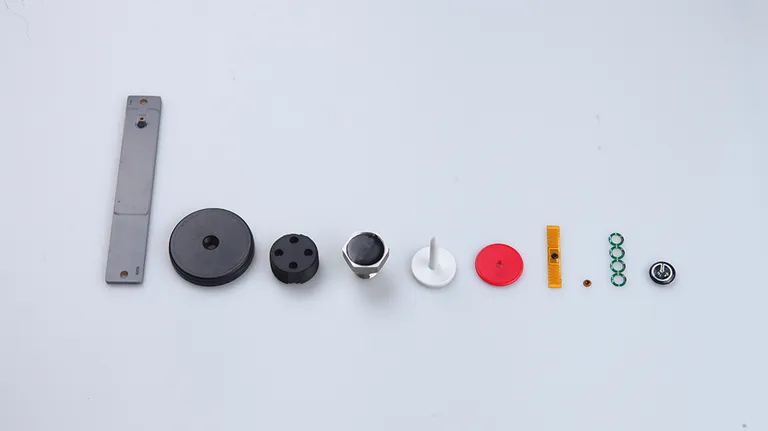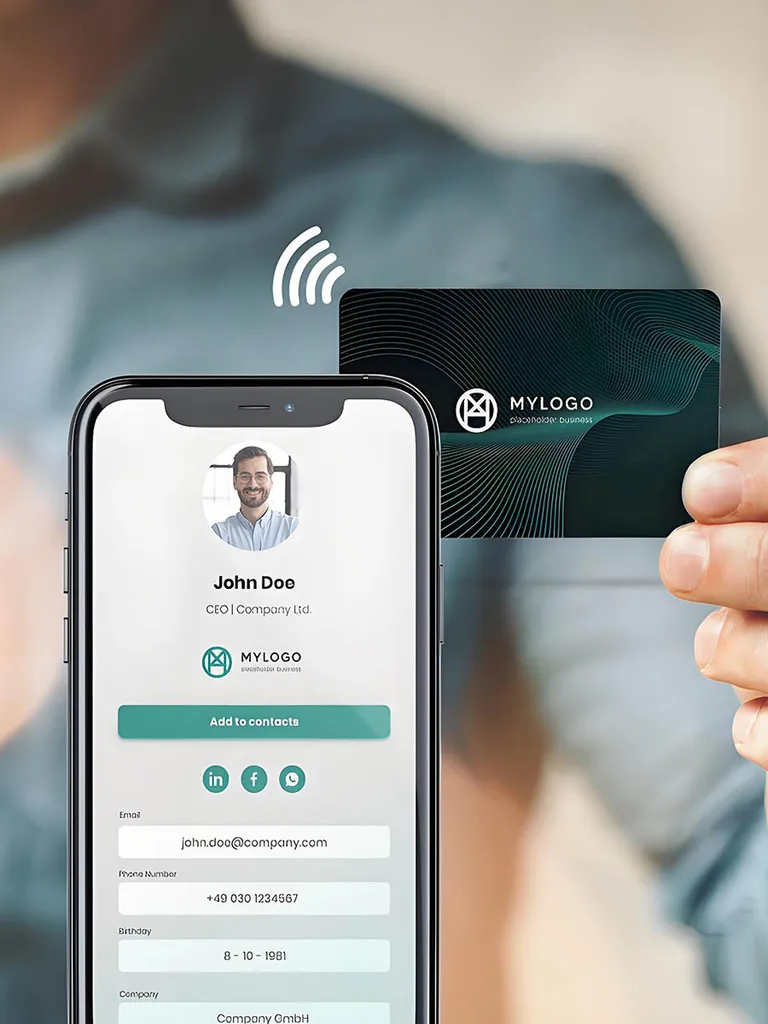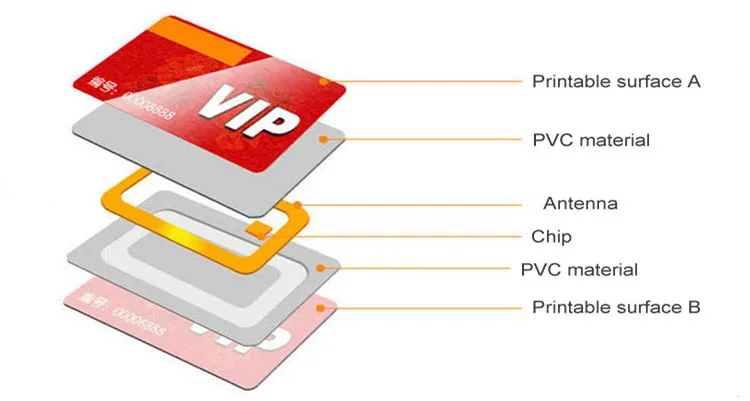
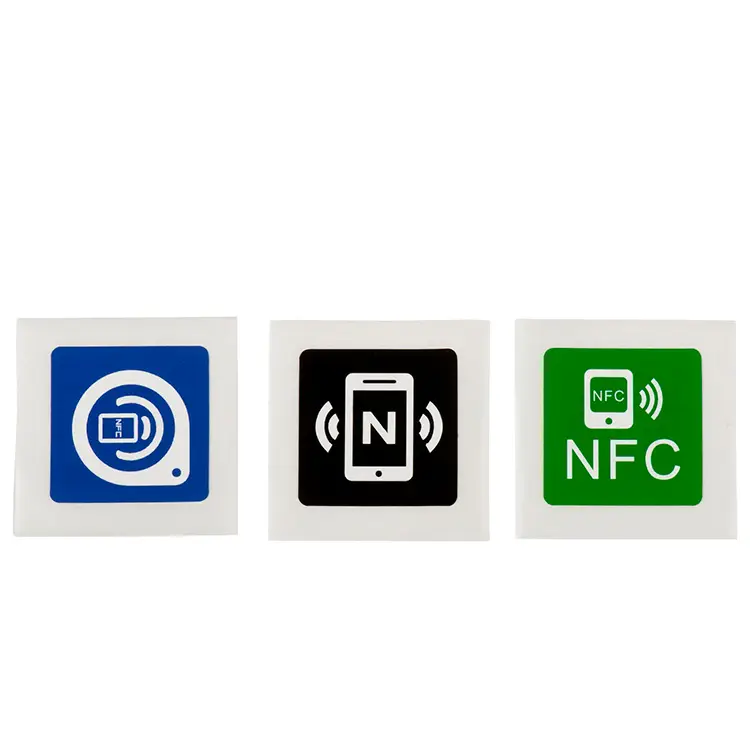
“NFC” and “RFID” are often used as if they were competing technologies, or as if they were the same thing. Neither is quite right, and the confusion is expensive: it is how a project ends up with a pallet of long-range labels no phone can read, or a drawer of phone stickers a warehouse portal never notices. The clean way to state the relationship is this: NFC is a subset of RFID. This guide explains what that means, the differences that actually affect a purchase, and how to tell which one a given job needs.
Table of Contents
NFC is a subset of RFID
RFID (radio-frequency identification) is the broad family: a reader powers and reads a tag over radio waves, across three frequency bands. NFC (near-field communication) is one specific corner of that family — the high-frequency band at 13.56 MHz — with an extra layer of rules on top, defined by the NFC Forum and the ISO/IEC 18092 standard (NFCIP-1). NFC’s reader/writer and card-emulation modes interoperate with the same ISO/IEC 14443 contactless technology that non-NFC HF cards use.
So every NFC tag is an RFID tag, but not every RFID tag is NFC. What NFC adds to plain HF RFID is a standardised data format and a set of interaction modes designed for smartphones and short, one-to-one exchanges. That extra layer is why your phone can read an NFC sticker but not a long-range logistics label.

The differences that matter
Five differences decide most projects. The first, range, quietly settles more decisions than the rest combined.
| Property | NFC | Wider RFID |
|---|---|---|
| Frequency | 13.56 MHz only | LF 125–134 kHz, HF 13.56 MHz (includes NFC), UHF 860–960 MHz |
| Typical read range | A few centimetres (tap distance) | LF a few centimetres; HF up to roughly 10 cm (ISO/IEC 15693 vicinity tags further with large fixed readers); UHF typically up to several metres |
| Coupling | Inductive (near-field) | Inductive at LF/HF; backscatter (far-field) at UHF |
| Smartphone support | Read by almost all modern phones | Only the HF/NFC band; UHF needs a dedicated reader |
| Data rules | NDEF records defined by the NFC Forum | GS1 EPC identifiers on UHF; raw memory on many HF/LF chips |
NFC’s short range is a feature, not a shortcoming. Keeping the interaction to tap distance means a card or phone is read only when the user deliberately presents it, which matters for access and payment.
NFC’s interaction modes
Plain RFID tags are passive and reactive: they answer a reader and cannot start a conversation. NFC devices are more flexible, and the NFC Forum defines three modes:
- Reader/writer mode — an NFC device reads or writes a passive NFC tag. This is what happens when a phone opens the link on an NFC poster or programmes an NFC sticker.
- Card-emulation mode — the device behaves like a contactless card, so a phone can act as a transit card or payment card to an existing reader.
- Peer-to-peer mode — two active NFC devices exchange data directly. This was central to early NFC and is defined in the standards, though modern phones increasingly favour reader/writer and card-emulation for the same tasks.
A passive NFC or RFID tag, by contrast, only ever responds; it has no power of its own until a reader energises it and cannot initiate anything.
When to choose NFC and when to choose UHF RFID
You rarely need to agonise over this. Two blunt questions settle most cases: will a person hold a phone up to the item, and do you need to read many items at once, hands-free?
- Choose NFC when a human interacts with a smartphone — marketing taps, tap-to-pay, authentication, NFC business cards — or when short range is a security requirement, as in access control. NFC handles one item at a time, deliberately.
- Choose UHF RFID when you need to read many items at once or from a distance: inventory counts, dock-door portals, vehicle identification and event throughput. Products like RFID laundry tags and UHF wristbands sit here.
- Choose both when you need consumer smartphone interaction and supply-chain tracking on the same item. Dual-technology labels carry an NFC chip and a UHF chip together.
For a fuller decision framework across all three bands, see RFID frequencies explained: LF vs HF vs UHF.
Common misconceptions
- “NFC is a brand-new technology.” It is not. NFC is a subset of HF RFID standardised in the early 2000s, older than the smartphones that popularised it. What is new is native phone support, not the radio protocol.
- “RFID can read you from across a room without consent.” Passive NFC tags and most HF cards need the reader within a few centimetres; ISO/IEC 15693 vicinity tags reach further with large fixed antennas, but not across a room. Only UHF reaches several metres, and even then reliable reads depend on antenna orientation and what surrounds the tag.
- “NFC is always more secure than other RFID.” Security depends on the chip and protocol, not the frequency band. A basic NFC chip that only returns an identifier offers little protection; an AES-based chip such as DESFire or NTAG 424 DNA is far stronger, whatever the label on the box.
- “NFC always needs an app.” Modern phones read an NFC web-link record natively and open it in the browser. An app is only required for writing tags or handling custom payloads.
- “NFC and other RFID tags are interchangeable.” They are not. A phone will not read a UHF logistics tag, and a UHF dock-door reader will not see an NFC sticker. Choose by the use case, not by whatever tag is on the shelf.
The standards behind each
Procurement specifications are written in standard numbers, not marketing words. Knowing which one your tag and reader implement is what prevents an interoperability surprise after the tags are printed:
- ISO/IEC 14443 — the proximity standard at 13.56 MHz (Types A and B), range intentionally under about 10 cm. It governs contactless payment cards, most transit cards and the secure NFC profile. NTAG, MIFARE and DESFire chips sit here.
- ISO/IEC 15693 — the vicinity standard, also 13.56 MHz, with a longer read range and slower data rate. Common for library and light asset-tracking chips; readable by iPhones and a subset of Android phones, with narrower support than 14443.
- ISO/IEC 18092 (NFCIP-1) — the NFC-specific layer, defining peer-to-peer behaviour and the polling that lets phones parse NFC Forum tag types.
- ISO/IEC 18000-63 — the UHF air interface (widely known as EPC Gen2), operating 860–960 MHz with anticollision for large tag populations. This is the standard behind retail and supply-chain RFID.
What this means when you buy
Get the band right first, because it is the one decision no later firmware change can undo. If a phone has to read it, you need NFC or another HF chip; if you need range or bulk reads, you need UHF; and if you need both, you need a dual-technology tag. Everything else — chip model, memory, security, body material — comes after that.
Once the band is settled, confirm the exact chip against the readers or phones that must accept it, and prove it on your own equipment before committing to volume. Browse NFC cards, NFC stickers and the full RFID tag range, tell us the application and reader through the inquiry form, and request a sample pack so you can test tap distance and phone compatibility yourself before you order.