
RFID Label Production
RFID Label Manufacturer
Custom UHF & HF Labels

Quick answer
Proud Tek is a direct RFID label factory in Shenzhen — converting since 2008 and shipping to buyers in 50+ countries — that runs a roll-to-roll line for UHF RAIN and HF/NFC labels and the wet and dry inlays inside them: face stock, adhesive, inlay, print and encoding, converted in one pass and read-verified before it ships. 'Manufacturer' here means the actual converting line, not a trading desk forwarding your PO — we pick the chip, tune the antenna to your surface, pre-encode the EPC or NDEF, and ship rolls formatted for your applicator with the compliance paperwork attached. Housed hard tags — on-metal, laundry and ceramic — are built on a separate molding line; this page is the label-and-inlay converting menu, the sample-to-PO path, and the certifications your procurement team can verify before the first order.
- UHF and HF chip options (Impinj M700/M800, NXP UCODE 8/9, Alien Higgs-9 for UHF; NTAG, ICODE SLIX, MIFARE for HF) matched to your reader infrastructure.
- Custom label converting: any size, shape, adhesive type and liner material, supplied on rolls compatible with Zebra, SATO, Avery Dennison and other applicator systems.
- Print and encode in one pass. Combine barcode, human-readable text and full-color graphics with RFID encoding on the same label.
At a glance
Use these short answers to decide whether this page matches the project before moving into the detail.
What Proud Tek converts
A Shenzhen RFID label line, direct since 2008, that runs UHF RAIN and HF/NFC labels and the wet and dry inlays inside them roll-to-roll — face stock, adhesive, print and...
What you can order
Finished, converted labels on applicator-ready rolls, or bare wet and dry inlays for converters who keep face stock, print and die-cutting in-house. UHF paper and synthe...
Next step
Ready to move forward? Start your inquiry to get specific answers for this project.
Request RFID label quote- How encoding works
-
We write GS1 EPC schemes (SGTIN-96, SSCC-96) or NDEF records inline during converting, verify 100% of labels on the line, and key the EPC manifest to roll position so your printers and WMS can reconcile printed data to encoded EPCs.
- Proof to pull first
-
ISO 9001, ISO 14001 and ISO 45001 certificates (number and registrar on request), AQL 1.0 inspection per ISO 2859-1, and per-shipment RoHS / REACH / FCC / CE declarations — all verifiable before you commit.
What an RFID label manufacturer actually ships
'Manufacturer' is the most over-claimed word in label sourcing — plenty of the vendors printing it on a business card are quietly forwarding your PO to the plant that actually owns the die-cutter. Proud Tek runs the converting line itself: we select the chip and antenna, laminate the wet inlay into your face stock, print and encode in one pass, and read-verify every label before it ships with its certifications attached. Start with a free sample pack, or jump to the parts most buyers order — UHF RFID paper labels. The numbers below are the ones a procurement team checks first.
- Full label and inlay range from one line — UHF RAIN paper and synthetic labels, HF/NFC labels, tamper-evident labels, plus wet and dry inlays for converters — so an entire label program consolidates with one supplier instead of five.
- Direct chip allocation — UHF on Impinj M700 and NXP UCODE 8/9, HF/NFC on NTAG 213 and ICODE SLIX — genuine silicon matched to your reader fleet, not whatever is loose on the shelf.
- Antenna and substrate engineered to the surface — where a catalogue part will not read on your carton, PET film or a curved bottle, our RF team tunes the antenna geometry and picks the face stock rather than shipping a mismatch.
- Print and encode in a single converting pass — flexographic or digital print (barcode, human-readable text, full-color graphics) while the EPC or NDEF is written and inline verified, defective labels auto-flagged.
- Compliance handled, not hand-waved — GS1 EPC (SGTIN-96 / SSCC-96) encoding, AQL 1.0 sampling per ISO 2859-1, and RoHS / REACH / FCC / CE documentation per shipment, with quality records held seven years under ISO 9001.
The label and inlay capability menu
The table is the fast way to see whether we cover your part. Everything on it runs to a published air-interface standard — ISO/IEC 18000-63 (EPC Gen2v2) for UHF at 860-960 MHz, ISO/IEC 14443 and ISO/IEC 15693 for HF/NFC at 13.56 MHz — so a label encoded today keeps reading across a reader or phone fleet's lifetime. Chip names are representative of what we stock and allocate directly; browse live parts on the RFID labels catalogue and UHF retail price labels.
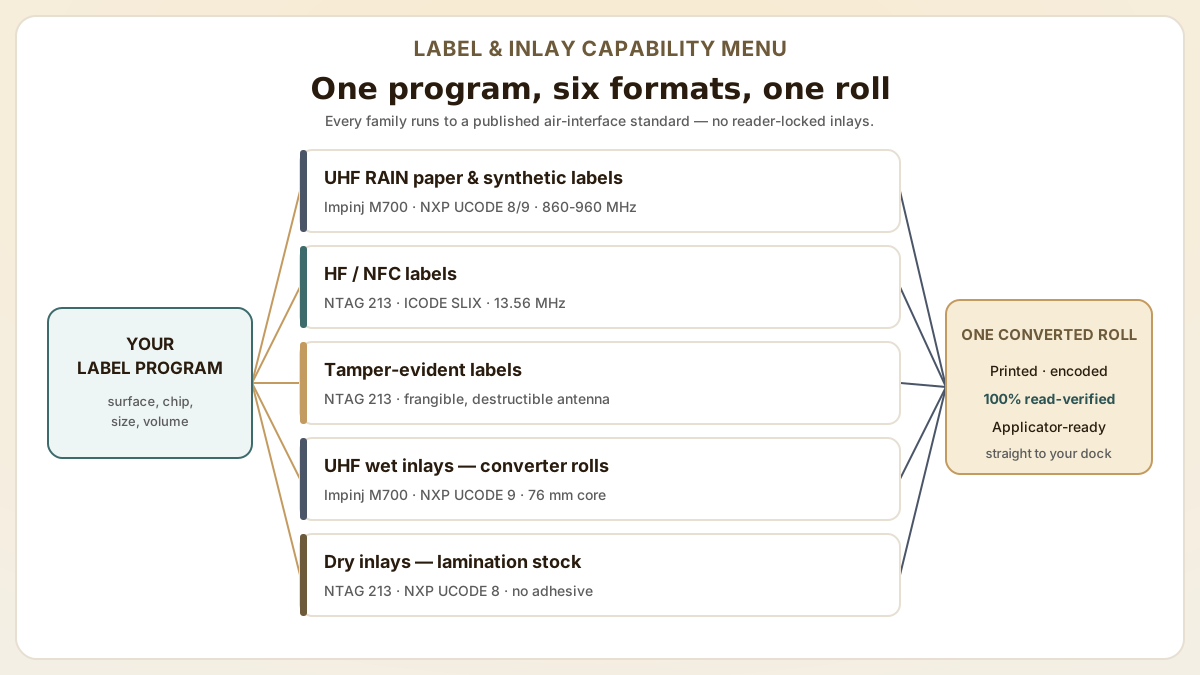
| Label / inlay family | Representative chip | Form | Typical size | Typical MOQ |
|---|---|---|---|---|
| UHF RAIN paper label | Impinj M700, NXP UCODE 8 | Converted — face + acrylic PSA + liner | 50x25 to 100x150 mm | From 5,000 labels (1,000 digital-print) |
| UHF synthetic (PET / PP) label | NXP UCODE 9, Impinj M700 | Converted — weatherproof face stock | 50x25 to 100x100 mm | From 5,000 labels |
| HF / NFC label | NTAG 213, ICODE SLIX | Converted — 13.56 MHz | 15x15 to 50x50 mm | From 500 labels (100 blank) |
| Tamper-evident label | NTAG 213, NXP UCODE 8 | Converted — frangible / destructible antenna | 15x15 to 100x50 mm | From 5,000 (100 destructive-antenna) |
| UHF wet inlay (converter rolls) | Impinj M700, NXP UCODE 9 | Wet — PSA + glassine liner, 76 mm core | 44x44 or 96x22 mm die | 5,000-10,000 inlays / combo |
| Dry inlay (lamination stock) | NTAG 213, NXP UCODE 8 | Dry — bare film, no adhesive | 44x44 to 50x50 mm | From 5,000 UHF / 1,000 specialty |
Wet inlays, dry inlays, and the materials underneath
Label converters buy components; end users buy finished labels — and sourcing at the right stage is the difference between keeping the converting margin and paying someone else's. The same chip and antenna ships two ways: a wet inlay carries pressure-sensitive adhesive and a release liner, ready to laminate into your stock, while a dry inlay is bare film for card lamination and over-molding. Get the stage right and the die-cutter that earns your margin stays in your building.
- Wet inlays — chip-on-PET with permanent acrylic adhesive and a glassine or PET release liner, supplied on 76 mm (3-inch) cores at 2,000-10,000 inlays per roll.
- Roll geometry matched to your cassette — web widths of 45 / 50 / 58 / 76 / 100 mm and pitches from 14 to 35 mm, held to +/-0.5 mm pitch and +/-0.3 mm chip-placement tolerance.
- Dry inlays — the same chip and antenna with no adhesive and no liner, engineered for heat-press card lamination and injection over-molding rather than label converting.
- Converter-line compatibility — rolls configured for Mark Andy, Nilpeter, MPS, Edale, Bobst and OMET lines running at 50-150 m/min; glassine liner standard, PET liner specified above 50 m/min where glassine risks tearing.
- Adhesive graded to the end use — general-purpose permanent acrylic at 18 N/25 mm FINAT peel for paper, cryo-grade all-temperature acrylic to -40 °C for cold chain (standard acrylic loses bond below -5 °C), and low-surface-energy adhesives for polyethylene and polypropylene.
- Face stock to the environment — thermal-transfer paper indoors, PET and PP for moisture and chemicals, polyimide to +200 °C, and cryogenic stock to -196 °C for specimen labels.
- 100% RF test at the inlay stage — every inlay is read-tested inline and rejects excluded; orders of 50,000+ ship with a sensitivity histogram, yield report and EPC manifest in CSV or XML.
Inline print, encode and label QC
RFID label programs fail audits on data, not on glue — wrong EPC schemes, duplicate serials, a chip that will not answer. So encoding and verification run inline at converting speed, and the documentation pack is built during the run instead of reconstructed the night before your audit. What lands on your dock is traceable to roll position.
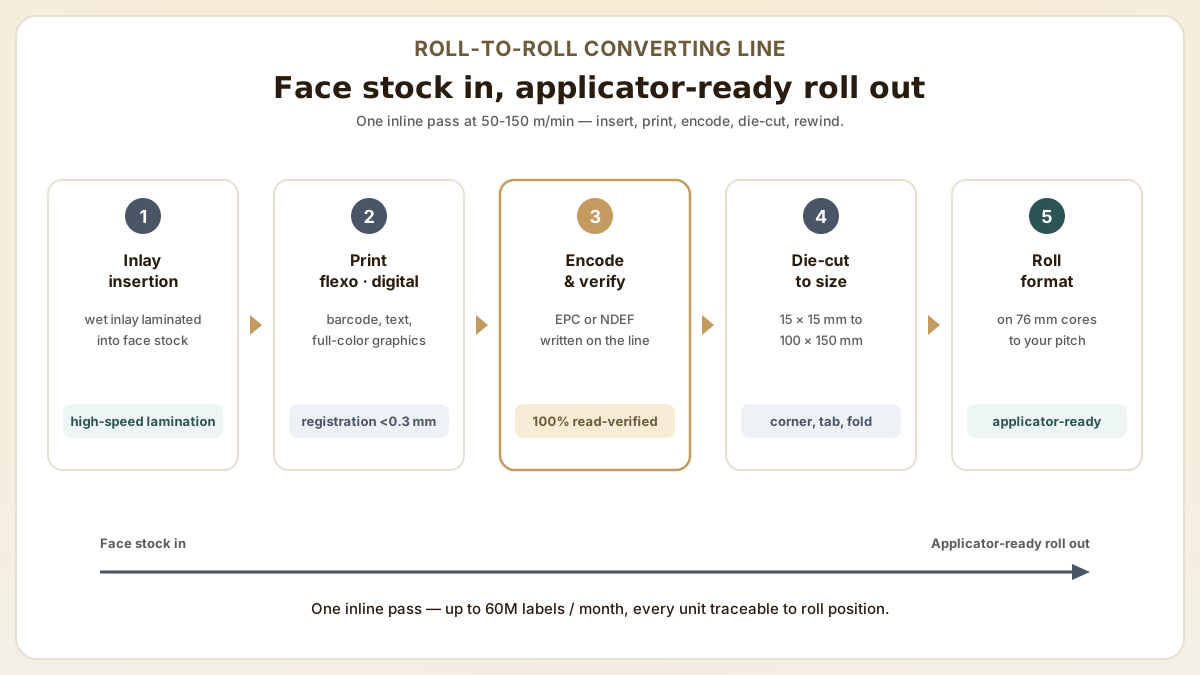
- Print and encode in one pass — barcodes, human-readable text and graphics print while the EPC is written and verified, registration held under 0.3 mm, failed labels automatically marked for rejection.
- GS1 encoding service — SGTIN-96 and SSCC-96 schemes or custom formats, written from sequential, random or customer-supplied lists, with lock bits and access passwords set per program and the EPC manifest keyed to roll position.
- Custom die-cutting — any label size from 15 × 15 mm NFC mini-tags to 100 × 150 mm shipping labels, with corner-radius, tab and fold options, formatted on 76 mm cores to your applicator pitch and winding direction.
- Printer-side compatibility — blank, encode-ready rolls on standard 76 mm cores for Zebra, SATO and Printronix RFID thermal-transfer printers if you encode in-house.
- AQL inspection and RF validation — print quality, adhesive peel and dimensional accuracy sampled per ISO 2859-1 at AQL 1.0, RF performance validated on Voyantic Tagformance equipment, with a functional test report plus RoHS / REACH and FCC / CE radio-conformity docs shipped per lot.
Proof your procurement team can verify
Trust on a first label order is not a feeling; it is a stack of documents your supplier-qualification team can check without us in the room. Everything below is verifiable before you commit — the certifications page lists each standard and how to confirm it with the registrar, and the factory page documents the line behind the rolls.
- ISO 9001, ISO 14001 and ISO 45001 certificates — certificate number and issuing registrar provided on request for independent verification.
- 100% inline RF verification on every inlay and every encoded label, with the EPC manifest (CSV or XML, keyed to roll position) delivered alongside the shipment.
- AQL 1.0 sampling per ISO 2859-1 for print, adhesive peel and dimensions, plus RF performance validated on Voyantic Tagformance equipment.
- Open factory audits across two Shenzhen sites by appointment, with virtual walk-throughs and third-party (SGS, TUV, Intertek) inspection when a program requires it.
- Per-shipment documentation pack — functional test report, RoHS / REACH material declarations and FCC / CE radio-conformity certificates by SKU.
- Quality records — production travelers, encoding logs and QC data — retained seven years under ISO 9001, traceable by SKU or encoding lot.
Useful next pages
Use these linked product, guide and comparison pages to keep the next click specific and practical.
Verify us before you commit
The documents and access a supplier-qualification team pulls first.
Start with the strongest label and inlay parts
The most-ordered labels and inlays by form factor.
FAQ
What UHF RFID chips do you use in your labels?
We support all major UHF RAIN RFID chips including Impinj M700, Impinj M800, NXP UCODE 8, NXP UCODE 9, Alien Higgs-9, and cost-optimized alternatives. Chip selection depends on your required read range, memory size, and reader infrastructure. Our engineers recommend the optimal chip for your specific application.
What is the difference between a wet inlay and a dry inlay?
A wet inlay includes a pressure-sensitive adhesive backing and a release liner, ready to laminate into label stock on a converting line. A dry inlay is the same chip and antenna on bare film with no adhesive and no liner, designed for heat-press lamination into cards or over-molding into housings. Label converters buy wet inlays; card manufacturers and hard-tag assemblers buy dry inlays.
Can you pre-encode RFID labels with GS1 EPC data before shipment?
Yes. We write SGTIN-96, SSCC-96 or custom EPC schemes during converting, from sequential, random or customer-supplied serial lists. Lock bits and access passwords are configured per your program specification, and each order ships with an EPC manifest in CSV or XML keyed to roll position so your printers and systems can correlate printed data to encoded EPCs.
Can you make labels that read reliably on metal or near liquid?
Yes, within the honest limits of a flexible label. For metal we supply on-metal UHF labels with a foam or ferrite spacer that lifts the antenna off the surface, and for containers of water, shampoo or other high-permittivity liquids we tune the antenna and, where the read budget demands it, move you to an on-metal construction. If the environment is genuinely brutal — autoclave cycles, deep cryogenics, decade-long outdoor exposure — a housed hard tag on our [RFID tag factory](/lp/rfid-tag-factory/) line is the right tool, and we will say so rather than sell you a label that fails at month six.
Can you design a custom antenna for our size or read-range target?
Yes — custom antenna design is in-house, not outsourced. Give us the label footprint, the surface it lives on and the read range you need, and our RF team designs and simulates the antenna, prototypes it as a wet or dry inlay, and returns samples with read-range data measured on Voyantic Tagformance equipment. Standard antennas cover most sizes from a 15 × 15 mm NFC die up; a custom antenna is the move when the footprint, the mounting surface or the range target falls outside the catalogue.
Can you supply RFID labels compatible with our existing label applicators?
Yes. Provide your applicator model and we will configure roll diameter, core size, label pitch, inter-label gap, and winding direction to match. We routinely supply labels formatted for Zebra, SATO, Avery Dennison, Datamax and other applicator brands.
Sources & references
Primary standards, OEM datasheets and regulatory documents cited by this article. All URLs were verified on the access date shown below.
- ISO/IEC 18000-63:2015 — RFID for item management, Part 63 (860-960 MHz Type C UHF air interface)
The UHF RAIN air-interface (EPC Gen2v2) our 860-960 MHz paper, synthetic and inlay labels are built to.
- GS1 EPC Tag Data Standard
Encoding reference for the SGTIN-96 and SSCC-96 EPC schemes we write inline during label converting.
- ISO/IEC 14443-4:2018 — Contactless proximity objects (Part 4: Transmission protocol)
The 13.56 MHz proximity air-interface behind NTAG-based HF/NFC labels.
- ISO/IEC 15693-2:2019 — Contactless vicinity objects (Part 2: Air interface and initialization)
The 13.56 MHz vicinity air-interface behind ICODE SLIX HF labels for library and industrial use.
- ISO 9001:2015 — Quality management systems
The quality-management standard our converting line, 100% inline verification and seven-year record retention are certified against.
Proud Tek is a Shenzhen-based RFID & NFC manufacturer supplying hotel chains, transit operators, event venues and retail brands worldwide. Every order includes free samples, RF testing and dedicated project support.
Get a Quick Quote
Tell us about your project and we'll respond within one business day. Fields marked (asterisk) are required.