
Healthcare Compliance
RFID Blood Bank Tracking
21 CFR Part 11
Quick answer
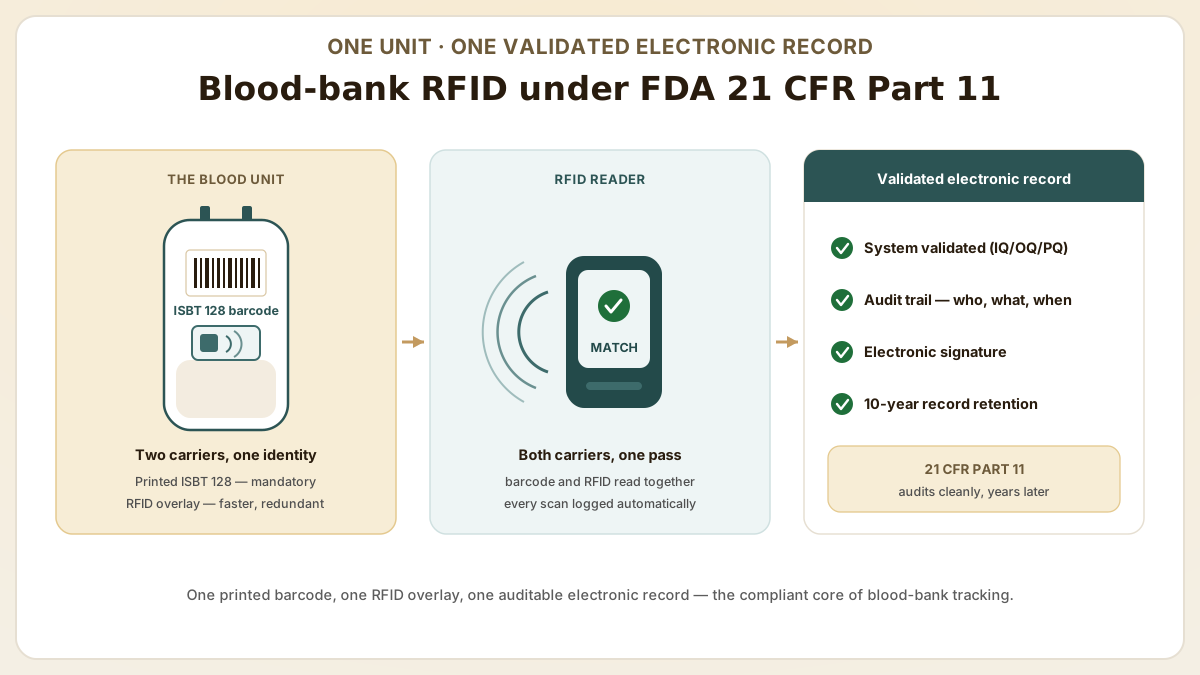
Blood bank RFID layers validated electronic records over the mandatory ISBT 128 barcode to satisfy FDA 21 CFR Part 11 — audit trails, electronic signatures and 10-year record retention. RFID-augmented bedside checks cut patient-blood mismatch errors 50-80%.
- Wrong-blood-in-tube and wrong-patient transfusion errors carry mortality risk; ISBT 128 + RFID tracking eliminates ID-mismatch errors that paper labels and manual transcription cannot.
- FDA 21 CFR Part 11 requires validated electronic records, audit trails and electronic signatures for blood bank operations — RFID systems can satisfy these when properly designed.
- Implementation typically combines printed ISBT 128 barcode (regulatory-mandated) with RFID overlay (operational efficiency) for unified blood-product traceability.
At a glance
Use these short answers to decide whether this page matches the project before moving into the detail.
Key takeaway
Wrong-blood-in-tube and wrong-patient transfusion errors carry mortality risk; ISBT 128 + RFID tracking eliminates ID-mismatch errors that paper labels and manual transcription cannot.
Why do blood banks need RFID?
Blood banks need RFID because one question has to be answered correctly at every handoff — is this the right unit for this person — and paper labels plus manual transcri...
Next step
Ready to move forward? Start your inquiry to get specific answers for this project.
Get a blood-bank RFID quoteWhy do blood banks need RFID?
Blood banks need RFID because one question has to be answered correctly at every handoff — is this the right unit for this person — and paper labels plus manual transcription are exactly where that answer fails. A single unit passes through many hands between a donor's arm and a patient's vein: collection, testing, labeling, storage, crossmatch, release, and the bedside check. The cost of a wrong answer is measured in lives, not dollars, so a blood bank layers identity check on identity check and keeps an exact record of each step. Blood bank operations are among the highest-risk healthcare workflows. Wrong-blood-in-tube (WBIT) and wrong-patient transfusion errors carry serious morbidity and mortality risk. RFID complements ISBT 128 barcode for redundant, faster identification.
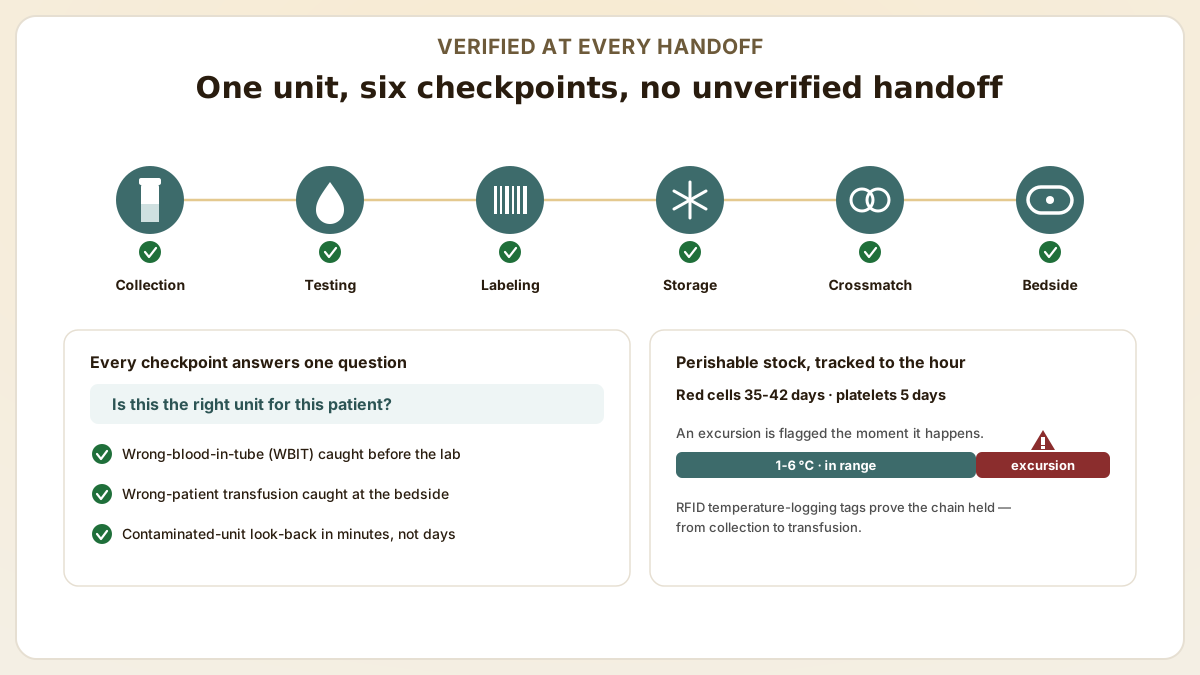
- WBIT prevention: blood specimen collected from wrong patient. RFID-verified patient wristband + RFID-tagged tube ensures match before sample reaches lab.
- Transfusion verification: pre-transfusion 'two-RN check' enhanced by RFID scan of patient wristband + blood bag. Eliminates visual ID mismatch.
- Inventory and expiry: blood products have strict shelf life (35-42 days for red cells, 5 days for platelets). RFID tracks every unit's expiry and triggers FIFO use.
- Recall and look-back: contaminated donor unit triggers recall of all derived products. RFID accelerates the trace from days (manual) to minutes.
- Cold chain: blood components require strict temperature control. RFID temperature-logging tags prove cold-chain integrity from collection to transfusion.
What does FDA 21 CFR Part 11 require?
FDA 21 CFR Part 11 requires that any electronic record standing in for paper — including RFID scan data — be validated, audit-trailed, electronically signed, access-controlled and retained. The rule governs electronic records and electronic signatures for FDA-regulated industries including blood banks, and an RFID system must satisfy each requirement to qualify as a valid electronic record.
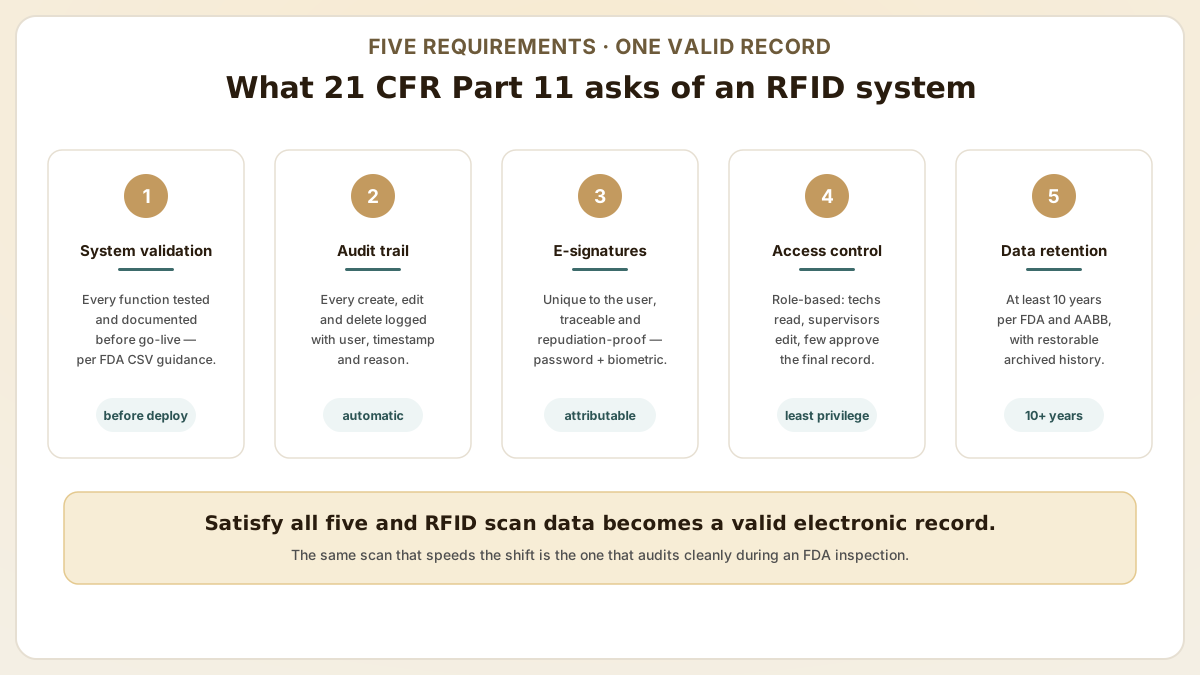
- System validation: the RFID system must be validated per FDA's Computer Software Validation guidance. Each function tested and documented before deployment.
- Audit trail: every record creation, modification and deletion logged with user, timestamp and reason. RFID scan events captured automatically; manual edits require justification.
- Electronic signatures: where the system replaces wet signatures, electronic signatures must be unique to the user, traceable, and protected against repudiation. Combination of password + biometric is typical.
- Access control: role-based access to RFID system. Lab technicians read; supervisors edit; only authorized users approve final records.
- Data retention: blood bank records retained for at least 10 years per FDA + AABB standards. RFID system must support long-term archival with restorable history.
How do you implement RFID + ISBT 128 in a blood bank?
Implementation keeps the regulator-mandated ISBT 128 barcode as the primary identifier and adds RFID only at the high-touch points, then validates the whole system per 21 CFR Part 11. Blood bank RFID is one of the most demanding healthcare RFID environments; the five-step playbook below comes from successful AABB-accredited blood bank deployments.
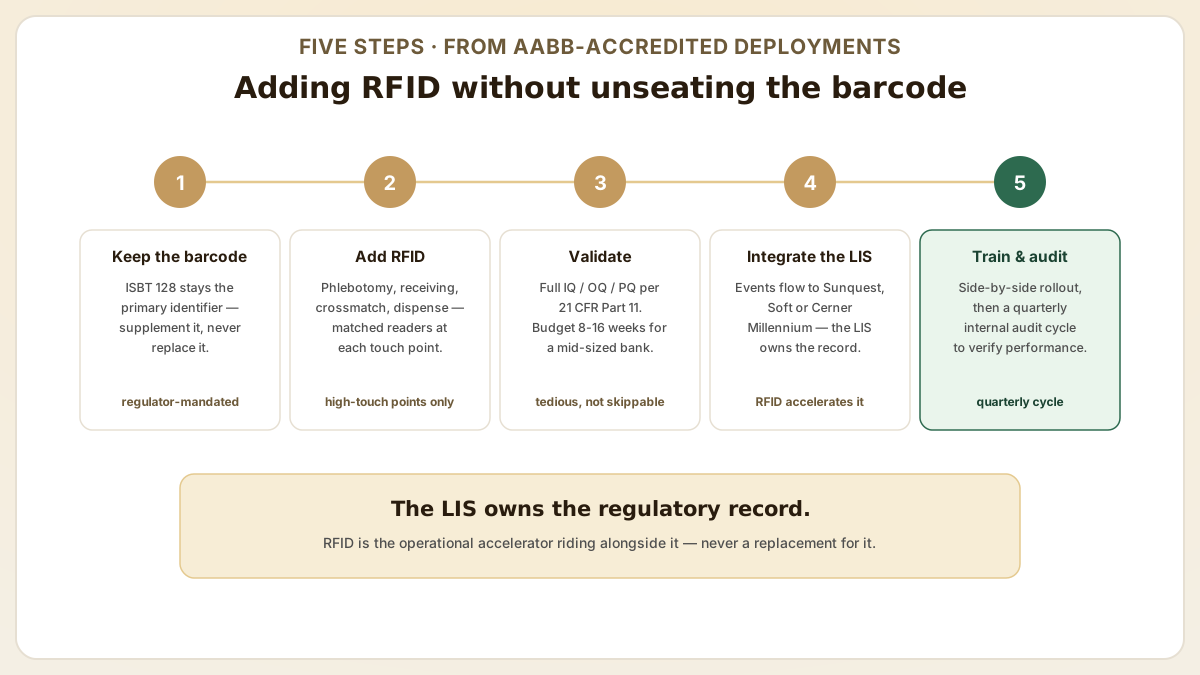
- Maintain ISBT 128 barcode primary: regulatory-mandated printed barcode on every blood bag, label and crossmatch tag. Cannot be replaced — only supplemented.
- Add RFID at high-touch points: phlebotomy collection (tube + patient wristband), lab receiving, crossmatch, dispense to patient. Each touch point has matched RFID readers.
- Validate per 21 CFR Part 11: full system validation including IQ/OQ/PQ. Validation typically 8-16 weeks for a mid-sized blood bank.
- Integrate with LIS (Laboratory Information System): RFID-read events flow to LIS (Sunquest, Soft, Cerner Millennium) for transfusion records. LIS owns the regulatory record; RFID is operational accelerator.
- Train and audit: phlebotomy and lab staff trained on new workflow with side-by-side phase. Internal audit cycle (quarterly) verifies system performance.
Where do FDA, AABB and ICCBBA actually intersect?
Blood bank RFID has to satisfy several regulations at once, and one validated dataset is what lets it satisfy them together. Blood bank operations sit inside an unusually dense regulatory stack. FDA's 21 CFR Part 606 (Current Good Manufacturing Practice for Blood and Blood Components), 21 CFR Part 610 (General Biological Products Standards), 21 CFR Part 630 / 640 (Source plasma and final-product standards), 21 CFR Part 11 (electronic records / signatures), AABB's Standards for Blood Banks and Transfusion Services (currently 33rd edition), and ICCBBA's ISBT 128 standard for blood, tissue and cellular products together define what an RFID program must produce. Reviewing public summaries from Title21 Health Solutions, Ideagen and SCC Soft Computer surfaces five intersection points buyers consistently care about.
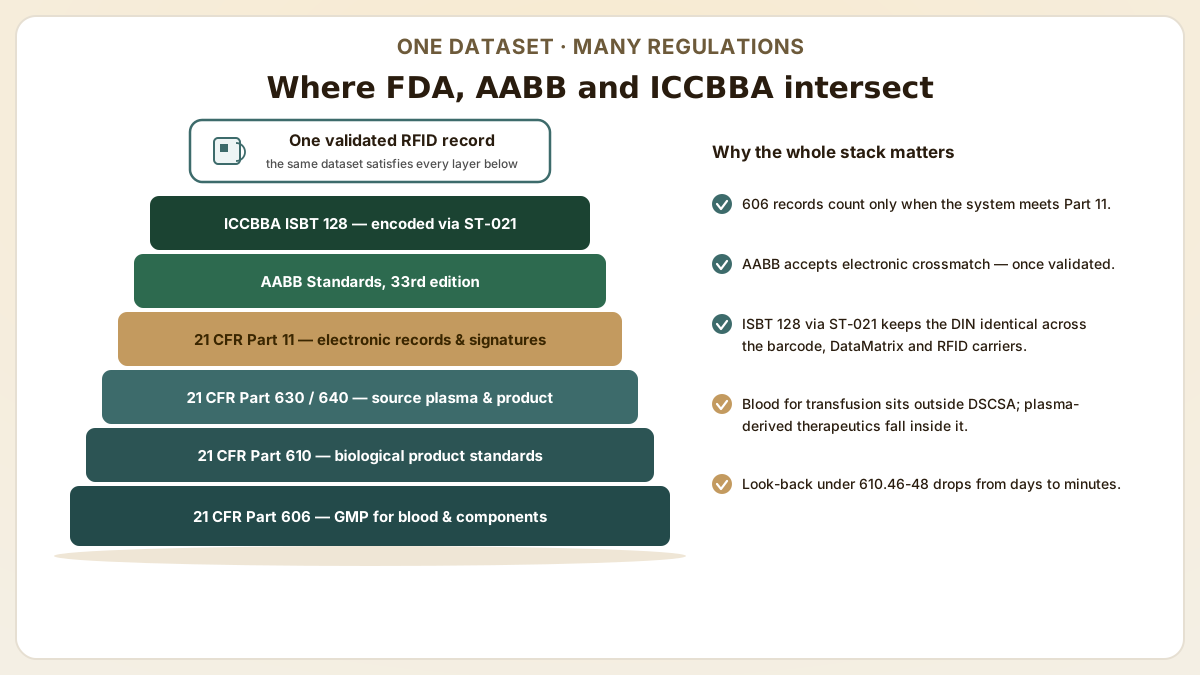
- 21 CFR 606 versus 21 CFR Part 11: 606 governs the manufacturing standards (donor screening, testing, labelling, recordkeeping), while Part 11 governs electronic records and signatures used to satisfy 606. RFID logs are valid 606 records only when the underlying system meets Part 11 — validation, audit trail, electronic signature, retention.
- AABB Standards 33rd edition (and the corresponding Accreditation Program): AABB explicitly addresses electronic crossmatch, electronic issue, and electronic remote dispensing — all of which are typical RFID enablers. The Standards do not mandate RFID, but they accept RFID-driven verification when the system has been validated and the procedures documented.
- ICCBBA ISBT 128: the global standard for blood, tissue and cellular product identifiers. ISBT 128 is encoded in 1D Code 128 and 2D DataMatrix carriers; ICCBBA also publishes guidance for encoding ISBT 128 in RFID under ISBT 128 ST-021. Programs adding RFID should encode the same Donation Identification Number (DIN) and product code in the RFID payload as on the printed label.
- DSCSA scope: blood and blood components for transfusion are explicitly outside the DSCSA's product scope (DSCSA covers prescription drugs). Plasma-derived therapeutics, however, fall inside DSCSA. Multi-product blood centers and plasma fractionators must run two parallel traceability programs.
- Look-back and recall: 21 CFR 610.46-48 require look-back when a donor is later identified as having transmissible disease (HIV, HCV, HBV). RFID dramatically shortens look-back time: the FDA expects look-back completion within tight windows; RFID-augmented LIS routinely produces the recipient list within minutes versus the days of manual chart review.
Vendor and platform landscape — what blood centers actually deploy
Evaluating blood-bank RFID software comes down to five buyer questions, and the first is always whether the vendor's 21 CFR Part 11 conformance statement covers electronic signatures. Blood-bank RFID is a tightly held vendor space. Title21 Health Solutions, SCC Soft Computer, Haemonetics BloodTrack, Mediware (now WellSky), Cerner Millennium PathNet Blood Bank Transfusion, Sunquest Blood Bank, and Ideagen quality-management overlays are the names that appear in most blood-center RFP shortlists. Public material from Title21, Haemonetics and Ideagen plus the SCC Soft Computer 2024 'What Machine is Used in Blood Banking' overview converge on five buyer questions worth pre-empting.
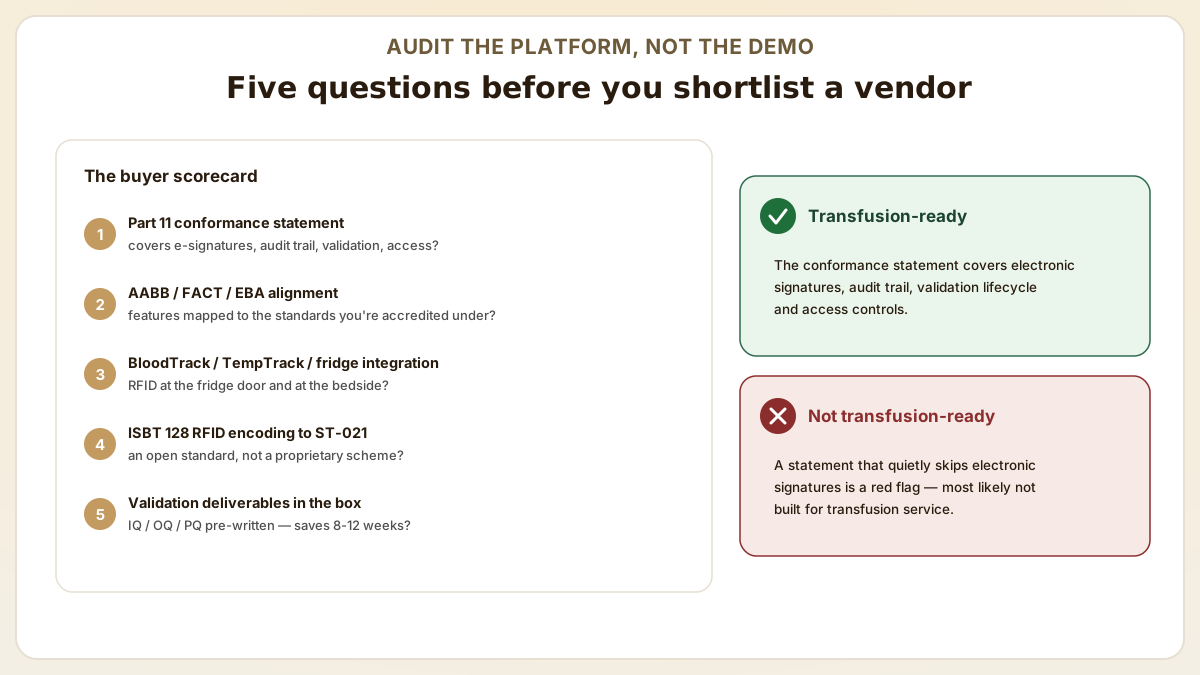
- 21 CFR Part 11 conformance statement: every credible blood-bank software vendor publishes a Part 11 conformance statement. Confirm that the statement covers electronic signatures, audit trail, system validation lifecycle, and access controls; conformance statements that exclude electronic signatures often signal a system that is not transfusion-ready.
- AABB / FACT / EBA accreditation alignment: accredited programs need vendors that explicitly map features to AABB Standards (and CAP Transfusion Medicine Checklist for laboratories holding CAP accreditation). FACT-NetCord covers cellular therapy. Title21 publishes alignment matrices for AABB, FACT/Netcord, EBA and 21 CFR Part 11.
- BloodTrack / TempTrack / RFID-fridge integration: Haemonetics BloodTrack is the dominant smart-fridge / blood-storage management platform; many blood centers run it as the operational layer above the LIS. RFID-tagged blood bags integrate at the fridge door (TempTrack) and the patient bedside (BloodTrack Tx).
- ISBT 128 RFID encoding (ST-021): ICCBBA's ST-021 specification defines the data structure for ISBT 128 in RFID. Ask vendors to demonstrate encoding to ST-021 rather than a proprietary scheme, especially when the blood center exchanges product with other centers (which is the norm in regional blood-supply networks).
- Validation deliverables in the box: established vendors ship IQ (Installation Qualification), OQ (Operational Qualification) and PQ (Performance Qualification) protocols pre-written; the blood-center QA team executes against the protocols rather than authoring them. This typically saves 8-12 weeks versus a fully bespoke validation effort.
Useful next pages
Use these linked product, guide and comparison pages to keep the next click specific and practical.
Blood bank RFID supply
ISBT 128 + RFID hybrid blood-bag tracking with FDA-validated software platforms.
Blood-bank regulatory authority references
Primary regulatory and standards sources blood-bank QA teams cite during AABB / FDA inspection.
Blood bag tag products
RFID tags designed for transfusion-error prevention workflows.
FAQ
Can RFID replace ISBT 128 barcode in blood banking?
No. AABB and FDA require ISBT 128 barcode as the primary blood-product identifier. RFID is an operational supplement that speeds workflow and adds verification redundancy. Blood-bag labels include both barcode (mandatory) and RFID (optional).
How does RFID survive blood-product cold storage?
Blood components store at 1-6°C (red cells), 20-24°C (platelets) or -20°C+ (FFP). Standard RFID labels survive all three ranges; specialty cryogenic-rated tags exist for liquid nitrogen storage if needed (rare for routine blood products).
Does RFID help with transfusion error prevention?
Yes — RFID-scanned patient wristband + blood bag at bedside provides electronic verification that paper labels cannot. Studies show 50-80% reduction in patient-blood mismatch errors when RFID-augmented bedside check is required.
What's the typical implementation time for blood bank RFID?
9-18 months for a mid-sized hospital blood bank. Validation per 21 CFR Part 11 is the longest phase (3-6 months). Hardware deployment 2-3 months. Staff training and side-by-side phase 3-6 months. Faster for blood centers with prior 21 CFR Part 11 validation experience and pre-written IQ/OQ/PQ packs from the chosen vendor.
How does ISBT 128 encoding work in an RFID payload?
ICCBBA publishes ST-021 (ISBT 128 in RFID) which defines how the Donation Identification Number (DIN), product code, expiry and ABO/Rh group are encoded into the RFID memory. The same data appears on the printed ISBT 128 1D barcode and on the secondary 2D DataMatrix; RFID is a third carrier carrying the same identifiers. Programs that encode proprietary data structures into RFID instead of ST-021 break interoperability the moment product is exchanged with another center.
Does this apply to plasma fractionation and cellular therapy products too?
Plasma-derived therapeutics fall under DSCSA (prescription-drug serialization) in addition to 21 CFR Part 606 / 640. Cellular therapy products (HPC, CAR-T) follow ISBT 128 plus FACT-NetCord and (for autologous CAR-T) ICCBBA Section 5. Multi-product blood centers and cell-therapy programs typically maintain separate ICCBBA registrations and separate RFID workflows for each product family.
Proud Tek is a Shenzhen-based RFID & NFC manufacturer supplying hotel chains, transit operators, event venues and retail brands worldwide. Every order includes free samples, RF testing and dedicated project support.
Get a Quick Quote
Tell us about your project and we'll respond within one business day. Fields marked (asterisk) are required.