
Healthcare Compliance
HIPAA-Compliant Patient ID RFID Wristbands
Quick answer
A patient wristband has one job at the bedside — answer 'is this the right person?' before anything else happens. An RFID version answers it in a fraction of a second, speeding bedside identification, medication safety and lab specimen tracking. But the same band can become a data leak if it's built carelessly. The difference is almost never the wristband itself; it's the chip you choose and the data you decide to put on it — both of which have to satisfy the HIPAA Security Rule and Privacy Rule.
- Wrong-patient errors cause 7-13% of medication errors and 5-10% of laboratory mismatches in US hospitals — RFID wristbands eliminate visual-only ID checks at every clinical touchpoint.
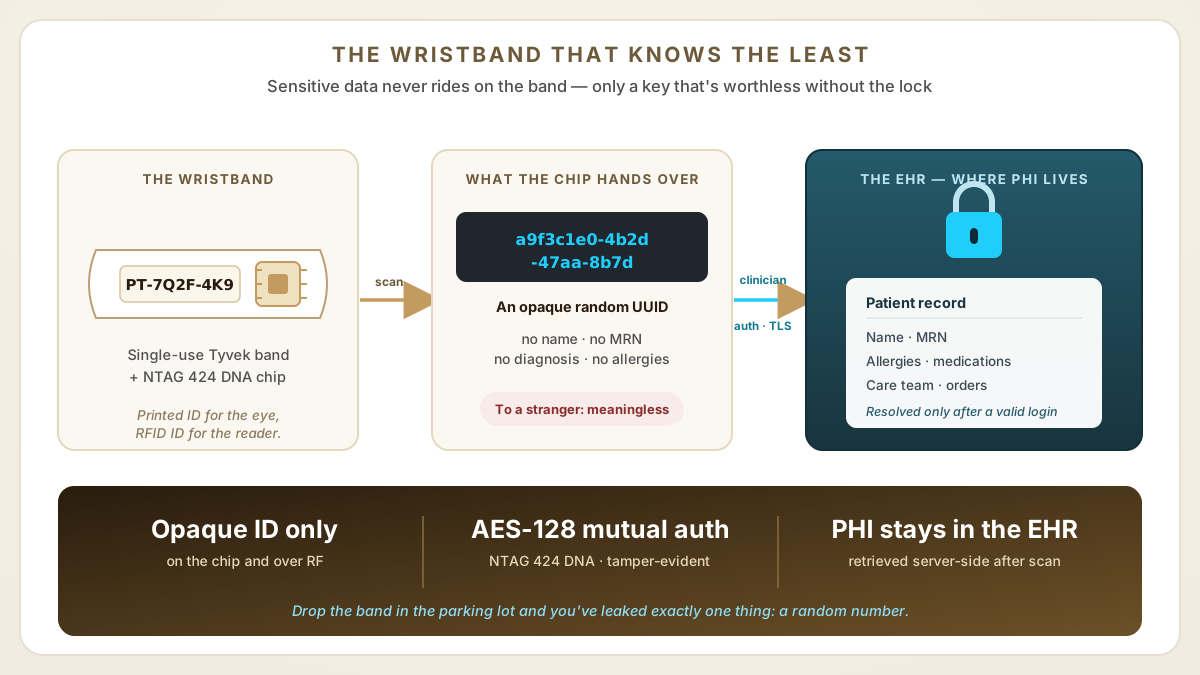
- HIPAA-compliant RFID design stores only an opaque patient identifier on the chip; PHI lives in the EHR and is retrieved server-side after wristband scan.
- Implementation cost runs $0.25-1.50 per wristband + $5-25K per scanner deployment. ROI from medication-error reduction and lab-mismatch prevention typically 9-18 months.
At a glance
Use these short answers to decide whether this page matches the project before moving into the detail.
Key takeaway
Wrong-patient errors cause 7-13% of medication errors and 5-10% of laboratory mismatches in US hospitals — RFID wristbands eliminate visual-only ID checks at every clinical touchpoint.
What does HIPAA require for patient RFID wristbands?
The most HIPAA-compliant [patient wristband](/products/rfid-wristbands/hospital-patient-id-wristband/) is, in a sense, the one that knows the least. Scan a well-designed...
Next step
Ready to move forward? Start your inquiry to get specific answers for this project.
Get a HIPAA RFID wristband quoteWhat does HIPAA require for patient RFID wristbands?
The most HIPAA-compliant patient wristband is, in a sense, the one that knows the least. Scan a well-designed band and the chip hands over nothing but an opaque string of characters — no name, no record number, no diagnosis — a key that is worthless to anyone who cannot also reach the locked system it opens. The whole trick of doing this safely is keeping the sensitive part somewhere the wristband never goes. HIPAA Security Rule and Privacy Rule both apply to RFID-stored patient data. The five requirements below define what 'HIPAA-compliant' means for an RFID wristband program.
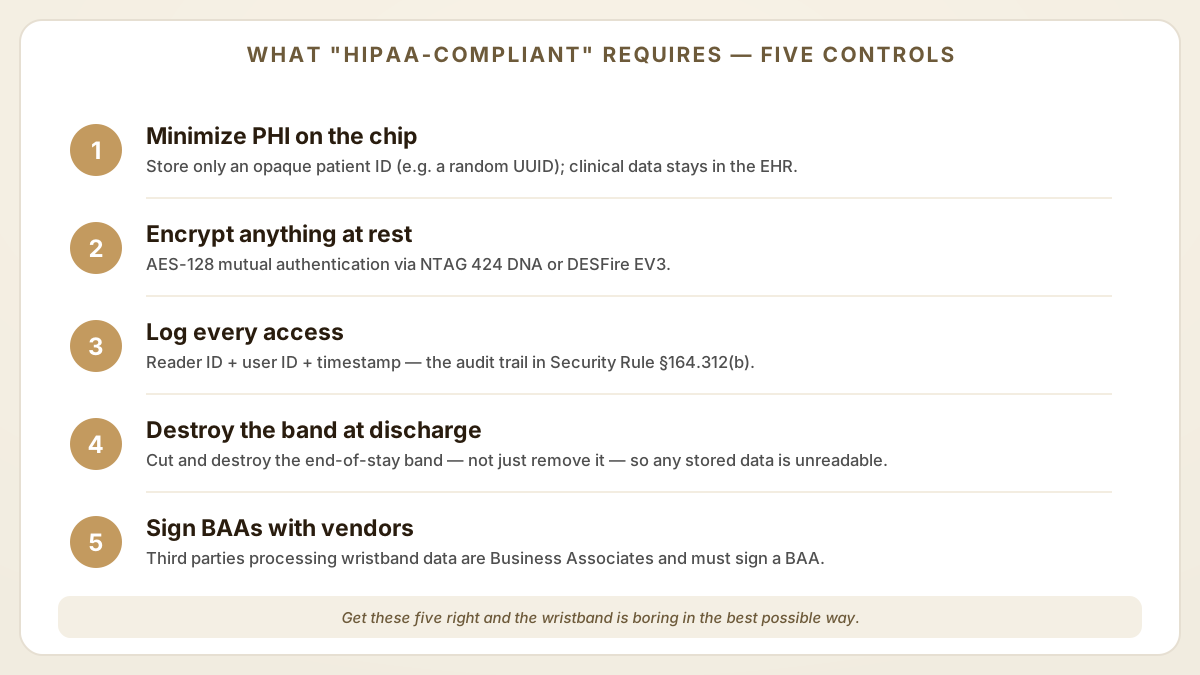
- PHI on the chip: should be minimized. Best practice stores only an opaque patient ID (e.g., random UUID) on the chip; clinical data stays in the EHR retrieved by ID lookup.
- Encryption at rest: chip-stored PHI (if any) must be encrypted. AES-128 mutual authentication via NTAG 424 DNA or DESFire EV3 satisfies HIPAA encryption-at-rest requirements.
- Access logging: every scan and EHR query logged with reader ID, user ID and timestamp. Required for HIPAA audit trail (security rule §164.312(b)).
- Disposal: end-of-stay wristband must be cut and destroyed (not just removed). Any chip-stored PHI rendered unreadable per HIPAA disposal requirements.
- Business Associate Agreements: third-party vendors processing wristband data are BAs and must sign BAA with the hospital.
How do you design HIPAA-safe wristband data?
If the wristband is a key, the point of good data design is making that key useless to anyone who pockets it. Chip-stored data design is the most consequential HIPAA decision in the whole program — and five principles separate the compliant setups from the at-risk ones.
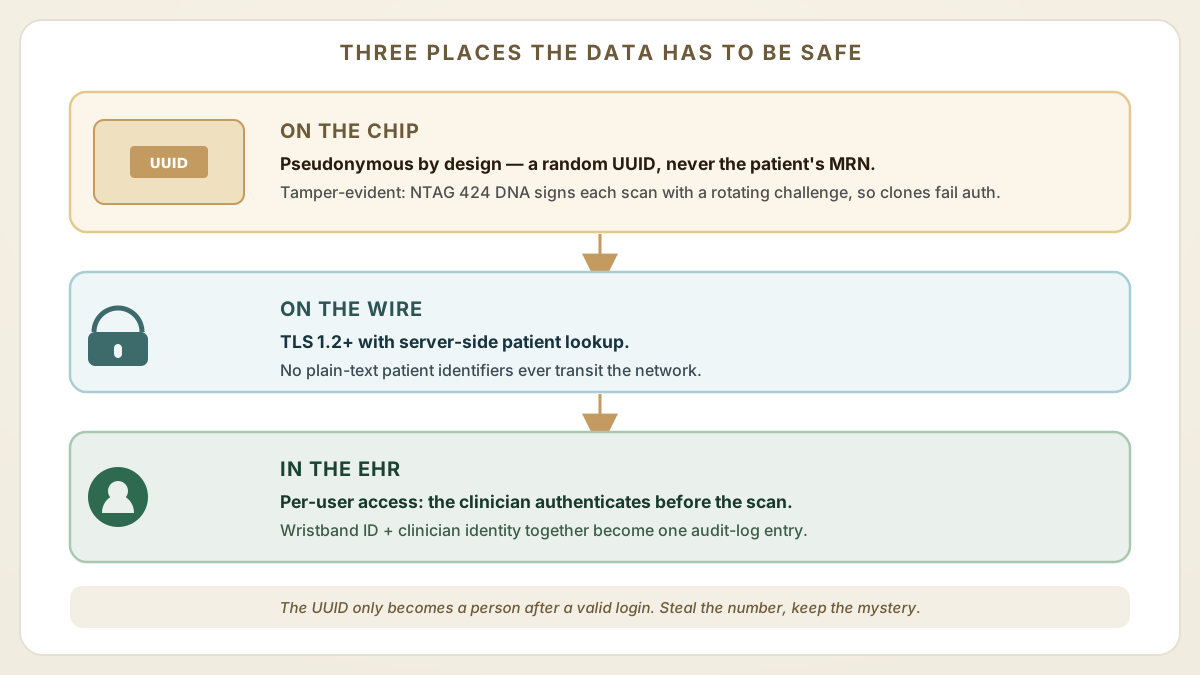
- Minimize stored PHI: ideally only opaque ID on chip. Patient name, MRN, allergies and other PHI stay in EHR.
- Pseudonymous identifier: use a random UUID, not the patient's MRN. UUID resolves to MRN only via authenticated EHR lookup.
- Tamper-evident chips: NTAG 424 DNA's secure messaging signs each scan with a rotating cryptographic challenge. Cloned wristbands fail authentication.
- Encrypted EHR data link: wristband-to-EHR queries must use TLS 1.2+ with server-side patient lookup. No plain-text patient identifiers transit the wire.
- Per-user EHR access: clinicians authenticate to EHR before wristband scan. The combination of wristband ID + clinician auth produces the audit log entry.
How do you roll out RFID patient wristbands?
Rolling out patient wristbands looks a lot like any other hospital RFID project — right up until you remember the tag is on a person, not a pallet, which raises the stakes at every step. The five-step rollout below mirrors successful 2024-2026 hospital deployments, and the thread running through all of them is simple: change one thing at a time.
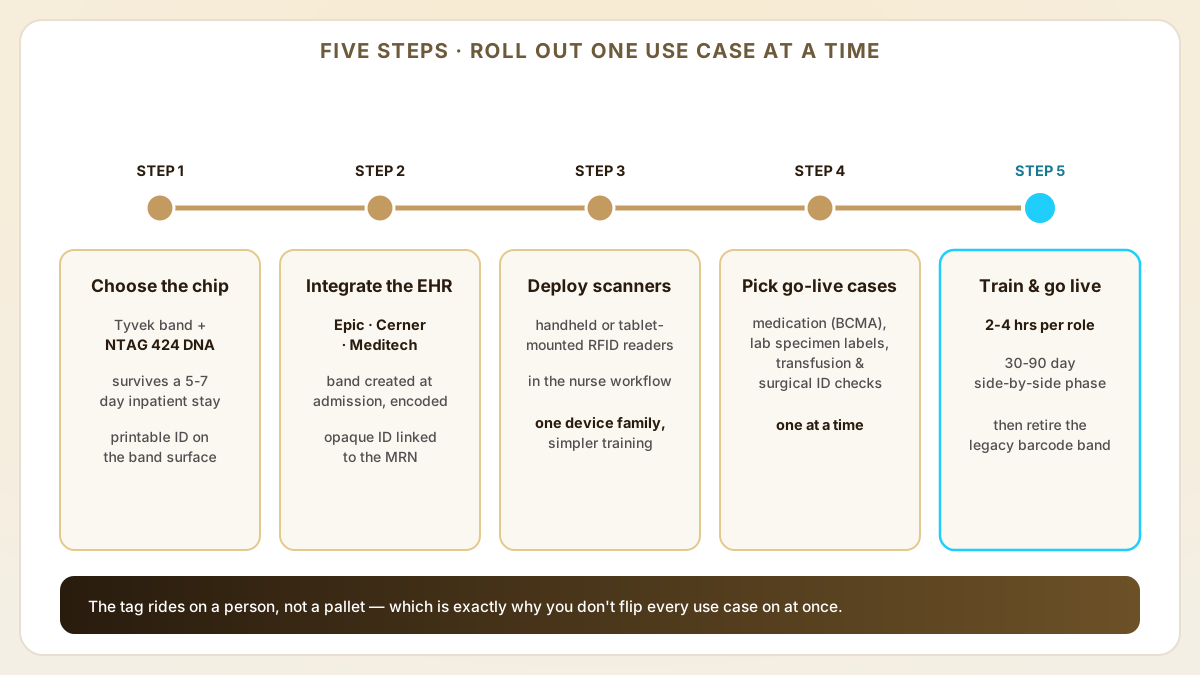
- Choose chip and form factor: thermally-sensitive Tyvek wristband with embedded NTAG 424 DNA chip is most common. Survives 5-7 day inpatient stay; printable per-patient identifier on band surface.
- Integrate with EHR and admission workflow: Epic, Cerner, Meditech all support wristband-printer integration. Wristband created at admission, encoded with opaque patient ID linked to MRN.
- Deploy bedside scanners: handheld or tablet-mounted RFID scanners in nurse workflow. Most facilities standardize on one device family for clinical staff training simplicity.
- Define use cases for go-live: medication administration verification (BCMA), lab specimen labeling, blood transfusion verification, surgical patient ID verification. Roll out one use case at a time.
- Train clinical staff: 2-4 hours per role on the new workflow. Most hospitals run a 30-90 day side-by-side phase before retiring legacy barcode wristbands.
Where HIPAA Security Rule actually intersects RFID design
Compliance teams don't grade your wristband on how clever it is; they grade it against HIPAA's Security Rule (45 CFR 164.302-318), the technical and administrative spine every RFID program gets cross-walked against. The good news: the rubric is short and stable. 2026 RFID-in-healthcare overviews and published wristband writeups keep landing on the same five Security-Rule controls — so come to the review ready to map your design to them line by line.
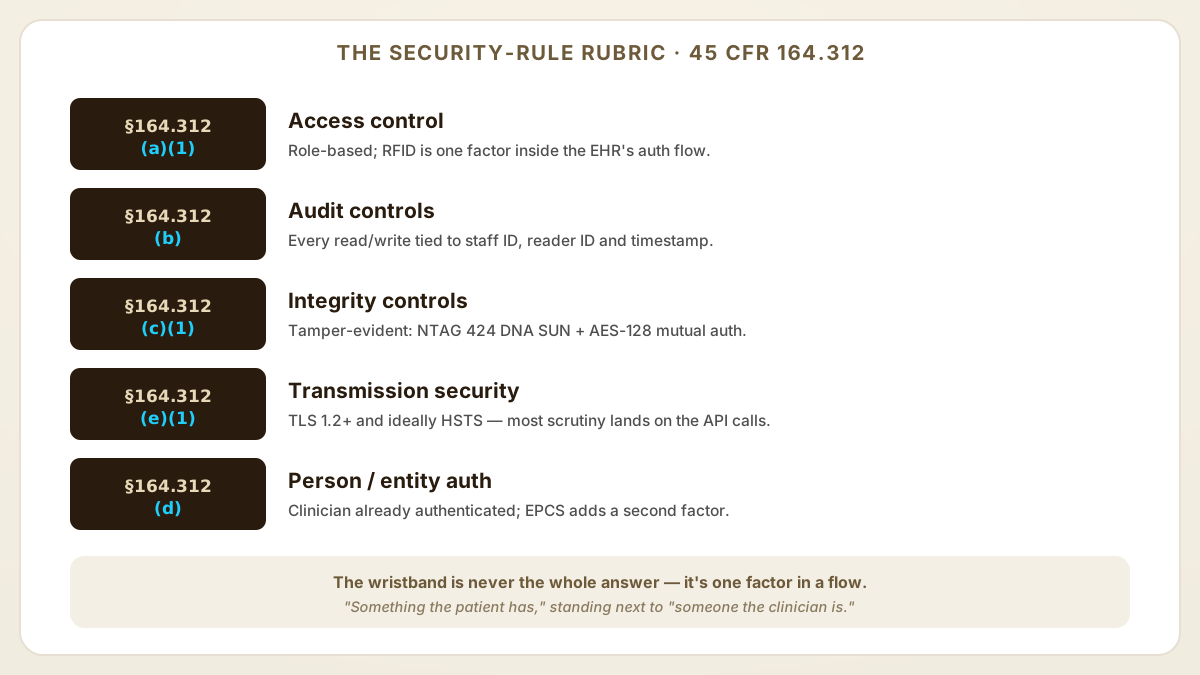
- Access control (§164.312(a)(1)): every wristband-to-EHR query must traverse role-based access — bedside nurse vs lab tech vs surgical team see different fields. RFID alone never carries authorisation; it is one factor (something the patient has) inside the EHR's existing user-authentication flow.
- Audit controls (§164.312(b)): every read/write event tied to staff identity, reader ID and timestamp. Industry guidance notes RFID badge-tap workflows produce 'a timestamped audit trail' that satisfies HIPAA logging without manual data-entry; the same expectation applies to patient-wristband scans.
- Integrity controls (§164.312(c)(1)): wristband-stored ID must be tamper-evident. NTAG 424 DNA's SUN message authentication, AES-128 mutual auth and rotating cryptographic challenges (sometimes summarised as 'AES-256 encryption protocol' in vendor literature) are what hospitals rely on to detect cloning.
- Transmission security (§164.312(e)(1)): wristband-to-EHR queries over Wi-Fi must use TLS 1.2+ and ideally HSTS. The wristband itself transmits very little data over RF; the heavy traffic is the resulting EHR API calls — that is where most HIPAA scrutiny lands.
- Person or entity authentication (§164.312(d)): the clinician scanning the wristband must already be authenticated to the EHR session. EPCS (Electronic Prescriptions for Controlled Substances) goes further, requiring two-factor; industry guidance notes a tap-to-authenticate badge can serve as one of those two factors, replacing one-time passwords for controlled-substance dispensing tied to a wristband-verified patient.
What does the wristband program cost when you cost in breach risk?
Here's the arithmetic that makes the budget conversation short. The global RFID-in-healthcare market is climbing from $4.64B in 2023 to a projected $14.65B by 2030 (Grand View Research) for one blunt reason: getting patient identification or PHI access wrong is expensive. HHS Office for Civil Rights settlement data runs from roughly $429,000 to $10.93M depending on severity, and IBM's Cost of a Data Breach has parked healthcare above every other industry for years. Against numbers like those, a wristband program is a rounding error — the breakdown below shows just how small.
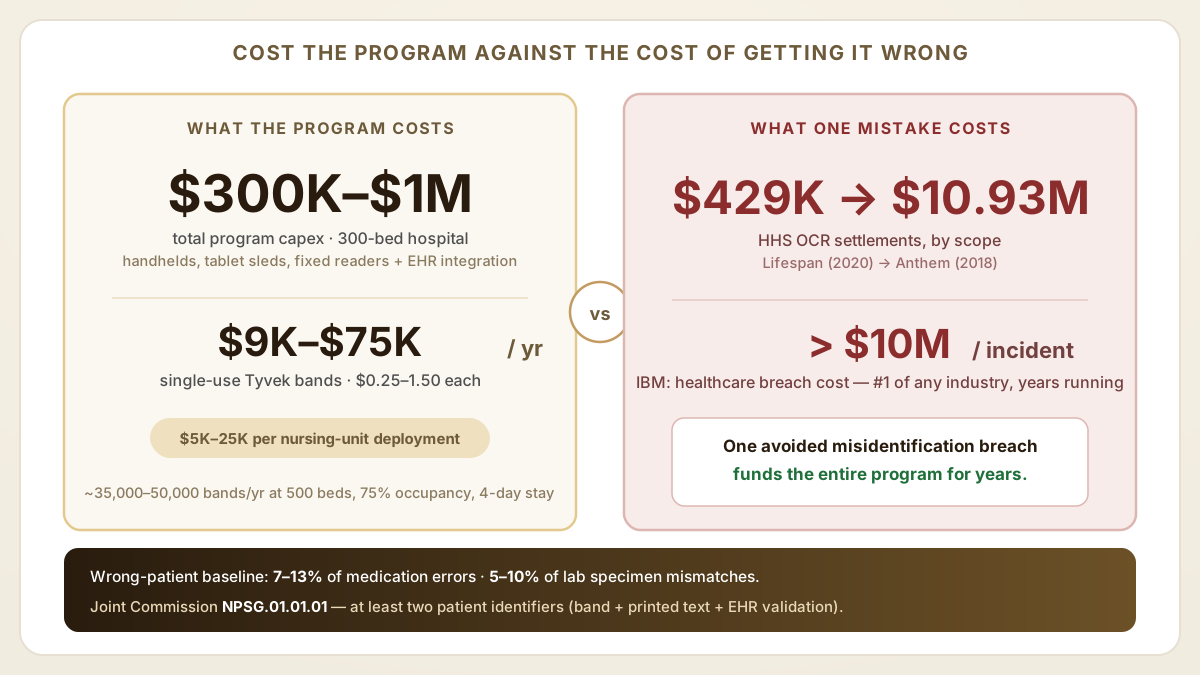
- Per-wristband consumables: $0.25-1.50 per single-use Tyvek RFID wristband at typical 200-500-bed inpatient volumes. A 500-bed hospital with ~75% occupancy and 4-day average length of stay consumes roughly 35,000-50,000 wristbands per year — annual consumable spend $9K-75K depending on chip choice.
- Reader and infrastructure capex: $5,000-25,000 per nursing-unit deployment for handhelds, tablet sleds, fixed bedside readers, plus integration to the EHR (Epic Rover, Cerner CareAware, Meditech BCMA modules). Most 300-bed hospitals run $300K-1M total program capex.
- Wrong-patient error baseline: published medication-administration error studies place wrong-patient events at 7-13% of medication errors and 5-10% of laboratory specimen mismatches; industry guidance notes 'patient misidentification is one of the most common errors in hospitals' and that RFID 'eliminates this at every touchpoint'.
- HIPAA breach cost reference: HHS OCR published settlements ranging from $429K (Lifespan, 2020) up to $10.93M (Anthem, 2018) depending on scope; IBM's healthcare breach cost has run above $10M per incident for several years. A single avoided wristband-driven misidentification breach typically funds the entire wristband program for years.
- Joint Commission alignment: National Patient Safety Goal NPSG.01.01.01 requires use of at least two patient identifiers when providing care, treatment and services. RFID wristband + visual band-text + EHR validation routinely satisfies this; auditors look for documented procedure plus evidence of audit-log retention.
Useful next pages
Use these linked product, guide and comparison pages to keep the next click specific and practical.
HIPAA-compliant patient RFID wristbands
Single-use Tyvek RFID wristbands, NTAG 424 DNA secure chips and EHR integration.
HIPAA and patient-safety reference material
Authority sources hospital security and compliance teams cite during wristband program design.
FAQ
Can a stranger read PHI off my RFID wristband?
Not in any useful way. A properly designed wristband stores only an opaque patient ID (a random UUID), not a name or MRN. Someone who scans it in a hallway gets meaningless data — only authenticated EHR access can resolve the UUID to patient information.
What chip is best for patient wristbands?
[NTAG 424 DNA](/guides/ntag424-dna-sun-cmac-authentication/) is the de facto standard for HIPAA-sensitive applications, and for good reason: AES-128 mutual authentication, tamper-evident packaging and FIPS 140-2 certified key management satisfy HIPAA Security Rule encryption requirements.
How long do RFID wristbands last on a patient?
Standard Tyvek RFID wristbands last 7-10 days in normal use, sufficient for most inpatient stays. Long-stay patients (ICU, oncology) get periodic re-issue. Pediatric and neonatal versions exist with smaller form factors.
Does RFID wristband replace barcode wristband?
Usually not — most hospitals deploy both: printed barcode for visual ID and legacy systems, plus RFID for fast contactless scanning. The barcode and RFID encode the same opaque ID; either can be used for any workflow that supports it. Joint Commission NPSG.01.01.01 (two-patient-identifier rule) is satisfied by either independently, but defence-in-depth is the dominant pattern.
What is the policy for newborn or pediatric wristbands?
Smaller form factors (10-15 mm wide) are standard for paediatric and neonatal wards, often paired with a maternal-band link so an alarm fires if the infant tag separates from the mother's tag inside the unit. Industry-published RTLS guidance treats infant abduction prevention as a distinct use case requiring exit-portal alerting in addition to wristband-level identity, with policies aligned to the National Center for Missing & Exploited Children's Guidelines for the Prevention of and Response to Infant Abductions.
What happens if the wristband fails or is removed?
No system reads 100% of the time, so policy has to cover the misses. Hospital policy must require a visual cross-check whenever the chip read fails (typically less than 1% of scans on a properly deployed wristband). Re-issuance is part of the standard nursing protocol: cut the failed wristband, document the disposal, and re-print/encode a new wristband from the existing patient record so the opaque-ID mapping carries forward. Wristband vendors publish guidance that wristband removal during inpatient stays should trigger a chart entry — auditors look for this in HIPAA and Joint Commission medical-record reviews.
Proud Tek is a Shenzhen-based RFID & NFC manufacturer supplying hotel chains, transit operators, event venues and retail brands worldwide. Every order includes free samples, RF testing and dedicated project support.
Get a Quick Quote
Tell us about your project and we'll respond within one business day. Fields marked (asterisk) are required.