
NFC Stickers
NTAG215 NFC Stickers
504-Byte Amiibo-Compatible

Quick answer
NTAG215 NFC stickers carry 504 bytes of user memory across 126 pages — 3.5x more than NTAG213 and the exact chip Nintendo specifies for Amiibo figures and cards. The mid-tier NFC Forum Type 2 chip-family-anchor for Wi-Fi-share NDEF, full-length URLs, complete vCards (RFC 6350), tabletop-game-state encoding, loyalty programmes and any application where memory exceeds NTAG213 (144 B) but does not require NTAG216 (888 B). Available wholesale in rolls, sheets and custom sizes Ø18-50 mm with optional NDEF / Amiibo binary pre-encoding, removable adhesive option and chip-type verification certificate.
- 504 bytes of user memory — 3.5x more than NTAG213; stores long URLs, full vCards (RFC 6350), Wi-Fi credentials (WSC NDEF) or complex loyalty records.
- Compatible with Nintendo Amiibo readers — NTAG215 is the exact Nintendo Amiibo chip specification (NTAG213 144 B + NTAG216 888 B are both incompatible).
- NFC Forum Type 2 certified — works with every NFC smartphone (iPhone 7+, all NFC Android) without an app. Per-tag chip-type verification certificate included with every order.
Used in these industries
Deployments where this product is referenced on our industry landing pages.



At a glance
Use these short answers to decide whether this page matches the project before moving into the detail.
Chip silicon
NXP NTAG215 (NT2H1511G0DU) — mid-tier NFC Forum Type 2 Tag Wafer / sawn die packaging — MOA-1 / SOT658-1 production reference
Memory architecture
504 bytes user memory — 126 pages × 4 bytes NDEF capacity ~492 characters URL after 7-10 byte overhead
Next step
Ready to move forward? Start your inquiry to get specific answers for this project.
Request NTAG215 sticker quote- Typical pricing
-
USD 0.10–0.30 /pc @ 5k+ (typical FOB Shenzhen range) — firm quote in one business day.
Commercial terms
- MOQ
- Varies by SKU — stock items from 100 pcs; custom production typically 200-1,000 pcs
- Lead time
- Production 2-3 weeks after artwork and encoding sign-off; reorders on a 3-4 week cycle
- Samples
- Free samples and RF test report with every order; courier at customer cost
- Payment
- 50% T/T deposit, 50% before shipment; Net 30/60 for established accounts; LC for large orders
- Shipping
- FOB Shenzhen / Yantian; DHL, FedEx or EMS air freight; sea LCL / FCL for volume
- Response
- Itemized quote within one business day, Mon-Fri (UTC+8)
Common problems buyers face when sourcing NTAG215 NFC stickers
- Wrong chip supplied instead of NTAG215 — a game accessory retailer ordering NTAG215 for Amiibo compatibility receives NTAG213 chips (the cheaper alternative); the smaller memory makes Amiibo data writing fail with an 'insufficient memory' error on the Nintendo console.
- Pre-encoded Amiibo data not accepted by Nintendo hardware. A buyer ordering pre-encoded Amiibo stickers receives tags where the data was written in the wrong NDEF format; Nintendo hardware expects a specific tag data structure and rejects improperly formatted tags.
- Adhesive too strong for repositionable application. A tabletop game publisher distributing NTAG215 stickers for players to move between game boards finds that permanent adhesive stickers tear the card backing when repositioned, requiring a removable adhesive variant.
- Antenna too small for reliable reads through thick game card stock. A game publisher embedding NTAG215 tags behind 600 gsm card stock finds the small Ø18 mm antenna reads unreliably when a card is face-down on a reader, requiring a larger antenna to penetrate the thick substrate.
- No NDEF pre-encoding service at required quantities. A developer ordering 500 uniquely encoded NTAG215 stickers with per-tag data files finds most suppliers only offer pre-encoding at 10,000+ MOQ, forcing manual encoding of each sticker.
504 bytes — the Goldilocks tier
Nintendo Amiibo data structure = 540 bytes total tag space — exactly matches NTAG215 NTAG213 (144 B) too small — Amiibo write fails 'insufficient memory' NTAG216 (888 B) wrong layout — Amiibo writes succeed but Switch hardware rejects Compatible with Switch, Wii U, 3DS / 2DS Amiibo NFC readers Head + tail bytes validated at encoding for Amiibo binary file format
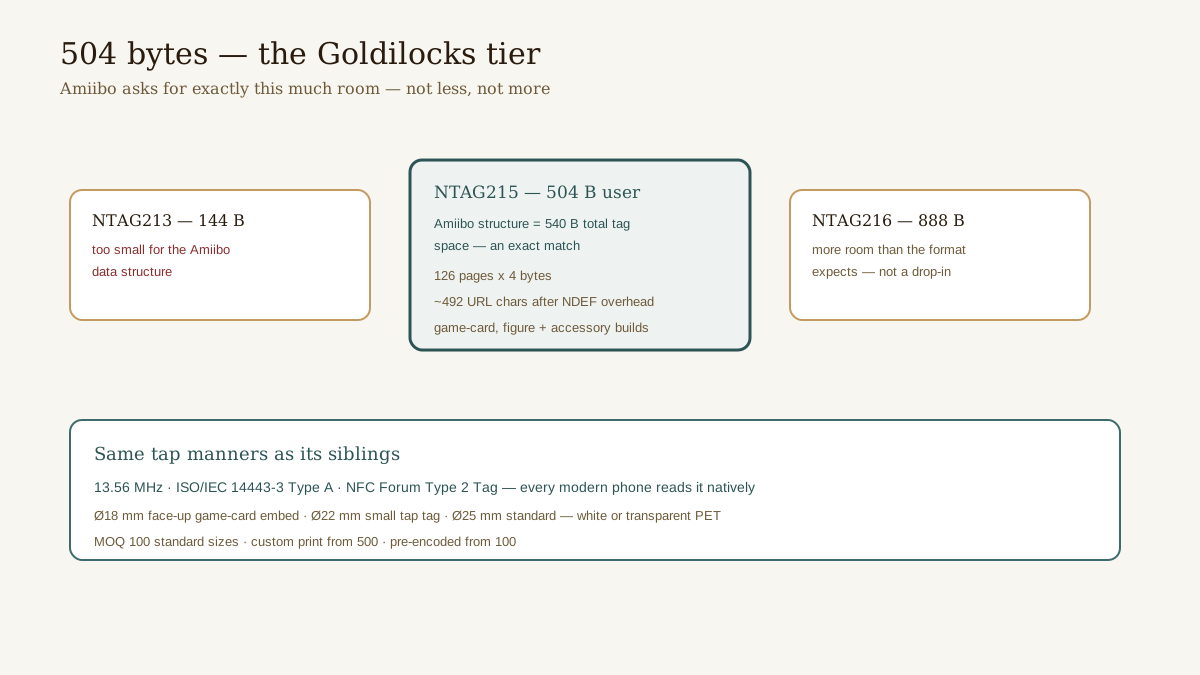
- vs NTAG213 (144 B) — when URL >132 char or Wi-Fi-share / Amiibo required vs NTAG216 (888 B) — when extended payload / multiple NDEF / on-chip provenance vs NTAG 424 DNA — when cryptographic anti-counterfeit required (this product is non-crypto) Cost positioning: ~30-40% premium over NTAG213, ~20% discount vs NTAG216
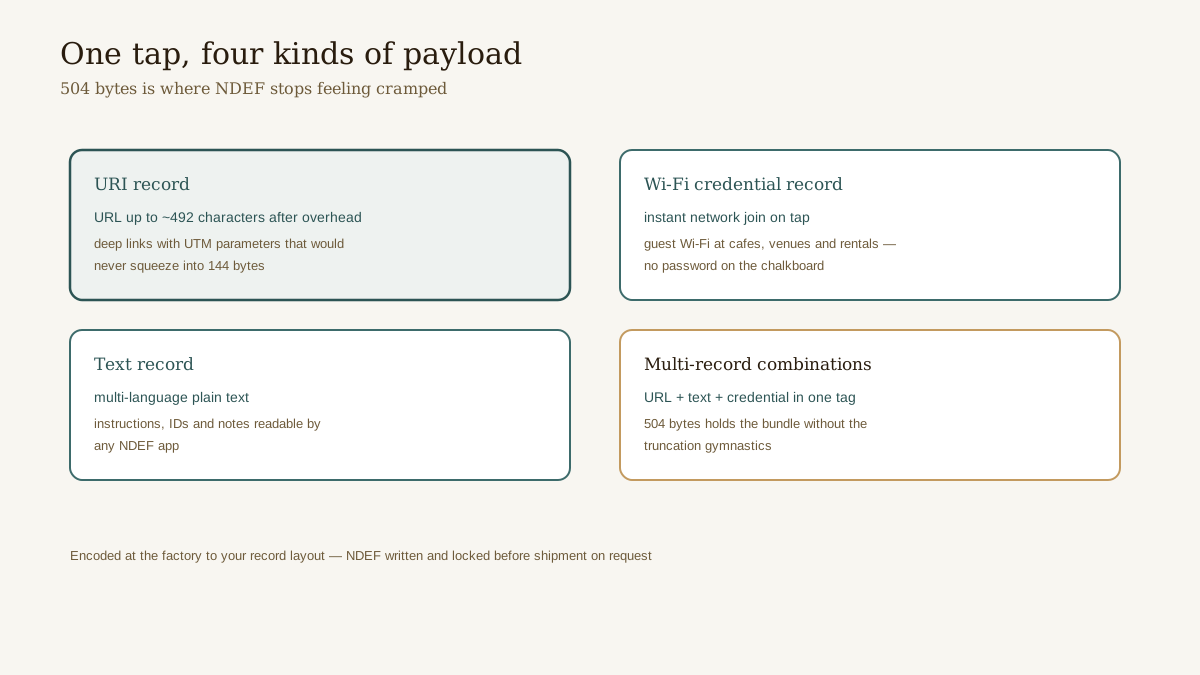
One tap, four kinds of payload
URI Record (URL up to ~492 characters after overhead) Text Record — multi-language plain text vCard 2.1 / 3.0 / 4.0 (RFC 6350) — full contact card Wi-Fi Simple Configuration NDEF — SSID + password + security Bluetooth handover record — pair-on-tap Smart Poster Record — multi-content combination
- Ø18 mm — game-card embedded (face-up read only) Ø22 mm — small-tag tap-only Ø25 mm — standard balanced size Ø30 mm — embedded behind 600 gsm card stock + reliable read Ø38 mm — extended range / tabletop board placement Custom shapes + non-circular die-cuts from MOQ 500
How Proud Tek solves NTAG215 NFC sticker sourcing problems
Generic NFC supplier — no chip verification / no Amiibo-format service
- Receives NTAG213 instead of NTAG215 — Amiibo write fails on Switch console
- Pre-encoded Amiibo binary in wrong NDEF format — rejected by Nintendo hardware
- Permanent adhesive on game-token sticker — tears card stock on reposition
- Ø18 mm antenna behind 600 gsm card stock — 73% read success
- Variable per-tag encoding only at 10,000+ MOQ — 4-hour manual encoding bottleneck
Proud Tek NTAG215 with chip-type cert + variable encoding (this page)
- Chip-type verification certificate per order — IC manufacturer code certified
- Amiibo-format encoding workflow — head + tail bytes validated for Switch / Wii U / 3DS
- Removable adhesive at standard MOQ 100 — clean-peel for card stock + paper
- Antenna-size guidance — Ø30 mm minimum for 600 gsm card stock = 100% read
- Variable per-tag encoding at MOQ 100 — UID-to-data CSV confirmation
- Chip verification on every order: Proud Tek reads and verifies the chip type identifier (IC manufacturer code) on every NTAG215 sticker before shipment; a chip type certificate listing the verified IC code is included with each delivery.
- Amiibo-format data writing available: our encoding team is experienced with the NTAG215 data structure required by Nintendo hardware; we write Amiibo-compatible binary data files (supplied by the buyer) in the correct format with head and tail bytes validated.
- Removable adhesive option at standard MOQ: Proud Tek stocks removable (repositionable) adhesive NTAG215 stickers with a clean-peel adhesive rated for card stock, paper and smooth plastic surfaces. Available at the same 100-piece MOQ as permanent adhesive.
- Antenna size guidance for embedded applications: we test read-through performance for buyers' specific substrate thickness and recommend the minimum antenna diameter; for 600 gsm card stock, we recommend Ø30 mm or larger.
- Variable data encoding at 100 pieces MOQ: Proud Tek's encoding workflow handles unique data per sticker from 100 pieces; buyers supply a data file and receive a UID-to-data mapping confirmation with each order.
Per-tap data published from a Proud Tek NTAG215 NFC sticker
- URL NDEF: 7-10 byte overhead + URI scheme + URL chars — total ≤504 byte memory.
- Wi-Fi WSC NDEF: SSID + password + security type — typical 50-200 bytes.
- vCard 4.0 (RFC 6350): full contact + URL + social — 250-400 bytes.
- Amiibo binary: 540 byte total tag space — matches NTAG215 exactly.
- 24-bit monotonic counter (page 130) — single-use token / tap counting.
NTAG215 memory layout and Amiibo compatibility
NTAG215 provides 504 bytes of user memory organised as 126 pages of 4 bytes each. Pages 0-3 are reserved for UID, lock bits and capability container. Pages 4-129 are user memory. Pages 130-134 hold configuration registers.
- Amiibo data structure: Nintendo Amiibo data occupies 540 bytes of the tag's total memory space — exactly matching NTAG215's capacity. NTAG213 (144 bytes) and NTAG216 (888 bytes) are both incompatible with Amiibo; only NTAG215 matches the spec.
- NDEF URL capacity: approximately 492 characters of URL after overhead. Suitable for full-length URLs, Wi-Fi credentials (SSID + password) and complete electronic business cards (vCard 2.1, 3.0 or 4.0).
- Wi-Fi sharing: the Android Wi-Fi NDEF payload (SSID, password, security type) typically requires 50-200 bytes — fits comfortably in NTAG215 with room for additional records.
- Counter function: page 130 provides a 24-bit monotonic counter for tap counting or single-use token management.
Applications
- Amiibo and game accessories — write Amiibo-compatible data for Nintendo Switch, Wii U and 3DS game integration.
- Wi-Fi credential sharing — encode SSID and password in an NFC Wi-Fi NDEF record for instant network connection.
- Detailed vCards — include full contact details, URL, social handles and note field in a single tap.
- Loyalty and punch cards — store loyalty balance, visit history and redemption data in 504 bytes.
- Board game and tabletop RPG integration — embed game state or character data into playing cards and miniature bases.
- Access tokens — URL-based one-time tokens or credential links for event check-in.
Substrate and finish options
- White PET — standard opaque label, printable, suitable for most indoor applications.
- Transparent PET — see-through sticker; antenna pattern concealed with white-fill option.
- Epoxy dome — clear epoxy protective coat for outdoor durability, premium product tags.
- Removable adhesive — clean-peel repositionable adhesive for card stock and smooth surfaces.
- High-tack adhesive — for textured, curved or low-energy plastic surfaces.
NTAG215 timeline — from NTAG family launch to Amiibo standard
- 2001 — NFC Forum founded
NXP, Sony and Nokia found the NFC Forum to standardise short-range (13.56 MHz) tag-based interaction; ISO/IEC 14443-3 Type A becomes the dominant transmission protocol.
- 2010-2012 — Wi-Fi Alliance Simple Configuration NDEF
Wi-Fi Alliance ratifies WSC / WPS Wi-Fi NFC handover spec — SSID + password + security NDEF record format becomes a primary use case for higher-memory NFC chips.
- 2013 — NTAG213/215/216 family launches
NXP launches NTAG213/215/216 — same Type 2 Tag T2T format with PWD_AUTH password protection, faster command set and tighter memory tiering (144/504/888 bytes). NTAG215 occupies the mid-tier.
- 2014 — Nintendo selects NTAG215 for Amiibo
Nintendo launches the Amiibo platform on Wii U + 3DS — Mario, Link, Samus, Pikachu, Animal Crossing figures + cards. NTAG215's 504-byte user memory matches Nintendo's Amiibo data structure exactly. NTAG215 becomes the de-facto Amiibo chip standard.
- 2017 — Nintendo Switch launch + Amiibo Joy-Con NFC
Nintendo Switch ships with NFC reader in right Joy-Con and Pro Controller — Amiibo NTAG215 reading becomes default per-console hardware. Amiibo accessory retailer ecosystem (BOTW, ACNH, Smash Bros) explodes.
- 2018 — iOS 12 background NFC enables NDEF launch
Apple iOS 12 enables background NDEF reading on iPhone XS / XR — Wi-Fi-share + vCard NFC tap-tag-to-action works without an app. NTAG215 becomes the default chip for memory-bound consumer NFC use cases.
- 2020-2024 — Tabletop game + loyalty NFC adoption
NTAG215 expansion into tabletop / board game NFC integration (character cards, miniature bases), retail loyalty programmes, smart-poster + table-stand verticals. Removable adhesive variant becomes standard for game-token applications.
- 2026 — Today: NTAG215 chip-family-anchor for mid-tier NFC
Reference operating practice across amiibo-figure-accessory, wifi-share-router-config, vcard-trade-show-badge, tabletop-game-character-card and loyalty-punch-card programmes converge on NTAG215 as the default mid-tier NFC sticker — with NTAG213 (144 B) reserved for entry-tier URL-only and NTAG216 (888 B) reserved for vCard / extended-payload use cases.
The reference facts, at a glance
Chip silicon
NXP NTAG215 (NT2H1511G0DU) — mid-tier NFC Forum Type 2 Tag Wafer / sawn die packaging — MOA-1 / SOT658-1 production reference Chip-type verification certificate — IC manufacturer code read + certified per order
Substrates
White PET (75 µm) — standard opaque, printable, indoor-rated Transparent PET — see-through; antenna concealable with white-fill Epoxy dome — outdoor durability + premium feel Card stock laminate — board-game embedded application Paper face stock (FSC) — short-term indoor-only
Adhesives
Acrylic permanent (3M 467MP / 9472LE) — smooth flat surfaces Rubber-based enhanced — textured + curved Removable / repositionable — card stock, board game movable tokens High-tack — low-surface-energy plastics High-temperature (up to 120 °C) — electronics assembly use
Application verticals
Nintendo Amiibo — figure / card / accessory production Wi-Fi credential sharing — instant connect on tap Detailed vCard — full contact + URL + social handles + note field Loyalty + punch cards — balance + visit history + redemption Tabletop / board game — character data + game state encoding Event check-in tokens — URL-based one-time-use tokens
Standards + compliance
ISO/IEC 14443-3 Type A initialization + anticollision NFC Forum Type 2 Tag + NDEF + URI RTD Wi-Fi Alliance WSC / WPS Wi-Fi NFC handover spec IETF RFC 6350 vCard format Apple Core NFC framework + Android NFC API RoHS / REACH compliant materials
Procurement
MOQ 100 (standard sizes, white PET) Custom-print MOQ 500, pre-encoded MOQ 100 (incl. variable per-tag data) Lead time 5-10 business days standard, 12-15 for variable encoding UID-to-data confirmation CSV with every variable-encoding order Chip-type verification certificate — IC code read + certified per order
Useful next pages
Use these linked product, guide and comparison pages to keep the next click specific and practical.
Other NFC memory sizes
Choose the right chip for your memory requirements.
Authentication NFC tags
For applications requiring cryptographic security beyond NTAG215.
Inlay components
For converters laminating NTAG215 into custom products.
Gaming and collectible applications
NTAG215 is the chip Amiibo uses; the gaming-collectible SKU is built on this silicon.
FAQ
Is NTAG215 the same chip used in Nintendo Amiibo?
Yes. Nintendo specifies NTAG215 for all official Amiibo figures and cards. The chip's 504-byte memory matches the Amiibo data structure (540 bytes total tag space) exactly. NTAG213 (144 bytes) and NTAG216 (888 bytes) are both incompatible — only NTAG215 works.
How much data can NTAG215 store compared to NTAG213?
NTAG215 provides 504 bytes of user memory versus 144 bytes for NTAG213 — 3.5 times more. In practice, NTAG215 stores approximately 492 characters of URL (vs ~132 for NTAG213), a complete vCard (RFC 6350) with multiple fields, or Wi-Fi credentials with room to spare.
Can you pre-encode NTAG215 stickers with custom data?
Yes, including variable data (unique content per sticker). From 100 pieces minimum, we write any NDEF-formatted data (URL, text, vCard, Wi-Fi, custom binary) onto each sticker. For variable data, supply a data file mapping UID to payload; we deliver a UID-to-data confirmation CSV.
What is the read range of NTAG215 stickers?
Read range depends primarily on antenna size. A Ø25 mm NTAG215 sticker reads at 3-5 cm on most smartphones. A Ø30 mm antenna reads at 4-6 cm. Smaller Ø18 mm antennas read at 1-3 cm. For embedded applications (inside packaging, behind card stock), use the largest antenna that fits your space.
What adhesive options are available for NTAG215 stickers?
We offer five adhesive grades: standard permanent acrylic (smooth surfaces, indoor), enhanced rubber-based (textured, curved, low-energy plastics), removable / repositionable (clean-peel for card stock, paper, smooth plastic), high-tack (challenging low-surface-energy plastics) and high-temperature (up to 120 °C for electronics assembly). Standard is permanent acrylic unless otherwise specified.
Sources & references
Primary standards, OEM datasheets and regulatory documents cited by this article. All URLs were verified on the access date shown below.
- NXP NTAG213/215/216 — NFC Forum Type 2 Tag compliant IC with 144/504/888 bytes user memory (product page + NT2H1511G0DU data sheet)
Primary chip silicon datasheet — NTAG215 (NT2H1511G0DU) mid-tier 504-byte user memory, 32-bit PWD_AUTH password, 7-byte UID, 24-bit monotonic counter.
- ISO/IEC 14443-3 — Identification cards — Contactless IC cards — Proximity cards — Part 3: Initialization and anticollision
RF transmission protocol stack — Type A initialization + anticollision.
- NFC Forum Type 2 Tag Operation Specification
T2T command set, memory model, NDEF mapping for NTAG21x family.
- NFC Forum NDEF Specification (NFC Data Exchange Format)
- Wi-Fi Alliance — Wi-Fi Simple Configuration (WSC/WPS) specification (Wi-Fi NFC handover NDEF record structure)
- IETF RFC 6350 — vCard Format Specification (used for NDEF-encoded contact records)
vCard 4.0 specification — full contact card with name + phone + email + URL + photo URL + social handles, typical 250-400 bytes for NTAG215 NDEF encoding.
- Nintendo — Amiibo hardware (NTAG215 chip specification per Nintendo amiibo documentation; consumer-facing compatibility reference)
Nintendo Amiibo hardware — selected NTAG215 (504 byte user memory) as exact chip; total Amiibo data structure occupies 540 bytes of tag space matching NTAG215 capacity.
- Apple Developer — Core NFC framework (native tag reading, iPhone 7+ support)
iOS 11 introduced Core NFC for app-based tag reading; iOS 12 (2018) enabled background NDEF reading on iPhone XS / XR.
- Android Developer — NFC basics and NDEF tag dispatch
Android NFC API + NDEF tag dispatch — native intent-based URL launch + Wi-Fi handover + Bluetooth pairing on tap.
- Bluetooth SIG — NFC Out-of-Band Pairing (Bluetooth handover NDEF)
Bluetooth handover NDEF record specification — pair-on-tap workflow leveraging NTAG215 mid-tier memory.
Proud Tek is a Shenzhen-based RFID & NFC manufacturer supplying hotel chains, transit operators, event venues and retail brands worldwide. Every order includes free samples, RF testing and dedicated project support.
Get a Quick Quote
Tell us about your project and we'll respond within one business day. Fields marked (asterisk) are required.