
On-Metal NFC
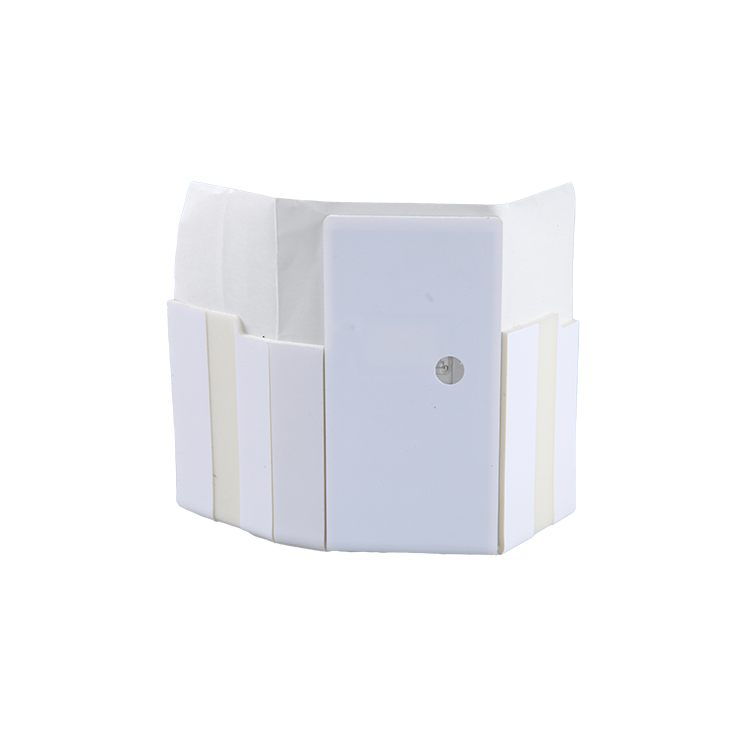
NFC Anti-Metal Sticker
Ferrite-Backed On-Metal Tag

Quick answer
Standard NFC stickers fail completely on metal — the metal plane creates eddy currents that cancel the antenna's magnetic field and read distance drops to zero. NFC anti-metal stickers integrate a ferrite absorber layer (rigid, 1.2-2.5 mm, max read range) or closed-cell foam spacer (flexible, 2-3 mm, conforms to curved pipes) that suppresses eddy currents and restores 2-5 cm phone read range / 5-10 cm dedicated-reader range on steel, aluminium, stainless steel and powder-coated metal. NTAG213 / NTAG216 / NTAG 424 DNA chip variants, 13×13 to 50×50 mm sizes, IT asset / manufacturing equipment / utilities pipe / medical device / metal product authentication.
- Reads reliably on steel, aluminium and other conductive metal surfaces where standard NFC stickers produce zero signal. Ferrite or foam spacer suppresses eddy currents and restores antenna performance.
- Ferrite or foam spacer layer isolates the NFC antenna from the metal substrate — restoring 2-5 cm phone read range / 5-10 cm dedicated-reader range on metal.
- NTAG213 (144 B), NTAG216 (888 B) and NTAG 424 DNA (416 B + AES-128 SUN) chip variants in 13×13 mm to 50×50 mm sizes; 1.2 mm slim profile available for inside-enclosure applications.
Used in these industries
Deployments where this product is referenced on our industry landing pages.



At a glance
Use these short answers to decide whether this page matches the project before moving into the detail.
Chip silicon
NXP NTAG213 (NT2H1311G0DU) — 144 B entry-tier NXP NTAG216 (NT2H1611G0DU) — 888 B asset-record on-chip
Anti-metal mechanism — ferrite absorber
Magnetically permeable + electrically resistive material Allows antenna magnetic field to pass + suppresses eddy currents
Next step
Ready to move forward? Start your inquiry to get specific answers for this project.
Request anti-metal sticker quote- Typical pricing
-
USD 0.10–0.30 /pc @ 5k+ (typical FOB Shenzhen range) — firm quote in one business day.
Commercial terms
- MOQ
- Varies by SKU — stock items from 100 pcs; custom production typically 200-1,000 pcs
- Lead time
- Production 2-3 weeks after artwork and encoding sign-off; reorders on a 3-4 week cycle
- Samples
- Free samples and RF test report with every order; courier at customer cost
- Payment
- 50% T/T deposit, 50% before shipment; Net 30/60 for established accounts; LC for large orders
- Shipping
- FOB Shenzhen / Yantian; DHL, FedEx or EMS air freight; sea LCL / FCL for volume
- Response
- Itemized quote within one business day, Mon-Fri (UTC+8)
Common challenges buyers face when deploying NFC tags on metal surfaces
- Standard NFC stickers produce zero read distance on metal. An IT asset manager applying standard NTAG213 stickers to aluminium server chassis measures read distance of 0 mm — the aluminium chassis acts as a ground plane that detunes and shorts the flat antenna, making the tag completely unreadable.
- Anti-metal tag too thick for equipment enclosure labelling. A manufacturer labelling the inside of a metal equipment door with NFC requires a tag under 2 mm total thickness; most rigid anti-metal hard tags are 3-4 mm thick and prevent the door from closing properly.
- Adhesive bond fails on powder-coated metal. A tool manufacturer applying anti-metal NFC stickers to powder-coated steel tool surfaces finds the tags fall off within 2 weeks due to poor adhesion to the low-energy textured powder-coat surface.
- Ferrite layer cracks on curved metal surface. A buyer applying anti-metal stickers to cylindrical stainless steel pipes finds the rigid ferrite core cracks when bent to conform to the pipe curvature, breaking the antenna and rendering the tag unreadable.
- Read range insufficient for handheld reader workflow. An inventory operator scanning anti-metal asset tags with a handheld reader at 10-15 cm distance finds that the competitor's tag only reads at 3-4 cm, requiring an inconvenient close-proximity scan workflow that slows inventory cycles.
Metal eats NFC fields — two ways to feed it anyway
Magnetically permeable + electrically resistive material Allows antenna magnetic field to pass + suppresses eddy currents 1.2-2.5 mm thickness range Rigid: cracks if bent below 100 mm radius Maximum read range on flat metal surfaces
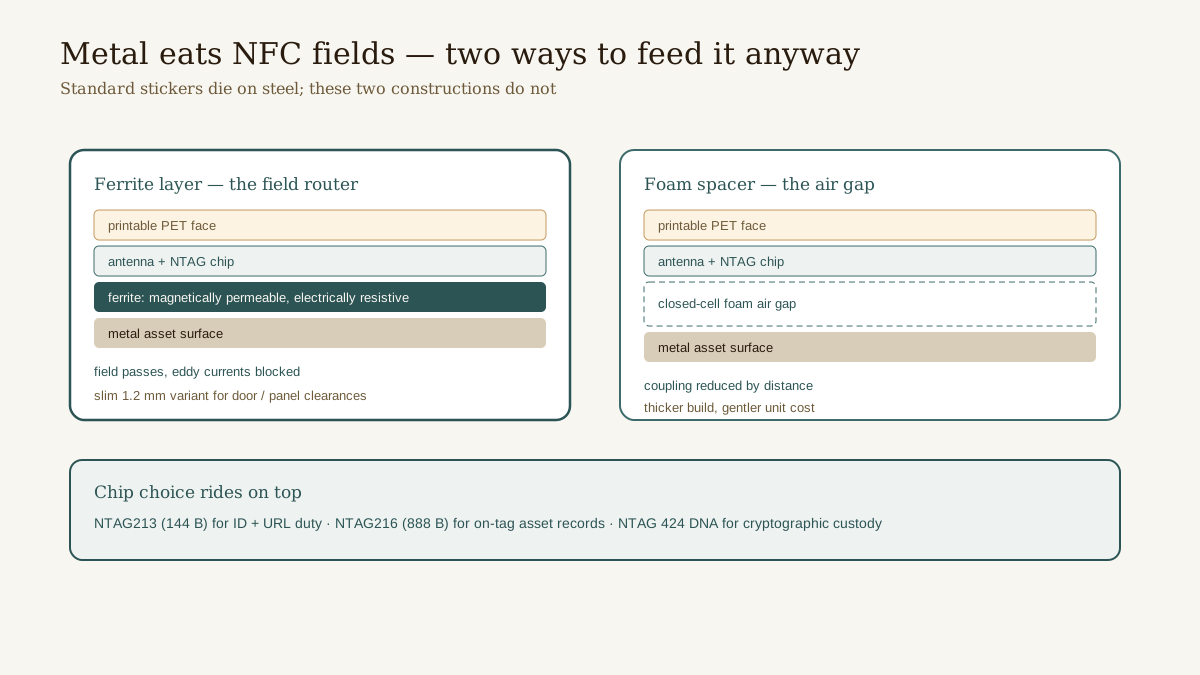
- Closed-cell foam interlayer creates air gap Reduces eddy-current coupling via distance 2.0-3.0 mm thickness range Flexible: conforms to 25 mm radius curves without cracking Suitable for cylindrical pipes + curved housings
- Industry-typical thinnest standard option Inside metal equipment door / panel space-constrained Trade-off: 2-4 cm read range vs 3-6 cm standard ferrite Custom 0.5 mm ultra-slim available at MOQ 5,000 (Murata MAGICSTRAP / TDK) Per-application thickness-vs-range trade-off matrix on request
On metal, size buys centimetres
13×13 mm: 1-2 cm phone / 2-3 cm reader 20×20 mm: 2-3 cm phone / 3-4 cm reader 25×25 mm: 2-4 cm phone / 4-6 cm reader 30×30 mm: 3-4 cm phone / 5-7 cm reader 40×40 mm: 4-5 cm phone / 7-9 cm reader 50×50 mm: 5-6 cm phone / 9-11 cm reader
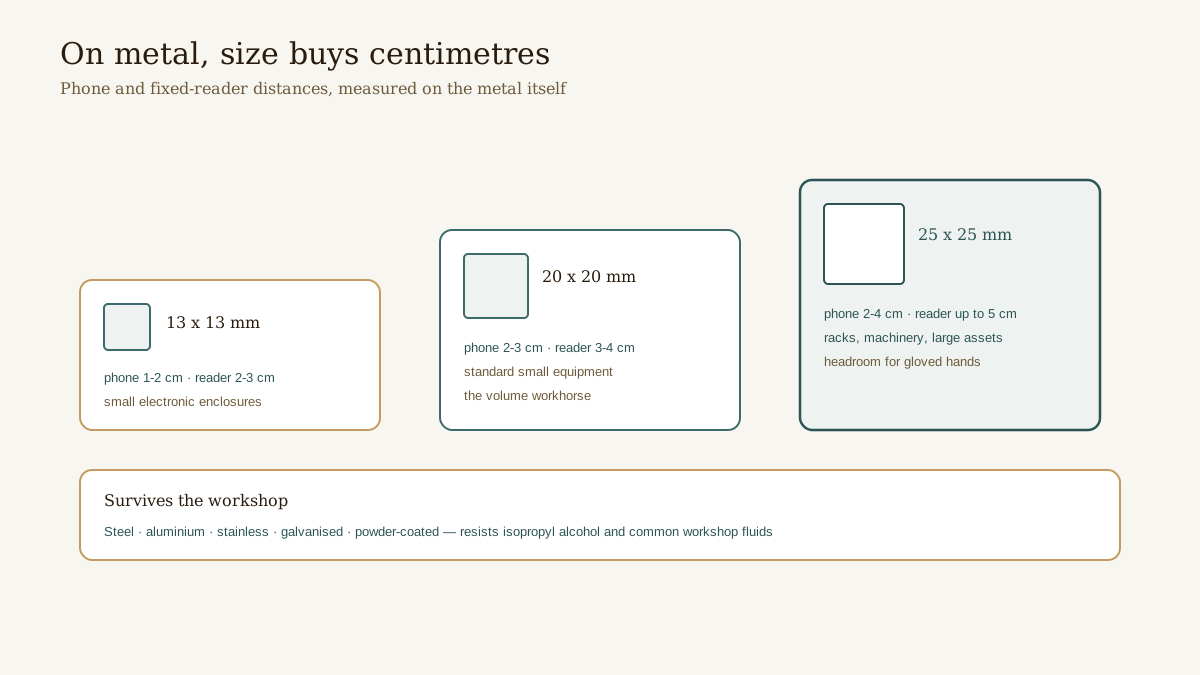
- 13×13 mm — compact label for small electronic enclosures 20×20 mm — standard small-equipment tag 25×25 mm — IT asset baseline 30×30 mm — extended read range 40×40 mm — premium read range (5-6 cm phone) 50×50 mm — maximum read range (handheld 11+ cm)
- Steel + aluminium + stainless steel + galvanised + powder-coated Resists isopropyl alcohol + acetone + brake fluid + WD-40 Survives sterilisation cycles for medical-equipment label UV-stable for outdoor enclosure Salt-fog tested for marine / coastal environment
How Proud Tek solves NFC anti-metal sticker sourcing problems
Common buyer mistakes — generic anti-metal sticker without application match
- Standard NFC sticker on aluminium server: 0 cm read distance (eddy-current short)
- Rigid 3-4 mm hard tag inside metal door: door won't close
- Generic acrylic PSA on powder-coat tool: 22% peel rate in 2 weeks
- Rigid ferrite on cylindrical pipe: ferrite cracks at <100 mm bend radius
- 13×13 mm tag for handheld 10 cm scan: 3-4 cm range = workflow slowdown
Proud Tek application-matched ferrite vs foam vs powder-coat-PSA (this page)
- Ferrite absorber + foam spacer matched to flat vs curved surface
- 1.2 mm slim ferrite for inside-enclosure space-constrained labelling
- High-tack rubber-based PSA stocked for powder-coat + textured paint
- Closed-cell foam variant flexes to 25 mm radius without cracking
- 50×50 mm tag = 11+ cm handheld read range for distance scan workflow
- Ferrite and foam spacer options matched to application — Proud Tek recommends ferrite-core anti-metal stickers for flat metal surfaces (maximum read range, <1.5 mm profile), and foam spacer variants for curved metal surfaces (flexible, bends to conform to cylindrical surfaces without cracking).
- Ultra-thin 1.2 mm profile option — Proud Tek's slim ferrite anti-metal stickers achieve a 1.2 mm total thickness profile (industry-typical thinnest standard option) for space-constrained labelling inside equipment enclosures and panels.
- Powder-coat adhesive option — we stock anti-metal stickers with a high-tack rubber-based adhesive rated for powder-coated metal, textured paint and other low-surface-energy coated metal surfaces; peel strength is specified on the product datasheet.
- Flexible foam spacer for curved surfaces — the foam spacer variant uses a closed-cell foam interlayer that flexes to conform to cylindrical and curved metal surfaces without cracking; rated for curvature radius down to 25 mm.
- Optimised antenna design for handheld reader range — our 40 × 40 mm and 50 × 50 mm anti-metal stickers are antenna-optimised for maximum read range on metal; we provide a read range specification at 10 cm and 15 cm from the tag for handheld reader selection.
Per-tap data published from a Proud Tek NFC anti-metal sticker
- Eddy current physics: metal ground plane shorts flat antenna magnetic field.
- Ferrite (µ_r > 1, resistive): permeable to H-field + suppresses eddy currents.
- Foam spacer: air gap reduces coupling distance — flexible alternative to ferrite.
- 50×50 mm + ferrite + 30 dBm reader: 9-11 cm handheld range on flat steel.
- Slim 1.2 mm: trade-off range (2-4 cm) for inside-enclosure space-constrained.
Why standard NFC tags fail on metal — and how anti-metal tags solve it
Understanding the physics of NFC on metal helps you specify the right tag for your application.
NFC operates by inductive coupling. The reader creates a magnetic field, and the tag's loop antenna couples to this field, drawing power and exchanging data. When a flat NFC antenna is placed directly on a metal surface, the metal acts as a conductive ground plane that creates eddy currents in opposition to the antenna's magnetic field. These currents cancel the antenna's signal, effectively making the tag invisible to NFC readers. Read distance drops to zero, even with direct contact.
Anti-metal NFC tags insert a spacer layer between the antenna and the metal surface. A ferrite absorber layer provides the most efficient isolation. Ferrite material is magnetically permeable but electrically resistive, allowing the magnetic field to pass while suppressing eddy currents. A foam spacer layer works by creating an air gap that reduces eddy current coupling; it is more flexible than ferrite but typically requires a thicker spacer for equivalent performance.
Anti-metal tag format comparison
| Format | Thickness | Flexibility | Best surface | Typical read range on metal |
|---|---|---|---|---|
| Ferrite core (standard) | 1.5-2.5 mm | Rigid | Flat metal surfaces | 3-6 cm phone / 6-10 cm reader |
| Ferrite core (slim) | 1.2 mm | Rigid | Flat metal, inside enclosures | 2-4 cm phone / 4-7 cm reader |
| Foam spacer | 2.0-3.0 mm | Flexible (25 mm radius) | Curved or irregular metal | 2-4 cm phone / 4-7 cm reader |
| Hard anodised tag | 3.0-4.0 mm | Rigid housing | Harsh industrial environments | 4-8 cm phone / 8-12 cm reader |
Applications
- IT asset tracking — label servers, network switches, monitors and laptops with NFC for scan-on-demand inventory.
- Manufacturing equipment — tag metal machinery, tools and fixtures for maintenance records and usage logging.
- Utilities and infrastructure — apply to metal pipes, valves, junction boxes and electrical cabinets for field data access.
- Medical equipment — tag stainless steel carts, IV poles and equipment frames for sterilisation cycle tracking.
- Automotive — label metal vehicle parts, frames and chassis for assembly tracking and aftermarket authentication.
- Retail and brand protection — NTAG 424 DNA anti-metal stickers for authenticating metal products and packaging.
NFC anti-metal sticker timeline — from 2008 NXP AN1445 to 2024 EU ESPR DPP
- 2008 — NXP AN1445 antenna design guide published
NXP publishes Application Note AN1445 — canonical antenna design guide for MIFARE and ICODE on metal. Defines eddy-current loss mechanism + ferrite-absorber mitigation. Foundation reference for industry on-metal antenna design.
- 2013 — NXP NTAG213/215/216 family launches
NXP releases NTAG21x family — 144 / 504 / 888 byte NFC Forum Type 2 Tag. First standard NFC chip family with sufficient market scale to drive ferrite-backed anti-metal sticker as standard SKU.
- 2014 — Apple iPhone 6 + Apple Pay normalises NFC handsets
Apple ships iPhone 6 with NFC; widespread Android NFC support already established. Consumer-grade phone NFC tap on metal-asset tag becomes mass-market use case.
- 2017 — ISO/IEC 27001:2017 + asset-inventory baseline
ISO/IEC 27001:2017 + Annex A.8.1 asset inventory control + NIST SP 800-53 CM-8 component inventory framework matures. NFC anti-metal IT asset tagging programmes scale across enterprise.
- 2018 — NXP NTAG 424 DNA + iOS 12 background NFC
NXP launches NTAG 424 DNA AES-128 SUN cryptographic chip; Apple iOS 12 enables background NDEF reading on iPhone XS / XR. Anti-metal cryptographic asset authentication becomes consumer-grade.
- 2020-2022 — Slim 1.2 mm ferrite + foam-spacer variant maturity
1.2 mm slim ferrite (industry-typical thinnest standard option) + closed-cell foam spacer variant for curved pipes mature. Per-application ferrite-vs-foam selection becomes standard procurement decision.
- 2024 — EU ESPR 2024/1781 DPP + asset-record DPP linkage
EU ESPR 2024/1781 Digital Product Passport phased rollout 2027-2030 — electronics + battery + textile categories. NFC anti-metal IT-asset and equipment labels become DPP carrier-ready via GS1 Digital Link URI.
- 2026 — Today: NFC anti-metal sticker standard practice
Operating notes from enterprise-it-asset, manufacturing-equipment-maintenance, utilities-pipe-valve-cabinet, medical-equipment-sterilisation, automotive-frame-assembly and metal-product-brand-authentication programmes converge on NTAG213 / NTAG216 / NTAG 424 DNA + ferrite or foam application-matched + high-tack-PSA powder-coat option as the default architecture.
The reference facts, at a glance
Chip options
NXP NTAG213 (NT2H1311G0DU) — 144 B entry-tier NXP NTAG216 (NT2H1611G0DU) — 888 B asset-record on-chip NXP NTAG 424 DNA (NT4H2421Gx) — 416 B AES-128 SUN cryptographic NXP NTAG 424 DNA TagTamper — bridge-antenna CTTES Field-rewriteable for asset-state transitions
Substrate + adhesive
PET face stock — printable + chemical-resistant Standard acrylic permanent adhesive — smooth metal High-tack rubber-based adhesive — powder-coated metal + textured paint Aluminium anodised face — harsh industrial environment hard-tag Operating temperature −40 °C to +85 °C (ferrite) / −40 °C to +70 °C (foam)
Application verticals
IT asset tracking — server + switch + monitor + laptop Manufacturing equipment — machinery + tool + fixture maintenance log Utilities + infrastructure — pipe + valve + junction box + electrical cabinet Medical equipment — IV pole + cart + sterilisation cycle tracking Automotive parts — vehicle frame + chassis + assembly line Brand protection — NTAG 424 DNA on metal product authentication
IT asset compliance
ISO/IEC 27001 A.8.1 — asset inventory control NIST SP 800-53 Rev 5 CM-8 — Information System Component Inventory PCI DSS 4.0 Req 12.5.1 — system component inventory SOX Section 404 + PCAOB AS 2201 fixed-asset internal controls ServiceNow ITAM + IBM Maximo + Ivanti Neurons compatible
Tamper-evident option
Bridge-antenna CTTES register — permanently set on peel AES-128 SUN cryptographic per-tap signature Cloud-registry verification + tampered-status alert Defeats label-swapping fraud across assets Ferrite + tamper-loop coexistence engineered into single sticker
Procurement
MOQ 500 pieces (standard ferrite or foam, NTAG213) MOQ 1,000 (NTAG 424 DNA cryptographic + tamper) Lead time 10-15 business days Pre-encoded UID + asset-mapping CSV Custom shape / size / face print / adhesive grade Sample sets 25-50 pcs for read-range qualification on actual metal substrate
Useful next pages
Use these linked product, guide and comparison pages to keep the next click specific and practical.
Standard NFC stickers
For non-metal surfaces. Lower cost than anti-metal variants.
Authentication NFC tags
Secure NFC with cryptographic anti-cloning for metal product authentication.
Industry applications
Industry deep-dives where this SKU is commonly specified.
FAQ
Why don't standard NFC stickers work on metal?
Metal surfaces create eddy currents that oppose the magnetic field used by NFC inductive coupling. These eddy currents cancel the tag antenna's signal, reducing read distance to zero regardless of how close the reader is placed. An anti-metal tag inserts a ferrite absorber or foam spacer layer between the antenna and the metal to suppress eddy currents and restore antenna performance.
What is the read range of NFC anti-metal stickers on a steel surface?
Typical read range on a flat steel surface is 2-5 cm for smartphone readers and 5-10 cm for dedicated NFC reader hardware, depending on tag size and antenna design. Our 40 × 40 mm and 50 × 50 mm ferrite-core tags achieve 5-6 cm on steel with a standard NFC smartphone. Smaller tags (13 × 13 mm) achieve 2-3 cm on the same surface.
Can anti-metal NFC stickers be applied to curved metal surfaces?
Ferrite-core anti-metal stickers are rigid and will crack if bent to a radius below approximately 100 mm. For curved metal surfaces (pipes, cylinders, rounded housings), use our foam-spacer variant, which is flexible and conforms to curvature radii as small as 25 mm without cracking or antenna damage.
What chip is best for IT asset tracking with anti-metal stickers?
NTAG213 is sufficient for storing an asset ID as a URL or text record (opens your asset management system when tapped). NTAG216 provides enough memory to store the full asset record locally (purchase date, serial number, warranty, location) without a server lookup. NTAG 424 DNA is appropriate if you require cryptographic verification that the tag has not been cloned or moved to a different asset — pairs with ServiceNow ITAM, IBM Maximo, Ivanti Neurons via REST API.
What is the minimum order for anti-metal NFC stickers?
500 pieces for standard sizes (20 × 20 mm, 25 × 25 mm, 30 × 30 mm, 40 × 40 mm, 50 × 50 mm) in NTAG213. NTAG216 and NTAG 424 DNA variants: 500 pieces. Custom sizes, non-standard shapes or custom-printed face labels: 500 pieces. NTAG 424 DNA with cryptographic SUN provisioning: 1,000 pieces. Contact us for samples before bulk ordering.
Sources & references
Primary standards, OEM datasheets and regulatory documents cited by this article. All URLs were verified on the access date shown below.
- NXP AN1445 — Antenna design guide for MIFARE and ICODE (eddy-current loss mechanism on metal and ferrite-absorber mitigation; canonical on-metal antenna reference)
Canonical industry reference for HF/NFC antenna design on metal — defines eddy-current loss mechanism + ferrite-absorber mitigation engineering. Foundation for ferrite-vs-foam-spacer trade-off.
- NXP NTAG213/215/216 — NFC Forum Type 2 Tag data sheet family (chip options used in standard anti-metal stickers)
NTAG213/215/216 chip silicon — 144 / 504 / 888 byte tier for entry / mid / high-memory anti-metal sticker variants.
- NXP NTAG 424 DNA — NFC Forum Type 4 Tag with AES-128 SUN/SDM messaging (authenticated on-metal variant)
NTAG 424 DNA + TagTamper variant — AES-128 SUN cryptographic chip for anti-counterfeit on-metal product authentication. Bridge-antenna CTTES tamper-evidence option.
- ISO/IEC 14443-3 — Identification cards — Contactless IC cards — Proximity cards — Part 3: Initialization and anticollision
ISO/IEC 14443-3 — Type A initialization + anticollision air-interface for NFC HF on-metal sticker.
- NFC Forum — Analog and Digital Protocol specifications (inductive-coupling reader-tag contract)
NFC Forum Analog + Digital Protocol — defines reader-tag inductive-coupling contract that anti-metal ferrite engineering must preserve.
- Klaus Finkenzeller — RFID Handbook (3rd Edition, Wiley, 2010), Chapter 4 antenna theory
Klaus Finkenzeller RFID Handbook 3rd ed. — canonical academic reference for HF antenna theory + on-metal eddy-current analysis. Industry-standard textbook for RFID antenna engineering.
- NIST SP 800-53 Rev. 5 — security and privacy controls for information systems and organizations (CM-8 information-system component inventory: asset-tracking control reference)
NIST SP 800-53 Rev 5 CM-8 Information System Component Inventory — federal asset-tracking control reference. NFC anti-metal IT asset labels feed CM-8(3) automated detection + CM-8(4) location.
Proud Tek is a Shenzhen-based RFID & NFC manufacturer supplying hotel chains, transit operators, event venues and retail brands worldwide. Every order includes free samples, RF testing and dedicated project support.
Get a Quick Quote
Tell us about your project and we'll respond within one business day. Fields marked (asterisk) are required.