
Industry Trends
Digital Product Passports and NFC Tags
Quick answer
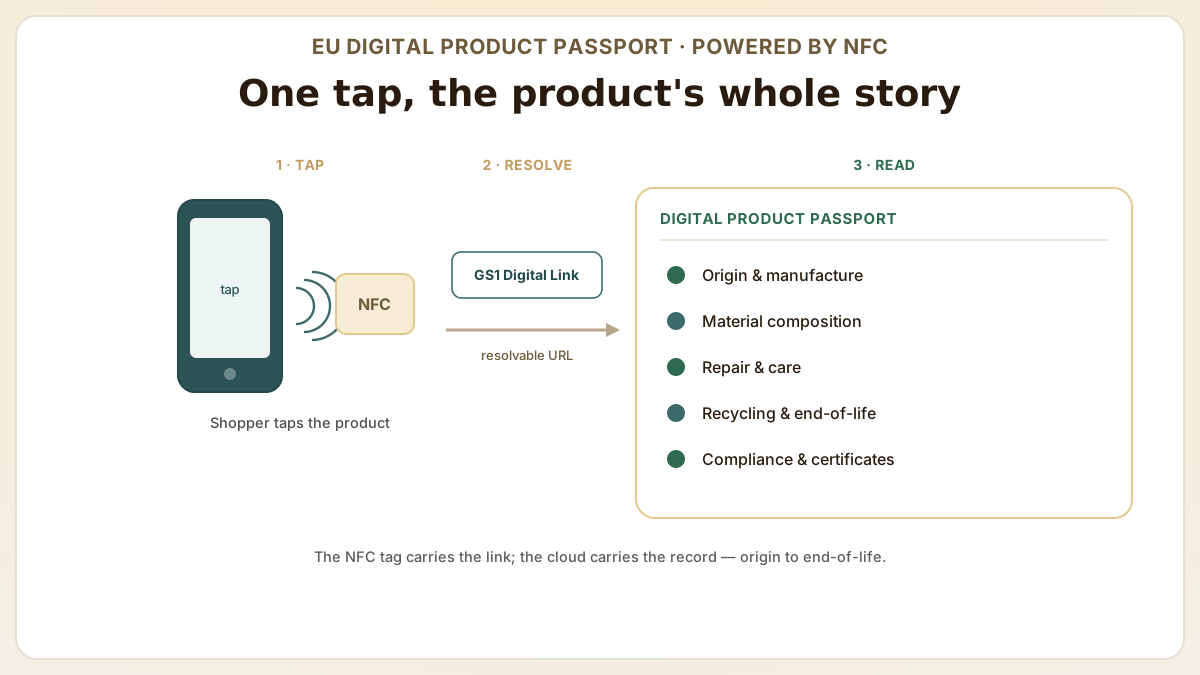
EU Digital Product Passports start becoming mandatory in 2027, and an NFC tag is how a shopper actually taps a product to read one — its origin, materials, repair guide and recycling route. This is the specification-level guide to how NFC tags carry EU-mandated Digital Product Passports (DPP) for textiles, batteries, electronics and construction materials: the regulatory requirements, data architecture, tag selection and implementation timelines B2B manufacturers and brand owners have to get right.
- The EU's Ecodesign for Sustainable Products Regulation (ESPR) mandates Digital Product Passports for multiple product categories starting in 2027, creating a massive B2B market for NFC-enabled product tagging.
- NFC tags provide the consumer-accessible interface for DPP data. A smartphone tap retrieves product origin, material composition, repair guides and recycling instructions.
- DPP implementation requires coordination between NFC hardware, cloud-hosted data repositories, GS1 identification standards and product-lifecycle management systems.
At a glance
Use these short answers to decide whether this page matches the project before moving into the detail.
Key takeaway
The EU's Ecodesign for Sustainable Products Regulation (ESPR) mandates Digital Product Passports for multiple product categories starting in 2027, creating a massive B2B market for NFC-enabled product tagging.
What is a Digital Product Passport?
Somewhere in Brussels, a regulation decided that every battery, garment, and laptop sold in the EU should be able to explain itself — where it came from, what it is made...
Next step
Ready to move forward? Start your inquiry to get specific answers for this project.
Plan your DPP implementationWhat is a Digital Product Passport?
Somewhere in Brussels, a regulation decided that every battery, garment, and laptop sold in the EU should be able to explain itself — where it came from, what it is made of, and how to recycle it — to anyone holding a smartphone. Manufacturers received this as a compliance deadline; their customers will experience it as a tap. A Digital Product Passport (DPP) is a structured digital record that accompanies a physical product throughout its lifecycle, providing standardized information on material composition, manufacturing origin, environmental footprint, repairability and end-of-life recycling pathways. The tag that makes the tap work is the cheap part of the project; the structured data behind it — mapped below — is the part that keeps program managers up at night.
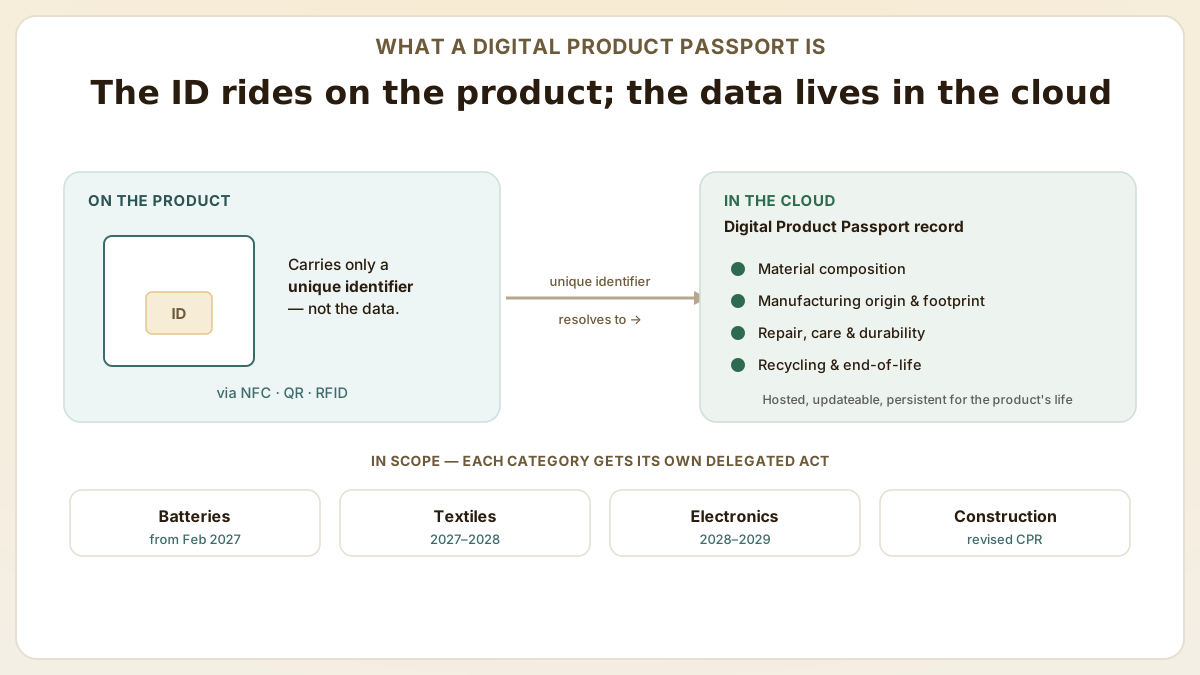
The EU's ESPR framework mandates DPPs as a tool to advance circular-economy objectives. Each product category will have delegated acts specifying which data elements must be included in the passport. The data is hosted on a cloud platform and linked to the physical product via a unique identifier carried on an NFC tag, QR code or RFID label.
- Batteries: DPP requirements apply from February 2027, covering battery chemistry, capacity, carbon footprint, recycled content and collection instructions — the category with the earliest, most detailed rules, unpacked in the EU battery passport implementation guide.
- Textiles: DPP requirements expected from 2027–2028, covering fiber composition, country of manufacturing, care instructions and recyclability — the apparel DPP deep dive covers the fashion-specific data model.
- Electronics: DPP timelines vary by delegated act, targeting energy efficiency, repairability scores, hazardous substance declarations and spare-part availability.
- Construction products: DPP requirements align with the revised Construction Products Regulation, covering environmental declarations and performance characteristics.
Why NFC is the preferred DPP carrier
For a DPP carrier, NFC's edge over a plain QR code comes down to three things a procurement team actually cares about: authenticity, durability and a consumer experience that survives contact with a real customer. A QR code can carry the same link — the table below is where the two quietly part ways.
| Criterion | NFC tag | QR code | UHF RFID |
|---|---|---|---|
| Consumer access | Smartphone tap: no app needed | Camera scan: requires focus/alignment | Requires dedicated reader: no consumer access |
| Authentication | Chip UID + cryptographic signing (NTAG 424 DNA) | Visual code: easily duplicated | EPC: no consumer-facing authentication |
| Durability | Embedded in product: survives washing, handling | Printed: fades, tears, abrades | Tag dependent: good for logistics, less for consumer |
| Data capacity | URL link to cloud (unlimited data) | URL link to cloud (unlimited data) | On-tag EPC + user memory (limited) |
| Cost per unit | $0.08 – $0.25 | $0.01 – $0.03 (print cost) | $0.03 – $0.10 |
| Anti-counterfeit | Strong: cryptographic chip identity | Weak: code is easily reproduced | Moderate: EPC cloning is possible |
Which NFC tag do you select for a DPP?
The tag in a DPP-compliant product has three jobs: survive the product's expected lifetime, resist tampering and provide cryptographic authentication so nobody can mint a counterfeit passport. Which chip you pick is mostly a question of how much of that third job you actually need — the decision map below sorts it out.
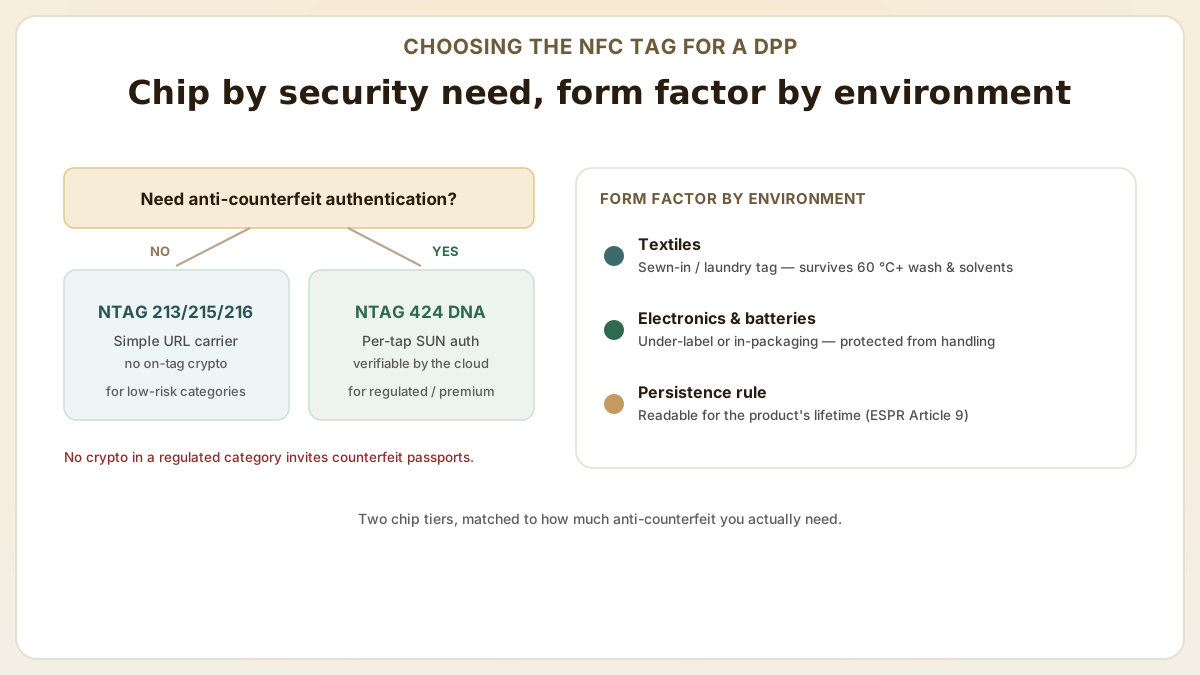
- NTAG 424 DNA (NXP) is purpose-built for DPP and authentication applications. It generates a unique, one-time authentication code (SUN message) on every tap, verifiable by the cloud backend.
- NTAG 213/215/216 are suitable for basic DPP implementations where the tag serves as a simple URL carrier without on-tag cryptographic authentication.
- Textile DPP tags must survive industrial washing (60 °C+), dry cleaning solvents and mechanical agitation. RFID laundry tags or sewn-in NFC labels are required.
- For electronics and batteries, NFC tags can be embedded under the product label or in the packaging, where they are protected from mechanical damage.
How do data architecture and standards work?
It is tempting to picture the entire passport living on the chip. It does not. A DPP is not a monolithic data file on the tag; it is a distributed data architecture, with the NFC tag providing a resolvable link to a cloud-hosted data record. The diagram below traces the whole path from tap to data.
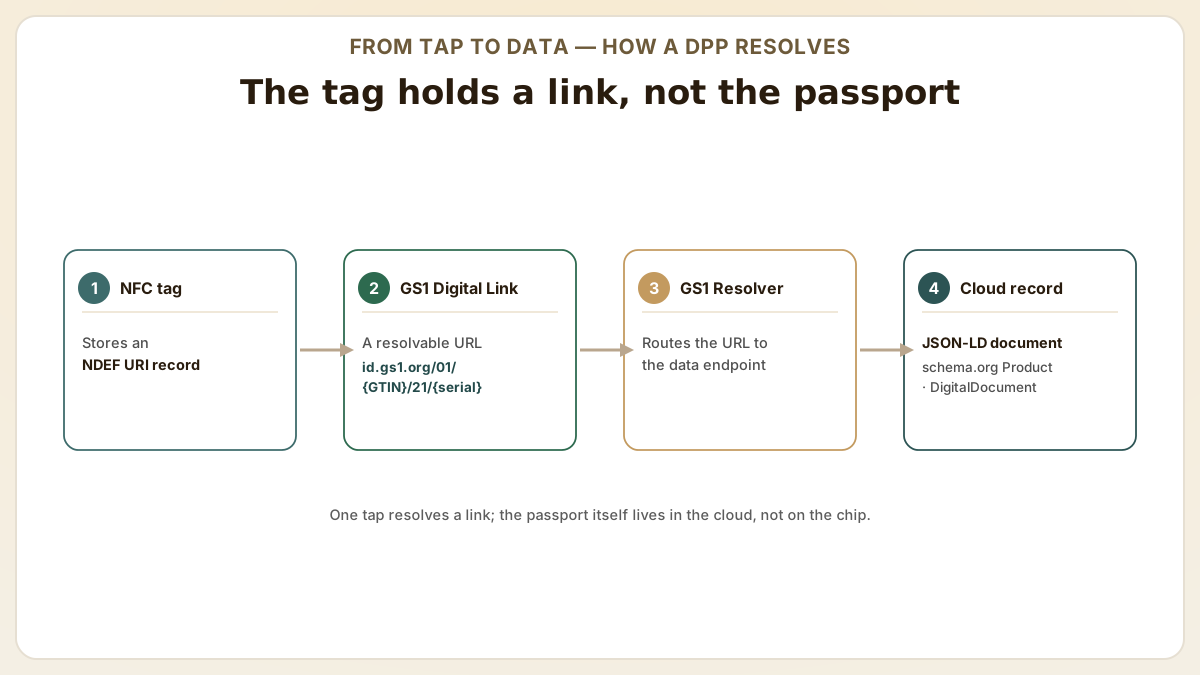
The GS1 Digital Link standard provides the URI structure for DPP identifiers: a product GTIN (Global Trade Item Number) combined with a serial number, encoded as a URL that resolves to the product's DPP data endpoint. The NFC tag stores this GS1 Digital Link URL as an NDEF URI record. When tapped, the smartphone browser resolves the URL to the manufacturer's DPP data repository or a neutral registry.
- GS1 Digital Link format: https://id.gs1.org/01/{GTIN}/21/{serial} — resolvable to product-specific data via GS1 Resolver infrastructure.
- DPP data is typically served as a JSON-LD document conforming to schema.org Product and DigitalDocument types.
- Decentralized identifiers (DIDs) and verifiable credentials (VCs) are being explored as trust layers to ensure DPP data integrity without relying on a single centralized registry.
- Manufacturers must plan for 10–20 year data-hosting obligations matching product lifespans. Cloud storage and URL persistence are critical architectural decisions.
What's the implementation roadmap for B2B manufacturers?
Manufacturers should begin DPP preparation now, even before delegated acts are finalized. The alternative — waiting for the rules to be perfectly clear, then sourcing tags, standing up a data backend, and re-tooling a production line in the weeks before a mandate — is how a planned budget line becomes an emergency one. Starting early costs less and panics no one; the four phases below keep it a budget line rather than a fire drill.
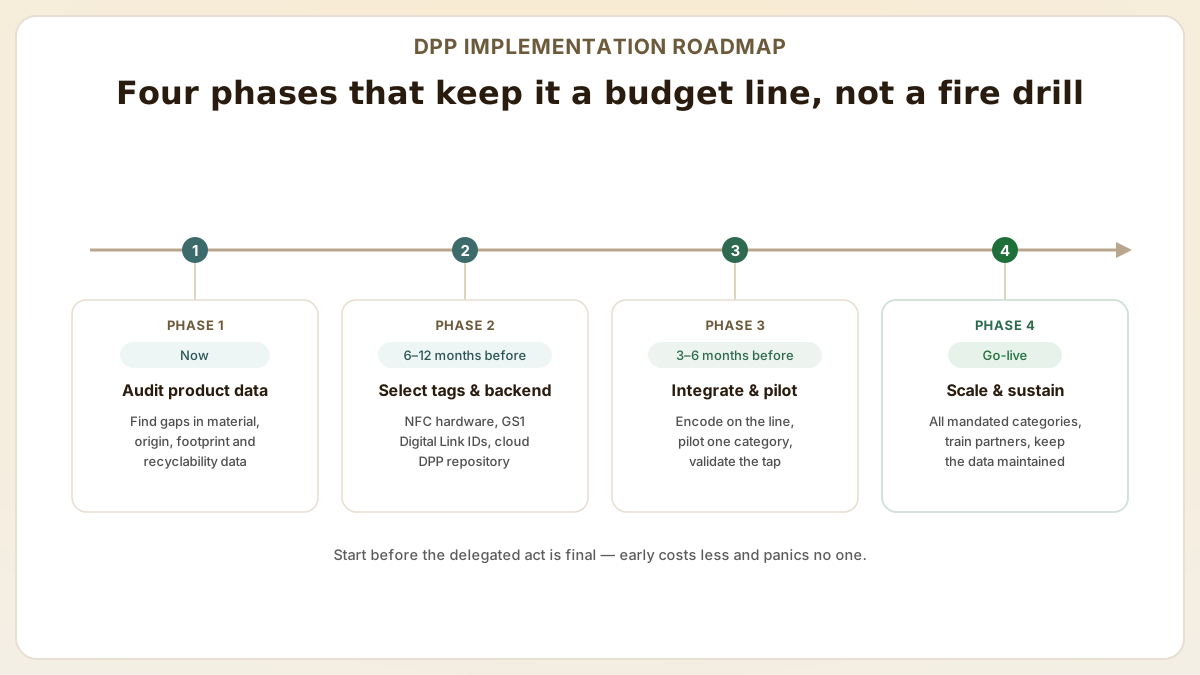
- Phase 1 (now): Audit product-data availability. Identify gaps in material composition, supplier origin, carbon-footprint and recyclability data.
- Phase 2 (6–12 months before mandate): Select NFC tag hardware, establish GS1 Digital Link identifiers and build or procure the cloud DPP data repository.
- Phase 3 (3–6 months before mandate): Integrate NFC tag encoding into production lines, pilot with a single product category and validate consumer tap experience.
- Phase 4 (go-live): Scale to all mandated product categories, train supply-chain partners on source-tagging requirements and establish ongoing data-maintenance workflows.
What does the ESPR delegated-act timeline actually look like?
ESPR Regulation (EU) 2024/1781 entered into force in July 2024 as a framework — not a single compliance date. Each product category receives its own delegated act and 18+ month transition period. The Commission published the ESPR Working Plan 2025-2030 on 16 April 2025, which set the order in which categories will receive delegated acts. Read the timeline below as a queue, not a calendar: the dates slip, but the order rarely does.
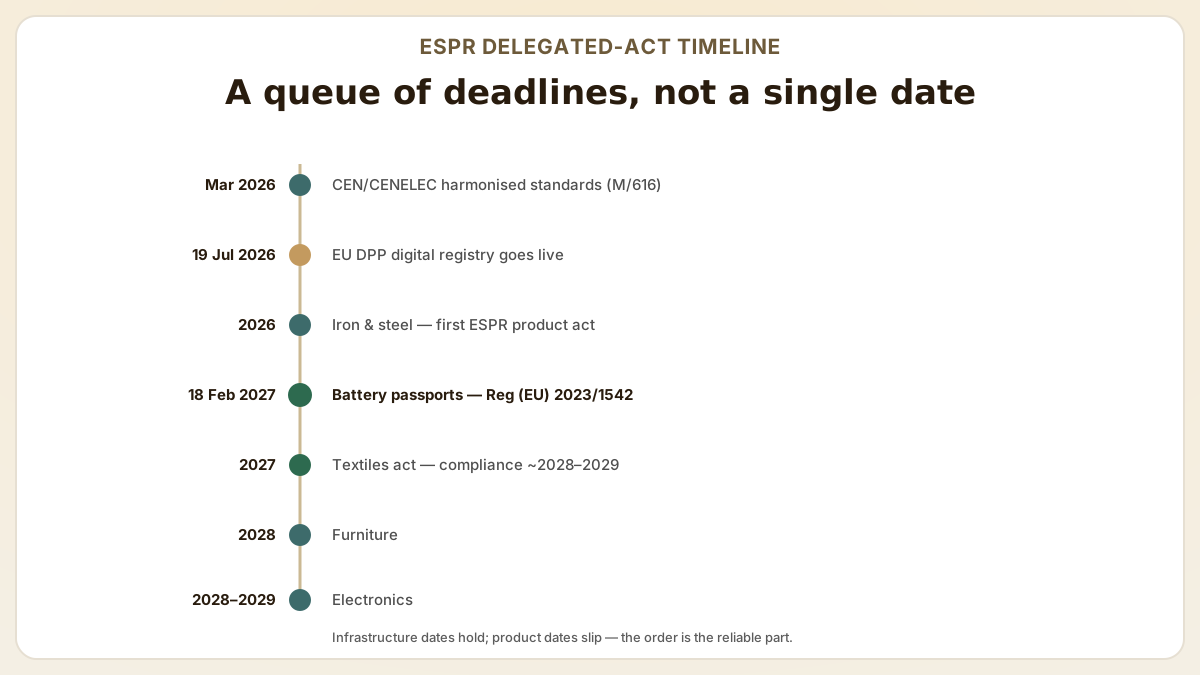
- By 19 July 2026 the Commission must stand up the EU DPP digital registry that stores the unique identifiers — that infrastructure deadline is on track even when product-specific deadlines slip. Brand-side DPP backends should be designed to interoperate with this registry from day one.
- Battery passports go live first: from 18 February 2027, EV batteries, industrial batteries above 2 kWh, and LMT (light means of transport, e.g., e-bike) batteries on the EU market must carry a DPP retrievable via QR — under Regulation (EU) 2023/1542. The Commission's battery due-diligence guidelines are expected by 26 July 2026.
- ESPR product-specific delegated acts: iron and steel adoption expected 2026 (the first ESPR product act), textiles 2027 (compliance ~late 2028 / 2029), furniture 2028, electronics 2028-2029. The first delegated acts have already slipped 6-9 months from the originally planned late-2025 dates.
- Adjacent regulations create overlapping obligations: the revised Detergents Regulation (EU) 2025/411 (Council approval December 2025) and the Toy Safety Regulation (EU) 2025/279 (application from August 2030) both add DPP-style passports outside ESPR. End-of-Life Vehicles Regulation, Critical Raw Materials Act and revised Construction Products Regulation each add their own product-passport obligations.
- CEN/CENELEC harmonised standards under European Commission Standardisation Request M/616 (2024) are scheduled to land March 2026 — these will dictate DPP data model interoperability, so brands shouldn't lock proprietary schemas before then.
Which NFC chip and encoding choices stay future-proof through the ESPR rollout?
Here is the timing trap: compliance dates land in 2027-2030, but a tag ordered today has to survive a 5-10+ year product lifecycle — so the chip and encoding decisions made in 2026 are the ones that either age gracefully or force an expensive re-tag. This is the section worth over-thinking now, because you cannot patch a chip in the field.
- Default to NTAG 424 DNA (or DESFire EV3 for higher security) for any product likely to fall under ESPR or sectoral DPP. Plain NTAG213/215/216 work for low-risk categories, but their lack of cryptographic SUN/CMAC authentication exposes brands to counterfeit-DPP attacks once enforcement scales.
- Specify GS1 Digital Link 1.4.x grammar at encoding time: `https://id.gs1.org/01/{GTIN}/21/{serial}` (or your brand-controlled resolver). One URL covers product info, anti-counterfeit landing page and DPP — and aligns with GS1 EU DPP guidance.
- Plan EPCIS 2.0 event emission from manufacturing, customs handover and repair events. EPCIS 2.0 is JSON-LD native and is rapidly becoming the de facto event schema for DPP supply-chain data in EU pilots.
- Pick tamper-evident form factors (NTAG 424 DNA TT) for categories where a substituted chip on a counterfeit shell would be valuable to attackers — luxury, electronics, high-value batteries.
- Validate persistence: ESPR Article 9 requires the data carrier to remain accessible for the product's expected lifetime. For textiles that means surviving 60 °C+ industrial wash and dry-cleaning solvents (sewn-in NFC laundry tags); for electronics and batteries that means under-label or in-mould placement that survives normal handling and end-of-life recovery.
Useful next pages
Use these linked product, guide and comparison pages to keep the next click specific and practical.
NFC tags for Digital Product Passports
NFC stickers and labels for embedding DPP links in products, packaging and labels.
Authentication-grade NFC products
NFC tags with cryptographic authentication for anti-counterfeit DPP implementations.
FAQ
When do Digital Product Passports become mandatory?
The EU battery DPP regulation applies from February 2027. Textile DPP requirements are expected in 2027–2028. Electronics and other product categories will follow via individual delegated acts under the ESPR framework. Non-EU manufacturers exporting to the EU must also comply.
Can a QR code replace an NFC tag for DPP compliance?
The ESPR regulation does not mandate a specific data carrier technology. QR codes are technically compliant. However, NFC tags offer significant advantages in durability, authentication and consumer experience. Many brands are adopting NFC as the primary carrier with a printed QR code as a fallback.
How much does NFC-based DPP tagging cost per product?
At scale (100 000+ units), NFC tag cost ranges from $0.08 to $0.25 per unit depending on chip type (NTAG 213 vs NTAG 424 DNA), form factor and application method. Cloud hosting, data management and integration add $0.01–$0.05 per product per year. Total DPP cost per unit is typically under $0.30.
What data must a Digital Product Passport contain?
Required data elements vary by product category and are defined in delegated acts. Common elements include: product identification (GTIN + serial), material composition, country of manufacturing, carbon footprint, repairability score, hazardous substance declarations, recycling instructions and warranty information.
Which product categories receive ESPR delegated acts first, and when?
Per the ESPR Working Plan 2025-2030 (adopted 16 April 2025): iron and steel is the first product-specific delegated act expected in 2026. Textiles follow in 2027 (compliance ~late 2028 to 2029). Furniture is targeted for 2028 (compliance 2029-2030). Electronics is expected 2028-2029 (compliance 2029-2030). Mattresses, mobile phones and construction materials follow in 2029-2030+. Note that the first ESPR delegated acts have already slipped 6-9 months from the originally planned late-2025 dates — treat published timelines as moving targets and budget for an 18+ month implementation runway regardless of your specific deadline.
How does the EU Battery Regulation 2023/1542 differ from ESPR-driven DPPs?
The Battery Regulation is technically separate from ESPR and pre-dates the ESPR Working Plan, but it serves as the template that ESPR delegated acts will follow. Key differences: (1) the Battery passport is mandatory from 18 February 2027 for EV, ≥2 kWh industrial and LMT (e-bike, e-scooter) batteries — earlier than any ESPR product category; (2) it explicitly requires QR as the data carrier (NFC and RFID are also permitted but QR is the named default); (3) required data includes state-of-health metrics, cobalt and lithium sourcing, and end-of-life handling instructions specific to electrochemistry. Brands subject to both the Battery Regulation and a future ESPR delegated act will typically use one shared data backend, with one tag per product carrying the GS1 Digital Link URL that resolves into the appropriate passport view.
Sources & references
Primary standards, OEM datasheets and regulatory documents cited by this article. All URLs were verified on the access date shown below.
- Regulation (EU) 2024/1781 — Ecodesign for Sustainable Products Regulation (ESPR)
Framework regulation establishing the Digital Product Passport; entered into force 18 July 2024.
- Regulation (EU) 2023/1542 — EU Batteries Regulation
Battery passport provisions apply from 18 February 2027 for EV, industrial (>2 kWh) and LMT batteries.
Proud Tek is a Shenzhen-based RFID & NFC manufacturer supplying hotel chains, transit operators, event venues and retail brands worldwide. Every order includes free samples, RF testing and dedicated project support.
Get a Quick Quote
Tell us about your project and we'll respond within one business day. Fields marked (asterisk) are required.