
Industry Trends
RFID Market Trends and Forecast 2025
2030
Quick answer
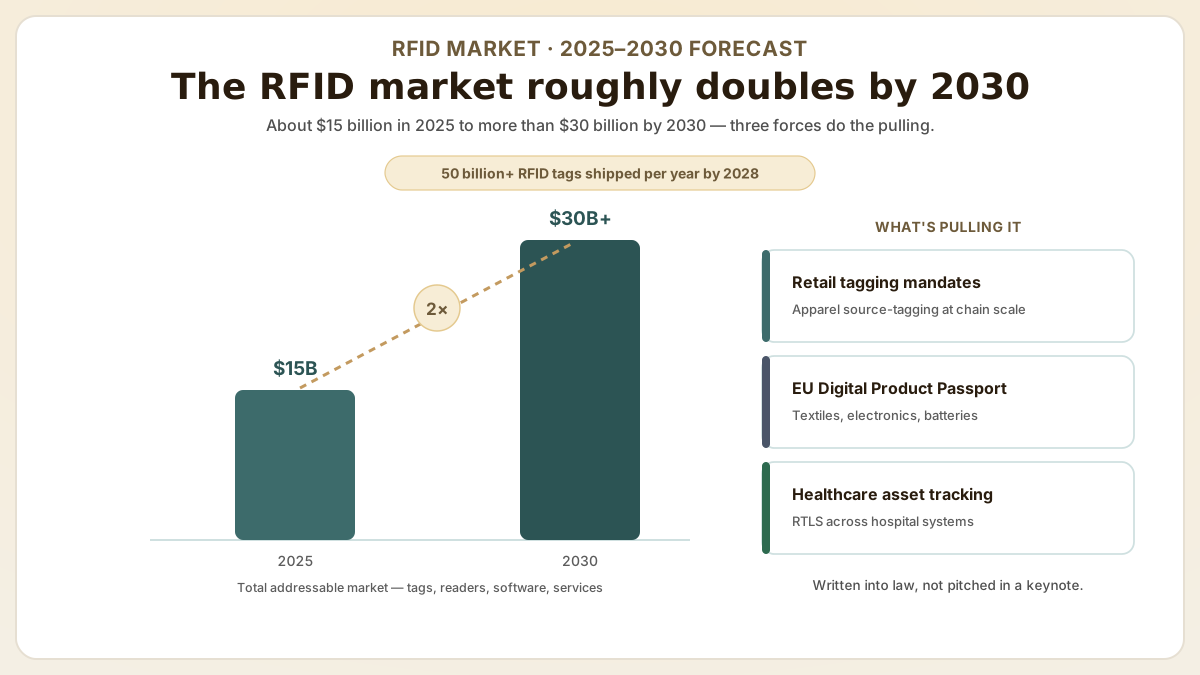
The global RFID market roughly doubles from about $15 billion in 2025 to over $30 billion by 2030, as retail tagging mandates, the EU Digital Product Passport and healthcare RTLS turn adoption from a keynote pitch into law. A 2025–2030 forecast of growth drivers, vertical CAGRs, pricing and strategy for B2B RFID suppliers and system integrators.
- The global RFID market is projected to grow from $15 billion in 2025 to over $30 billion by 2030, driven by retail item-level tagging mandates, EU Digital Product Passport regulations and healthcare asset-tracking expansion.
- UHF RFID tag volumes are growing at 20–25 percent CAGR as apparel retailers transition from pilot programs to chain-wide source-tagging mandates.
- NFC tag demand is accelerating beyond payments into product authentication, consumer engagement and regulatory compliance applications.
At a glance
Use these short answers to decide whether this page matches the project before moving into the detail.
Key takeaway
The global RFID market is projected to grow from $15 billion in 2025 to over $30 billion by 2030, driven by retail item-level tagging mandates, EU Digital Product Passport regulations and healthcare asset-tracking expansion.
How do market size and growth trajectory work?
Every few years, someone stands in front of a procurement committee with a slide showing RFID adoption curving sharply up and to the right — and every few years the curv...
Next step
Ready to move forward? Start your inquiry to get specific answers for this project.
Discuss RFID strategyHow do market size and growth trajectory work?
Every few years, someone stands in front of a procurement committee with a slide showing RFID adoption curving sharply up and to the right — and every few years the curve quietly flattens back into the footnotes. What is different about this decade is almost too dull to make a good slide: the growth is being written into law rather than pitched in a keynote, which is exactly why this forecast is worth reading literally. The RFID industry has transitioned from a niche automatic-identification technology to a mainstream data-capture platform deployed across retail, logistics, healthcare, automotive and government verticals.
Industry analysts project the total addressable RFID market (including tags, readers, software and services) to exceed $30 billion by 2030, up from approximately $15 billion in 2025. Tag volumes alone are expected to surpass 50 billion units annually by 2028, driven primarily by apparel retail mandates and logistics labeling standards.
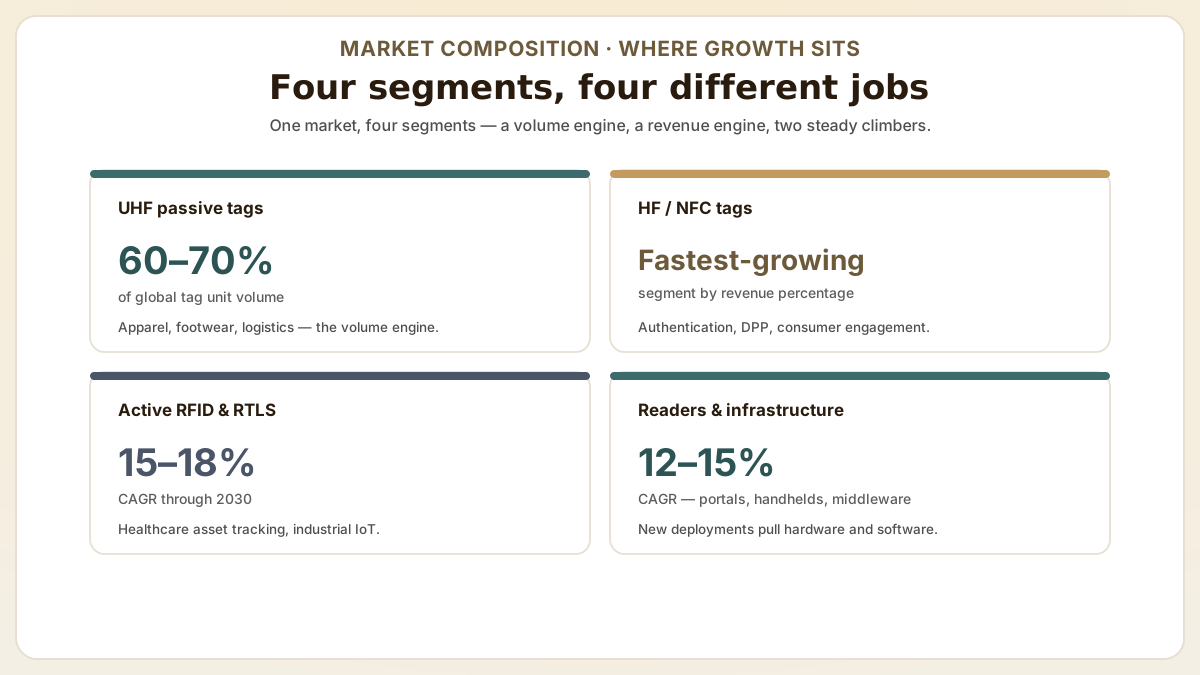
- UHF RFID passive tags account for the largest volume segment, with apparel, footwear and logistics driving 60–70 percent of unit demand.
- HF/NFC tags are the fastest-growing segment by revenue percentage, driven by authentication, DPP and consumer-engagement use cases.
- Active RFID and RTLS markets are growing at 15–18 percent CAGR, fueled by healthcare asset tracking and industrial IoT applications.
- RFID reader and infrastructure revenue is growing at 12–15 percent CAGR as new deployments require portal readers, handhelds and middleware platforms.
What are the key growth drivers by vertical?
Growth is not spread evenly — six verticals pull demand at very different speeds, and backing the wrong one is how a confident five-year market-development plan turns into next year's cautionary slide. The table below ranks them by the RFID application driving adoption, the force behind it, and the pace each is setting through 2030.
| Vertical | Primary RFID application | Growth driver | 2025–2030 CAGR |
|---|---|---|---|
| Apparel retail | Item-level inventory (UHF) | Omnichannel fulfillment mandates | 20–25 % |
| Logistics / 3PL | Case and pallet tracking (UHF) | Automation, labor-cost reduction | 15–20 % |
| Healthcare | Patient and asset tracking (HF/UHF) | Safety regulations, RTLS expansion | 18–22 % |
| Automotive | Parts tracking, vehicle access (UHF/HF) | Supply-chain visibility, EV battery DPP | 12–16 % |
| Consumer goods | Product authentication (NFC) | EU DPP regulation, brand protection | 25–30 % |
| Hospitality | Key cards, wristbands (HF) | Contactless guest experience | 10–14 % |
What are the RFID technology evolution trends?
The tag itself is not standing still. Five technical shifts are quietly rewriting what an RFID label can do — from disappearing under a jewelry hangtag to sensing temperature, and eventually printing for less than a rounding error. The horizon below sorts them by how close each is to your loading dock.
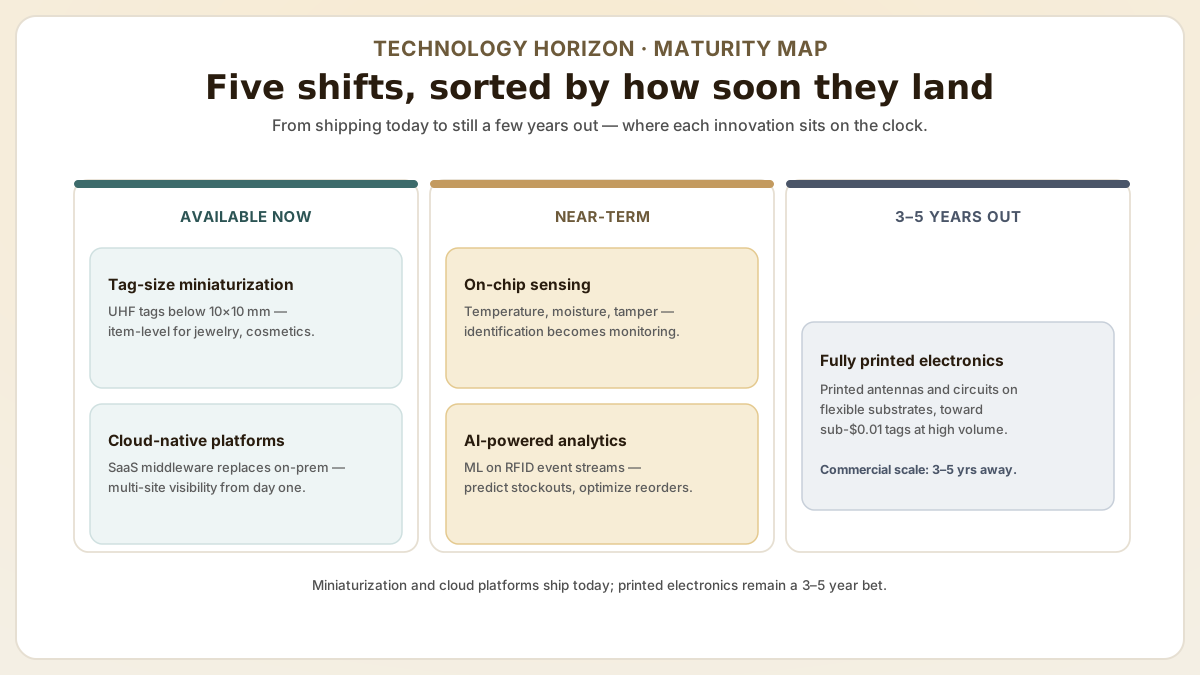
- Tag-size miniaturization: UHF tags below 10 × 10 mm are enabling item-level tagging for jewelry, cosmetics and pharmaceutical unit-dose packaging.
- On-chip sensing: Next-generation UHF chips integrate temperature, moisture and tamper-detection sensors, extending RFID from identification to condition monitoring.
- Printed electronics: Fully printed RFID antennas and circuits on flexible substrates promise sub-$0.01 tag costs at very high volumes, though commercial-scale production remains 3–5 years away.
- Cloud-native RFID platforms: SaaS middleware platforms replace on-premises RFID middleware, reducing deployment complexity and enabling multi-site visibility from day one.
- AI-powered RFID analytics: Machine-learning algorithms applied to RFID event streams detect anomalies, predict stockouts and optimize replenishment cycles.
How do pricing trends and cost structure work?
Tag pricing is the most critical variable in RFID total cost of ownership — and the one line item every procurement team can quote from memory, usually to more decimal places than the rest of the budget ever gets. The trajectory below traces where UHF, NFC and specialty tag prices have been and where they are heading — the raw material for any contract negotiation or program budget. For the apparel inlay math in detail, see the item-level tagging cost model.
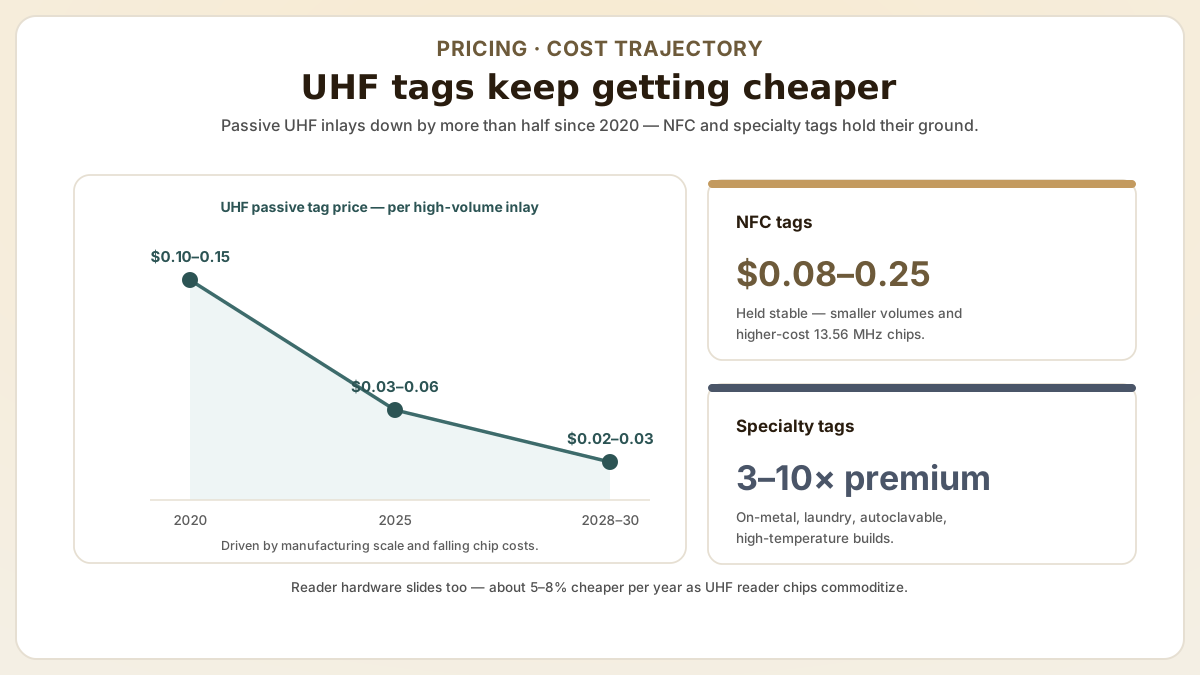
- UHF passive tag prices have declined from $0.10–$0.15 in 2020 to $0.03–$0.06 in 2025 for high-volume apparel inlays, driven by manufacturing scale and chip-cost reductions.
- NFC tag prices remain relatively stable at $0.08–$0.25 due to smaller production volumes and higher-cost 13.56 MHz chip architectures.
- Specialty tags (on-metal, laundry, autoclavable, high-temperature) carry 3–10x premiums over standard labels due to materials and engineering complexity.
- Reader hardware prices are declining 5–8 percent annually as competition increases and UHF reader chips become commoditized.
- Software and integration services represent an increasing share of total RFID project cost as deployments scale from pilots to enterprise-wide rollouts.
What should B2B RFID suppliers and integrators do now?
Position for the market that is arriving, not the one that paid the bills last decade. The five moves below separate the suppliers who ride the retail-and-DPP wave from those still optimizing the access-control card business into a comfortable corner.
- Diversify beyond access-control cards: The highest-growth segments (retail, logistics, DPP) require different tag formats, encoding services and integration capabilities.
- Invest in NFC authentication products: DPP mandates and brand-protection demand are creating a large, recurring market for NFC tags with cryptographic authentication.
- Build source-tagging services: Retailers are pushing tagging responsibility upstream to suppliers and manufacturers. B2B RFID providers who offer encoding and application services capture more value per tag.
- Develop sustainability-certified product lines: ESG-mandated procurement policies are filtering the vendor landscape toward suppliers who can document recycled content, carbon footprint and end-of-life recyclability.
- Offer cloud-connected middleware: The shift from on-premises to SaaS RFID platforms creates recurring-revenue opportunities for B2B integrators.
Regulatory tailwinds shaping 2026-2030 — DPP, DSCSA, FMD, Battery Reg, T2/T3 mandates
Regulation is the single biggest driver of RFID market growth in this decade — the rare forecast you can read straight out of a statute book. Five regulatory waves are pulling demand independently, at different rates and across different verticals; the timeline below plots when each one starts to bite. For the deep dive, see the EU Digital Product Passport 2027 guide.
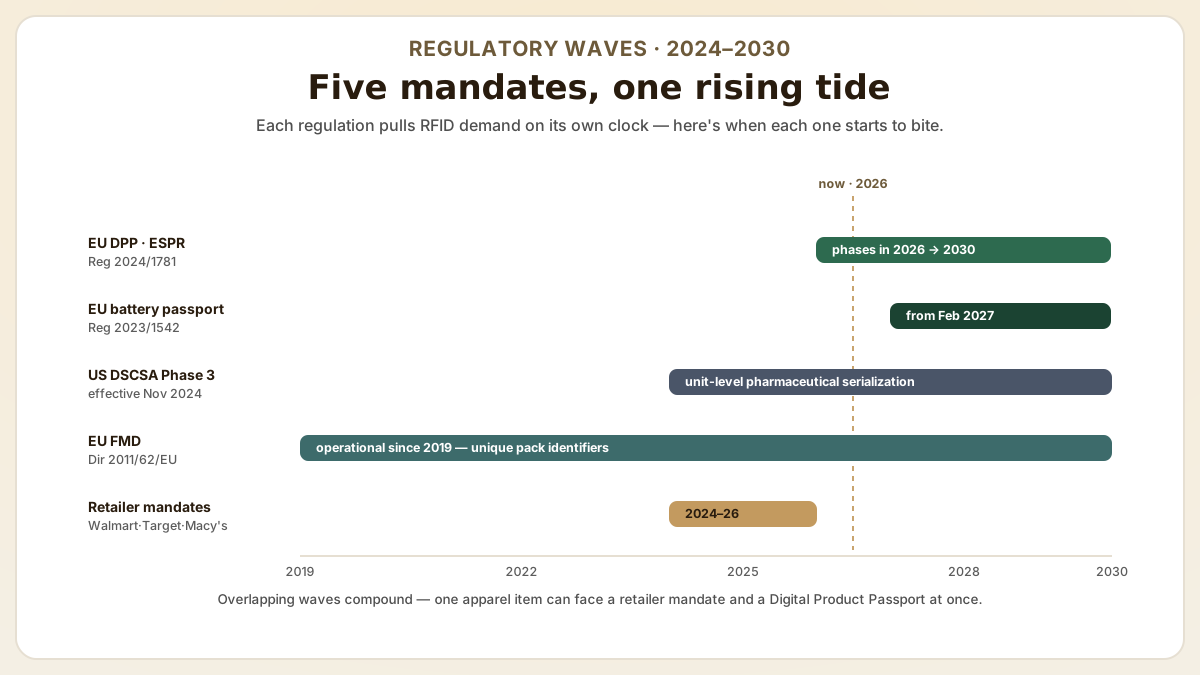
- EU ESPR Digital Product Passport (Regulation 2024/1781) — phased rollout 2026-2030 covering textiles, electronics, batteries, construction. NFC + UHF dual-chip the dominant carrier; expected to add 5-10 billion NFC tag units per year by 2028.
- EU Battery Regulation (2023/1542) — battery passport mandatory from February 2027 for industrial batteries >2 kWh and EV batteries. CATL, LG Energy, Northvolt, Panasonic, Gotion all driving NFC-tagged battery deployments now.
- US DSCSA Phase 3 (Drug Supply Chain Security Act) — effective November 2024, requires unit-level tracking and pharmaceutical serialisation. Wholesalers and dispensers must accept GS1 SGTIN-encoded packaging; RFID/NFC complementary to 2D barcodes for tamper-evidence.
- EU FMD (Falsified Medicines Directive 2011/62/EU) — operational since 2019, requires unique product identifier on prescription packaging. Combined with NFC NTAG 213 TT (Tag Tamper) chip detects cap removal; growing into wider adoption by Pharmacist Direct programmes.
- Walmart, Target and Macy's source-tagging mandates — Walmart RFID Phase 5 (2024-2026), Target T2/T3 (2024-2025), Macy's Vendor Compliance (2024). Combined the three drive 80%+ of UHF apparel inlay volume in North America. Inditex (Zara), H&M, Decathlon and Uniqlo run equivalent European-scale programmes.
Tier-1 deployment leaders by vertical — who's already at scale in 2026
When sizing your own deployment or building a business case, knowing who's already running at scale tells you both the capacity of the supplier base and the ROI ceiling for your category. The brands below have all published RFID metrics in earnings calls, sustainability reports or NRF/RAIN Alliance keynotes — which is to say they were happy to share the numbers only once the numbers stopped being embarrassing.
- Apparel and footwear — Walmart (5+ billion UHF tags/year mandate), Inditex/Zara (full item-level since 2016), H&M (rolling out 2024-2026), Decathlon (1,700+ stores 100% tagged), Macy's (full chain), Lululemon (98%+ accuracy), Nike, Adidas, Uniqlo. RAIN UHF dominant; SML and Avery Dennison co-lead inlay supply.
- Logistics and 3PL — Kuehne+Nagel, DSV, DHL Supply Chain, FedEx, UPS, Maersk Logistics rolling RFID into containerisation, returnable transport item (RTI) and last-mile parcel. Cintas, UniFirst, Aramark/Vestis dominate uniform/laundry. Confidex and Xerafy lead industrial tag supply.
- Healthcare — major US hospital systems (HCA, Tenet, Ascension, Kaiser Permanente), surgical sponge tracking via Stryker SurgiCount + RFID (FDA + AORN compliance), pharmaceutical wholesalers (Cardinal Health, Owens & Minor, McKesson, AmerisourceBergen) for DSCSA. NXP DESFire EV3 and HID Trusted Tag dominant for patient ID.
- Hospitality — Marriott Bonvoy, Hilton Honors, IHG, Accor, Hyatt at near-100% MIFARE DESFire EV3 hotel key conversion. ASSA ABLOY VingCard, dormakaba Saflok, Salto, Onity dominate lock supply. Wristband programmes at all-inclusive resorts (Sandals, Beaches, Club Med).
- Consumer goods authentication — LVMH (Aura Blockchain Consortium), Estée Lauder, L'Oréal, Hennessy, Moët-Hennessy, Pernod Ricard. NXP NTAG 424 DNA the de-facto standard chip for premium NFC anti-counterfeit + DPP.
Useful next pages
Use these linked product, guide and comparison pages to keep the next click specific and practical.
NFC tags and stickers
NFC products for consumer engagement, product authentication and Digital Product Passport applications.
RFID cards and tags
Blank RFID cards, windshield tags and specialty tags for access control, logistics and asset tracking.
Industry research and analyst references
Authoritative market research and standards organisations cited throughout this forecast.
FAQ
How large is the global RFID market in 2025?
The global RFID market (including tags, readers, software and services) is estimated at approximately $15 billion in 2025. Tag revenue accounts for roughly 40 percent, with readers, software and integration services making up the remainder.
Which RFID segment is growing fastest?
By unit volume, UHF passive tags for retail item-level tagging are the fastest-growing segment at 20–25 percent CAGR. By revenue growth rate, NFC tags for product authentication and Digital Product Passports are growing at 25–30 percent CAGR from a smaller base.
Will RFID tag prices continue to decline?
UHF tag prices are expected to continue declining toward $0.02–$0.03 at very high volumes by 2028–2030 as manufacturing scales and chip costs decrease. NFC tag prices will decline more slowly due to lower volumes and more complex chip architectures. Specialty tags will retain premium pricing due to materials and engineering requirements.
Which regulations are driving RFID demand through 2030?
Five regulatory waves dominate. The EU ESPR Digital Product Passport (Regulation 2024/1781) phases in from 2026 across textiles, electronics and batteries; the EU Battery Regulation (2023/1542) makes a battery passport mandatory from February 2027; US DSCSA Phase 3 (effective November 2024) requires unit-level pharmaceutical tracking; the EU Falsified Medicines Directive has required a unique identifier on prescription packaging since 2019; and Walmart, Target and Macy's source-tagging mandates drive most North American UHF apparel inlay volume.
Which RFID chip vendors are gaining or losing share in 2026?
On the UHF side, NXP UCODE 9 and Impinj M730/M750/M770 dominate volume share (combined ~75-85% of source-tagged retail mandate inlays); Alien Higgs-9 holds steady niche share. EM Microelectronic and STMicroelectronics serve specialised low-cost and chip-DNA segments. On the HF/NFC side, NXP MIFARE and NTAG dominate (>70% global), with Infineon (CIPURSE) and STMicroelectronics ST25 chipsets gaining in transit and access control. The Chinese ecosystem (Fudan, Shanghai Belling, NationZ) supplies large domestic markets but is largely excluded from regulated Western retail and government mandates due to procurement security policies.
How fast is the active RFID and BLE-RFID hybrid market growing?
Active RFID (battery-powered tags with longer range and richer sensing) and Bluetooth Low Energy (BLE) RTLS are growing at 18-22% CAGR through 2030, faster than the headline RFID market. Use cases concentrate on healthcare patient/asset tracking (Stanley Healthcare, Sonitor, CenTrak, Versus), construction equipment tracking (Tive, BlackBerry Radar, Powerfleet) and industrial IoT (HID Bluzone, Wirepas, Quuppa). The hybrid trend — UHF RFID for low-cost item ID + BLE/UWB for real-time location — drives much of the growth, with Apple AirTag and Google Find My Device commoditising the consumer-facing tracker layer.
Sources & references
Primary standards, OEM datasheets and regulatory documents cited by this article. All URLs were verified on the access date shown below.
Proud Tek is a Shenzhen-based RFID & NFC manufacturer supplying hotel chains, transit operators, event venues and retail brands worldwide. Every order includes free samples, RF testing and dedicated project support.
Get a Quick Quote
Tell us about your project and we'll respond within one business day. Fields marked (asterisk) are required.