
EU Compliance
EU Battery Passport
RFID/NFC Guide for 2027

Quick answer
EU Battery Regulation 2023/1542 requires a Digital Battery Passport for every industrial, EV and LMT battery over 2 kWh from February 2027 — a data record that has to outlive the battery, the paperwork, and possibly the company that made it. Here is how the RFID/NFC data carrier and the CIRPASS-ready backend actually come together.
- EU Battery Regulation (2023/1542) mandates a Digital Battery Passport for every battery over 2 kWh from 18 February 2027 — EV, industrial and light-means-of-transport (LMT). No passport, no EU market.
- The passport rides on a persistent data carrier (QR, NFC, RFID) that has to survive 10+ years, -40°C to +85°C, and the vibration of a vehicle that was never built to be gentle.
- Battery passport data is a biography, not a barcode: manufacturing trace, chemistry composition, charge cycles, second-life status and end-of-life recycling pathway — far richer than an apparel DPP.
At a glance
Use these short answers to decide whether this page matches the project before moving into the detail.
Key takeaway
EU Battery Regulation (2023/1542) mandates a Digital Battery Passport for every battery over 2 kWh from 18 February 2027 — EV, industrial and light-means-of-transport (LMT). No passport, no EU market.
What is the EU Battery Regulation passport?
The EU spent years deciding that batteries should come with paperwork that outlives them, and Regulation 2023/1542 (in force since August 2023) is the result: the Batter...
Next step
Ready to move forward? Start your inquiry to get specific answers for this project.
Get a battery passport NFC quoteWhat is the EU Battery Regulation passport?
The EU spent years deciding that batteries should come with paperwork that outlives them, and Regulation 2023/1542 (in force since August 2023) is the result: the Battery Passport, a mandatory transparency mechanism for industrial, EV and LMT batteries. Every in-scope battery has to carry a persistent identifier that links to a backend data record — and keep carrying it long after anyone remembers installing it.
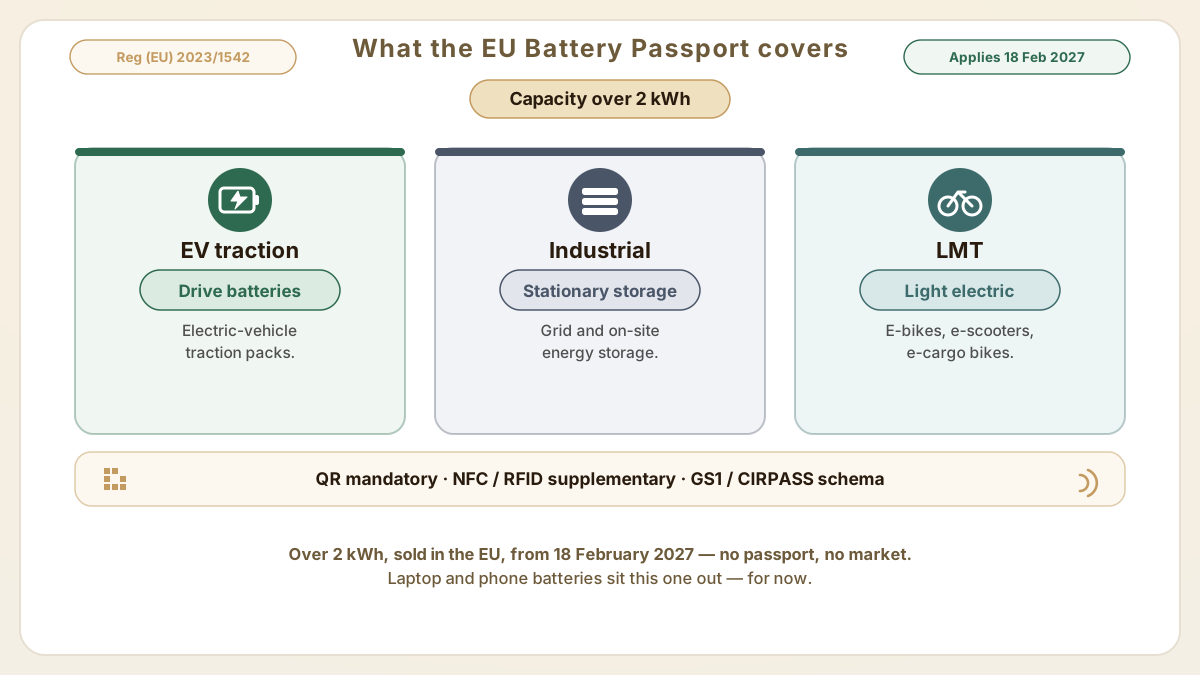
- Scope: batteries over 2 kWh. That sweeps in EV traction batteries, industrial stationary storage and LMT (e-bikes, e-scooters, e-cargo bikes). The laptop and phone in front of you are excluded — for now.
- Mandatory data carrier: a machine-readable QR code on the battery body plus a persistent unique identifier. NFC and RFID are accepted as supplementary carriers, and plenty of manufacturers add NFC purely for the service technician — who, in a noisy bay with gloves on, is rarely in the mood to download an app to read a battery. A tap is the feature that actually gets used.
- Data persistence: the passport must be readable during manufacturing, deployment, second-life repurposing and recycling. Battery lifespans routinely pass 10 years, so persistent is doing real work in that sentence — the carrier has to still be there at the end.
- Cross-border interoperability: readable in any EU member state via standard GS1 / CIRPASS data schemas. Proprietary formats that only your own software can open do not count.
- Enforcement: from February 2027, batteries placed on the EU market without a passport face market-removal orders and per-unit fines under each member state's implementation. We will add it later is not a passport.
What battery data must the passport contain?
A battery passport has to satisfy people who will never be in the same room: the line worker who assembled the pack, the mechanic who replaces it years later, and the recycler who eventually takes it apart for the metals inside. Each one needs a different slice of the truth, and none of them gets to phone the others. That is why battery DPP data is far richer than an apparel DPP — the mandatory data points span the battery's full lifecycle, and pulling them together means wiring the passport into manufacturing MES and field telematics.
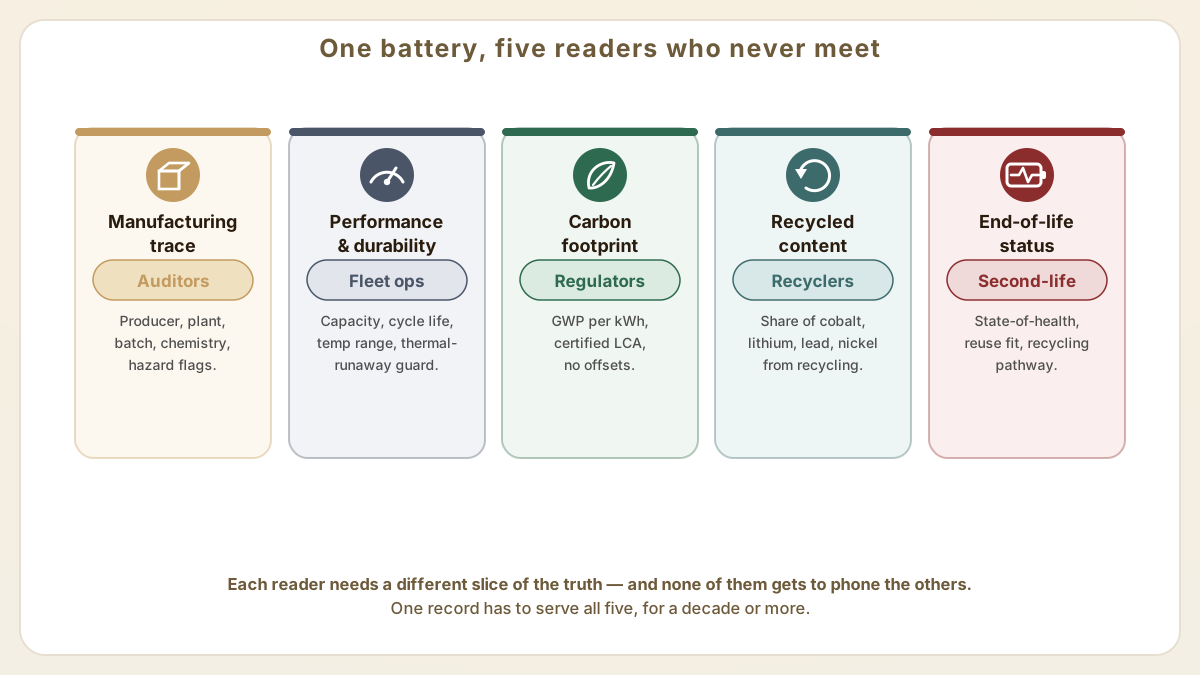
- Manufacturing trace: producer ID, plant ID, batch and date. Chemistry composition by mass (Li-ion variants, Na-ion, etc.) with hazardous-substance flags — the part the recycler quietly cares about most.
- Performance and durability: rated capacity, cycle life, operating temperature range, thermal-runaway protection. Updated periodically over the battery's life, not frozen at the factory gate.
- Carbon footprint: GWP (Global Warming Potential) declared per kWh of energy stored, measured via certified life-cycle assessment. No hand-waving — it has to be calculated.
- Recycled content: percentage of cobalt, lithium, lead and nickel from recycled sources. Mandatory disclosure starts 2027, with minimum thresholds that only rise from there.
- End-of-life status: current state-of-health, second-life suitability, recycling pathway recommendation. Updated by service centers and recyclers — i.e. people the OEM has never met.
How do you implement RFID/NFC on batteries?
Implementing a battery passport is harder than tagging a T-shirt, and not by a little: harsher environment, far longer life, much richer data. A hangtag on a hoodie has to survive the shop floor; a battery tag has to survive a decade strapped to something that gets hot, gets cold, and gets shaken on purpose. The five steps below are how early-mover OEMs structured their 2025-2026 pilots.
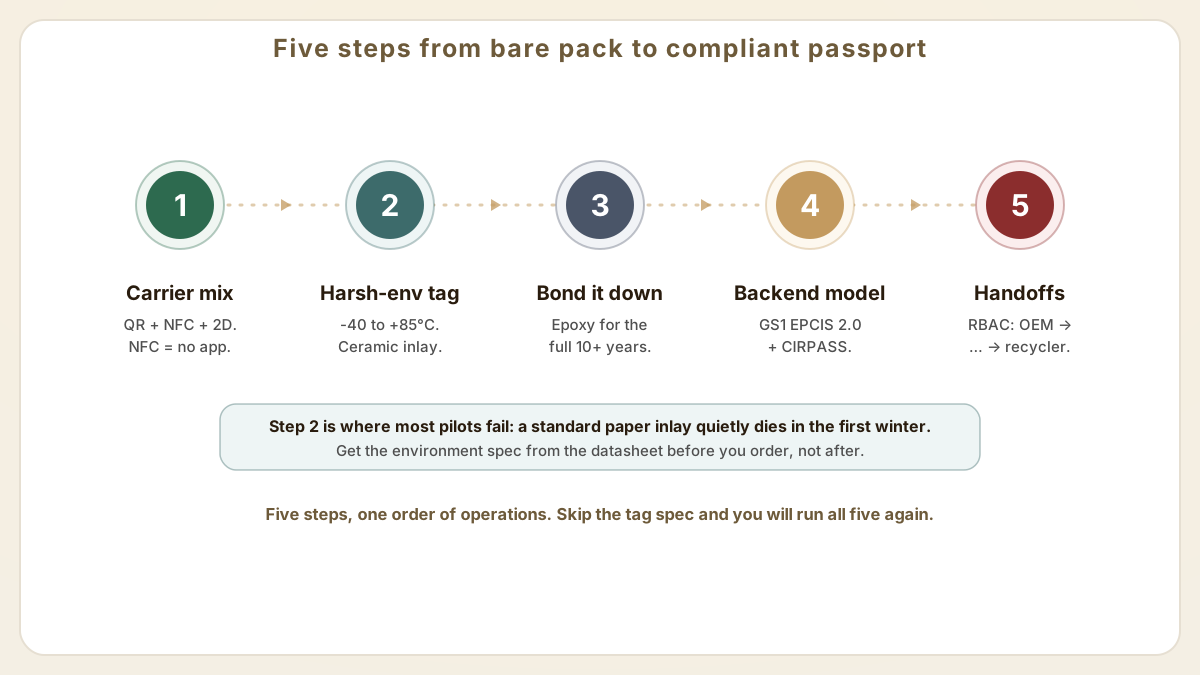
- Choose the data-carrier mix: QR (mandatory) + NFC (recommended) + 2D matrix (industrial). NFC buys you tap-to-update for service technicians who, again, are not installing your app.
- Select a harsh-environment NFC tag: standard inlays quietly fail in battery thermal cycles (-40°C to +85°C). Specify ceramic-substrate or high-temperature inlays rated for automotive use.
- Bond the tag to the casing like you mean it: epoxy or industrial adhesive rated for the full 10+ year lifespan. Stickers peel under temperature cycling, usually the week after the warranty conversation starts.
- Build the backend data model: GS1 EPCIS 2.0 + CIRPASS schemas. Data flows from MES (manufacturing data), BMS (battery management system runtime data) and field telematics (cycle history) into a single unified passport record.
- Plan for ownership transitions: each battery may pass through OEM → fleet operator → second-life user → recycler. The passport must support permission-based read/write at every handoff. A battery can outlast the companies and IT systems that first set up its permissions, so the model has to assume the person who configured it is long gone.
What does the full Battery Regulation 2023/1542 timeline look like beyond 2027?
The 18 February 2027 passport date gets the headline, but anyone signing off on a 10-year tag investment has to plan around the full sequence of obligations Regulation (EU) 2023/1542 layers in — and around the fact that the Commission has already moved some of the goalposts, most notably via Regulation (EU) 2025/1561, which pushed the due-diligence obligations back.
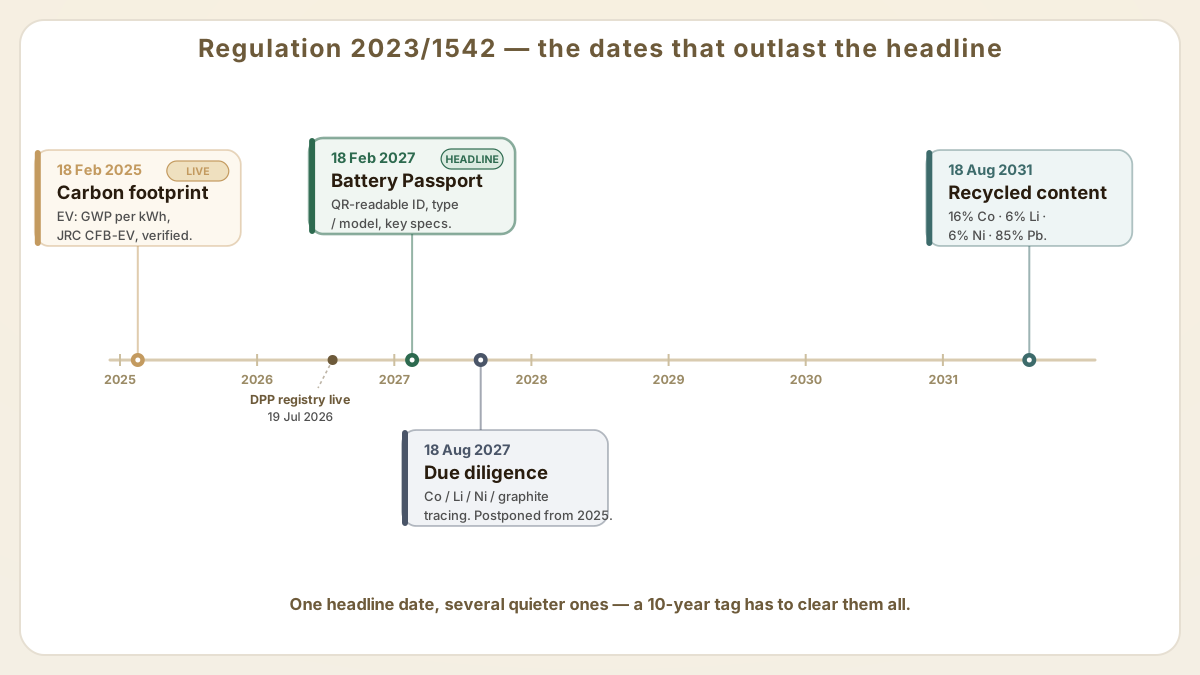
- Carbon footprint declaration for EV batteries: from 18 February 2025, manufacturers must calculate and declare carbon footprint per battery model and per manufacturing plant. Calculations follow the JRC's CFB-EV methodology (site-specific, batch-level, no carbon offsets allowed) and must be third-party verified and posted publicly online. This one is already live.
- Battery passport mandatory: from 18 February 2027, all EV, industrial >2 kWh and LMT batteries placed on the EU market must carry a digital passport accessible via QR. Initial requirements include identification, type/model and key technical characteristics; lifecycle/durability data follow in subsequent delegated acts.
- Due diligence obligations: originally set for 18 August 2025, postponed to 18 August 2027 by Regulation (EU) 2025/1561. Operators must trace cobalt, lithium, nickel and natural graphite supply chains, keep 10-year chain-of-custody records, and submit to third-party verification. Extra time, not a reprieve.
- Recycled content thresholds: from 18 August 2031, batteries placed on the EU market must contain minimum 16% cobalt, 6% lithium, 6% nickel and 85% lead from recycled sources. Recycling-process minimum recovery efficiencies of 50% lithium and 90% cobalt/nickel/copper apply per Annex III.
- Catena-X / open standards interoperability: passport data must be exchangeable through an open interoperable network — Catena-X is the reference automotive ecosystem. Closed proprietary or single-vendor blockchain stacks risk non-conformity. Decentralised storage with selective data-sharing permissions is the architecture pattern most aligned with the Regulation's data-protection clauses.
Which Battery Passport data fields land first vs in later delegated acts?
A popular way to overspend on 2027 is to build the whole thing at once — state-of-health, granular cycle data, the lot — none of which the regulation actually requires yet. Knowing what is mandatory in February 2027 versus what is merely signposted for later delegated acts is what lets an OEM phase its BMS and telematics spend instead of front-loading it.
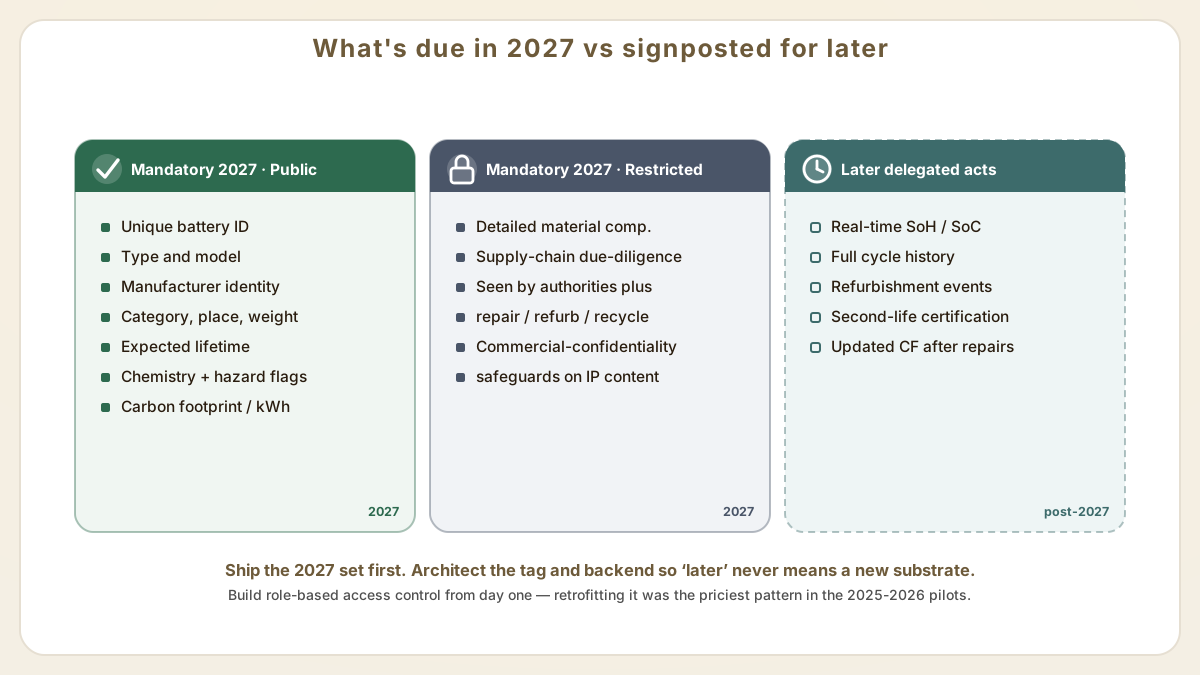
- Mandatory at 2027 go-live (per Annex XIII first wave): unique battery identifier, basic characteristics (type, model), manufacturer identity, battery category, place of manufacture, battery weight, expected lifetime, chemistry composition with hazardous-substance flags, and the battery's carbon footprint declared per kWh.
- Mandatory but with reduced public access at 2027: detailed material composition and supply-chain due-diligence data — accessible to authorities and to repair/refurbishment/recycling operators, but with commercial-confidentiality safeguards for IP-sensitive content.
- Anticipated in later delegated acts: real-time State of Health (SoH) and State of Charge (SoC) telemetry, full cycle history, refurbishment events, second-life repurposing certification, and updated carbon footprint after major repairs. Architect the BMS and telematics now so adding these later does not require a tag-substrate change.
- Public vs restricted views: Annex XIII splits passport content into general-public, regulator and end-of-life-processor views with different read/write permissions. Build role-based access control from day one — bolting it on later was the single most expensive retrofit pattern observed in 2025-2026 pilots.
- Vehicle-passport convergence: forward-looking OEMs (Audi MaterialLoop is the publicised example) are designing battery passport architecture to plug into a future broader vehicle passport covering steel, aluminium, glass, tyres, plastics and rare earths — letting one ID infrastructure serve many regulations.
Useful next pages
Use these linked product, guide and comparison pages to keep the next click specific and practical.
Battery DPP-ready NFC supply
High-temperature NFC inlays, ceramic substrates and DPP backend integration.
FAQ
What's the deadline for EU Battery Passport compliance?
18 February 2027, for batteries over 2 kWh placed on the EU market — EV, industrial and LMT. Consumer batteries (your laptop, your phone) sit out the first wave, though they are widely expected to be pulled in around 2030. Plan for the date you have, not the extension you are hoping for.
Do I need NFC if QR is sufficient?
Strictly, QR satisfies the regulation on its own. NFC is the supplementary carrier people actually thank you for: easier to read from an awkward angle in a vehicle bay, and unbothered by the grime that turns a printed QR into modern art. Most OEMs add NFC even though QR would technically pass.
How long must the data carrier survive?
10+ years for EV and industrial batteries. Standard NFC inlays tap out in 1-3 years under battery thermal cycling — which is exactly when you need them not to. Specify ceramic-substrate tags rated for AEC-Q200 automotive temperature classes.
Who owns the passport data?
The OEM at manufacturing, the fleet operator after sale, the recycler at end-of-life — with role-specific read/write rights at each step. The passport is a permission-based record that changes hands, not a single-owner asset you can lock in a drawer.
Did the EU Battery Regulation due-diligence date really get postponed?
Yes. The original 18 August 2025 application date for due-diligence obligations was postponed to 18 August 2027 by Regulation (EU) 2025/1561, giving operators more time to build chain-of-custody systems for cobalt, lithium, nickel and natural graphite. The Battery Passport date (18 February 2027) did not move. Plan as if the new 2027 due-diligence deadline holds — but keep watching, because the EU has a well-documented pattern of 6-12 month slippage on delegated acts (see the CEPS in-depth analysis of March 2024 and the ESPR Working Plan of April 2025).
Should we use Catena-X, a private blockchain or a vendor-hosted SaaS for the battery passport backend?
The Regulation wants interoperable, open-standards data exchange with selective sharing, which makes Catena-X — the reference automotive ecosystem — the safest single answer for OEM-side passport infrastructure. Pure private blockchains and single-vendor SaaS risk non-conformity unless they implement EPCIS 2.0 + GS1 Digital Link export and integrate with the EU central DPP registry (live by 19 July 2026). The pattern that actually showed up in 2025-2026 OEM pilots: passport data anchored on a decentralised ledger (Catena-X or equivalent) for immutability, with vendor SaaS handling the user-facing dashboards and tag-encoding workflow. Whatever you pick, avoid black-box vendor lock-in on data portability — passport records must follow the battery through OEM → fleet operator → second-life owner → recycler, whether or not your vendor is still in business.
Proud Tek is a Shenzhen-based RFID & NFC manufacturer supplying hotel chains, transit operators, event venues and retail brands worldwide. Every order includes free samples, RF testing and dedicated project support.
Get a Quick Quote
Tell us about your project and we'll respond within one business day. Fields marked (asterisk) are required.