
UHF RFID Read Range
How Far Can a UHF RFID Tag Be Read?
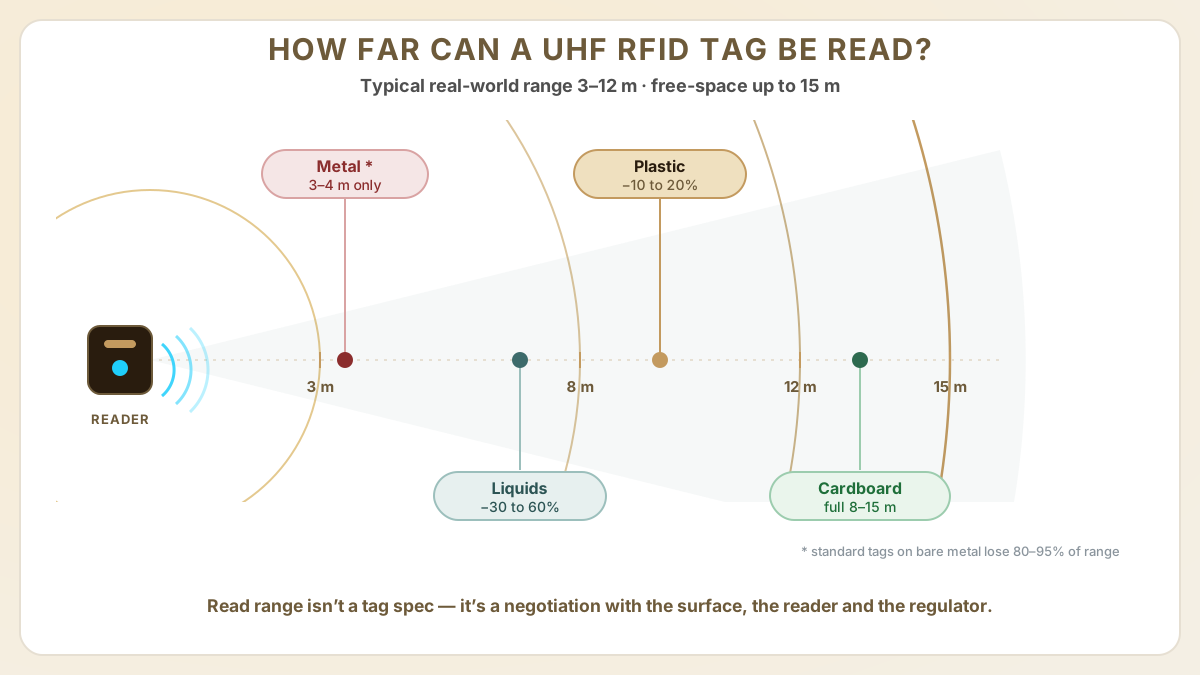
Quick answer
'How far will it read?' is the most-asked question in RFID planning — and the one most likely to be answered with a single confident number the warehouse floor gleefully disproves by lunchtime. The honest answer is a range: 3-12 meters. Read distance isn't a fixed property of the tag so much as a negotiation between tag sensitivity, reader transmit power, antenna gain, mounting-surface material, environmental conditions and regulatory power limits.
- Typical read range is 3-12 meters — and yes, that's a range, not a dodge. Standard UHF paper labels on cardboard read 3-8 m with commercial fixed readers; high-performance inlays on non-metallic surfaces stretch to 8-15 m.
- The surface wins every argument: what you mount the tag on matters more than the tag itself. Cardboard performs best, plastic does well, liquids drag range down, and metal needs a specialized anti-metal tag before it cooperates.
- Proud Tek does the arguing for you. We test and recommend UHF tags matched to your exact surface and read-range requirements, and hand over the performance data before you commit to a volume order.
At a glance
Use these short answers to decide whether this page matches the project before moving into the detail.
Key takeaway
Typical read range is 3-12 meters — and yes, that's a range, not a dodge. Standard UHF paper labels on cardboard read 3-8 m with commercial fixed readers; high-performance inlays on non-metallic surfaces stretch to 8-15 m.
What factors determine UHF RFID read range?
Read range isn't really a property of the tag; it's a negotiation between the tag, the reader, the surface it's stuck to, and the air in between — and that negotiation r...
Next step
Ready to move forward? Start your inquiry to get specific answers for this project.
Get UHF RFID range optimization helpWhat factors determine UHF RFID read range?
Read range isn't really a property of the tag; it's a negotiation between the tag, the reader, the surface it's stuck to, and the air in between — and that negotiation rarely breaks the buyer's way. A datasheet promises one tidy distance in a clean lab; the warehouse floor quietly renegotiates it the moment the tag lands on a pallet of bottled water. The five factors below are the terms of that deal — and the first four spend most of their energy losing to the fifth.
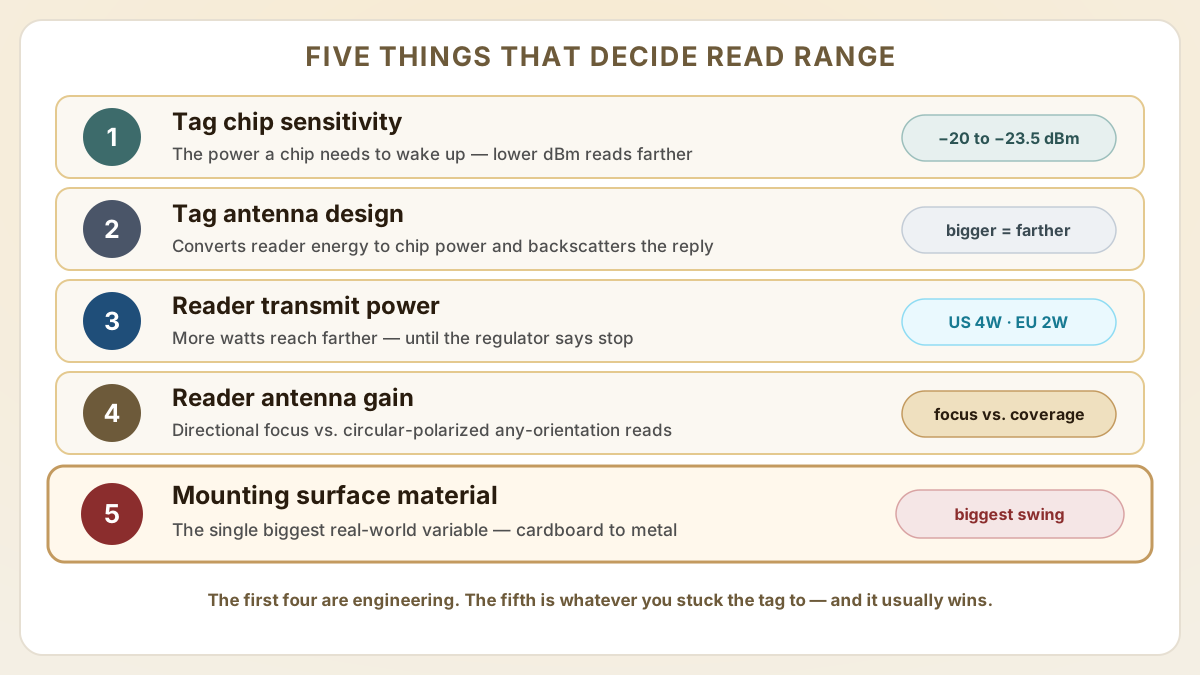
- Tag chip sensitivity: measured in dBm, chip sensitivity determines the minimum power the tag needs to wake up and respond. Better sensitivity (e.g., -22 dBm) means longer read range. Modern chips like Impinj Monza R6-P and NXP UCODE 9 have industry-leading sensitivity.
- Tag antenna design: the antenna converts reader energy into chip power and backscatters the response. Larger antennas generally achieve longer range. Antenna design must be matched to the operating frequency and the intended mounting surface.
- Reader transmit power: fixed UHF readers transmit at 1-4W (country-dependent). Higher power reaches farther, but regulatory limits cap maximum transmit power. US allows up to 4W EIRP, Europe limits to 2W ERP in the 865-868 MHz band.
- Reader antenna gain: directional reader antennas focus energy toward the tag area. Circular polarized antennas provide orientation-independent reading at moderate gain. Linear polarized antennas provide higher gain but require tags to be consistently oriented.
- Mounting surface material: the single biggest real-world variable. Tags on cardboard, paper and dry materials perform at full rated range. Plastic and wood reduce range by 10-20%. Liquids (water, beverages) absorb RF energy and reduce range by 30-60%. Metal reflects RF energy and requires specialized anti-metal tags with purposely designed spacer layers.
What are the read range expectations by scenario?
Averages are comforting and mostly useless; what you actually deploy is a specific tag on a specific thing in a specific doorway. So here are the ranges real hardware tends to hit by scenario — from cooperative retail hang tags to laundry tags that read through a damp towel and quietly resent it. Find the row that looks like your dock, and set expectations there.
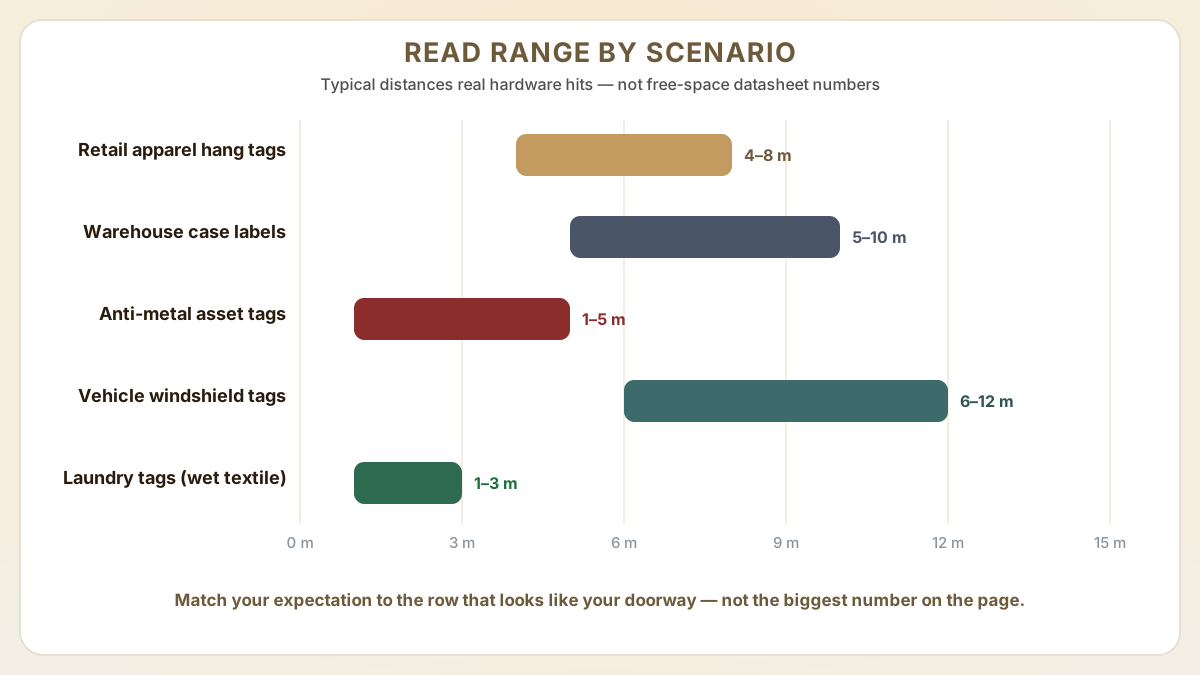
- Retail apparel hang tags — 4-8 meters. Tags on fabric and cardboard hang tags achieve good range with standard inlays. Dense tag populations in clothing stores require anti-collision optimization but not extended range.
- Warehouse case labels — 5-10 meters. UHF labels on corrugated cardboard cases perform well at dock door portals. Multiple cases on a pallet are read simultaneously through the pallet load.
- Anti-metal asset tags — 1-5 meters. Specialized tags with spacer layers on metal surfaces (IT servers, tools, containers) achieve shorter range but sufficient for handheld inventory and portal reading.
- Vehicle windshield tags — 6-12 meters. Long-range UHF windshield tags for tolling and parking achieve extended range because the vehicle approaches the reader antenna directly in a controlled geometry.
- Laundry tags — 1-3 meters. Tags on wet textile items have reduced range due to water absorption. RFID laundry tunnel readers compensate with high-power, close-range antenna arrays.
How do you maximize UHF RFID read range in real deployments?
Lab-spec read ranges (10-15 m) rarely survive contact with an actual warehouse — the floor takes its cut in surface losses, reader settings and stray metal. The good news: most of that range is recoverable. These five field-tested moves claw back 30-60% of what the environment quietly skims off the top.
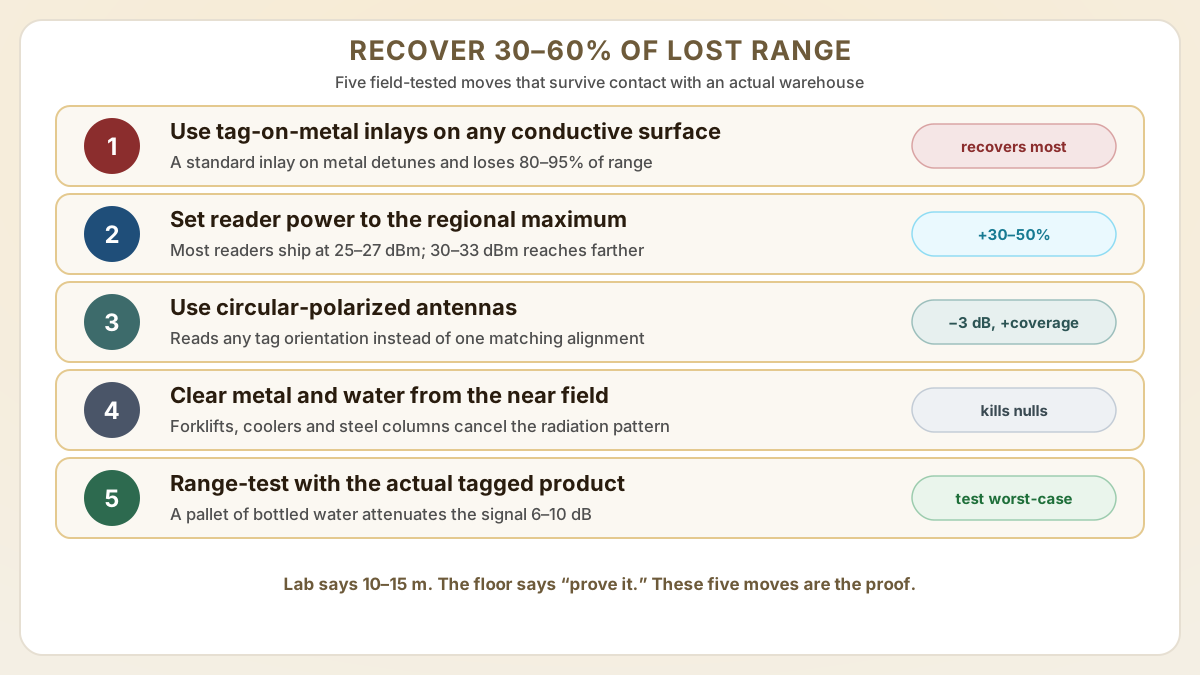
- Choose tag-on-metal inlays for any conductive surface: a standard inlay placed on metal loses 80-95% of range due to antenna detuning. Anti-metal tags with a foam or ceramic spacer recover most of that range at 2-3× the unit cost.
- Set reader transmit power to maximum allowed by region: in the US (FCC Part 15) the limit is 4W EIRP; in EU (ETSI EN 302 208) it is 2W ERP. Most readers ship at 25-27 dBm by default; bumping to 30-33 dBm can add 30-50% range.
- Use circular polarized antennas for unpredictable tag orientations: linear polarized antennas only read tags in matching orientation. Circular polarization sacrifices ~3 dB peak gain but reads any orientation, which is more useful in real workflows.
- Eliminate metal and water within the antenna's near field: a forklift, water cooler or steel column within 1-2 m of the antenna creates reflections that cancel parts of the radiation pattern. Survey the read zone for these blockers first.
- Test with the actual tagged product, not a sample tag in free space. A 50-pack of bottled water at the back of a pallet attenuates UHF signals 6-10 dB. Always range-test with worst-case product loading before committing to portal placement.
Read-range benchmarks by tag, chip and reader — the numbers that match real datasheets
Vendor datasheets are the closest thing this industry has to a straight answer — treat free-space numbers from Avery Dennison, SML, Smartrac, Confidex and Xerafy as your starting line, not your finish line. The figures below are typical 2026 reference values for the most-deployed inlays at 4W EIRP (FCC) on cardboard or low-loss substrate. Then do the honest thing and subtract 30-60% for the real world.
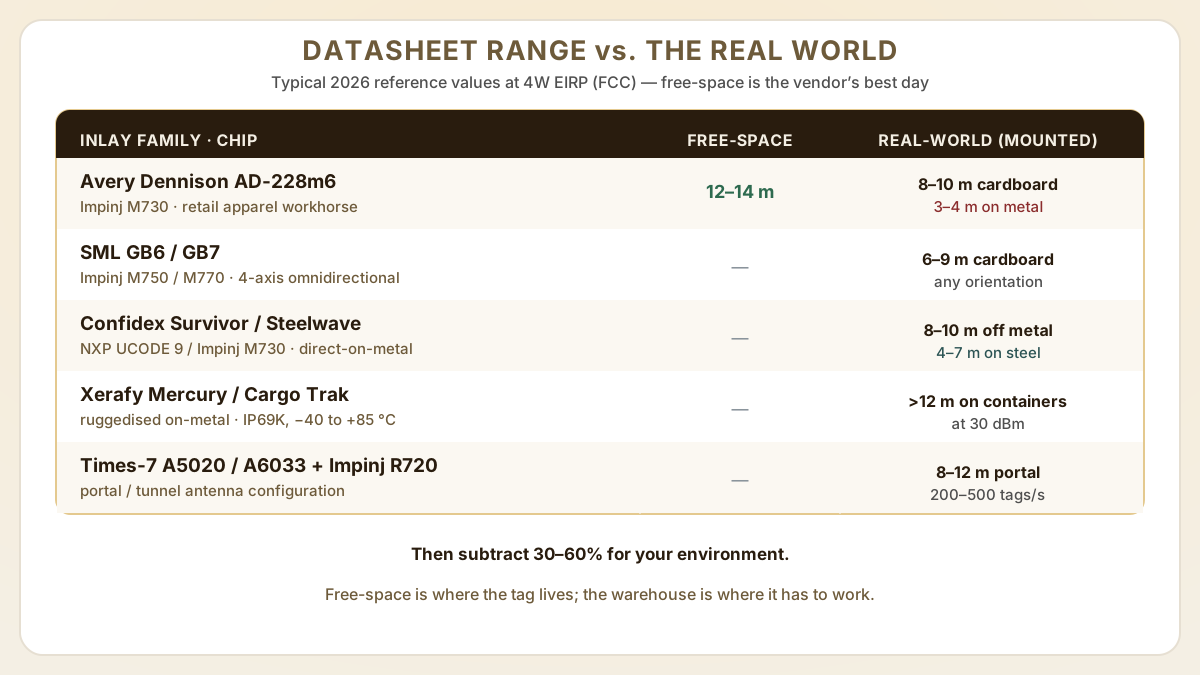
- Avery Dennison AD-228m6 (Impinj M730) wet inlay 70x14mm — free-space ~12-14m; cardboard ~8-10m; on-metal-rated variant ~3-4m. The volume workhorse for retail apparel mandate; ARC Spec G certified for Walmart and Target.
- SML GB6 / GB7 inlays (Impinj M750/M770) — 4-axis omnidirectional designs that read 6-9m on cardboard with stable reads at any tag orientation; ideal for high-density apparel rack sweeps and dock-door portals.
- Confidex Survivor B / Ironside Slim / Steelwave (NXP UCODE 9 or Impinj M730) — designed for direct-on-metal industrial assets, achieving 4-7m on steel and 8-10m off-metal. Standard choice for IT asset tracking, returnable transport items and cargo containers.
- Xerafy Mercury / Cargo Trak / Container Trak — ruggedised on-metal tags rated for >12 m read range on shipping containers and rail cars at 30 dBm transmit power, IP69K and -40 to +85 °C operating range.
- Times-7 SlimLine A5020 / A6033 portal antennas paired with Impinj R720 reader — 8-12m typical inventory portal range; tunnel-reader configuration with 4 antennas reads 200-500 items per second at 0.5-1.2 m/s conveyor speed.
Region-by-region UHF regulations and how they cap your real-world range
Physics sets the ceiling; regulators set it lower, and they don't take requests. UHF rules vary by country and cap the range your deployment can legally reach — which is why a bargain 'global' tag that doesn't match the local frequency band is a false economy. The chip powers up just fine; the antenna is quietly detuned, and your range walks out the door.
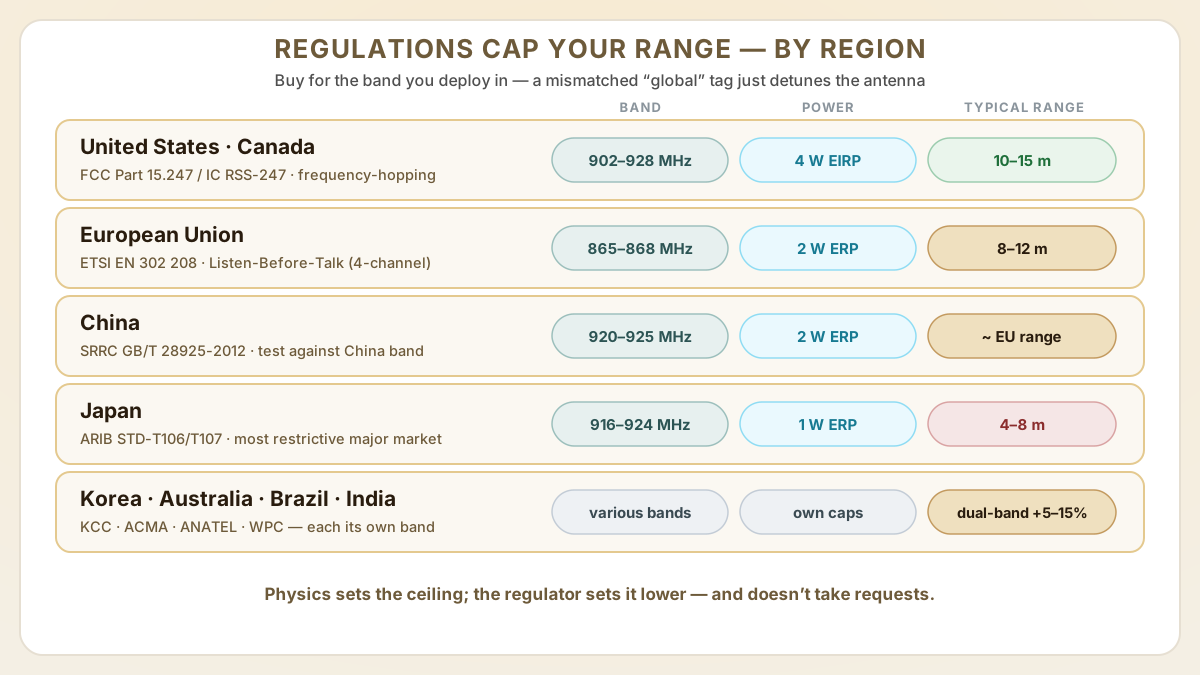
- United States and Canada — FCC Part 15.247 / IC RSS-247 — 902-928 MHz, up to 4W EIRP (36 dBm) frequency-hopping spread spectrum. Maximum free-space range typically 10-15m for premium tags, supports the highest power floor globally.
- European Union — ETSI EN 302 208 — 865-868 MHz (Lower Band) or 915-921 MHz (Upper Band, post-2018), up to 2W ERP (33 dBm), Listen-Before-Talk required. Range typically 8-12m free-space; the 4-channel LBT structure penalises dense reader environments.
- China — SRRC GB/T 28925-2012 — 920-925 MHz, up to 2W ERP. Free-space range comparable to EU; tag SKUs sold in China should be tested specifically against the China band rather than assumed identical to EU upper band.
- Japan — ARIB STD-T106/T107 — 916-924 MHz, up to 1W ERP for outdoor and 0.25W for indoor. Range is typically 4-8m, the most restrictive major market — affects warehouses, retail and conference badge applications.
- Korea, Australia, Brazil and India each have their own frequency bands and power limits — KCC 917-923 MHz, ACMA 920-926 MHz, ANATEL 902-907.5/915-928 MHz, WPC 865-867 MHz. For multi-country deployments, dual-band 'global' tags from Avery, Smartrac and Confidex add roughly 5-15% on per-tag price but eliminate SKU-management overhead.
Useful next pages
Use these linked product, guide and comparison pages to keep the next click specific and practical.
UHF RFID tags by read range
Tags optimized for your specific range requirements.
UHF reader and inlay vendor references
Authoritative datasheets and country-band information used to size real read-range expectations.
FAQ
What is the maximum read range of a UHF RFID tag?
On a perfect day — high-performance tag on a non-metallic surface, maximum legal reader power, directional antenna, clear line of sight — read ranges of 12-15 meters are achievable, and some specialized long-range vehicle tags claim 20+ meter ranges in controlled environments. Perfect days are rare. Real-world deployments typically land at 3-10 meters once environmental factors, tag orientation variability and multi-tag populations take their turn.
Why is my RFID read range shorter than the tag specification says?
Because the spec was measured on the tag's best behavior. Tag specifications come from ideal laboratory conditions: free space (no mounting surface), a single tag, optimal orientation, maximum reader power. Real-world range is always shorter — the mounting material absorbs or reflects energy, multiple tags compete for reader attention, orientation is rarely optimal, obstructions get in the way, and the environment adds interference. Expect 50-70% of the specified free-space range in typical deployments.
Can I increase the read range of my existing RFID tags?
Often yes, and without buying a single new tag: increase reader transmit power (within regulatory limits), use higher-gain reader antennas, optimize antenna placement and orientation, reduce environmental interference sources, and make sure no tag is covered by metal or liquid. If those adjustments aren't enough, switching to a higher-sensitivity tag inlay provides the next level of range improvement.
Why do tags fail in dense crowds (apparel racks, conference badges, baggage handling) even at short range?
Ironically, range is usually innocent here — the culprit is tag-to-tag collision and energy absorption. UHF Gen2 anti-collision (the Q-algorithm) handles 50-200 simultaneous tags well, but at 500+ tags packed densely (apparel rack, baggage carousel, dense badge crowd) tag-to-tag detuning lowers individual tag sensitivity by 3-8 dB. The fix isn't more power, it's more finesse: multi-antenna reader configurations (4-8 ports), longer dwell time per read cycle (target 99% read confidence at 3-5 second window), and reader settings tuned for high tag density (Session 1 or 2 with persistent inventoried flag). Real-world Walmart and Target store sweeps achieve 95-99% read rates by tuning Impinj or Zebra reader Session and Q parameters per store layout.
What is the read range of an on-metal UHF tag in real warehouse conditions?
Expect the datasheet to be optimistic and plan around the honest number. Free-space datasheets for premium on-metal tags (Confidex Steelwave, Xerafy Mercury, HID InLine 200/500) typically claim 8-12 meters. Flush-mounted on a steel rack or asset, real-warehouse range runs 3-7 meters at 4W EIRP — about 50-60% of free-space spec. The remaining loss comes from antenna detuning, multipath cancellation from neighbouring metal surfaces and orientation mismatch. To recover range, use a 5-10 mm foam standoff if mechanically possible, choose ferrite-backed inlays specifically tuned for the asset surface, and run a Voyantic Tagformance or CISC RFID Xplorer survey before committing to a 50K+ tag SKU.
Proud Tek is a Shenzhen-based RFID & NFC manufacturer supplying hotel chains, transit operators, event venues and retail brands worldwide. Every order includes free samples, RF testing and dedicated project support.
Get a Quick Quote
Tell us about your project and we'll respond within one business day. Fields marked (asterisk) are required.