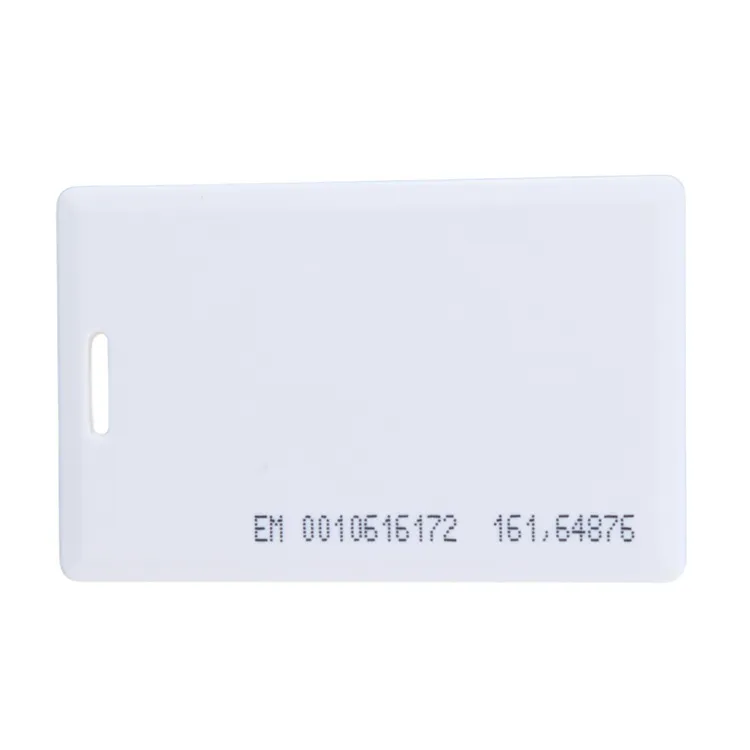
RFID Cards
Clamshell Card
Free standard samples · Quotation within one business day
Product details
What is a clamshell RFID card?
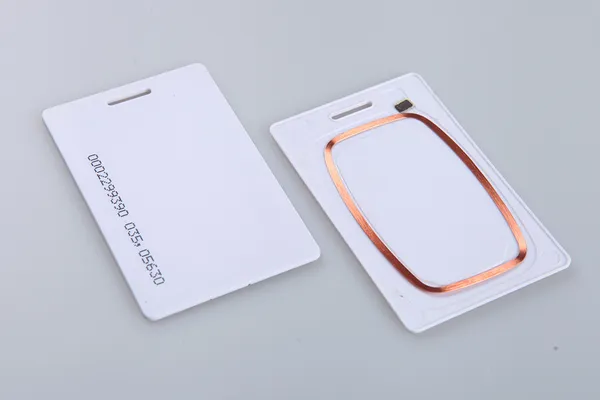
A clamshell card is a thick, rigid RFID card made from two moulded ABS halves sealed around a chip and a wound copper antenna. It is commonly around 1.8 mm thick, more than twice a standard 0.76 mm ISO card, and the extra depth leaves room for a larger low-frequency coil. Most clamshells are 125 kHz proximity cards for door access, time and attendance and parking; the selection rule is simple: match the chip and data format to the reader you already have, and choose the clamshell body when a thick, rigid card matters more than a printed photo.
| Item | Clamshell card |
| Body | Two-part moulded ABS shell, sealed around the inlay |
| Thickness | Commonly around 1.8 mm; thicker versions exist, so the exact figure is confirmed in the quotation |
| Footprint | Close to ISO/IEC 7810 ID-1 (85.60 × 53.98 mm); confirm the outline if the card must fit a holder or dispenser |
| Frequency | 125 kHz LF as standard; 13.56 MHz HF variants on request |
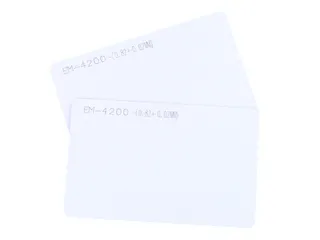
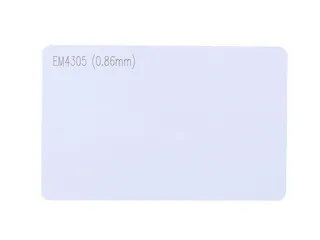
| Standard chips | EM4200 (read-only); rewritable EM4305 and T5577, on genuine EM Microelectronic and Microchip ATA5577C chips |
| Antenna | Wound copper coil, typically larger than in a thin laminated card |
| Slot punch | Pre-moulded slot, vertical or horizontal |
| Marking | Printed or laser-engraved sequential number and/or chip ID; logo printing on the face |
| Colour | White as standard; other colours on request |
| Encoding | Blank, or pre-encoded to your number range via the RFID encoding service |
| Samples and lead time | Standard samples free; customised samples carry a setup fee; standard products 2–3 weeks |
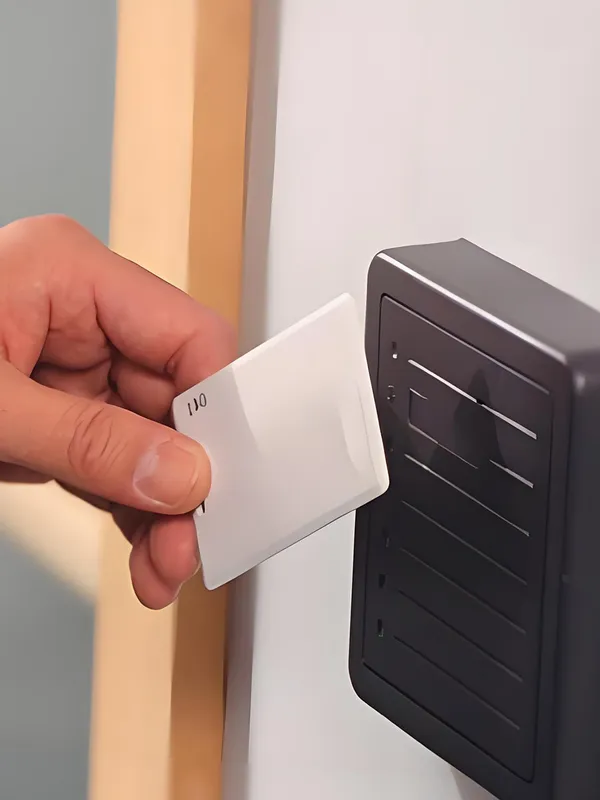
Clamshell card vs ISO thin card: which one do you need?
Both formats talk to the same 125 kHz reader in the same way. The difference is the body: what it can carry on its face, how rigid it is and how much antenna fits inside.
| Attribute | Clamshell card | ISO thin card |
| Thickness | Commonly around 1.8 mm | 0.76 mm nominal (ISO/IEC 7810 ID-1) |
| Construction | Two ABS halves sealed around a wound coil | Laminated PVC sheets around an inlay |
| Direct-to-card printing | Usually not: most desktop card printers are built for thin cards, so photo ID goes on an adhesive label | Yes: dye-sublimation, retransfer, offset or digital printing edge to edge |
| Rigidity | Rigid moulded body; does not flex | Flexible; a bent card can crack the antenna over time |
| Read range tendency | Often slightly longer on the same reader because of the larger coil | Shorter coil area; range set mainly by the reader |
| Slot punch | Moulded in during production, clear of the antenna | Punched after printing; the position must avoid the coil |
| Wallet and printer fit | Too thick for most card wallets and printers | Fits wallets, sleeves and card printers |
| Typical use | Shared door cards, contractor and visitor passes, parking, attendance | Printed staff and student ID badges, membership cards |
Choose a clamshell when the card is handled hard, reissued often or hangs on a reel all day, and the face only needs a logo and a number. Choose a thin printed RFID card when every card carries a photo, a name or full-colour artwork, or when you print cards in-house.
Which chip should a 125 kHz clamshell card use?
The body does not decide compatibility; the chip and its data format do. Start from the reader model or a working card from the installed system, then pick the chip that reproduces what the reader expects.
| Chip | Type | Choose it when |
| EM4200 | Read-only; factory-programmed ID read as the 64-bit EM4100/EM4102 frame | The reader enrols EM-format IDs and you only need a unique number per card |
| EM4305 | Rewritable; 512-bit EEPROM, 32-bit password and write protection | The system writes data to the card, or you need an EM-format or FDX-B output set by configuration |
| T5577 | Rewritable; configurable data rate and modulation, optional password | You must reproduce a specific LF format or issue replacements for an existing number range |
- Proprietary 125 kHz formats: some access systems read a vendor-specific format rather than the EM4100 frame. A T5577 can be configured for several LF formats, but whether a card is accepted depends on the system. Ask your system provider which card format it accepts before ordering, and test a sample on the live reader.
- HITAG and other LF chips: if the reader names HITAG 2, ask for the HITAG 2 card and whether a clamshell body is available for the chip you need.
- Number range: for replacement or expansion cards, send the facility code and number range your system uses so pre-encoded cards continue the sequence.
Can a clamshell card carry a 13.56 MHz chip?
Yes, HF clamshell variants can be made on request, for example with a MIFARE Classic chip for systems that still read one. Availability, construction and lead time depend on the chip and are confirmed in the quotation. For a new 13.56 MHz project, a thin MIFARE DESFire card is usually the stronger starting point, because it can be printed and carries modern cryptography; for sites running both frequencies during a migration, consider a combi card that carries both an LF and an HF chip.
How are clamshell cards numbered and marked?
Numbering links the physical card to the record in your access software, so decide the scheme before production rather than after delivery.
- External sequential number: a running number printed or laser-engraved on the face or back, useful for stock control and issuing.
- Chip ID number: the ID read by the reader, printed on the card in the format your software displays: decimal, hexadecimal, or a facility-code-plus-card-number layout. Send a screenshot or example from your software so the format matches.
- Laser engraving vs printing: engraving resists wear and cannot be rubbed off; ink printing gives more colour choice. Which methods are available for your colour and chip is confirmed with the quotation.
- Logo printing: a one- or two-colour logo on the face is typical; full-colour artwork is possible on some clamshells, but fine photographic detail is better handled by an adhesive label or a thin printed card.
- Number list: a file in Excel, CSV or XML lists every card's chip ID against its printed number, so enrolment can be imported rather than typed if your access-control software has an import function. Pre-encoded clamshells are each verified by a read-back once programmed and shipped with a data report; see the RFID encoding service.
How do you put a photo ID on a clamshell card?
Most desktop card printers are designed for cards close to 0.76 mm, so a 1.8 mm clamshell usually will not feed. The usual approach is to print the photo, name and design on a thin adhesive-backed PVC card or label in your own printer and stick it to the clamshell face. The clamshell keeps the antenna and the rigid body; the label carries the personalisation and can be replaced when a badge is reissued. If every card needs a photo and you issue them in volume, a thin inkjet PVC ID card or printed RFID card removes the labelling step.
Slot punch and attachment options
- Vertical (portrait) slot: the card hangs upright from a strap clip or badge reel; the usual choice for staff badges.
- Horizontal (landscape) slot: the card hangs sideways, for landscape artwork or holders that expect it.
- No slot: for cards kept in a wallet, a vehicle or a card holder.
- Because the slot is moulded clear of the coil, it does not cut through the antenna, which is a common failure point when thin cards are punched after delivery.
Are 125 kHz clamshell cards secure?
A thick, rigid body adds no data security. EM4100-type 125 kHz cards transmit a fixed ID without authentication, so the ID can be read and written onto a rewritable T5577 blank with inexpensive tools. Password protection on an EM4305 or T5577 stops the card from being rewritten; it does not stop the transmitted ID from being copied. For existing LF systems, clamshells are a practical replacement or expansion card. For a new system, or where a copied credential carries real cost, consider an authenticated 13.56 MHz credential such as MIFARE DESFire and plan the reader change with your integrator.
Clamshell card, thin 125 kHz card or proximity fob?
| Format | Best for | Watch out for |
| Clamshell card | Hard daily use, shared and contractor cards, badge reels, parking and gate cards | Needs an adhesive label for photo ID; too thick for wallets and card printers |
| Thin 125 kHz card | Printed staff ID, photo badges, cards printed in-house | Less rigid; punch the slot clear of the antenna |
| Proximity fob | Keyring carry, residential entry, gyms and lockers | Little room for a name or photo; shorter range than a card on some readers |
All three can use the same 125 kHz chip, so a site can mix formats on one reader: fobs for residents, clamshells for contractors and printed thin cards for staff. The RFID key fobs for access control guide covers mixed-format deployments; for gate and car-park projects, test the card on the long-range reader you plan to install.
How do you check compatibility before ordering?
- Identify the reader: brand, model and frequency, or send photos of the reader label.
- Send a working card or its ID as your software displays it, so the chip and number format can be matched.
- Confirm whether cards are read-only IDs or must be written by the system.
- State the range you need and test a sample at the real mounting position; read distance depends on the reader and its antenna as much as on the card.
- Check the holder, reel or dispenser against the card thickness and slot position.
Ordering clamshell cards and samples
Send the chip or reader model, slot orientation, numbering scheme and format, logo or printing, colour, whether cards are blank or pre-encoded, the quantity and the destination through the inquiry form. We reply within one business day, and a workable inquiry receives a quotation within one business day. Standard samples are free and a setup fee applies to customised samples; the sample pack lets you test several LF formats on your reader first. Standard products generally ship in 2–3 weeks, and large orders are scheduled individually. Minimum order quantity, unit price and freight are confirmed in the quotation for your specification and destination.
We produce each order in our factory in Shenzhen and draw on established chip supply channels, which keeps project pricing competitive, quality stable and lead times reliable. Quality-system and certification details are on the company page.
Frequently asked questions
How thick is a clamshell card?
Clamshell cards are commonly around 1.8 mm thick, compared with 0.76 mm for a standard ISO card. Thickness varies by construction, so the exact figure for your order is confirmed in the quotation; check it against any holder, reel or dispenser you use.
Can I print photos directly on a clamshell card with my ID card printer?
Usually not. Most desktop card printers are built for cards close to 0.76 mm and will not feed a clamshell. Print the photo on an adhesive-backed PVC label and apply it to the face, or choose a thin printed RFID card if every card needs a photo.
Which chip is inside a 125 kHz clamshell card?
Do clamshell cards read further than thin cards?
Often slightly further on the same reader, because the thicker body holds a larger coil. The reader and its antenna still set most of the range, so test a sample at the real mounting position before ordering, especially for gate or parking readers.
Can the chip ID be printed on the card to match my access software?
Yes. The chip ID can be printed or laser-engraved in decimal, hexadecimal or a facility-code-plus-card-number layout. Send an example of how your software displays card numbers so the printed format matches.
Can I order a clamshell card with a 13.56 MHz MIFARE chip?
HF clamshell variants can be made on request; availability and lead time are confirmed in the quotation. For a new HF project, a printable thin MIFARE DESFire card usually offers better security and personalisation.
Should I choose a clamshell card or a key fob?
Choose a clamshell for badge reels, shared contractor cards and uses where a visible number or label matters. Choose a proximity fob for keyring carry. Both can use the same 125 kHz chip, so they work side by side on one reader.
Are clamshell card samples free?
Standard samples are free, and a setup fee applies to customised samples with your logo, numbering or encoding. Send the reader model and the chip you need, and we confirm the sample arrangement for your destination.
Buyer guides
- How to Read an RFID Tag Quotation, Line by Line What decides RFID card and tag prices, and how to compare quotations line by line: unit-price basis, tooling, encoding, samples, freight and Incoterms.
- RFID RFP Template: Questions to Ask Every Supplier An RFID RFP template for distributors: the supplier questions that produce comparable quotes, and how to read the replies against one specification.
- RFID MOQ, Explained: How Minimums Form and How to Discuss Them How RFID MOQ forms from chip lots, inlay rolls, print sheets and setup — and how buyers can discuss a smaller pilot or first order honestly.
Ready to specify your order?
Send the product, quantity and application so we can confirm the options and pricing for your project.