RFID Cards
MIFARE DESFire EV2 Cards
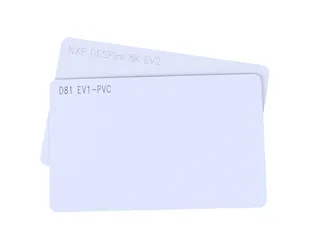
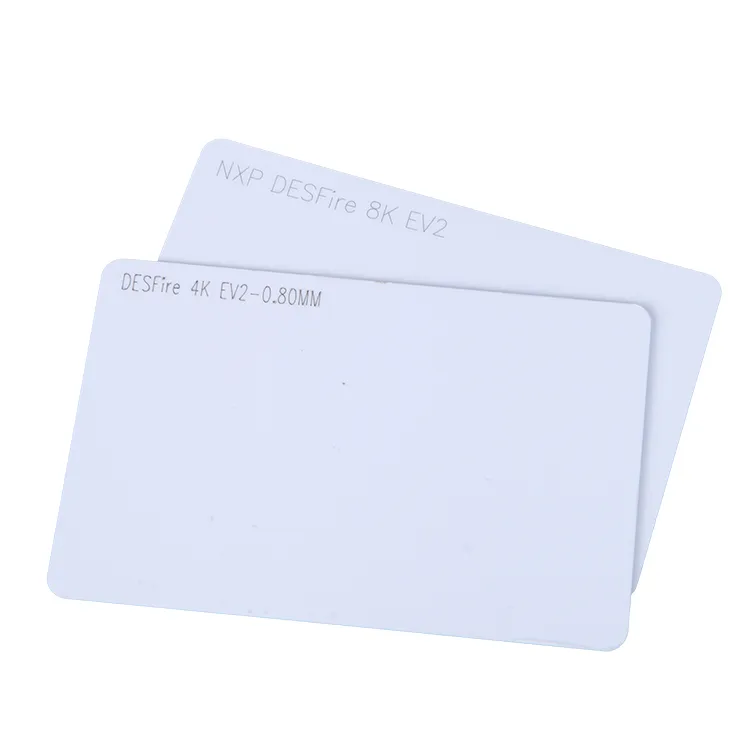
DESFire EV2 cards for access-control estates built on NXP's DESFire EV2 generation — 2K, 4K and 8K memory with AES-128 authentication — for replacement cards and system expansion where installed readers and key sets specify EV2.
MIFARE DESFire EV2 cards for systems that specify this generation. Include the required memory—such as 2K, 4K or 8K—the reader model and the application profile when requesting samples or a bulk quotation.
NXP marks EV2 as not recommended for new designs and directs new designs to EV3. Existing EV2 projects should confirm the specified chip and current supply; evaluate any alternative with the system integrator before approval.
Free standard samples · Quotation within one business day
Product details
DESFire EV2 card samples and bulk orders
For an existing EV2 installation, start with the approved chip and card specification. Request the required memory capacity, card body, printing and delivery state together so the quotation and sample address the same project. Current supply of the exact EV2 part and the available finished-card options are confirmed in the quotation.
- Card body: specify dimensions, thickness and material, such as an ID-1 card (85.6 × 54 mm). Confirm the proposed construction and antenna design; discuss other formats through the DESFire tag and fob page.
- Printing and finishing: send artwork for both sides, finish, visible numbering, barcodes or QR codes, and any magnetic stripe or signature-panel requirement. Confirm which options are included in the sample and quotation.
- Encoding and personalisation: agree factory-default or transport-key delivery versus cards prepared with your application, files and permissions. A visually blank card is not necessarily in an untouched chip state. Provide the required delivery profile and numbering scheme, without live secret keys in the RFQ.
- Key-management handover: any loading of production keys is arranged separately with the party responsible for issuance, and encoding is performed only for the organisation that administers the system.
- Samples and lead time: free standard samples are available (a customised sample carries a setup fee), and the standard lead time for standard products is generally two to three weeks; the schedule and the availability of a specific EV2 part are confirmed in the quotation.
Compare EV2 2K, 4K and 8K card requirements
This table compares 2K, 4K and 8K card requirements; it is not the complete EV2 memory range. NXP’s public short data sheet also lists 16 KB and 32 KB devices. Confirm the exact part and current finished-card availability in the quotation. Choose capacity from your integrator’s application and file plan, including file-system overhead and planned growth, because memory size alone does not make cards interchangeable.
| Variant | NXP type (17 pF / 70 pF) | EEPROM | What to confirm |
| DESFire EV2 2K | MF3D22 / MF3DH22 | 2 KB (2048 bytes) | The application, keys, files and records fit the available memory |
| DESFire EV2 4K | MF3D42 / MF3DH42 | 4 KB (4096 bytes) | The complete application plan and future updates fit the available memory |
| DESFire EV2 8K | MF3D82 / MF3DH82 | 8 KB (8192 bytes) | The required multi-application or record capacity and reader profile are supported |
The listed standard parts have 17 pF input capacitance; the “H” parts have 70 pF, which NXP offers for small-form-factor antenna designs. The inlay design still needs validation in the finished card or tag. NXP specifies 25-year data retention and typical 500,000 write cycles at 22 °C in the short data sheet; these IC figures do not guarantee the service life of a printed card. Send the exact part or approved card specification so the sample can be checked against the system you use.
Reader and firmware compatibility
A displayed card number proves identification, not successful application authentication. Before a repeat order or migration, ask the reader or lock vendor to confirm the points below and test the proposed card with the issuing software and installed firmware.
- Air interface: the reader implements ISO/IEC 14443-2/3 Type A and the ISO/IEC 14443-4 (T=CL) transmission protocol that DESFire uses. A 13.56 MHz rating on its own does not confirm 14443-4 support.
- Command set: the firmware supports the DESFire and ISO/IEC 7816-4 commands your application needs — selecting the application, authenticating, and reading or writing the file types you use — not only UID reading.
- Secure messaging: confirm the D40, EV1 or EV2 mode, key type and file communication settings your application uses. Check every required EV2 feature against the reader firmware and approved card profile.
- Backward compatibility: if EV1 or D40 (MF3ICD40) cards are still in the field, verify the reader keeps reading them alongside EV2 during a migration.
- Keys and diversification: agree who holds the application master keys, how they are diversified per card, and how the readers are loaded with them.
- Sample test: authenticate and run the real transaction — issue, read and write, an interrupted transaction and its recovery — with production reader firmware and software before any bulk order.
Before you order: EV2 checklist
- Exact EV2 part and memory capacity, or the approved card specification from your integrator; the 2K/4K/8K comparison on this page is not the entire chip-family range.
- Whether this is a repeat order that must match an installed specification, or a new project for which EV3 was evaluated first.
- Reader brand, model and firmware, the secure-messaging mode and key type, and the application and file plan.
- Delivery profile: factory-default/transport settings or project-personalised cards, plus who loads production keys, enrols cards and approves the sample.
- Card construction, artwork, numbering, quantity, destination and required date.
- Sample acceptance: verify application authentication and the required read/write transactions on the actual issuing software and readers; keep the approved configuration for repeat orders.
What MIFARE DESFire EV2 is
MIFARE DESFire EV2 is an NXP contactless multi-application IC that works at 13.56 MHz on the ISO/IEC 14443 Type A air interface and communicates with the ISO/IEC 14443-4 transmission protocol. Data is held in an application and file structure addressed with ISO/IEC 7816-4 commands, and applications can use hardware cryptography: DES, 2K3DES and 3K3DES for compatibility, and AES with 128-bit keys for current designs. NXP marks EV2 as not recommended for new designs and directs new projects to DESFire EV3; this page supports enquiries for installations that already specify it. The sections below describe the IC. The availability of a specific EV2 part, and of any finished-card batch, is confirmed in the quotation.
EV1, EV2 and EV3: what changed
These three DESFire generations share the 13.56 MHz ISO/IEC 14443 Type A interface, the ISO/IEC 7816-4 file commands and the DES/2K3DES/3K3DES/AES-128 cryptographic engine, and each newer chip keeps backward-compatibility modes for the older ones. What changes between generations is the set of application-security features and the certification level. A feature benefits your project only when the chip, the reader firmware and the application all implement it.
| DESFire EV1 | DESFire EV2 | DESFire EV3 | |
| Secure messaging | D40 and EV1 modes | AES-based EV2 secure messaging; retains EV1 and D40 compatibility modes | Retains D40, EV1 and EV2 secure-messaging modes |
| Applications per card | Up to 28 | Virtually unlimited | Virtually unlimited |
| Files per application | Up to 32 | Up to 32 | Up to 32 |
| Multiple key sets | — | Up to 16 sets per application (key rolling) | Yes |
| Transaction MAC | — | Yes, at application level | Yes |
| Proximity Check (relay-attack protection) | — | Yes | Yes |
| Delegated application management (MIsmartApp) | — | Yes | Yes |
| Secure Dynamic Messaging / SUN | — | — | Yes (mirrored into the NDEF message; NTAG DNA-compatible) |
| Transaction Timer | — | — | Yes (mitigates man-in-the-middle attacks) |
| Common Criteria | EAL4+ (hardware and software) | EAL5+ (hardware and software) | EAL5+ (hardware and software) |
| NXP status for new designs | Not recommended | Not recommended | Recommended replacement |
EV2 provides backward-compatible D40 and EV1 secure-messaging modes, but a replacement card still needs the application configuration, keys and reader support expected by the installed system. EV2 features such as multiple key sets, Transaction MAC, Proximity Check and delegated application management need the relevant configuration and command support. Have the integrator confirm and test the features the project actually uses.
Application and file structure
A DESFire card behaves like a small on-card file system with three levels. At the top is the PICC — the card itself — which holds the card master key, the card-wide configuration and the list of applications. Each application is addressed by a 3-byte Application ID (AID) and carries its own keys and its own set of files: EV1 allows up to 28 applications, while EV2 and EV3 remove the practical limit and are bounded only by available memory. Each application holds up to 32 files (file IDs 0x00–0x1F), and every file has its own access rights and communication mode, so one card can keep an access credential, a stored-value purse and a ticket side by side without any of them sharing a key.
| File type | What it holds | Generation note |
| Standard data file | A fixed-length block of binary data, written in place. | Supported by EV1 and EV2 |
| Backup data file | The same as a standard file but with a shadow copy; writes apply only on CommitTransaction and can be rolled back with AbortTransaction. | Supported by EV1 and EV2 |
| Value file | A 32-bit signed value with credit, debit and limited-credit operations and configurable limits, for cashless purses. | Supported by EV1 and EV2 |
| Linear record file | A fixed number of fixed-length records that fill once, for logs or ordered entries. | Supported by EV1 and EV2 |
| Cyclic record file | A ring of fixed-length records where the oldest is overwritten, for a rolling transaction history. | Supported by EV1 and EV2 |
| Transaction MAC file | A special file that chains a MAC and a counter across the commands of an authenticated transaction, so a back-office system can confirm the transaction ran on a genuine card. | EV2 (kept in EV3) |
Each file carries four access-rights fields — read, write, read-and-write, and change-access-rights — and each field names one of the application's keys, or is set to “free” (no authentication) or “deny” (never). Backup, value and record files take part in transactions: a set of writes is staged and then committed atomically, so an interrupted tap never leaves a fare balance or a log half-written.
Authentication and secure messaging
Reading a UID does not authenticate a DESFire application. In mutual authentication, the card and reader prove possession of the required key and establish session protection. The selected authentication mode and each file’s access and communication settings determine what can be read, written or transmitted in plain form. The card, reader firmware and application must implement the agreed configuration.
- D40 compatibility mode: retained for legacy installations using the original DES/2K3DES scheme. Confirm the configured key type and reader requirements; do not assume this provides AES protection.
- EV1 secure messaging: AuthenticateISO supports 2K3DES or 3K3DES keys, while AuthenticateAES uses AES keys. These retain the corresponding EV1 compatibility mode.
- EV2 secure messaging: AuthenticateEV2First and AuthenticateEV2NonFirst use AES keys. The first starts the transaction’s EV2 authentication; the latter supports subsequent authentication within that transaction. Confirm the required commands and settings with the integrator.
File communication can be plain, protected with a cryptographic checksum, or encrypted, depending on the authentication and file settings. Authentication alone does not mean every file is encrypted or every read requires a key. NXP’s public EV2 short data sheet describes these choices and the supported authentication commands; use the detailed product documentation for implementation. Key diversification is covered separately in NXP application note AN10922.
Key management: keys, versions and key sets
Keys live at two levels. The PICC holds a card master key governing card-level management. Each application can hold up to 14 keys and has its own key settings and file access rights. Key-version information helps an issuer manage updates, but it is not a substitute for the secret key or the required permissions. Confirm the selected ChangeKey or ChangeKeyEV2 procedure against the exact application configuration.
EV2 supports multiple key sets per application, allowing the issuer to prepare and roll to another key set when the reader estate supports that process. An integrator may use per-card diversification, such as the scheme in NXP AN10922, with protected master-key storage in an HSM or SAM. This is a deployment design decision, not an automatic property of a blank card. Agree who creates, holds and loads the keys and how the readers obtain the required credentials before ordering. Do not put live secret keys in an RFQ.
The DESFire command set
DESFire supports native commands and ISO/IEC 7816-4 wrapping over ISO/IEC 14443-4. The overview below helps identify what the reader stack must implement; it is not an encoding specification. NXP’s public EV2 short data sheet lists command families, and the detailed product documentation defines their parameters and security requirements. The card configuration, reader firmware and application must support the operations selected by the integrator.
| Command family | Representative commands | Purpose | Generation note |
| Selection & discovery | SelectApplication, GetApplicationIDs, GetDFNames | Select the PICC or an application and list the applications on the card. | Supported by EV1 and EV2 |
| Card & chip info | GetVersion, GetCardUID, FreeMem, ReadSig | Return chip type, memory size, UID and free memory; ReadSig returns the NXP originality (ECDSA) signature. | GetVersion EV1; ReadSig EV2 |
| Authentication | Authenticate (D40), AuthenticateISO, AuthenticateAES, AuthenticateEV2First, AuthenticateEV2NonFirst | Run mutual authentication using the configured key type and establish the corresponding secure-messaging mode. | D40/EV1 compatibility; EV2First/NonFirst added in EV2 |
| Application management | CreateApplication, DeleteApplication, GetKeySettings, ChangeKeySettings | Create or delete an application and set who may manage it. | Supported by EV1 and EV2 |
| Key management | ChangeKey, ChangeKeyEV2, GetKeyVersion, InitializeKeySet, FinalizeKeySet, RollKeySet | Change keys and read key versions; the key-set commands roll between key sets. | ChangeKey EV1; key sets EV2 |
| File management | CreateStdDataFile, CreateBackupDataFile, CreateValueFile, CreateLinearRecordFile, CreateCyclicRecordFile, CreateTransactionMACFile, DeleteFile, GetFileSettings, ChangeFileSettings | Create the file types, delete files, and read or change their access rights. | Data/record/value files EV1; Transaction MAC file EV2 |
| Data & records | ReadData, WriteData, ReadRecords, WriteRecord, ClearRecordFile | Read and write standard, backup and record files under the file's communication mode. | Supported by EV1 and EV2 |
| Value operations | GetValue, Credit, Debit, LimitedCredit | Read and adjust a value file’s balance; LimitedCredit allows a bounded increase without full Credit permission. | Supported by EV1 and EV2 |
| Transactions | CommitTransaction, AbortTransaction, CommitReaderID | Commit or roll back staged writes atomically; bind a reader identity into the transaction. | Commit/Abort EV1; CommitReaderID EV2 |
| Relay-attack protection | PreparePC, ProximityCheck, VerifyPC | Measure the RF round-trip time so a relayed card can be rejected. | EV2 |
| Secure Dynamic Messaging | SDM / SUN (configured through file settings) | Expose configured dynamic data through an NDEF read for verification by the application or backend; a phone read alone does not verify authenticity. | EV3 |
| Configuration | SetConfiguration | Set card-wide options such as Random ID, default-key handling and secure-messaging settings. | Supported by EV1 and EV2 |
Security certification
The generations differ in their Common Criteria evaluation as well as their features. Public NXP material rates DESFire EV1 at Common Criteria EAL4+ and both EV2 and EV3 at EAL5+ — the EV3 hardware and operating system are evaluated to EAL5+ augmented with AVA_VAN.5. Certification covers the chip and its operating system, not a finished card or a deployment: a card left with default keys is not secure whatever the chip's rating. Treat the EAL level as one input to a tender requirement and confirm the exact certified part with your integrator.
Why upgrade from MIFARE Classic to DESFire
MIFARE Classic uses Crypto-1, whose published security weaknesses make it unsuitable to treat as equivalent to modern AES application authentication. An installation that authorises a card from its UID alone also has a separate problem: the UID is an identifier, not proof that the card holds an application secret. Assess both the credential technology and the reader’s actual authentication behaviour when planning a migration.
DESFire supports AES-128 mutual authentication and configurable file permissions and communication protection. Copying a UID alone does not reproduce an authenticated application, but installing a DESFire chip does not automatically secure the system. Files configured for free access or plain communication may expose data; default keys and poorly protected issuer keys also weaken the deployment. Configure the application’s access rights, secure messaging and key management, and make the reader authenticate the application. Random ID can reduce disclosure of the fixed UID during card selection; it does not replace authentication or guarantee that a card cannot be tracked.
- Reader firmware: move the readers to a build that authenticates the DESFire application with the project's keys, rather than accepting the UID.
- Key ceremony: generate the master keys in an HSM or SAM, choose the AN10922 diversification scheme, and record who holds and loads the keys before the first card is encoded.
- Dual-technology period: run multi-technology readers that accept the legacy cards and the new DESFire cards together, reissue cards on natural attrition, then set a hard date to disable the legacy card types in the access software so old clones stop working.
For a new system NXP directs designs to DESFire EV3; order EV2 to match an installation that already specifies it, and treat any generation change as a change to the approved specification. See MIFARE Classic cards, the MIFARE DESFire family and MIFARE Plus cards for the migration options.
Related choices: MIFARE DESFire family, MIFARE Plus cards, the DESFire tag and fob and all RFID cards.
Technical references: NXP MIFARE DESFire EV2 product and lifecycle page, the DESFire EV2 short data sheet and the NXP DESFire EV3 page. Chip documentation describes IC capabilities; it does not establish Proud Tek’s stock or a finished card’s compatibility.
Frequently asked questions
Which EV2 memory size do I need: 2K, 4K or 8K?
Use the complete application and file plan, including overhead and future updates. The 2K, 4K and 8K choices on this page are comparison points, not a promise that any particular application fits. NXP also lists 16 KB and 32 KB EV2 devices. State the required capacity and exact part in the RFQ, and confirm current card availability and sample compatibility before ordering.
What is the difference between the MF3D and MF3DH parts?
They are the same DESFire EV2 chip and memory. The standard part (MF3D22, MF3D42, MF3D82) has 17 pF input capacitance for card-sized antennas; the “H” part (MF3DH22, MF3DH42, MF3DH82) has 70 pF for the smaller antennas in labels, wristbands and small fobs. Match the part to the inlay so the read range suits the format.
How is DESFire EV2 different from EV1 and EV3?
EV1 offers up to 28 applications and Common Criteria EAL4+. EV2 adds multiple key sets, Transaction MAC, Proximity Check and delegated application management, removes the practical application-count limit and is certified to EAL5+. EV3 keeps the EV2 feature set and adds Secure Dynamic Messaging (SUN) and a Transaction Timer. NXP recommends EV3, not EV1 or EV2, for new designs.
Will DESFire EV2 work with my existing readers?
Only if the readers implement the ISO/IEC 14443-4 protocol, the DESFire command set, and the secure-messaging mode and keys your application uses. Detecting the chip or reading its UID does not prove that. EV2 can authenticate in the older D40 and EV1 modes for a mixed estate, but confirm the reader firmware and test a sample end to end.
Can a MIFARE DESFire EV2 card be cloned?
Copying a UID alone does not reproduce an application that the reader correctly authenticates with protected AES keys. That is not a guarantee that every EV2 card or deployment is secure. File permissions and communication modes can allow free or plain-data access, and default keys, exposed issuer keys or a reader that checks only the UID can undermine protection. Have your integrator configure and test application authentication, file access, key management and any required relay-attack protection.
Should I start a new project on DESFire EV2?
NXP does not recommend EV2 for new designs and points new projects to EV3. Order EV2 when an existing installation specifies it; for a new system, evaluate EV3 with your integrator and qualify a sample. Treat any generation change as a change to the approved specification, not a like-for-like swap.
Do the cards arrive ready for my access or payment application?
Only when the delivery profile and issuing responsibilities are agreed. A card supplied in its factory-default or transport state still has chip configuration and key material; it should not be described as having “no keys”. Project applications, production keys, permissions and enrolment must be prepared by the agreed party. Confirm whether we deliver cards for your own personalisation or prepare an approved application profile, then retain that specification for repeat orders.
What file types can a DESFire EV2 application hold?
Five, plus one that EV2 adds: standard data files (a fixed block written in place), backup data files (a shadow copy committed atomically), value files (a 32-bit balance with credit, debit and limited-credit), linear record files (fixed records that fill once) and cyclic record files (a ring that overwrites the oldest). EV2 and EV3 also provide a Transaction MAC file, which chains a MAC across an authenticated transaction so a back-office system can confirm it ran on a genuine card. Each file has its own access rights and communication mode.
How many applications, files and keys does an EV2 card support?
EV1 allowed up to 28 applications; EV2 and EV3 remove the practical limit, so the ceiling is the card's memory. Each application holds up to 32 files and up to 14 keys, and EV2 adds multiple key sets per application so keys can be rolled without re-issuing cards. Size the card from the application and file plan your integrator provides, not from the maximum counts, because a 2K card cannot hold 32 large files.
Which secure-messaging modes does DESFire EV2 support?
NXP’s public EV2 short data sheet lists D40, EV1 and AES-based EV2 secure messaging. AuthenticateEV2First and AuthenticateEV2NonFirst use AES keys. Confirm the mode, key type and each file’s access and communication settings with the integrator; a successful UID read or authentication does not by itself prove that all file data is encrypted.
Do I need Proximity Check and Transaction MAC on EV2?
Proximity Check and Transaction MAC are available EV2 features, but their value depends on the application and supporting system. Proximity Check helps detect relayed communication; Transaction MAC provides transaction evidence for backend verification. Your integrator should decide whether they are required, configure them and verify reader and backend support with the sample. They are not automatically enabled protections on every supplied card.
Why move from MIFARE Classic to DESFire?
A DESFire application can use AES-128 mutual authentication, giving a migration route away from Classic’s Crypto-1 security weaknesses and UID-only access checks. The improvement depends on the application permissions, keys and reader configuration. Qualify the new credential on the existing or upgraded reader estate, agree key management and plan how legacy credentials will be retired. For new designs NXP directs buyers to EV3; retain EV2 when it is the approved existing-system specification.
Buyer guides
- How to Read an RFID Tag Quotation, Line by Line What decides RFID card and tag prices, and how to compare quotations line by line: unit-price basis, tooling, encoding, samples, freight and Incoterms.
- RFID RFP Template: Questions to Ask Every Supplier An RFID RFP template for distributors: the supplier questions that produce comparable quotes, and how to read the replies against one specification.
- RFID MOQ, Explained: How Minimums Form and How to Discuss Them How RFID MOQ forms from chip lots, inlay rolls, print sheets and setup — and how buyers can discuss a smaller pilot or first order honestly.
Ready to specify your order?
Send the product, quantity and application so we can confirm the options and pricing for your project.