Analytics cookies. Can we use Google Analytics and its cookies to see how visitors use this site? Change this any time under Cookie settings in the footer. Privacy policy
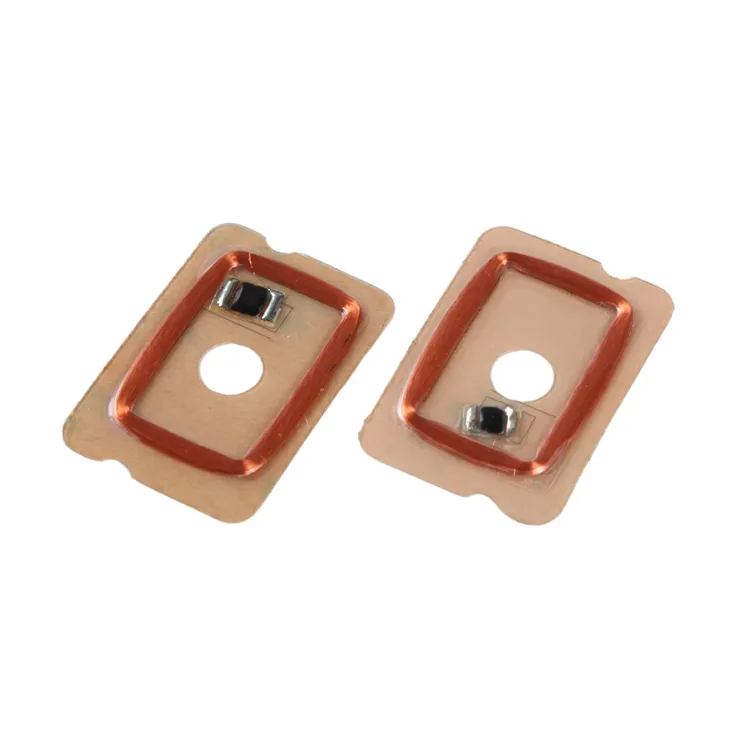
A 125 kHz RFID sticker is a low-frequency credential on adhesive — a chip like EM4200, T5577 or HITAG 2 with a printed antenna — for sticking onto badges, assets or equipment where a card won't fit.
125 kHz RFID stickers for systems that specify a compatible low-frequency chip and identifier format. Compare the paper, PVC or PET face, dimensions and adhesive for the intended object. Send the reader model, chip requirement, quantity and artwork, and test an attached sample before approving the batch.
Free standard samples · Quotation within one business day
Product details
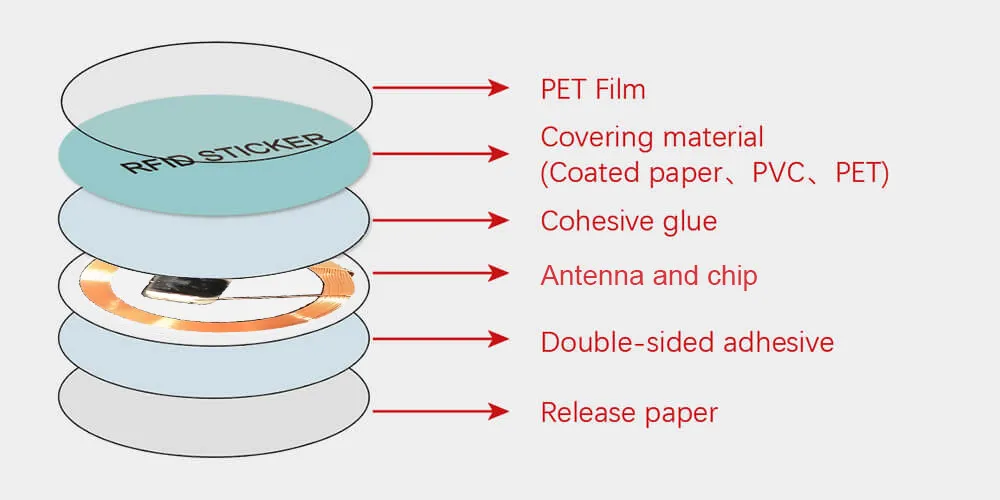
Exploded View
The structure of the 125 kHz RFID sticker
It is made of either paper, PVC or PET material and has an adhesive backing for easy application to flat or curved surfaces.
Specification:
Product Name
125 kHz RFID sticker
Material
Antenna: Copper Coil Coating: art paper/PVC/PET, adhesive & release paper
Dimension
ø30mm / ø35mm / ø40mm
Reader compatibility
Match the selected chip, encoding and identifier format to the installed 125 kHz reader
Frequency
125khz
Chip
EM4200, EM4305, ATA5577
Reading distance
2-5cm (depending on reading distance)
Printing
Offset printing, digital printing
Working Temperature
-25~70℃
Delivery
200pcs/bag, 2000 pcs/carton.
Applications
Asset Tracking
These stickers are suitable for tracking assets such as inventory, equipment, or tools.
Access Control
They can be used for access control systems, allowing authorized personnel to gain entry to secure areas.
Identification
The stickers provide a unique identifier for items or individuals.
Advantage
Why choose Proud Tek 125 kHz RFID stickers?
Ultra-Thin Design: At just 0.58mm, these RFID stickers are incredibly thin and almost invisible, fitting seamlessly into any surface.
Reader check: validate the selected antenna and label construction on the actual mounting surface with the intended reader.
Exposure requirements: specify any moisture or immersion conditions and request model-specific evidence before using the label in that environment.
What a 125 kHz RFID sticker is
A 125 kHz RFID sticker is a self-adhesive low-frequency (LF) label built around a 125 kHz chip and a copper-coil antenna. LF tags carry a short identifier that a reader enrols, rather than application files, so the sticker suits access control, attendance, membership and asset identification on systems that already run at 125 kHz. It reads at close range, a few centimetres, and is a retrofit format: it adds contactless identification to an object an existing LF reader already understands.
The frequency alone does not identify the chip. A 125 kHz reader accepts a specific chip and data format, so send the reader model and the required credential specification before choosing the chip. A number printed on an existing tag does not prove which chip it uses or that a desktop writer can copy it.
125 kHz chip options
We build 125 kHz stickers around the three chips below, using genuine EM Microelectronic EM4305 and Microchip ATA5577C parts for the two writable options; our "EM4100" stickers are made on the EM4200. They behave differently, and the reader decides which one you need.
Chip
Type
Identity and memory
Choose it when
EM4200
Read-only, fixed ID
Factory-programmed identifier; EM's laser-programmed replacement for the EM4100/EM4102
Your readers enrol a fixed EM4100/EM4102 number and the tag never has to be rewritten
EM4305
Rewritable
512-bit EEPROM in 16 words of 32 bits, a factory 32-bit chip UID, and Manchester or Bi-phase encoding
You need to write or change the stored identifier and your encoder supports EM4305
T5577 (ATA5577C)
Configurable / emulating
363-bit total memory with seven 32-bit user blocks; the ATA5577C supports the 100-150 kHz range
You must match an existing LF format and your writer supports T5577
EM4305 and T5577 use different programming commands, so an encoder that writes one may not write the other; confirm the chip your equipment supports. These are chip selection points, not a promise of finished-label performance: the antenna, the label construction and your reader set the practical read distance. The chip facts here are drawn from the EM4200 card, EM4305 card and T5577 card pages; the EM Microelectronic EM4205/EM4305 data sheet and the Microchip ATA5577C data sheet are the primary references.
125 kHz, 13.56 MHz or UHF?
125 kHz is an LF band. A phone's built-in NFC reads 13.56 MHz, not 125 kHz, so an ordinary smartphone will not read these stickers. If your project is phone-based or needs stored data such as a URL, compare MIFARE stickers and NTAG213 NFC labels at 13.56 MHz. For long-range vehicle or logistics reads, a UHF label is the right band. Match the band to the reader you already run.
Specify the label around the object
Mounting surface: plastic, paper, glass, wood or metal, flat or curved. Metal near any RFID antenna can reduce range, so ask about a suitable construction and test a sample in its final position.
Face and finish: paper, PVC or PET, blank or printed; add serial numbers, a barcode or a QR code where a visible match to the electronic ID is needed.
Dimensions: the standard round formats are ø30, ø35 and ø40 mm; give the available area and shape.
Environment: indoor or outdoor, wet, or exposed to chemicals, so the adhesive and face are chosen and tested for those conditions.
Encoding and numbering
Tell us whether you need blank stickers for your own encoding or pre-programmed tags in an agreed format, and whether the printed number must match the electronic ID. EM4305 and T5577 can be supplied blank for your writer or pre-encoded to a specification; EM4200 carries a fixed factory ID. Pre-encoded stickers are read back one by one after writing and the batch comes with a data report; with numbered stickers you also get a list in Excel, CSV or XML matching each tag's ID to the number printed on it (RFID encoding service). Confirm the chip and data format in the quotation, and validate a sample on your encoder and reader before the batch.
Before you order
The reader, lock or encoder model, or a working tag, so we can confirm the chip and data format.
The chip: EM4200 for a fixed number, EM4305 or T5577 where the ID must be written or must match an existing format.
The surface and environment, including any metal or outdoor exposure.
Size, face material, artwork and any serial number, barcode or QR code.
Blank or pre-encoded delivery, plus quantity and delivery date. Samples are available for reader testing.
No. A phone's built-in NFC operates at 13.56 MHz, while these are 125 kHz LF stickers. Use a 125 kHz reader or encoder, or choose a 13.56 MHz label such as an NTAG213 NFC label for phone-based projects.
Which chip should I choose: EM4200, EM4305 or T5577?
Start from your reader and encoder. EM4200 carries a fixed factory ID and suits EM4100/EM4102 systems. EM4305 and T5577 are rewritable but use different programming commands, so pick the one your writer and system support. Test a sample before ordering.
Will these stickers work with my existing 125 kHz readers?
Only if the chip and data format match what the reader enrols. A shared 125 kHz frequency is not enough. Send the reader model and credential specification, then validate a sample through enrolment and normal use.
Can I stick a 125 kHz label on metal?
Metal near any RFID antenna can reduce range. Specify the surface, ask about a suitable construction, and test a sample in its final position on the actual object before the batch.
Can you print serial numbers or a barcode on the stickers?
Yes. Paper, PVC and PET faces take offset and digital printing, and we can add a human-readable number, barcode or QR code that matches the electronic ID. Confirm the artwork and variable-data format in the quotation.
Do you supply blank or pre-encoded 125 kHz stickers?
Both, depending on the chip. EM4305 and T5577 can be blank for your encoder or pre-programmed to an agreed format; EM4200 has a fixed factory ID. Confirm the delivery state and approve a sample before the order.
Buyer guides
How to Read an RFID Tag Quotation, Line by LineWhat decides RFID card and tag prices, and how to compare quotations line by line: unit-price basis, tooling, encoding, samples, freight and Incoterms.