Which MIFARE family fits your system?
Start with one rule: installed readers dictate replacement orders, while cloning risk and multi-application boundaries dictate new specifications. Ordering a higher-security chip never upgrades an existing site on its own if the wall readers still expect MIFARE Classic sectors or only read the unauthenticated card UID.
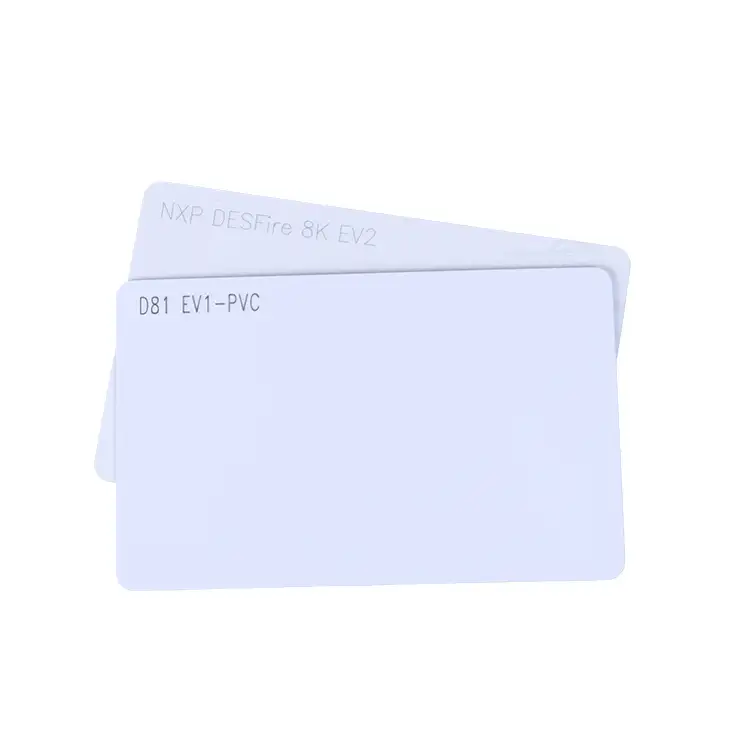
Order [MIFARE Classic EV1 1K](/product/mifare-classic-card/) (`MF1S50`) or [4K](/product/mifare-4k-card/) (`MF1S70`) when maintaining an installed access, hotel or membership estate whose readers only speak Classic commands. Specify [MIFARE Plus](/product/mifare-plus-card/) (`MF1P` / `MF1PH` EV2 for new bridge designs; note that original Plus S is discontinued by NXP and ordered only for explicit installed-base replacements) when a large Classic reader fleet must migrate to AES-128 in stages without swapping every door reader overnight. Specify [MIFARE DESFire EV3](/product/mifare-desfire-cards/) for new access, transit, campus and multi-application builds, or [MIFARE DESFire EV2](/product/mifare-desfire-ev2-cards/) where an existing installation's approved specification locks in EV2.
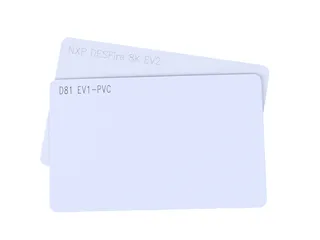
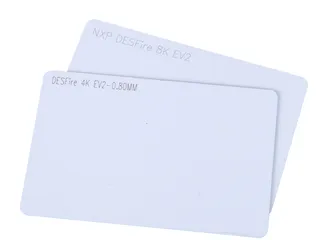
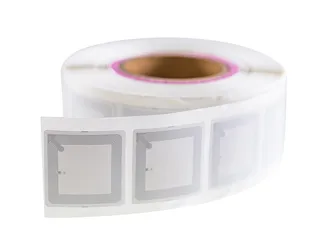
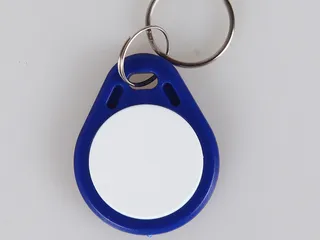
Every chip family below can be built into ISO ID-1 PVC, PET, PLA or wooden cards, DESFire and access key fobs, adhesive MIFARE stickers (thin PET, epoxy or ferrite on-metal) and RFID wristbands. Silicon capabilities come from NXP's public data sheets; finished credential read range and compatibility depend on antenna geometry, mounting surface and reader firmware, verified on samples.
MIFARE Classic EV1 vs MIFARE Plus EV2 vs MIFARE DESFire EV2/EV3: datasheet comparison
All three families share the 13.56 MHz ISO/IEC 14443 Type A RF layer for anticollision, then diverge immediately in protocol framing, memory structure and cryptographic key hierarchy:
| Dimension | MIFARE Classic EV1 (1K / 4K) | MIFARE Plus (EV2 current; S/X/EV1 legacy) | MIFARE DESFire (EV3 current; EV2 / Light) |
|---|---|---|---|
| Representative NXP silicon | MF1S50YYX_V1 (1K), MF1S70YYX_V1 (4K) | MF1P22 / MF1PH22 (2K), MF1P42 / MF1PH42 (4K) | EV2 MF3D(H)x2; EV3 MF3D(H)x3; Light MF2DL(H)x0 |
| Transmission protocol | ISO/IEC 14443-3A + proprietary Classic commands | SL1: Classic over 14443-3A; SL3: ISO/IEC 14443-4 (ISO-DEP) | ISO/IEC 14443-4 (ISO-DEP / T=CL) + ISO 7816-4 wrapping |
| Memory sizes (NXP) | 1 KB (1,024 B) or 4 KB (4,096 B) | 2 KB or 4 KB (1 KB on Plus SE) | 2 KB, 4 KB, 8 KB (16/32 KB listed on EV2; 640 B on Light) |
| Memory model | Fixed 16-byte blocks in 16 (1K) or 40 (4K) sectors | Fixed 16-byte blocks in 32 (2K) or 40 (4K) sectors | 3-byte Application IDs (AIDs) holding up to 32 typed files each |
| Transaction rollback | Single 32-bit Value Block transfer/restore | Value Block operations per sector | Atomic CommitTransaction / AbortTransaction on Backup, Value & Record files |
| Cryptography | 48-bit Crypto-1 (publicly broken; key recovery in minutes) | SL1: Crypto-1; SL3: 128-bit AES (EV2 adds SL1SL3MixMode) | 128-bit AES (plus 2K3DES / 3K3DES compatibility; up to 14 keys/app & 16 key sets) |
| Common Criteria (IC + OS) | Not certified | EAL5+ on Plus EV1 / EV2 (EAL4+ on SE / X) | EAL5+ on DESFire EV2 / EV3 (EAL4 on DESFire Light) |
| UID / privacy options | 7-byte UID or 4-byte NUID ordering variants | 7-byte UID or 4-byte NUID ordering variants | 7-byte factory UID with optional Random ID during anticollision |
| Relay & phone-tap features | None | Proximity Check, Transaction MAC & Transaction Timer (EV2) | Proximity Check & Transaction MAC (EV2/EV3); SUN dynamic NDEF URL & Timer (EV3) |
| NXP status for new designs | Not recommended for new designs | Plus EV2 active (original Plus S discontinued) | DESFire EV3 active & recommended (EV1/EV2 not recommended for new designs) |
Why Classic EV1 hardening and UID-only readers still fail security audits
Two misconceptions regularly cause newly purchased access cards to fail penetration tests. The first is assuming that MIFARE Classic EV1 fixed Crypto-1. Compared with pre-2014 Classic silicon, genuine NXP EV1 hardened the card's random-number generator and suppressed encrypted error leakage (blocking the original *darkside* and *nested* attacks), yet the 48-bit Crypto-1 stream cipher remained unchanged for backward compatibility. Published *hardnested* attacks still recover EV1 sector keys once an attacker authenticates to a single sector. Use Classic EV1 when matching installed Classic readers — where genuine NXP silicon avoids third-party compatible clones with backdoor keys — and validate sector-trailer bytes in our MIFARE Classic Access Bits Calculator so malformed complements never permanently lock a sector.
The second trap is UID-only enrolment. Every 13.56 MHz ISO/IEC 14443-A credential transmits its UID (or 4-byte NUID) in plain text during anticollision before any cryptographic authentication starts. If a door controller, turnstile or printer release reader only reads that unauthenticated UID, buying DESFire EV3 or MIFARE Plus provides no protection against UID emulators. True copy resistance starts only when reader firmware selects an AES-protected sector (Plus SL3) or application file (DESFire) and completes mutual authentication with diversified keys.
When maintaining legacy controllers that enrol UIDs, check whether the software expects a 4-byte NUID (single-size anticollision) or a 7-byte UID (double-size anticollision, where cascade level 1 begins with cascade tag `0x88`). You can inspect MSB/LSB byte order, 10-digit card print formats and Wiegand parity in our RFID UID & Wiegand Format Converter.
Choosing your upgrade path: MIFARE Plus (SL1 → SL3) vs MIFARE DESFire EV3
When retiring MIFARE Classic, integrators choose between two architectures based on how quickly the reader estate can be touched and how many systems share the card:
- Choose MIFARE Plus EV2 when readers must upgrade in phases: Cards ship in personalisation state `SL0` or Classic-compatible `SL1` so existing Classic readers keep opening doors while older panels are replaced building by building. On Plus EV2, `SL1SL3MixMode` even allows migrated sectors to require AES-128 (`SL3`) while legacy sectors stay in `SL1`. Once all readers support Plus SL3 over ISO/IEC 14443-4, cards switch permanently upward to `SL3` (security-level transitions never reverse).
- Choose MIFARE DESFire EV3 for new builds and multi-application credentials: Each department or vendor (physical access, transit ticketing, cashless canteen, EV charging, follow-me print) gets its own 3-byte Application ID (`AID`) and up to 14 keys without sharing sector maps. Backup, Value and Record files stage writes and commit atomically on `CommitTransaction`, preventing corrupted balances when a card is pulled away mid-tap.
- Need smartphone browser verification too? DESFire EV3 adds NXP's Secure Dynamic Messaging (`SUN`), mirroring an AES-CMAC signature and read counter into an NDEF URL — the same tap-verification mechanism used on NTAG 424 DNA (configure offsets with our NTAG 424 DNA SDM Calculator).
- Tight single-application budget on modern readers? Evaluate MIFARE DESFire Light (`640 bytes`, one predefined application with five fixed files and AES-128 authentication) if your reader vendor explicitly supports its EV2-subset command profile.
Form factors, 17 pF vs 70 pF capacitance, and smartphone NFC behaviour
Switching from an ISO ID-1 card (`85.6 × 54 mm`) to a smaller credential changes antenna physics as well as packaging. Standard DESFire ICs (`MF3D22`, `MF3D43`, `MF3D83`) use 17 pF input capacitance tuned for full-size card coils. For compact coils inside key fobs, adhesive MIFARE stickers (including ferrite-backed on-metal labels for laptops, steel cabinets and tools) and silicone or fabric wristbands, NXP offers 70 pF high-capacitance (`"H"`) variants (`MF3DHx2`, `MF3DHx3`, `MF1PHx2`) to maintain coupling across smaller apertures. Always test smaller form factors on the actual wall reader, because compact coils read at shorter range than ID-1 cards.
If smartphones are part of your workflow, check platform support before locking the chip:
| Chip mode | Apple iOS (iPhone) | Android NFC | Browser URL tap without an app |
|---|---|---|---|
| MIFARE Classic EV1 | Not supported (Core NFC cannot read Classic sectors) | Optional — works only on phones with an NXP NFC controller | Unreliable; use NTAG213 stickers instead |
| MIFARE Plus (SL3) | Supported in custom apps via ISO-DEP (ISO 7816 / 14443-4) | Supported in custom apps via `IsoDep` | Not standard unless formatted as Type 4 NDEF |
| MIFARE DESFire EV2 / EV3 | Supported in custom apps via Core NFC `NFCISO7816Tag` | Supported in custom apps via `IsoDep` | Yes, when configured as NFC Forum Type 4 NDEF (EV3 adds dynamic SUN CMAC) |
Published 2026-11-26 · Updated 2026-11-26