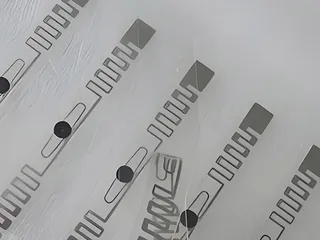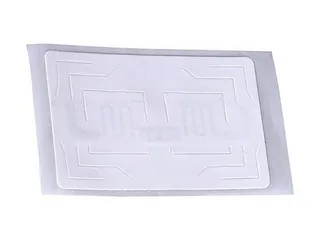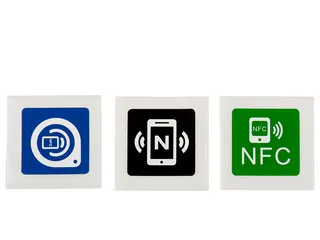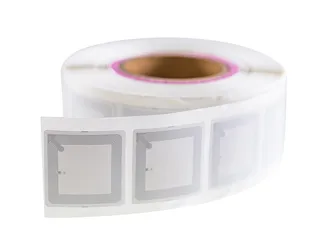
Which roll format matches your production or tagging line?
All three formats can carry the exact same silicon — whether a RAIN RFID (UHF) IC such as NXP UCODE 9/9xe or Impinj M730/M830 (compared in NXP UCODE 9 vs Impinj M730, M750 & M830/M850) or a 13.56 MHz HF/NFC IC such as NTAG213, NTAG 424 DNA, ICODE SLIX2 or MIFARE DESFire EV3. What changes is how many converting layers are already finished before the roll reaches your facility:
Order a dry inlay when your own line laminates, embeds or coats the transponder — for example pressing inlays between PVC, PETG or wooden card sheets, sealing inlays inside woven or cardstock apparel hang tags, or potting transponders into rigid plastic housings.
Order a wet inlay (often clear PET with adhesive on a liner) when your converting press laminates its own pre-printed paper or film face stock, or when warehouse teams stick an unprinted transponder underneath an existing carton barcode, inside a plastic badge holder or inside a returnable tote.
Order a converted RFID label or hang tag when rolls go straight into an on-site RFID printer-encoder (such as Zebra, SATO, Printronix or Honeywell industrial printers, confirmed by printer model) or straight onto merchandise, cartons, pallets and assets with factory printing and GS1 EPC or NDEF pre-encoding.
Layer-by-layer comparison: dry inlay vs wet inlay vs RFID label
Moving from dry inlay to wet inlay to finished label adds adhesive, release liner, face stock and die-cut registration. Neither a dry nor a wet inlay carries a thermal-printable paper or matte synthetic topcoat:
| Attribute | Dry Inlay | Wet Inlay (Clear / Unfaced) | Converted RFID Label / Ticket |
|---|---|---|---|
| Layer stack (top to bottom) | IC + etched antenna on continuous carrier web (typically PET) | Carrier + antenna + IC + pressure-sensitive adhesive (PSA) + release liner | Printable face stock + top adhesive + inlay + mounting adhesive + release liner |
| Delivered web form | Continuous uncut web (single-row or multi-row across) | Die-cut individual transponders on release liner | Die-cut labels on liner, or perforated fanfold / hang-tag tickets |
| Direct thermal / ribbon printing | No — requires face lamination first | Not designed for standard paper ribbons (clear PET top film) | Yes — coated paper, direct thermal, thermal-transfer paper or synthetic PET/PP |
| Who typically orders it | Card factories, label converters, ticket printers, hard-tag moulders | Label converters without adhesive coaters, concealed packaging / badge retrofits | Brands, 3PL warehouses, retailers, healthcare & asset-tracking teams |
| Critical mechanical spec | Web width, row count across, pitch, lamination heat/pressure window | Adhesive grade, liner release tension, antenna cut size, storage conditions | RFID printer model (inlay-to-gap offset), core ID, max OD, wind direction |
| Proud Tek catalogue pages | UHF RFID inlays | UHF RFID inlays, NTAG stickers | UHF labels, MIFARE stickers, paper cards |
Converting and printer-encoder specs that prevent line stoppages
Most roll rejections happen mechanically rather than electrically — an inlay pitched for one printer's RF coupler fails to encode in another, or a hot-lamination cycle stresses a carrier film meant for cold adhesive converting. Specify these parameters up front so sample rolls match your machine:
- Dry inlay converting: State web width, number of rows across the web, centre-to-centre pitch, core inner diameter (for example 76 mm / 3 in), maximum outer roll diameter, eye-mark / registration-mark needs, and whether your press uses cold PSA lamination, hot-melt adhesive or heated card press cycles.
- Wet inlay adhesive & liner: Specify the mounting substrate (corrugated kraft carton, high-density polyethylene tote, glass, ABS or polycarbonate), application temperature, whether permanent, removable or freezer-grade adhesive is required, and how defective units on a roll must be flagged (ink mark vs removed and spliced).
- Finished rolls for RFID printer-encoders: Always name the exact printer make and model in your RFQ. Print-and-encode printers energise a narrow near-field coupler at a fixed distance from the label's leading gap or black mark; we position the inlay inside the die-cut and wind the roll (face-in or face-out, core size and outer diameter) to match that printer's specification, verified on a sample roll.
- Metal and liquid-filled packaging: None of the three flat constructions above will read reliably when stuck straight onto steel racking, aluminium cases or foil pouches — metal detunes both UHF dipoles and 13.56 MHz coils. Specify a foam-spaced UHF on-metal label, a ferrite-backed HF sticker, or a rigid housing (see On-Metal vs Standard RFID & NFC Tags and custom RFID tags).
In-house encoding vs factory pre-encoded rolls
When you buy dry inlays, wet inlays or blank white labels for an on-site printer-encoder, UHF chips such as NXP UCODE 9 arrive with a pre-serialised factory code copied from Bank `10` (`TID`), which is not a GS1 identifier (inspect Bank `10` silicon headers in our UHF RFID TID Decoder).
If your suppliers or warehouses do not run RFID printer-encoders, Proud Tek can deliver converted labels, hang tags or wet inlays pre-printed and pre-encoded to your data plan through our RFID encoding service: `SGTIN-96` retail item EPCs (build ranges in our GS1 SGTIN-96 EPC Encoder), `SSCC-96` pallet codes, `GRAI-96` returnable-tote IDs and `GIAI-96` asset IDs (build and verify hex in our GS1 SSCC, GRAI, GIAI & SGLN EPC Calculator), or NFC Forum NDEF records (NDEF Generator). Every piece we encode is read back after encoding and ships with a verification data report; numbered labels and tickets include an Excel, CSV or XML file pairing each tag's EPC, TID or UID with its printed barcode or serial.
Ordering checklist: how to qualify samples before bulk converting
Proud Tek has manufactured RFID and NFC transponders in Shenzhen since 2008. Standard blank inlay and label samples are free; custom antenna tooling, custom roll slitting/die-cutting, printed artwork or pre-encoded samples carry a setup fee confirmed before production. Standard items generally take 2–3 weeks, and workable inquiries receive a quotation within one business day:
| Checklist item | Dry Inlay RFQ | Wet Inlay RFQ | Finished Label / Ticket RFQ |
|---|---|---|---|
| Chip & protocol | Named UHF or HF/NFC IC, or required memory bits | Named UHF or HF/NFC IC, or required memory bits | Named IC, retailer ARC Spec, or reader model |
| Dimensions | Max antenna footprint, web width, pitch, rows across | Die-cut outline, liner width, pitch | Finished label width × height, corner radius, gap |
| Materials | Carrier film & your lamination temp/pressure | Substrate material, adhesive type, liner | Face stock (DT, TT paper, PET), adhesive, artwork |
| Equipment & winding | Core ID, max OD, unwind orientation, defect rule | Core ID, max OD, applicator or press direction | Printer make/model, core ID, max OD, wind in/out |
| Encoding | Usually unencoded (or pre-encoded EPC list) | Blank or pre-encoded EPC / NDEF | Blank for printer, or pre-printed + pre-encoded with CSV/Excel report |
Published 2026-11-27 · Updated 2026-11-27