Do you actually need an on-metal tag?
On-metal constructions cost more and add thickness compared with a plain wet inlay or paper label, so start by checking what sits directly behind and around the antenna:
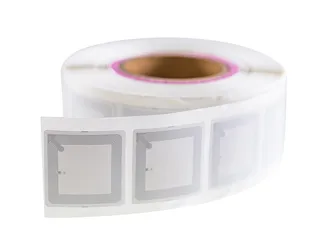
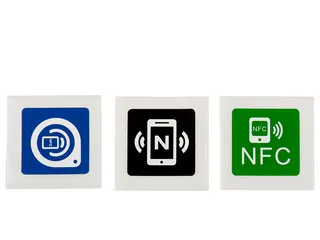
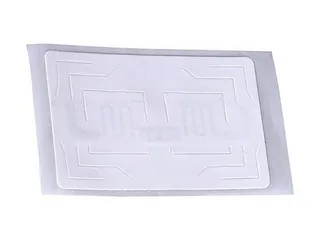
Use a standard inlay or label (NFC stickers, standard MIFARE stickers or UHF RFID labels) on corrugated cartons, plastic totes, apparel hang tags, glass windscreens and wooden fixtures — or whenever a non-metallic bracket holds the label well clear of metal (GS1 US's EPC placement guideline, Release 1.3 §§2.1–2.3 notes keeping standard UHF tags at least `1/4 inch` / `~6.4 mm` away from metal, foil or metallic inks).
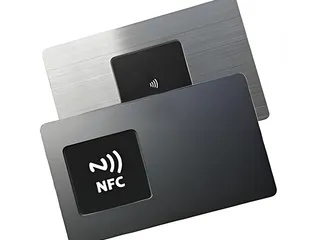
Specify an on-metal (anti-metal) tag whenever the label, sticker or hard tag mounts directly onto steel, stainless steel, aluminium, foil-lined packaging, server racks, returnable metal stillages, gas cylinders, tools or machinery — or when the credential itself has a metal body such as a metal NFC business card.
Standard vs on-metal constructions across LF, HF/NFC and UHF
Physics changes between inductive coupling (`125 kHz` LF and `13.56 MHz` HF/NFC) and radiative backscatter (`860–960 MHz` UHF), so the isolation layer inside an on-metal tag also changes (NXP AN11755 Rev. 1.7 §§2.3–2.3.1; Impinj on hard-to-tag items):
| Criterion | Standard label / inlay (off-metal) | On-metal HF / NFC (13.56 MHz & 125 kHz) | On-metal UHF / RAIN (860–960 MHz) |
|---|---|---|---|
| What metal does to a plain tag | Reads as designed on cardboard, plastic, wood or glass | Eddy currents in metal create an opposing magnetic field, absorb power & shift coil inductance | Metal reflects RF energy and detunes a standard flat dipole so it stops responding |
| How the on-metal build works | Thin paper or PET face + aluminium/copper antenna + adhesive | High-permeability ferrite sheet between antenna coil and metal; coil re-tuned with ferrite in place | Foam spacer (flexible label), FR4 PCB, ceramic core or ABS/PC housing coupling with the metal ground plane |
| Typical thickness | Sub-millimetre paper/PET label | Thin sticker + ferrite backing (thicker than a plain paper label) | Flexible foam label (~1 mm+) up to several millimetres on rigid hard tags |
| Printer compatibility | Standard thermal-transfer / desktop RFID printers | Flat sheets or rolls; check thickness before running through a label printer | Flexible foam UHF labels require an on-metal-capable RFID printer; rigid PCB/ABS tags are laser-marked or pre-printed |
| Read direction | Reads from both sides in free air | Reads from the outward-facing antenna side only — never through the metal sheet behind it | Reads outward from the mounted face; metal acts as a reflector behind the tag |
| Proud Tek formats | NTAG213 stickers, UHF labels, UHF inlays | Ferrite-backed NFC stickers, MIFARE stickers, 125 kHz stickers & metal NFC cards | Custom on-metal tags (ABS, PCB, ceramic, flexible foam) & on-metal LED UHF tags |
13.56 MHz NFC and HF on metal: ferrite backing vs antenna windows
When a smartphone or `13.56 MHz` reader approaches a bare NFC sticker stuck onto an aluminium laptop, steel machine panel or metal shelf, the alternating magnetic field induces circular eddy currents in the metal. As NXP demonstrates in AN11755, those eddy currents generate an opposing magnetic flux and shift the coil's resonant frequency.
Adding a ferrite layer behind the NFC inlay channels the magnetic flux between the phone and the coil instead of letting it penetrate the metal. Two rules matter in procurement: (1) you cannot simply stick loose ferrite tape behind an ordinary off-metal sticker without shifting its resonance — order an on-metal NFC or MIFARE sticker whose antenna was tuned with the ferrite sheet in place, and (2) the ferrite must cover the entire coil footprint.
On a [metal NFC business card](/product/metal-nfc-card/), the body itself is stainless steel or anodised aluminium. We build these in two proven ways: a ferrite-backed hybrid card (unbroken metal front face, tapped from the non-metal back) or a slotted/windowed metal card (a non-metal window around the inlay). Neither construction reads *through* solid steel, so mark the tap side clearly in your artwork.
860–960 MHz UHF on metal: flexible foam labels vs FR4 PCB and hard tags
UHF on-metal tags frequently read *further* on a flat metal plate than in free air because their antenna uses the metal surface as an image ground plane — which also means an on-metal-tuned UHF tag can perform poorly if placed on plastic or cardboard instead! Match the mechanical body to how the asset is handled:
- Flexible foam-spaced UHF on-metal labels: Adhesive labels with a thin closed-cell foam spacer for IT servers, laptops, indoor equipment and gently curved drums or cylinders. Confirm regional band tuning (`ETSI 865–868 MHz` vs `FCC 902–928 MHz` in our UHF Frequency by Country lookup) because high-Q on-metal antennas are narrower-band than broadband paper inlays.
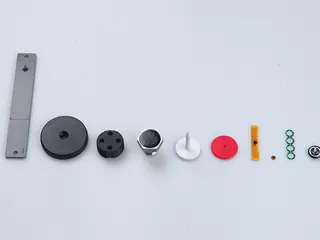
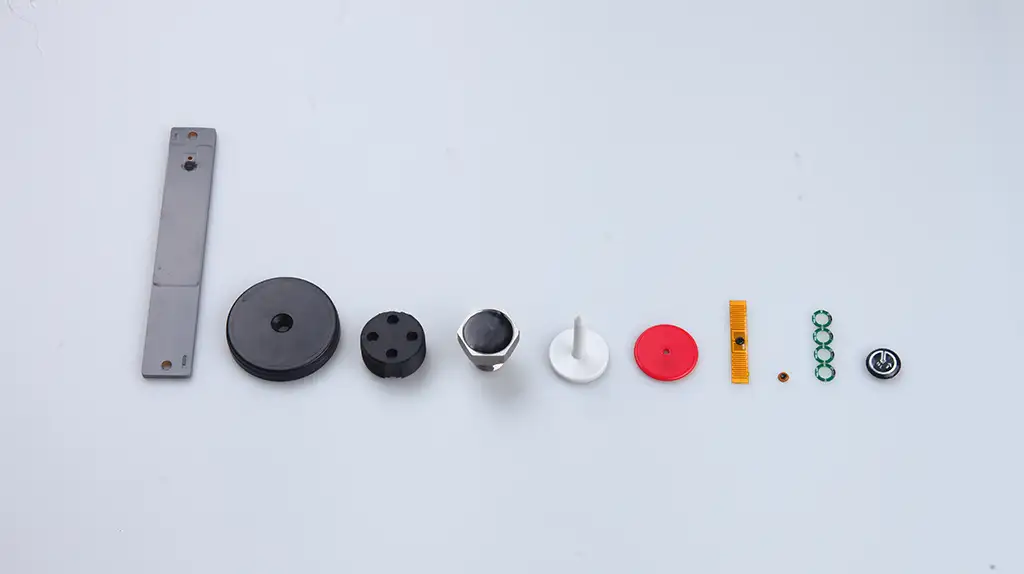
- FR4 PCB & miniature ceramic tags: Thin, stiff solder-mask PCB or ceramic tags fixed with industrial adhesive, rivets or epoxy potting inside milled tool recesses (see our RFID tool tracking guide). Surrounding metal walls inside a pocket shift tuning, so always test potted samples in the real tool steel.
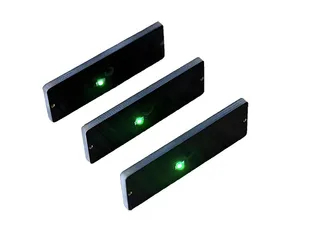
- Moulded ABS / PC / epoxy-sealed hard tags & cable-tie tags: Screw-, rivet-, weld-bracket or cable-tie housings for outdoor stillages, trailers, returnable containers and yard assets (vehicle & trailer identification). Where warehouse staff must spot one specific item on a crowded metal rack, our on-metal UHF tag with LED light flashes when addressed by a handheld reader.
Five specification details to include in an on-metal RFQ
Sending these five items lets our engineering team recommend an existing construction or quote a custom build within one business day — without back-and-forth guessing:
- 1. Surface material & geometry: Flat steel/aluminium panel, curved cylinder (state the diameter), or recessed cavity (state pocket length × width × depth).
- 2. Reader band & protocol: Smartphone NFC (`NTAG213` / `NTAG 424 DNA`), `13.56 MHz` access/industrial reader (`MIFARE DESFire`, `ICODE SLIX2` — size blocks in our ISO 15693 & ICODE SLIX2 Calculator), `125 kHz` LF (`T5577` / `EM4200`), or `UHF` (`ETSI` vs `FCC` band, size EPC/User banks in our UHF Memory Calculator).
- 3. Fixing method: High-tack acrylic/3M adhesive, screws/rivets, cable tie, hanging loop or epoxy potting.
- 4. Environmental exposure: Indoor office/server room vs outdoor UV, washdowns, oils, impact or heat cycles (IP, temperature and chemical limits are confirmed per design and verified in your sample test).
- 5. Printing & pre-encoding: Barcode/QR, laser-engraved serial numbers, or factory pre-encoding with read-back verification and an Excel, CSV or XML UID/TID/EPC mapping report (RFID encoding service).
Published 2026-11-26 · Updated 2026-11-26