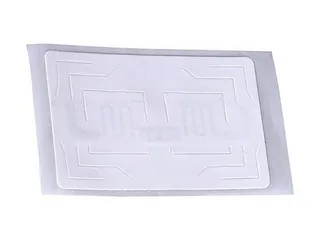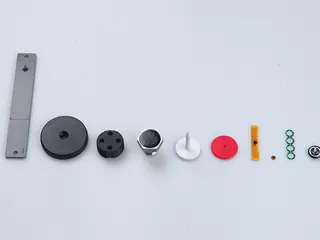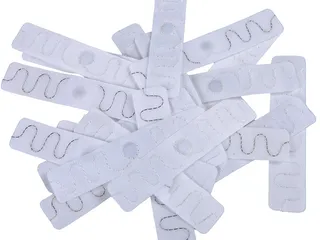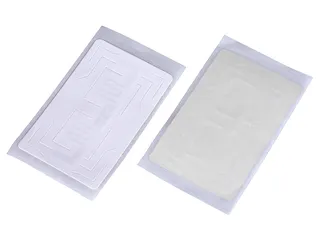

Which RAIN RFID chip family fits your label or inlay order?
Pick the silicon around your EPC scheme, whether any offline User-bank bits are written, and any retailer ARC or middleware TID rule:
Choose NXP UCODE 9 (`96-bit EPC`, `0-bit User`) or NXP UCODE 9xe (`128-bit EPC`, `0-bit User`) for high-volume retail price tickets, apparel hang tags, shipping cartons and pallet labels that store a standard `SGTIN-96`, `SSCC-96` or `128-bit` identifier without `Access`-password locking.
Choose Impinj M730 / M830 (`128-bit EPC`, `0-bit User`) when your programme specifies Impinj silicon or needs `128-bit` EPC plus a non-zero `Access` password, or Impinj M750 / M850 (`96-bit EPC`, `32-bit User`) when two 16-bit words of User memory are needed alongside a `96-bit` GS1 EPC.
Choose Impinj M780 (`496-bit EPC` / `128-bit User`), Impinj M781 (`128-bit EPC` / `512-bit User`), NXP UCODE Nxm (up to `496-bit EPC` / `752-bit User`, `880 bits` shared) or Alien Higgs-9 (configurable up to `496-bit EPC` / `688-bit User`) when encoding long alphanumeric GS1 keys such as `SGTIN-198` or `GRAI-170`, aerospace/automotive part records or offline maintenance data.
NXP UCODE vs Impinj M700/M800 vs Alien Higgs-9: datasheet matrix
All figures below come from the chip makers' published data sheets and product specifications (cited on our UHF RFID inlays page). Read sensitivity numbers are measured under each vendor's own reference dipole or model — a 1–2 dB difference on paper never replaces testing the finished inlay on your actual carton, garment or plastic tote:
| Chip | EPC Bank (01) | User Bank (11) | TID header / serial | Password & security notes | Read sensitivity (maker's data) |
|---|---|---|---|---|---|
| NXP UCODE 9 | 96 bits | None (0 b) | 96-bit TID (E2806995 / 6915h, 48-bit serial) | 32-bit Kill pwd; Access pwd hardwired to 0 | −24 dBm |
| NXP UCODE 9xe | 128 bits | None (0 b) | 96-bit factory-locked TID (MDID 006h) | 32-bit Kill pwd; Access pwd hardwired to 0 | −24 dBm |
| NXP UCODE Nxm | Up to 496 bits | Up to 752 bits | Factory TID (MDID 006h); 880 b shared pool | Three selectable EPC/User memory maps | −24 dBm |
| Impinj M730 | 128 bits | None (0 b) | 96-bit TID (E2801191h, 48-bit serial) | Shared 32-bit Kill/Access password; AutoTune V2 | −24 dBm |
| Impinj M750 | 96 bits | 32 bits | 96-bit TID (E2801190h, 48-bit serial) | Shared 32-bit Kill/Access password | −24 dBm |
| Impinj M775 | 128 bits | 32 bits | Extended TID (MDID 001h, S=1 crypto flag) | Impinj Authenticity (needs supporting reader & service) | −24 dBm |
| Impinj M780 / M781 | 496 b / 128 b | 128 b / 512 b | 96-bit TID (MDID 001h, 48-bit serial) | Fits SGTIN-198 (M780) or 64-byte User data (M781) | −23.5 dBm |
| Impinj M830 / M850 | 128 b / 96 b | 0 b / 32 b | 96-bit TID (E28011B0h series, 48-bit serial) | Drop-in antenna match for M730/M750; shared Kill/Access pwd | −25.5 dBm |
| Alien Higgs-9 | 96–496 bits | Up to 688 bits | Unique 48-bit serial in TID (MDID 003h) | Configurable NVM split; 200,000 write cycles | Up to −20 dBm |
Three firmware traps when migrating or second-sourcing UHF chips
Because every EPC Gen2v2 tag responds to the same air-interface inventory commands, procurement teams sometimes treat RAIN ICs as drop-in commodities. Three software details routinely halt encoding lines when a chip changes unannounced:
- Password commands (`Access` vs `Kill`): On NXP UCODE 9 and UCODE 9xe, the 32-bit Access password is permanently hardwired to zero (`00000000h`) — any RFID printer or encoder script that tries to write a non-zero Access password into Reserved Bank `00` Word `02h–03h` will fail! Conversely, on Impinj M700 and M800 chips, Kill and Access share a single 32-bit value, so setting an Access password simultaneously sets the Kill password.
- Protocol Control (`PC`) word length when EPC exceeds 96 bits: Tags delivered with a 96-bit pre-serialised EPC have `PC = 3000h` (`L = 6` words). If you switch to `UCODE 9xe`, `Impinj M730/M830` or `M780` to encode `128-bit` or `208-bit` (`SGTIN-198`) identifiers, your encoder must update Bank `01` Word `01h` (`PC`) — verify exact `PC` hex and `WordPtr` values in our UHF Memory & PC Word Calculator and generate `SGTIN-96` ranges in our GS1 EPC Encoder.
- Bank 10 TID whitelisting: Closed-loop laundry, tool-tracking, race-timing and retail QA stations often filter tags by the first 32 bits of Bank `10` (`E2806995` for UCODE 9 vs `E2801191` for M730). Paste a sample tag's hex into our UHF RFID TID Decoder to inspect its GS1 Mask Designer ID, Tag Model Number and 48-bit serial before switching batches.
Replacing discontinued NXP UCODE 8, UCODE 8m and UCODE 9xm
NXP lists UCODE 8 and UCODE 8m (`E2806894` / `6994`) as no longer manufactured and UCODE 9xm as end-of-life. When an older tender or bill of materials still names one of those parts, match the replacement to the memory banks your software actually uses and qualify samples on your items:
- Replacing UCODE 8 (`128-bit EPC`, `0-bit User`): Evaluate UCODE 9 if your programme only writes a `96-bit` GS1 EPC (NXP notes UCODE 9 can reuse UCODE 8 antenna footprints), or UCODE 9xe / Impinj M730 / M830 if your software uses the full `128-bit` EPC.
- Replacing UCODE 8m (`96-bit EPC`, `32-bit User`): Evaluate Impinj M750 or Impinj M850, both of which pair a `96-bit` EPC with `32 bits` (2 words) of User memory.
- Replacing UCODE 9xm (high-memory EPC + User): Evaluate NXP UCODE Nxm (`880 bits` shared across three memory maps), Impinj M780 (`496b EPC` + `128b User`), Impinj M781 (`128b EPC` + `512b User`) or Alien Higgs-9.
Regional antenna tuning, ARC retail specs and metal/liquid surfaces
Silicon is only half of a UHF tag: the aluminium or copper inlay geometry sets resonant band (`865–868 MHz` ETSI, `902–928 MHz` FCC, or global broadband — check destination limits in our UHF Frequency by Country Lookup) and surface tolerance. Standard paper or PET UHF RFID labels detune on steel racks, kegs or foil packaging; for metal equipment see On-Metal vs Standard RFID & NFC Tags and our custom RFID tags.
If your customer mandates an Auburn University ARC-approved inlay under a named retail Spec, state that Spec in your RFQ: Proud Tek makes no blanket ARC claim for its own house inlays, confirms before sampling whether a proposed inlay sits on that Spec's approved list, and can also convert a specified ARC-approved inlay into printed labels or hang tags.
Published 2026-11-27 · Updated 2026-11-27