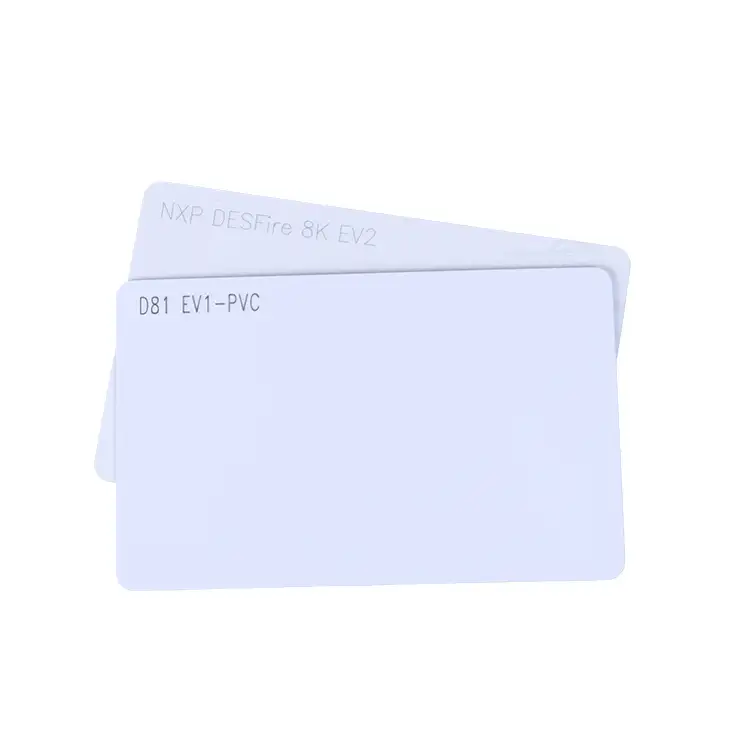
Procurement verdict: when to order DESFire EV3, DESFire EV2 or DESFire Light
Choose the chip generation around NXP's lifecycle status and your reader or lock vendor's approved credential list:
Specify [MIFARE DESFire EV3](/product/mifare-desfire-cards/) (`MF3D23` / `MF3D43` / `MF3D83`, or `70 pF` `MF3DHx3` for small antennas) for every new access-control, campus, transit, EV-charging or closed-loop payment design, and as the primary candidate when migrating an older EV1 or D40 estate.
Order [MIFARE DESFire EV2](/product/mifare-desfire-ev2-cards/) (`MF3D22` / `MF3D42` / `MF3D82` or `MF3DHx2`) when replenishing or expanding an existing installation whose approved card specification, SAM profile or front-desk hotel encoder explicitly requires EV2 and has not yet been re-qualified on EV3 silicon.
Evaluate MIFARE DESFire Light (`640 bytes` user EEPROM, Common Criteria `EAL4`) only for single-application badges, event passes or vending tokens whose readers support its EV2-subset secure messaging and fixed five-file template.
MIFARE DESFire EV2 vs EV3 vs DESFire Light: NXP datasheet comparison
All three chips operate at `13.56 MHz` over `ISO/IEC 14443 Type A` and `ISO/IEC 14443-4` (`T=CL`) with `ISO/IEC 7816-4` APDU framing available alongside native DESFire commands. The table below summarises NXP's public short data sheets (`MF3D(H)x2` Rev. 3.2 and `MF3D(H)x3` Rev. 3.1):
| Specification | MIFARE DESFire EV2 | MIFARE DESFire EV3 | MIFARE DESFire Light |
|---|---|---|---|
| Representative NXP parts | MF3D22, MF3D42, MF3D82 (17 pF); MF3DH22/42/82 (70 pF) | MF3D23, MF3D43, MF3D83 (17 pF); MF3DH23/43/83 (70 pF) | MF2DL(H)x0 (17 pF or 50 pF) |
| NXP lifecycle status | Not recommended for new designs | Active — recommended by NXP for new designs | Active (single-application tier) |
| EEPROM sizes (NXP) | 2 KB, 4 KB, 8 KB (16 KB & 32 KB also in EV2 SDS) | 2 KB, 4 KB, 8 KB (16 KB listed in EV3 feature list) | 640 bytes user memory |
| Applications & files | Memory-bounded 3-byte AIDs; up to 32 files per app | Memory-bounded 3-byte AIDs; up to 32 files per app | 1 predefined application with 5 fixed files (+ optional TMAC) |
| Cryptographic ciphers | AES-128, 2K3DES, 3K3DES, DES | AES-128, 2K3DES, 3K3DES, DES | AES-128 (with LRP option) |
| Key sets & key rolling | Up to 14 keys/app & up to 16 key sets (RollKeySet) | Up to 14 keys/app & up to 16 key sets (RollKeySet) | Fixed key slots; no multi-set rolling |
| Relay & MITM defences | Proximity Check + Transaction MAC | Proximity Check + Transaction MAC + Transaction Timer | Optional Transaction MAC; no Proximity Check |
| Dynamic phone-tap URL (SUN) | Not supported | Yes — Secure Dynamic Messaging (AES-CMAC in NDEF URL) | Not listed in NXP product features |
| NFC Forum certification | ISO 7816-4 / NDEF capable | NFC Forum Type 4 Tag certified | NFC Forum Type 4 Tag certified |
| Common Criteria (IC + OS) | EAL5+ | EAL5+ (augmented with AVA_VAN.5) | EAL4 |
| Legacy messaging modes | EV2, EV1 and D40 modes | EV2, EV1 and D40 modes | Subset of EV2 secure messaging only |
What DESFire EV3 actually adds over DESFire EV2
If your system only runs `SelectApplication`, `AuthenticateEV2First` (or `AuthenticateAES` in EV1 mode) and reads or writes an access-control file on a wall reader, EV2 and EV3 behave identically on the wire. EV3 justifies its place on new specifications for three concrete reasons:
- Secure Dynamic Messaging (`SUN`) for app-free smartphone checks: EV3 can mirror its UID, read counter and an `AES-128 CMAC` cryptographic tag into an NFC Forum Type 4 NDEF URL record every time an iPhone or Android phone taps the card — the same tap-verification pattern used on NTAG 424 DNA labels (calculate byte offsets in our NTAG 424 DNA SDM Calculator). Campus IDs, membership badges and transit passes can verify authenticity in a mobile web browser without forcing holders to install a custom app.
- Transaction Timer against relay latency: Alongside EV2's `Proximity Check`, EV3 adds a per-application Transaction Timer that bounds the maximum wall-clock time allowed between authentication and `CommitTransaction`, blocking man-in-the-middle relays that forward frames over a network link.
- Long-term silicon supply: Because NXP has already marked both DESFire EV1 and DESFire EV2 Not Recommended for New Designs, qualifying EV3 today avoids mid-project re-certification when older wafer lines tighten.
Can DESFire EV3 replace EV2 or EV1 as a drop-in card? Run this 5-point sample check
At the smart-card OS level, NXP engineered DESFire EV3 to execute EV2 (`AuthenticateEV2First`), EV1 (`AuthenticateAES` / `AuthenticateISO`) and legacy D40 commands without changing your application `AID`s, file IDs or diversified keys. However, never swap EV2 for EV3 on a purchase order without testing physical samples first, because third-party encoders and lock controllers sometimes enforce artificial chip checks:
- Check `GetVersion` (`0x60`) whitelisting in your encoder: Some access-control enrolment stations and hotel front-desk encoders read the `GetVersion` hardware/software major-version byte (`0x12` on EV2 vs `0x33` on EV3) and refuse to encode a card generation released after their firmware build.
- Verify the exact memory footprint (`2K` vs `4K` vs `8K`): Remember that Backup Data files allocate `2×` payload bytes for atomic rollback and Cyclic Record files reserve one extra record slot (`N + 1`). Size your application layout in our MIFARE DESFire Memory & File Calculator and confirm free EEPROM with `FreeMem` (`90 6E 00 00 00`).
- Confirm Windows PC/SC smart-card plug-and-play behaviour: Desktop USB NFC readers (compare commands in our PC/SC NFC Reader APDU Builder) may receive automatic ISO 7816 probe APDUs from Windows on card insertion, locking a DESFire chip into ISO-wrapped mode until RF reset if legacy software expects native framing.
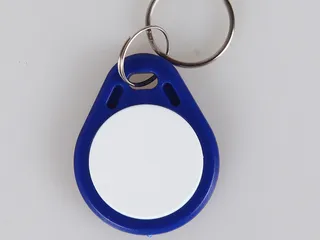
- Match `17 pF` vs `70 pF` capacitance to antenna size: Standard ISO ID-1 cards (`85.6 × 54 mm`) use `17 pF` silicon (`MF3D43`), whereas compact coils inside DESFire key fobs, MIFARE stickers and hotel wristbands often require `70 pF` (`MF3DH43`) for reliable coupling on wall locks.
- Confirm Random ID vs fixed 7-byte UID expectations: Enabling Random ID protects holder privacy during anticollision, but any legacy printer release, time clock or turnstile that still enrols unauthenticated UIDs (inspect formats in our RFID UID & Wiegand Converter) will see a different 4-byte `08h...` ID on every tap.
Formats, pre-encoding read-back and key custody
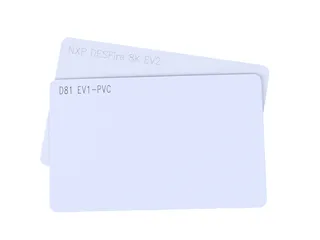
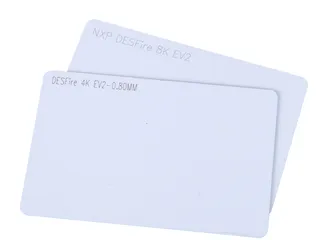
Proud Tek manufactures both [MIFARE DESFire EV3](/product/mifare-desfire-cards/) and [MIFARE DESFire EV2](/product/mifare-desfire-ev2-cards/) credentials in Shenzhen across printed PVC/PET cards, wooden cards, PLA corn-starch cards, multi-chip combi cards, key fobs, wristbands and ferrite on-metal stickers. If you are still deciding between Classic, Plus and DESFire across a wider site upgrade, see MIFARE Classic vs Plus vs DESFire.
Published 2026-11-27 · Updated 2026-11-27