Which multi-system card architecture matches your estate?
Ordering the wrong multi-technology build stalls rollouts because physical interfaces, silicon count and personalisation workflows are completely different across the three constructions:
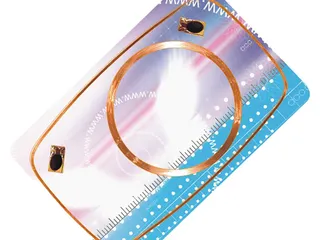
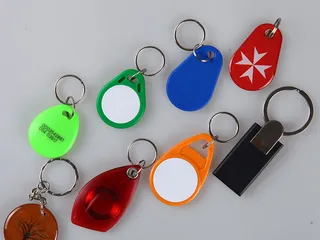
Specify a [Combi card](/product/combi-card/) (or its key-ring counterpart, a [dual-frequency key fob](/product/rfid-key-fob/)) when your buildings run two or three separate contactless radio systems that do not share data — for example legacy `125 kHz` proximity doors alongside new `13.56 MHz` MIFARE DESFire turnstiles, or `13.56 MHz` office doors alongside an `860–960 MHz` UHF car-park barrier.
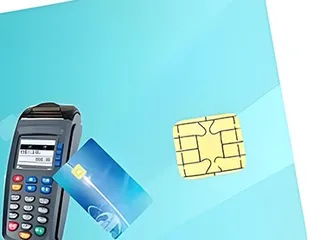
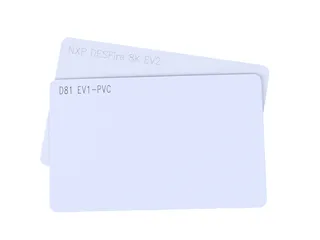
Specify a [Dual interface smart card](/product/dual-interface-card/) when one cryptographic application (typically on a Java Card / GlobalPlatform secure element) must be accessed both by inserting the card into an `ISO/IEC 7816` contact slot (PC workstation login, chip-and-PIN terminal or enrolment desk) and by tapping an `ISO/IEC 14443` `13.56 MHz` reader.
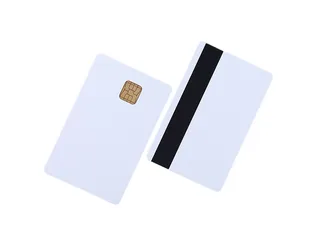
Specify a Stripe-and-chip card (covered on our RFID hotel key cards and printed RFID cards pages) when doors or gates read one contactless RFID chip while older lift panels, car-park columns or point-of-sale swipe readers still read a HiCo or LoCo magnetic stripe.
Combi card vs Dual interface card vs Stripe-and-chip card: architecture comparison
Combi cards, dual interface cards and stripe-and-chip cards are three distinct products and are never interchangeable. Compare their internal construction and encoding rules before writing a tender or purchase order:
| Attribute | Combi card (multi-chip) | Dual interface card | Stripe-and-chip card |
|---|---|---|---|
| Number of RFID / smart ICs | Two or more separate chips (usually two, sometimes three) | One single secure chip | One single contactless RFID chip |
| Physical interfaces on the card | Separate internal antennas per contactless band (no contact pad in standard contactless builds) | Surface ISO/IEC 7816 contact module + embedded 13.56 MHz coil | Embedded contactless antenna + external HiCo or LoCo magnetic stripe |
| Operating bands & standards | Any pairing of 125 kHz LF, 13.56 MHz HF/NFC and 860–960 MHz UHF (EPC Gen2) | ISO/IEC 7816-3 (T=0 / T=1) contact + 13.56 MHz ISO/IEC 14443-4 (T=CL) | 125 kHz, 13.56 MHz or UHF chip + ISO/IEC 7811 magnetic stripe (Tracks 1–3) |
| Do the interfaces share memory? | No — chips are electrically isolated; writing to one never updates the other | Yes — one die, one EEPROM/Flash & key store (where enabled on both interfaces) | No — the magnetic stripe and the RFID chip store independent data |
| Personalisation & encoding | Each chip is encoded and verified separately on its own band's writer | Personalised once (via contact or contactless) by the issuer or authorised bureau | RFID chip encoded over RF; magnetic tracks encoded on a magstripe encoder |
| Primary B2B use cases | Phased 125 kHz → DESFire upgrades; HF building access + UHF vehicle/yard gates | PKI logical + physical access, campus/transit smart cards, EMV & national ID bodies | Hotels, resorts & campuses keeping magstripe lifts, lockers or POS swipe terminals |
Inside a multi-chip combi card: antenna geometry and ID-matching rules
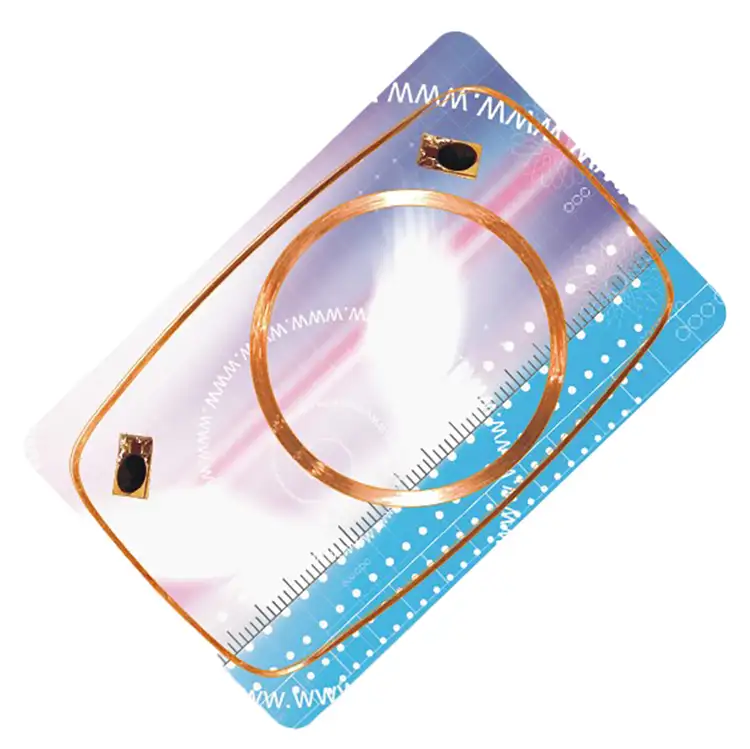
Inside an ISO ID-1 (`85.60 × 53.98 mm`) [combi card](/product/combi-card/), each contactless chip sits on its own tuned antenna — for example a `125 kHz` copper winding paired with a `13.56 MHz` coil, or a `13.56 MHz` coil paired alongside an `860–960 MHz` UHF dipole. Three practical rules save hours during commissioning:
- Choose the right 125 kHz half of the pair: If your legacy proximity controller simply enrols whatever 64-bit EM4100 number a card presents, pair read-only EM4200 with your 13.56 MHz chip. If you want both systems to enrol the *same* decimal badge number or facility code, pair rewritable T5577 or EM4305 so the LF side can be programmed to match (compare EM4200 vs EM4305 vs T5577).
- One printed serial cannot equal two factory UIDs: Every chip leaves wafer fab with its own permanent UID/TID. If a card carries a printed or laser-engraved badge number, tell us which chip's ID that visible number must follow (check byte order in our RFID UID & Wiegand Converter). For numbered combi orders, we supply an Excel, CSV or XML cross-reference file mapping each card's printed serial to its respective chip IDs.
- Test every radio band on its own reader: A desktop `13.56 MHz` USB NFC reader (see our PC/SC NFC Reader APDU Builder) only sees the HF chip; it cannot detect or verify the `125 kHz` or `UHF` inlay inside the same card.
Inside a dual interface smart card: MIFARE emulation and artwork keep-out zones
On a [dual interface card](/product/dual-interface-card/), both the gold `ISO/IEC 7816` contact pad and the embedded `13.56 MHz` antenna connect to the same microcontroller die. Two specification checks prevent expensive mismatches:
1. Contactless `ISO 14443-4` ≠ automatic MIFARE Classic/DESFire door support: Multi-application platforms such as NXP's JCOP 4 support `ISO/IEC 7816-3` (`T=0` and `T=1`) and `ISO/IEC 14443` (`T=CL`), while MIFARE Classic, MIFARE Plus EV1 or MIFARE DESFire EV2 implementations are optional platform configurations (NXP JCOP 4 brochure). If your dual interface PKI card must also open existing MIFARE door locks, state that emulation requirement upfront and test a sample on both the contact smart-card reader and the wall door reader.
2. Artwork keep-out zone and personalisation roles: The milled cavity for the surface contact module sits at a fixed ISO 7816-1 position, so logos, text, slot punches and embossing must stay clear of that pad (and clear of any optional magnetic stripe on the reverse). Issuing banking or government credentials onto a secure element belongs to the issuing scheme or an authorised personalisation bureau; Proud Tek manufactures the dual interface card body and inlay with offset/UV print, magstripe, signature panel or hologram to your agreed specification.
When a stripe-and-chip card is the simplest answer
In hotels, resorts and older university campuses (campus card systems and hotel key card systems), guest-room or dormitory doors often run `13.56 MHz` MIFARE Classic EV1, Ultralight C, Plus or DESFire while car-park gates, laundry rooms or point-of-sale terminals still swipe a magnetic track. Because a magnetic stripe has no chip at all, a stripe-and-chip card is a single-chip RFID card laminated with a HiCo (`2750` or `4000 Oe`, harder to erase accidentally) or LoCo (`300 Oe`) stripe — simpler and lower-cost than a multi-chip combi card whenever the legacy side is magnetic rather than `125 kHz` RF.
Published 2026-11-27 · Updated 2026-11-27