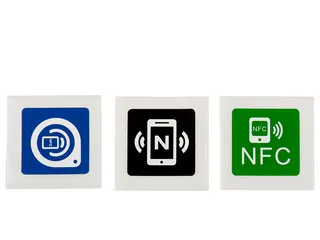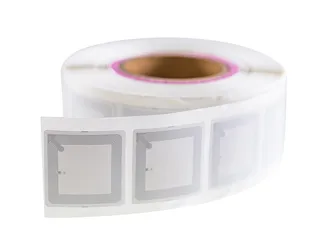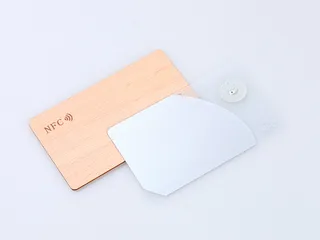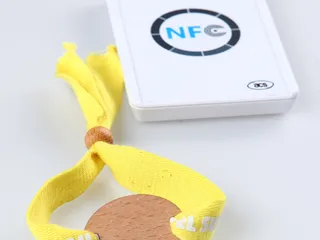
Which 13.56 MHz low-memory chip fits your project?
Buyers often group MIFARE Ultralight and NTAG213 together as "entry-level 13.56 MHz chips", only to discover in testing that a hotel lock encoder rejects NTAG213 or that consumer phones do not open a link smoothly from an Ultralight sticker. Start by separating who reads the tag:
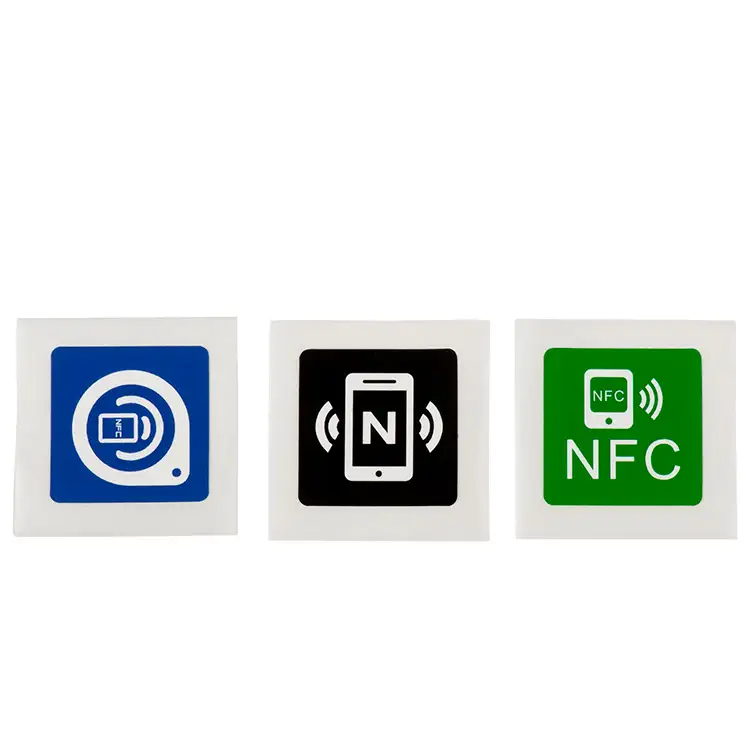
Choose [NTAG213](/product/nfc-sticker/) (or larger NTAG215 / NTAG216) whenever ordinary visitors tap the card, sticker or wristband with their own iPhone or Android phone to open a web link with no app installed. Choose MIFARE Ultralight EV1 (in MIFARE stickers, paper tickets or event wristbands) when dedicated turnstiles, transit validators or event scanners expect Ultralight EV1's 48/128-byte memory map and one-way tear-resistant counters. Choose MIFARE Ultralight C when an installed hotel lock (such as Onity ADVANCE Trillium, dormakaba Saflok or Salto paper guest cards) or transit gate requires Ultralight C's 2-key 3DES authentication.
If a copied tag would unlock a high-value bar tab, impersonate a branded product or open staff doors, move straight to AES-128: compare [NTAG 424 DNA vs NTAG213](/compare/ntag-424-dna-vs-ntag213/) for phone-facing verification and [MIFARE Classic vs Plus vs DESFire](/compare/mifare-classic-vs-plus-vs-desfire/) for access and cashless readers.
MIFARE Ultralight EV1 vs Ultralight C vs NTAG213: datasheet comparison
All silicon figures below come from NXP's public data sheets for MIFARE Ultralight EV1 (MF0ULx1, Rev. 3.3), MIFARE Ultralight C (MF0ICU2, Rev. 3.5) and NTAG213/215/216 (Rev. 3.2). Chip ratings describe the bare IC at 22 °C, not the mechanical life or read distance of a finished card, label or wristband:
| Specification | MIFARE Ultralight EV1 (MF0UL11 / MF0UL21) | MIFARE Ultralight C (MF0ICU2) | NTAG213 (NT2H1311) |
|---|---|---|---|
| Air interface & UID | ISO/IEC 14443 Type A, 106 kbps, 7-byte UID | ISO/IEC 14443 Type A, 106 kbps, 7-byte UID | ISO/IEC 14443 Type A, 106 kbps, 7-byte UID |
| NFC Forum Tag Type | Not stated in datasheet (made for reader/ticketing systems) | Not stated in datasheet (made for 3DES reader/lock systems) | NFC Forum Type 2 Tag compliant |
| User read/write memory | 48 bytes (MF0UL11) or 128 bytes (MF0UL21) | 144 bytes (pages 04h–27h; 1,536 bits total IC) | 144 bytes (pages 04h–27h; 180 bytes total IC) |
| Largest standard NDEF message | Depends on custom formatting & app | Depends on custom formatting & app | 137 bytes (132 chars after https://www.) |
| Authentication / protection | 32-bit PWD + 16-bit PACK (no cipher) | 2-key 3DES mutual challenge-response (112-bit key) | 32-bit PWD + 16-bit PACK (no cipher) |
| Hardware counters | Three independent 24-bit one-way counters | One 16-bit one-way counter | One 24-bit NFC read counter (auto-increments on read) |
| ASCII UID / counter mirror | No | No | Yes — mirrors 14-hex UID and/or 6-hex counter into NDEF |
| ECC originality signature | Yes (32-byte NXP ECC signature) | No | Yes (32-byte NXP ECC signature) |
| Primary B2B deployment | Single-trip / limited-use transit tickets & event day passes | Hotel guest paper/PVC cards & 3DES ticketing gates | No-app phone URL tags, smart packaging & business cards |
Smartphone behaviour: why NTAG213 is the standard for consumer taps
We do not present MIFARE Ultralight as an app-free smartphone tag. Android's compatibility rules mandate out-of-the-box NDEF enumeration across NFC Forum Tag Types 1–4 (Android Ndef reference), and iPhone XS and later automatically scan background URI records on NFC Forum tags while the screen is on (Apple Core NFC background reading; iPhone 7, 8 and X use NFC Tag Reader in Control Centre from iOS 14). Because NXP certifies NTAG213 to the NFC Forum Type 2 Tag specification and ships it with a Capability Container (`E1 10 12 00h` in Page `03h`), consumer phones dispatch `https://` links reliably without asking the user to install an app.
By contrast, neither the Ultralight EV1 nor the Ultralight C data sheet claims NFC Forum Type 2 compliance. Apple's Core NFC framework does expose `NFCMiFareFamily.ultralight` (Apple NFCMiFareFamily), which allows your own custom iOS or Android app to send Ultralight page-read, counter or 3DES commands — useful for staff inspection handsets — while general phone tap behaviour varies by handset and OS. If a consumer's own phone is the reader, specify NTAG213 stickers or NFC cards, size your payload in our NDEF Generator & Capacity Checker, and plan your `CFG0`/`CFG1` mirror and lock bytes in the NTAG21x Config, Mirror & Lock Calculator.
Hotel locks, transit gates and event wristbands: when Ultralight wins
When a dedicated reader or electronic door lock controls every tap, MIFARE Ultralight solves problems NTAG213 was never designed for:
In hospitality, major lock ecosystems list MIFARE Ultralight C (and on certain lock heads Ultralight EV1) for single-stay PVC, paper or wooden guest key cards — including Honeywell's Onity ADVANCE Trillium, dormakaba Saflok, ASSA ABLOY VingCard and Salto (see lock-by-lock references in our RFID hotel key card guide). Ultralight C's mutual 2-key 3DES handshake lets the front-desk encoder and door lock verify the guest credential without paying for multi-application DESFire silicon on a disposable check-in card.
In mass ticketing and day-pass wristbands, NXP specifies a typical ticketing transaction under `35 ms` and a fast counter increment under `10 ms` on MIFARE Ultralight EV1 (NXP MF0ULx1). Its three independent 24-bit one-way counters can only increment, never decrement — ideal for multi-ride passes or entry-quota tokens where the turnstile deducts remaining rides atomically. See our RFID event wristband guide for lane testing and closure selection.
Memory layout, passwords and permanent lock traps
Both NTAG213 and Ultralight organize EEPROM in 4-byte pages, which makes desktop PC/SC scripting straightforward on readers such as the ACR122U, ACR1252U and ACR1552U, yet three layout differences catch firmware teams off guard:
- 144 user bytes ≠ 144 NDEF bytes on NTAG213: Factory-formatted NTAG213 chips carry a 5-byte Lock Control TLV (`01 03 A0 0C 34h`) across Page `04h` and Byte `0` of Page `05h`, so the NDEF TLV starts at Page `05h` Byte `1` and fits a maximum 137-byte NDEF message (`132` characters after `https://www.`). Measure complete production URLs (with UTM or serial query strings) before choosing between NTAG213, NTAG215 (`492 B` max NDEF) and NTAG216 (`868 B` max NDEF).
- Password (`PWD`) vs permanent OTP lock bits: On both NTAG213 and Ultralight EV1, the 32-bit `PWD` allows authorized rewrites when `AUTH0` and `PROT` are configured, whereas Static (`Page 02h`) and Dynamic Lock bits freeze pages irreversibly. Write and read-back your `PWD` and `PACK` pages *before* lowering `AUTH0`, and check `AUTHLIM` so failed attempts cannot brick the tag.
- No anti-cloning on static pages: A 32-bit password stops a passer-by overwriting your tag, but any NFC reader can still copy an unencrypted NDEF message or 7-byte UID onto a simulator. Where anti-counterfeiting or cashless value is at stake, upgrade phone tags to NTAG 424 DNA labels (layout offsets in our NTAG 424 DNA SDM Calculator) and reader credentials to MIFARE DESFire cards.
Published 2026-11-26 · Updated 2026-11-26