Google Review NFC Card
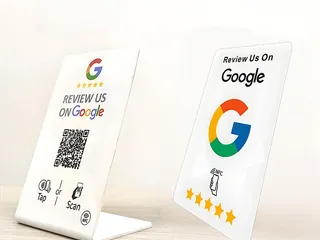
A Google review NFC card turns a tap into a 5-star review — the NTAG chip opens your Google review page directly — the offline-to-online trick for shops and restaurants that live on ratings.
RFID and NFC products for system integrators and distributors: cards, key fobs, wristbands, labels, industrial tags and selected desktop readers. Chip families range from 125 kHz LF to MIFARE, DESFire, NTAG and UHF. Compare the formats below, then share your reader, application, quantity and order requirements so we can review the right product and quotation.
A Google review NFC card turns a tap into a 5-star review — the NTAG chip opens your Google review page directly — the offline-to-online trick for shops and restaurants that live on ratings.
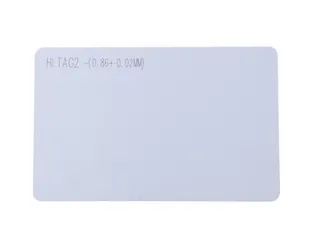
HITAG 2 is NXP's 125 kHz crypto transponder — the chip inside millions of car keys — whose 48-bit cipher was broken in 2012, so today it's ordered to keep existing vehicle and access systems running, not for new secure designs.
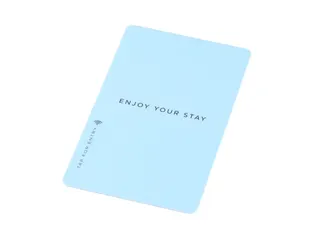
Hotel key cards are 13.56 MHz RFID credentials (MIFARE Classic, DESFire or Ultralight, depending on the lock system) that replace magnetic-stripe keys — the chip and encoding must match the installed door locks, not just the frequency.
Inkjet PVC cards are the ID card for offices without a card printer — an ink-receptive coating that takes full colour from a standard desktop inkjet — at a fraction of the cost of a dye-sublimation setup.
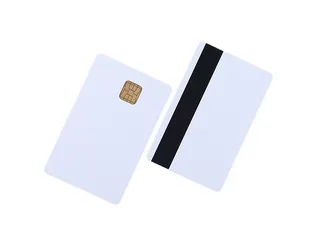
A Java Card is a smart card that runs code — NXP JCOP chips with a Java Card OS that loads your applets after issuance — the platform behind bank cards, eIDs and transit cards that need post-issue updates.
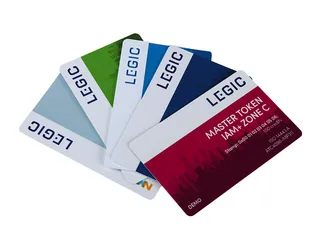
LEGIC is the Swiss access-control ecosystem — advant and CTC chips specified by the integrator, initialised by the system owner — for projects where the card must come from an approved LEGIC supply chain.
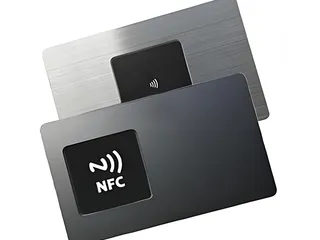
A metal NFC card is the executive business card — stainless steel or anodised aluminium with an NTAG chip — engineered around metal's habit of detuning 13.56 MHz antennas with a ferrite layer or antenna window.
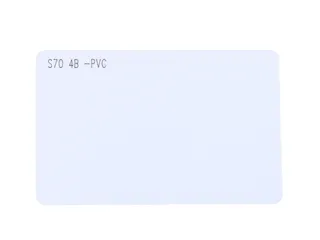
The MIFARE Classic 4K (S70) quadruples the 1K’s memory to 4,096 bytes across 40 sectors — the choice when a Classic system outgrows 1K, e.g.
MIFARE Classic 1K (S50) packs 1,024 bytes across 16 sectors — each guarded by its own keys — on NXP’s original 13.56 MHz contactless chip from 1994, among the most widely deployed smart-card chips in history.
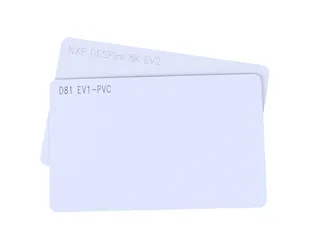
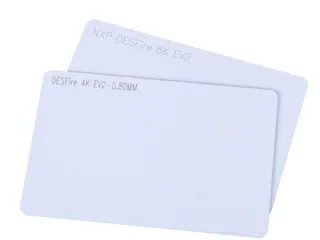
Proud Tek's MIFARE DESFire cards use NXP's DESFire contactless smart-card chips on ISO/IEC 14443-A 13.56 MHz — EV3 for new systems, EV2 and EV1 where an installed base specifies that generation.
DESFire EV2 cards for access-control estates built on NXP's DESFire EV2 generation — 2K, 4K and 8K memory with AES-128 authentication — for replacement cards and system expansion where installed readers and key sets specify EV2.
MIFARE Plus was NXP’s bridge between Classic and DESFire — AES-128 security in a Classic-compatible footprint — for systems that needed stronger cryptography without replacing readers.
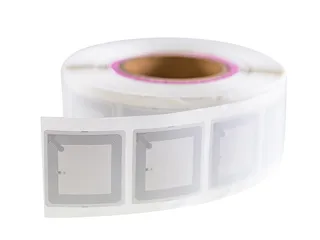
MIFARE stickers turn any phone or surface into a credential — a MIFARE chip on adhesive that sticks to a phone case, badge or asset tag — for systems that need the MIFARE format without issuing a card.
An NFC business card turns a tap into a contact exchange: the NTAG chip in the card triggers a phone to open a digital profile, vCard or link — no app needed on the recipient’s phone.
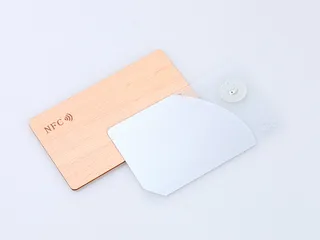
NFC cards are 13.56 MHz tap-to-interact credentials — an NTAG chip and antenna laminated in a card body — programmed to open a link, share a contact, join Wi-Fi, or authenticate a product.
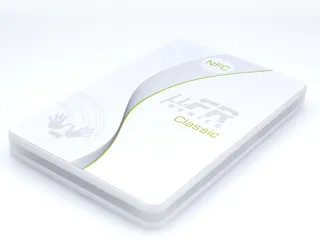
The µFR Classic CS is the reader for developers who'd rather call an SDK than send APDUs — free uFCoder libraries for MIFARE, DESFire, NTAG and JCOP — versus the ACR122U for software that already speaks PC/SC.