Why industrial RFID projects mix two or three tag constructions
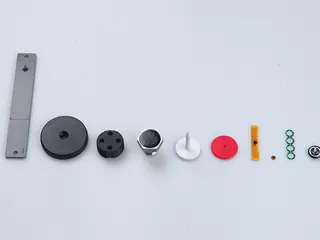
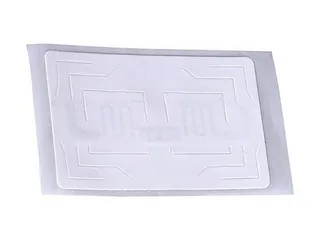
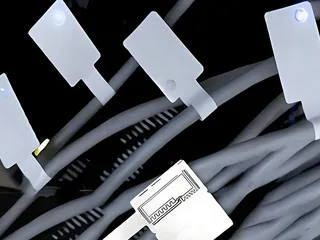
A single distribution centre or plant rarely standardises on one physical RFID tag. Corrugated shipping cases and plastic archive boxes take sub-millimetre UHF RFID labels printed and encoded on rolls; returnable steel stillages get riveted hard tags; hydraulic hoses and server-rack cables take self-locking [RFID cable-tie tags](/product/rfid-cable-tie-tags/); tractor units take glass [windshield tags](/product/rfid-windshield-tag/), while metal trailers behind them take screw-mounted on-metal tags.
Keep two engineering questions separate when writing your RFQ: (1) RF surface isolation — whether metal or liquid sits behind the antenna (covered in On-Metal vs Standard RFID & NFC Tags), and (2) mechanical fixing and lifecycle — whether the tag is printed once for a outbound shipment, tied around a vibrating hose, potted into a milled tool pocket, or designed to break if someone peels it off.
Note on terminology: on Proud Tek's pages, hard tag means a rigid, encapsulated industrial tag (ABS, PC, PPS, FR4 PCB or epoxy) for assets, pallets and containers — not a retail electronic article surveillance (EAS) anti-theft tag, for which no EAS function is claimed.
Side-by-side comparison: adhesive labels, hard tags, cable-tie tags, PCB tags & tamper seals
All five UHF options below read on standard EPC Gen2v2 (`ISO/IEC 18000-63`) portals and handhelds tuned for your regional band (`865–868 MHz` ETSI or `902–928 MHz` FCC — check other countries in our UHF RFID Frequency by Country lookup). Equivalent `13.56 MHz` HF/NFC (`ICODE SLIX2`, `NTAG21x`, `MIFARE DESFire`) and `125 kHz` LF (`EM4305`, `T5577`) builds are available in custom housings where close tap inspection replaces long-range sweeps:
| Format | How it attaches | Best surfaces & objects | Printer vs factory marking | Typical GS1 key | Proud Tek starting point |
|---|---|---|---|---|---|
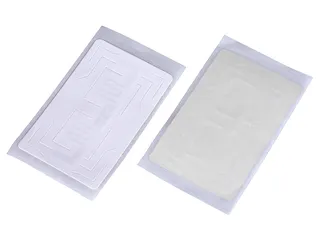
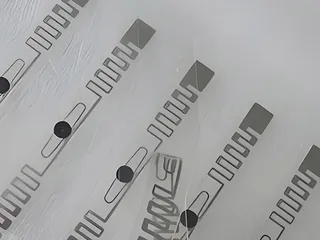
| Adhesive UHF label (paper / PET) | Pressure-sensitive permanent, removable or freezer adhesive on rolls | Corrugated cartons, pallet wrap, plastic bins, archive files & smooth indoor IT cases (foam-spacer variant on metal) | On-site thermal-transfer / direct-thermal RFID printer-encoder, or factory pre-printed & pre-encoded rolls | `SGTIN-96`, `SSCC-96`, `SGLN-96` or `GIAI-96` | UHF RFID labels & dry/wet inlays |
| Rigid hard tag (ABS / PC / PPS / epoxy) | Screws, pop rivets, weld brackets, industrial foam tape or pallet nails | Outdoor yard assets, steel stillages, returnable plastic totes, wooden/steel pallets & industrial laundry (`PPS`) | Not roll-printable; factory laser-marked, silk-screened or pre-encoded with TID/EPC report | `GRAI-96` (returnable) or `GIAI-96` (fixed) | Custom RFID tags & PPS laundry tags |
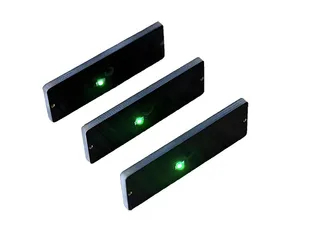
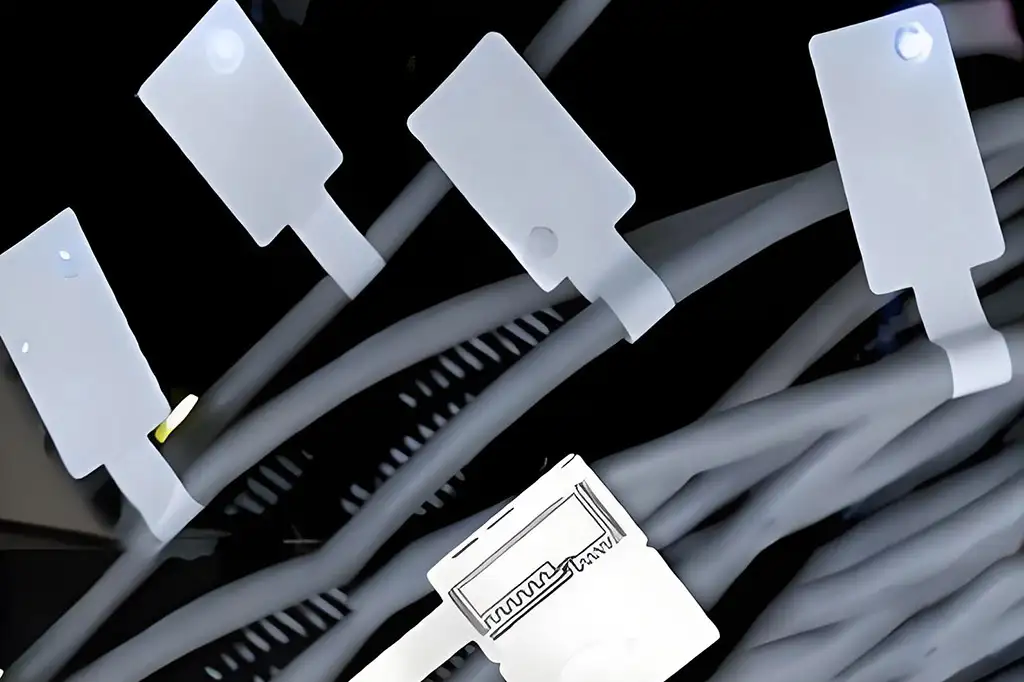
| Cable-tie & hose tag (plain or LED) | Integral self-locking nylon/plastic tie or strap threaded around the object | Data-centre cable bundles, pipes, valves, pallet slats & hydraulic hoses where adhesives lift | Factory laser-marked / printed serials & pre-encoded EPC; optional field-powered LED locator | `GIAI-96` or closed-loop maintenance ID | RFID cable-tie tags & LED UHF tags |
| FR4 PCB & miniature embeddable tag | Epoxy potting in a milled recess, high-bond adhesive or miniature screws/rivets | Hand tools, metal moulds, server blades & compact equipment with tight clearance | Solder-mask laser marking & factory encoding; test inside the actual metal pocket | `GIAI-96` or `GRAI-96` (rental tools) | Custom RFID tags & DESFire FR4 tags |
| Tamper-evident label & seal insert | Dummy-kerf frangible adhesive on glass/doors, or passive RFID insert inside a bolt/cable seal | Vehicle windscreens, headlights, meter doors, cases & freight-container seal bodies | Offset/thermal print + factory EPC encoding, permalock & kill password | `GIAI-96`, vehicle ID or seal serial | Windshield tags, headlight stickers & custom seal inserts |
Choosing by failure mode: peeling, forklift impact, curved metal and tampering
Most field replacements happen when an adhesive label is asked to do a mechanical fastener's job, or when a rigid tag sits proud on a face that pallet forks scrape:
- Curved cables, pipes and hydraulic hoses: Flat labels flag or lift on tight radii, oil mist and flexing lines. Thread a self-locking RFID cable-tie tag around the bundle or fitting instead. Note that wire-braid and spiral-wire hydraulic hoses (ISO 1436, ISO 3862) contain steel reinforcement right under the cover and typically need an on-metal tag construction, whereas textile-reinforced thermoplastic hoses are checked on standard samples.
- Forklift blades, cage stacking and washdowns: On wooden pallets, plastic crates and steel stillages, mount rigid ABS/PC hard tags inside a recessed pocket or between deck stringers rather than on an exposed leading edge. IP, temperature, chemical and wash limits belong to a specific construction and are confirmed per design and verified in an agreed sample test — never assumed from a chip datasheet.
- Crowded server racks and cable trays: Reading 80 EPCs in one sweep confirms presence, not which grey patch cord to unplug. Passive UHF cable-tie tags with LED and on-metal LED tags harvest reader RF energy to flash an LED when selected (lighting range is shorter than plain inventory range; confirm your handheld SDK supports the select/light command).
- Stopping credential transfer on vehicles and containers: On car and truck glass, a windshield tag uses die-cut *dummy kerf* slits through paper and aluminium so peeling tears the antenna; metallised or heated windscreens use an exterior headlight sticker instead (vehicle RFID identification). For shipping containers, Proud Tek manufactures the passive RFID tag insert while the certified mechanical bolt or cable seal body — and any ISO 17712 high-security classification required under programmes such as CBP CTPAT — comes from your seal manufacturer (battery-powered `ISO 18185` e-seals are not supplied).
GS1 keys, memory sizing and EPC Gen2 Lock / Permalock rules
Rigid hard tags, cable-tie tags and tamper seals cannot be run through an office label printer, so their EPC numbers, barcodes/laser marks and memory locks are normally applied during production via our RFID encoding service:
Generate or verify 96-bit `SSCC-96` (pallets), `GRAI-96` (returnable totes/kegs), `GIAI-96` (fixed assets) and `SGLN-96` (rack locations) payloads in our GS1 SSCC, GRAI, GIAI & SGLN EPC Calculator, or item-level `SGTIN-96` in the GS1 SGTIN-96 Encoder. If an existing maintenance system uses alphanumeric asset numbers requiring `GIAI-202` or `GRAI-170`, size the 16-bit word count and `PC` word in our UHF Memory & PC Word Calculator so you pick a high-memory chip (`Impinj M780`, `NXP UCODE Nxm`, `Alien Higgs-9`) rather than a 96/128-bit ID chip.
Before approving pre-encoded asset or vehicle tags, build your 20-bit `Lock` payload in our UHF Gen2 Lock Mask & Permalock Calculator. Two silicon details trip integrators repeatedly: NXP UCODE 9 and UCODE 9xe have their Access Password hardwired to `00000000h`, so password-lock (`PWD=1, PERM=0`) cannot stop EPC overwrites — only irreversible Permalock (`PERM=1`) freezes their EPC; and on chips with settable passwords (`Alien Higgs-9`, `Impinj M730/M750/M830/M850`, `Monza 4QT`), you must also lock `Bank 00` Reserved memory so nobody can read your Access Password over the air. Pair EPC checks with factory `Bank 10` TID verification (UHF TID Decoder) where clone detection matters.
Published 2026-11-28 · Updated 2026-11-28