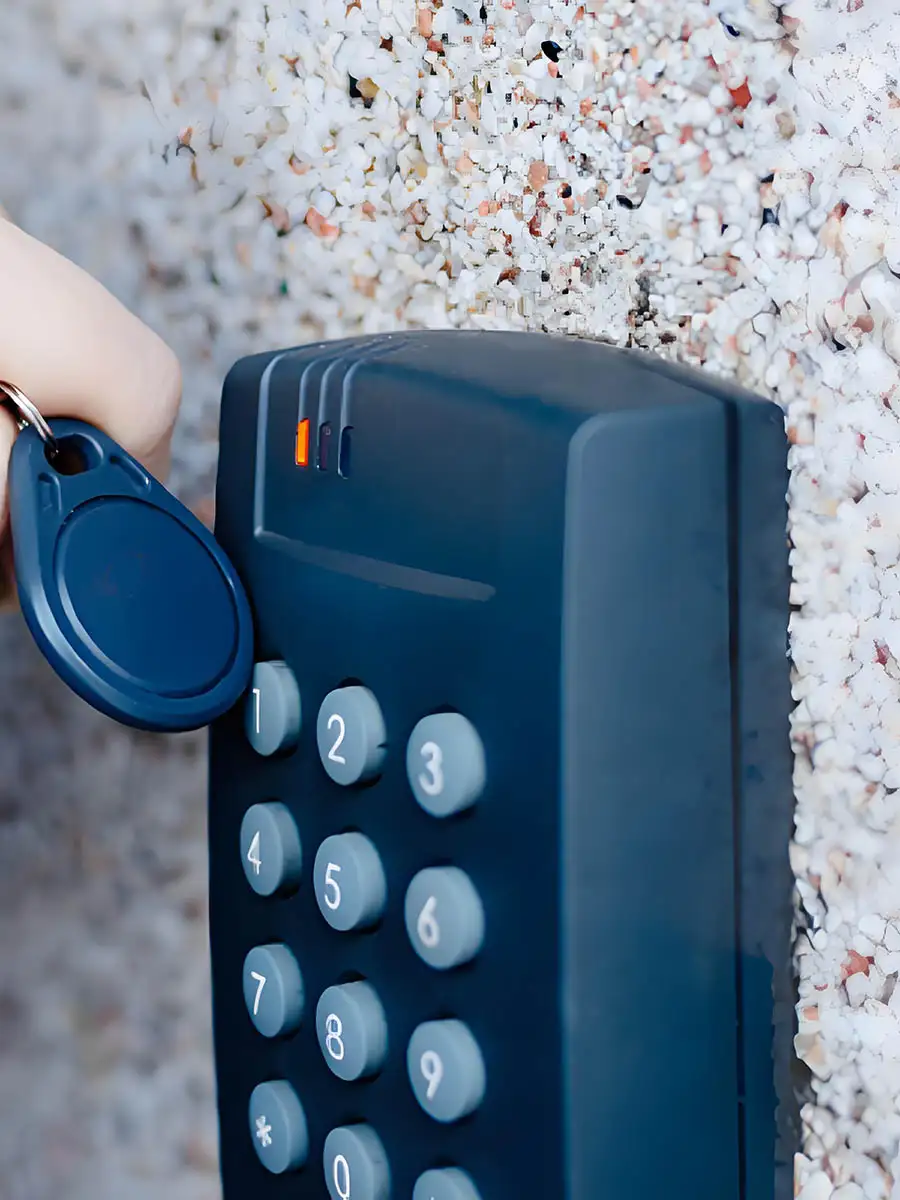
Start with the installed reader, then match the credential format to the user
Every access-control credential order settles the radio and chip before touching the housing: 125 kHz proximity (`EM4200` — the chip in our cards and fobs sold as "EM4100" — plus rewritable `Microchip ATA5577C / T5577`, `EM4305` and legacy `HITAG 2`) or 13.56 MHz smart-card HF (`ISO/IEC 14443 Type A` — genuine `NXP MIFARE Classic EV1 1K/4K`, `MIFARE Plus`, `MIFARE DESFire EV2/EV3` or `LEGIC advant`). See our RFID key fobs for access control guide for reader surveys and cloning checks.
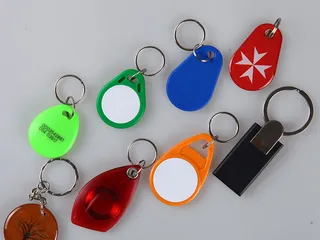
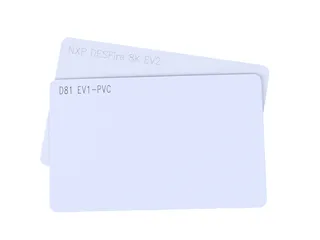
Once the chip and number format are fixed, you do not have to force one physical shape on every user group. Because the controller sees only the reader's output, one building routinely issues printed CR80 ISO cards to salaried staff who wear photo badges, ultrasonically welded ABS or leather key fobs to apartment tenants, and thick ABS clamshell cards to visiting contractors and car-park users.
Side-by-side comparison: key fobs, clamshell cards, ISO thin cards & epoxy/sticker discs
Compare the four credential formats by carry style, desktop card-printer compatibility, antenna geometry, dual-frequency migration support and marking options:
| Credential format | Construction & size | Photo ID & marking | Antenna & read behaviour | Dual-frequency (LF + HF) | Proud Tek starting point |
|---|---|---|---|---|---|
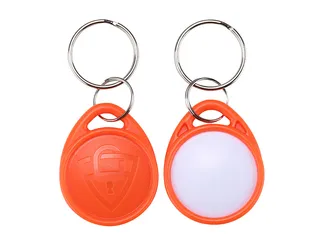
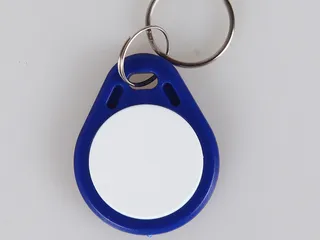
| RFID key fob (ABS, FR4, leather, silicone, wood) | Compact keyring housing; ultrasonically welded ABS outlasts glued shells, and FR4 is most durable for industrial/outdoor gates | No photo ID; laser-engraved numbers (resists keyring rub), silk-screen/UV logo or colour-coded shells | Small internal coil (`2–10 cm` on `125 kHz` fobs; `2–4 cm` typical on `DESFire` tags using `70 pF` "H" ICs) | Yes — dual-frequency key fob (`125 kHz` + `13.56 MHz`, two separate chips & coils) | Custom RFID key fobs, 125 kHz proximity fobs & DESFire tags |
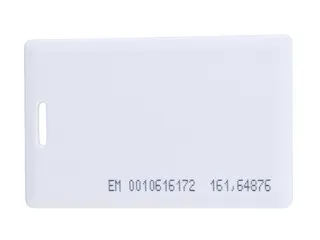
| Clamshell card (thick proximity card) | Two-part rigid moulded ABS shell, commonly around `1.8 mm` thick, with pre-moulded portrait or landscape slot clear of the coil | Too thick (`~1.8 mm`) for desktop card printers & wallets; laser/ink numbers, or apply a thin printed adhesive PVC overlay for photo ID | Rigid body does not flex; deeper shell holds a larger wound copper coil, often reading slightly further than a thin card on the same LF reader | Single-band `125 kHz` standard (`13.56 MHz` on request); use a combi card for LF + HF in card form | Clamshell RFID cards |
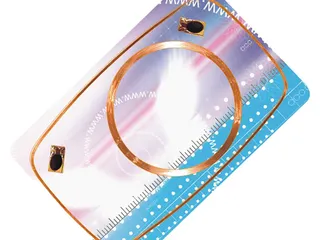
| CR80 ISO thin card (PVC, PET, rPVC, wood, PLA) | `85.60 × 53.98 × 0.76 mm` (`ISO/IEC 7810 ID-1`) laminated sheet; flexible (bending or bad slot punches can crack the coil) | Full edge-to-edge dye-sublimation, retransfer, offset or digital photo ID, barcodes & magnetic stripe (stripe-and-chip card) | Full card-area antenna for consistent wall-reader & desktop encoder coupling | Yes — multi-chip [combi card](/product/combi-card/) (`LF + HF` or `HF + UHF`); contact + contactless on one chip is a [dual interface card](/product/dual-interface-card/) | Printed RFID cards, 125 kHz cards & MIFARE DESFire cards |
| Epoxy key tag & adhesive upgrade sticker | Full-colour printed PVC/PET inlay under clear epoxy dome, or thin sticker (ferrite-backed on metal phones/cases) | Full-colour CMYK branding & serial numbering; sticks onto an existing non-RFID ID card or badge holder | Compact disc coil; on phones or metal badge clips, specify ferrite-backed on-metal stickers so metal does not detune `13.56 MHz` | Single-chip per sticker (`125 kHz` or `13.56 MHz`) | MIFARE stickers, 125 kHz stickers & DESFire epoxy tags |
Three procurement traps when mixing or migrating door credentials
Hardware rollouts stall when physical format changes expose hidden reader or numbering assumptions:
- Confusing dual-frequency fobs, combi cards, dual-interface cards and stripe-and-chip cards: A dual-frequency key fob and a [combi card](/product/combi-card/) each hold *two or more separate contactless chips* (for example `125 kHz T5577/EM4200` + `13.56 MHz MIFARE DESFire EV3`), each with its own antenna and enrolled on its own reader during a phased upgrade. A [dual interface card](/product/dual-interface-card/) has *one* smart-card IC reached through both an `ISO/IEC 7816` contact pad and a `13.56 MHz` antenna. A card with one RFID chip plus a magnetic stripe is a stripe-and-chip card (Combi vs Dual Interface vs Stripe-and-Chip). Note also that a ceramic NFC ring holds one chip only, so it cannot replace a dual-frequency fob.
- Printed number mismatches and `ATQA / SAK` assumptions: On `125 kHz` EM4100-format fobs and clamshells, one 40-bit ID can appear as 10-hex, 10-digit decimal (`32-bit`) or `Wiegand 26-bit` facility + card number — verify exact conversions in our RFID UID & Wiegand Converter and `Block 0` settings in the T5577 Block 0 Calculator. On `13.56 MHz` readers, decode `ATQA`, `SAK` and `ATS` responses in our ISO 14443-A ATQA, SAK & ATS Chip Decoder — and remember NXP AN10927: if a wall reader checks only the unauthenticated anticollision `UID`, even a `MIFARE DESFire EV3` fob offers no more copy resistance than a plain serial number.
- Desktop printer jams and post-delivery slot punching: Never feed a `~1.8 mm` clamshell card (or a bumpy multi-chip card without checking flatness on samples) into a standard `0.76 mm` direct-to-card printer, and never punch a lanyard slot into a thin RFID card without checking the antenna layout first. Clamshells solve lanyard wear by moulding the slot clear of the copper coil during shell injection.
Numbering, Excel/CSV/XML enrolment lists and sample qualification
Whether you choose laser-engraved ABS fobs, numbered clamshells or pre-printed DESFire cards, numbered orders from Proud Tek include an Excel, CSV or XML mapping file pairing each piece's chip `UID` or encoded ID with its printed/engraved serial number so administrators can bulk-import credentials instead of presenting hundreds of fobs one by one at an enrolment reader (RFID encoding service). Every pre-encoded credential is read back after programming and shipped with a data report.
Temperature and environmental ratings depend on the exact chip and body: `125 kHz` key fobs and PVC `125 kHz` cards carry an owner-confirmed working range of `−40 °C to 65 °C` (`2–10 cm` read distance), whereas `13.56 MHz` fob, tag and non-PVC card limits are confirmed per chip and housing in your quotation and verified on samples at your real gates or outdoor posts.
Published 2026-11-28 · Updated 2026-11-28