
Hotel Technology
Hotel Keycard Deactivated by Phone Magnet?
Quick answer
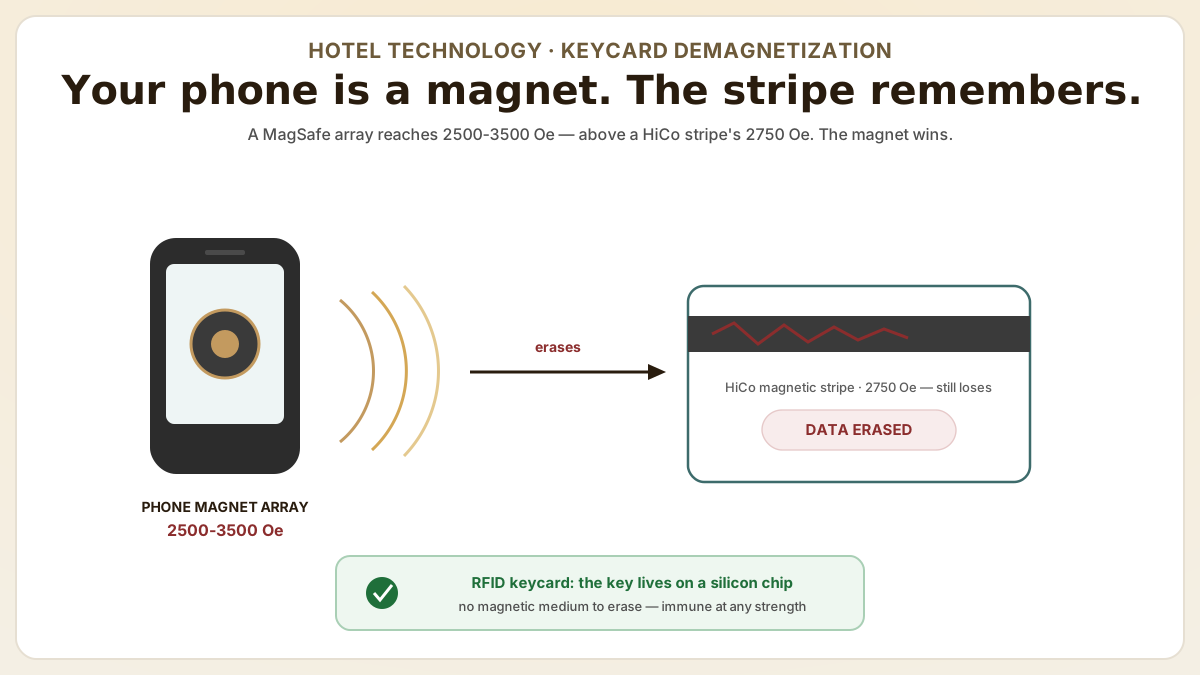
Yes — a phone really can kill a hotel keycard. MagSafe arrays hit 2500-3500 Oe, at or above a HiCo stripe's 2750 Oe coercivity, so the magnet wins. The guest almost never did anything wrong — and because RFID cards keep their data on a silicon chip, the upgrade fixes it for good.
- Modern smartphones contain neodymium magnets in speakers, haptic motors, and MagSafe systems that generate fields strong enough to erase HiCo magnetic stripe data at close contact.
- Hotels still using magstripe key cards face 15-25% re-encoding rates per guest stay, costing staff time, creating guest frustration, and damaging satisfaction scores.
- RFID contactless key cards are completely immune to magnetic fields because they store data on a silicon chip, not a magnetic stripe. Upgrading eliminates this problem permanently.
At a glance
Use these short answers to decide whether this page matches the project before moving into the detail.
Key takeaway
Modern smartphones contain neodymium magnets in speakers, haptic motors, and MagSafe systems that generate fields strong enough to erase HiCo magnetic stripe data at close contact.
What is happening physically when a phone deactivates a keycard?
It is one of the most reliable conversations in hospitality. A guest returns to the front desk, key in hand and faintly accusatory: it just stopped working, and they did...
Next step
Ready to move forward? Start your inquiry to get specific answers for this project.
Get RFID key card samples for your hotelWhat is happening physically when a phone deactivates a keycard?
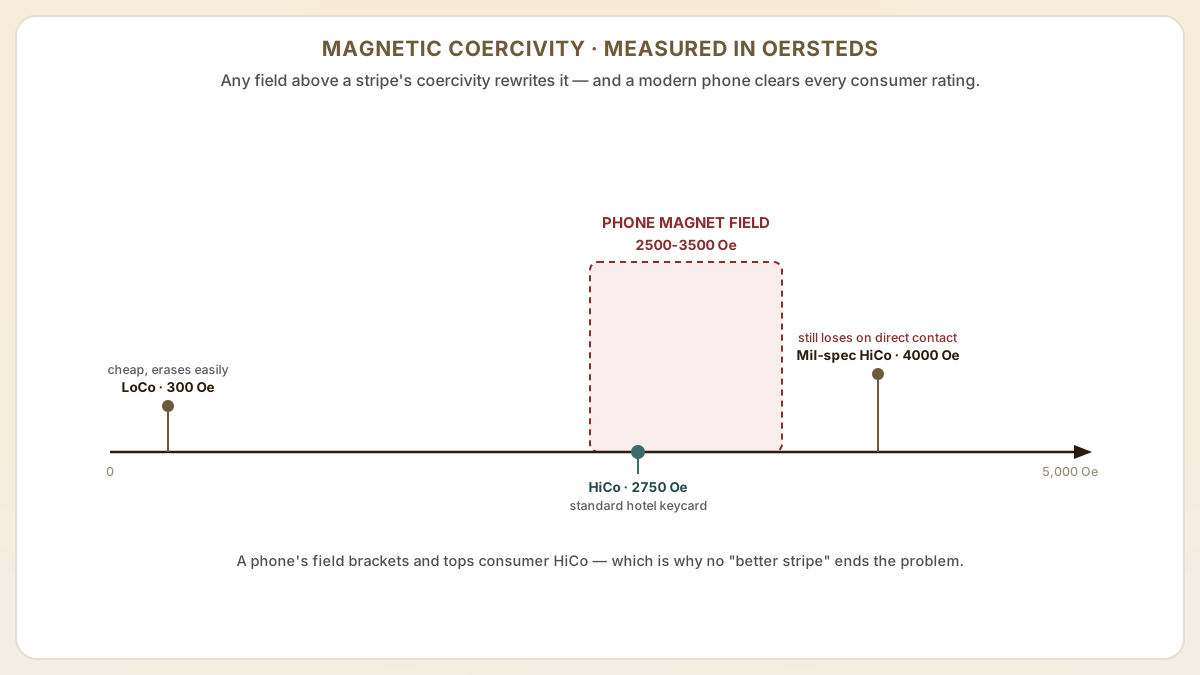
It is one of the most reliable conversations in hospitality. A guest returns to the front desk, key in hand and faintly accusatory: it just stopped working, and they did nothing to it. They are usually telling the truth — they did nothing except carry the card home in the same pocket as a phone that is, quietly, a magnet. This is not an urban legend; it is straightforward magnetic physics, and the scale below shows exactly where a modern phone's field overpowers the stripe. Knowing what happens at the surface of that stripe lets front-desk staff explain the issue with confidence and lets GMs make the upgrade case to ownership.
- Magnetic stripe data is stored as a sequence of north/south flux reversals in iron-oxide particles bonded to a thin polymer layer on the card. The lock reads this data by sensing voltage changes induced as the card slides past a read head.
- Coercivity (Oe, oersteds) is the magnetic field strength needed to reverse the flux pattern. LoCo magstripe (300 Oe) is cheap and easy to encode but easy to demagnetize. HiCo (2750 Oe) costs slightly more and resists everyday magnets — but not modern phone magnet arrays.
- Apple MagSafe arrays produce surface fields of 2500-3500 Oe — measured directly with a gaussmeter against the back of an iPhone 15 series. That's at or above HiCo coercivity. Sustained contact for 5-10 seconds is enough to flip flux patterns on the magstripe.
- Even Android phones without MagSafe carry neodymium magnets in speakers (rare-earth, 5000-12000 Gauss at the surface) and haptic motors. Carrying the keycard in the same pocket as the phone for hours produces cumulative exposure.
- This is fundamental to magnetic-stripe physics, not a product defect. No 'better magstripe' fixes it — even military-spec HiCo at 4000 Oe loses against direct MagSafe contact. The only categorical fix is to remove the magnetic medium.
Why phone magnets deactivate hotel keycards
Short version: any field stronger than the stripe's coercivity rewrites the data, and modern phones clear that bar with room to spare. The longer version — which magnet, how close, for how long — is worth knowing, because it decides whether you reach for HiCo stock or give up on the stripe altogether. For the full teardown, see magstripe vs RFID hotel cards.
- Magnetic stripe cards encode data as patterns of magnetized iron oxide particles on a thin stripe. These patterns are stable under normal conditions but can be overwritten or scrambled by any external magnetic field stronger than the stripe's coercivity rating.
- LoCo (low coercivity, 300 Oe) magstripe cards are especially vulnerable. Even the weak magnets in older phone cases can erase them. HiCo (high coercivity, 2750 Oe) cards resist casual magnetic exposure but still fail when pressed directly against modern neodymium magnets.
- Apple MagSafe arrays generate magnetic fields exceeding 3000 Oe at surface contact, which is strong enough to demagnetize even HiCo magnetic stripes. Guests who keep their keycard inside a MagSafe wallet case will almost certainly experience deactivation.
- Magnetic money clips and snap closures on women's handbags are surprisingly often the worst culprits — stronger fields than most phones because they use neodymium with no shielding. Front-desk staff should ask about both phone and bag closures during troubleshooting.
- This is not a defect in the card or the lock. It is a fundamental limitation of magnetic stripe technology that cannot be solved by using better cards, stronger encoding, or staff training. The only permanent fix is switching to a non-magnetic card technology.
What does keycard deactivation actually cost hotels?
The bill for 'the guest did nothing wrong' lands in five places, and only one of them is the replacement card. Re-encoding labor at peak check-in, consumable card waste, softening satisfaction scores, dated brand perception, and — the one that reaches Legal — security liability. The chart below stacks all five so an owner sees the total, not just the card.
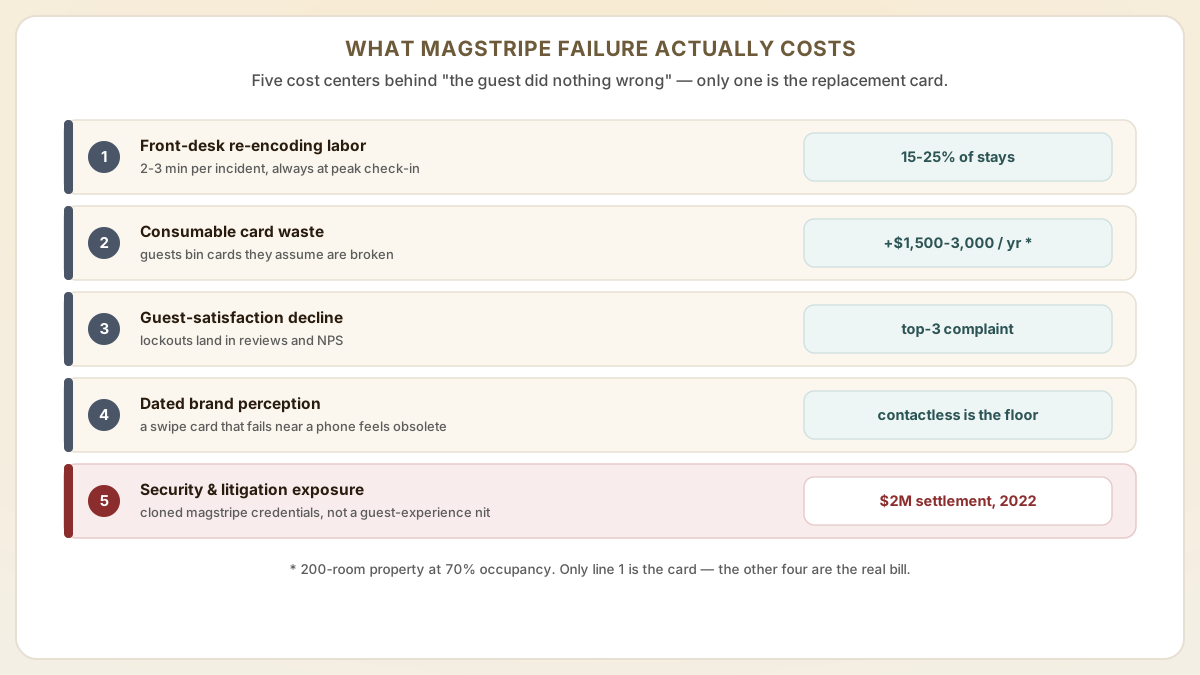
- Front desk re-encoding labor. Each deactivated keycard requires a guest to return to the front desk, wait in line, and have staff re-encode a replacement card. At 2-3 minutes per incident and 15-25% incidence rate, this consumes significant staff capacity during peak check-in and check-out periods.
- Guest satisfaction impact: being locked out of their room is one of the most frustrating experiences for hotel guests. Properties with high keycard failure rates see measurable declines in satisfaction surveys, online reviews, and NPS (Net Promoter Score). 'Room access' typically appears in the top-3 complaint categories at magstripe-heavy properties.
- Card waste: hotels discard cards that guests assume are broken, increasing card consumption and procurement costs by 10-20% beyond what a properly functioning system would require. A 200-room property at 70% occupancy spends an extra $1,500-3,000/year on consumable card stock attributable to demagnetization-driven waste alone.
- Brand perception: in an era of contactless everything, handing guests a magstripe card that fails near their phone feels outdated. Luxury and business travelers expect contactless RFID technology as a baseline. Mobile-key adoption is still only ~14% across major chains, so physical RFID cards remain the universal default — but the floor for that default is now contactless, not swipe.
- Insurance and litigation exposure: in 2022 a US hotel chain paid over $2M in settlements after a series of room thefts traced to cloned magstripe credentials. Magstripe is not just a guest-experience drag — it is increasingly a security and compliance liability.
How RFID key cards eliminate the magnet problem
The fix is categorical, not incremental: an RFID keycard stores its credential on a silicon chip with no magnetic medium to erase, so field strength stops mattering. A guest can leave the card on a MagSafe charger overnight and still open the door in the morning. Most properties can switch card stock without touching a single lock — the mechanics are covered in how hotel RFID key cards work. The diagram contrasts what the magnet actually meets inside each card.
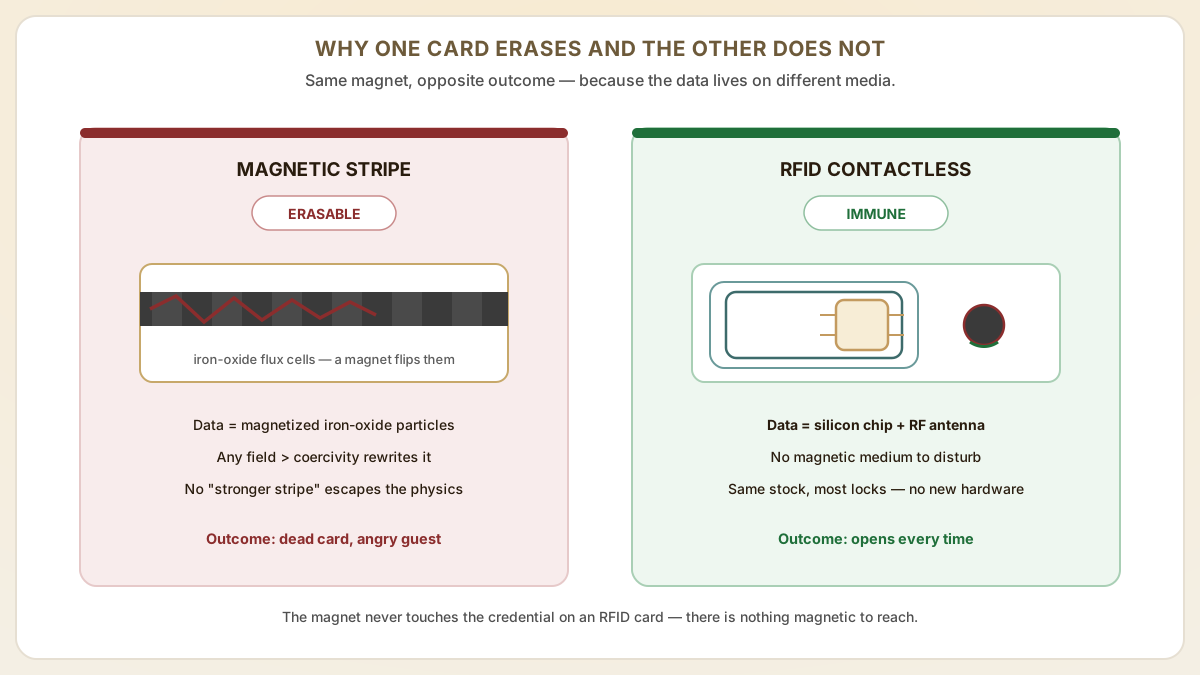
- RFID key cards store all data on a silicon microchip connected to a radio-frequency antenna coil. There is no magnetic medium involved, so no magnetic field (regardless of strength) can erase, corrupt, or alter the stored data.
- Guests can keep RFID key cards in the same pocket, wallet, or phone case as their smartphone without any risk of deactivation. The card will continue to open their door reliably for the duration of their stay.
- Most modern hotel lock systems (Assa Abloy, Dormakaba, SALTO, Onity) already support RFID. Many hotels simply need to switch their card supply from magstripe to RFID without replacing any lock hardware.
- Encryption tier upgrade comes free with the upgrade: RFID cards using DESFire EV3 carry AES-128 with EAL5+ Common Criteria certification — the same security level as banking cards. That upgrade is impossible on any magstripe technology.
- Proud Tek supplies RFID key cards compatible with all major hotel lock platforms at 30-50% less cost than OEM cards, enabling a painless and affordable transition away from magstripe.
Beyond phones: other everyday demagnetizers guests carry
The phone gets blamed for all of it, which is convenient for the phone and unfair to the handbag. Front-desk staff who only suspect 'phone' miss the other half of the demagnetizer population. CPI Card Group, a US card manufacturer, was one of the first vendors to publicly document the phone-magstripe correlation. Their incident dataset and Kisi's access-control field reports point to several non-phone culprits worth flagging in guest-facing instructions. The lineup below ranks them by erasure risk, because the worst offender is rarely the one the guest suspects.
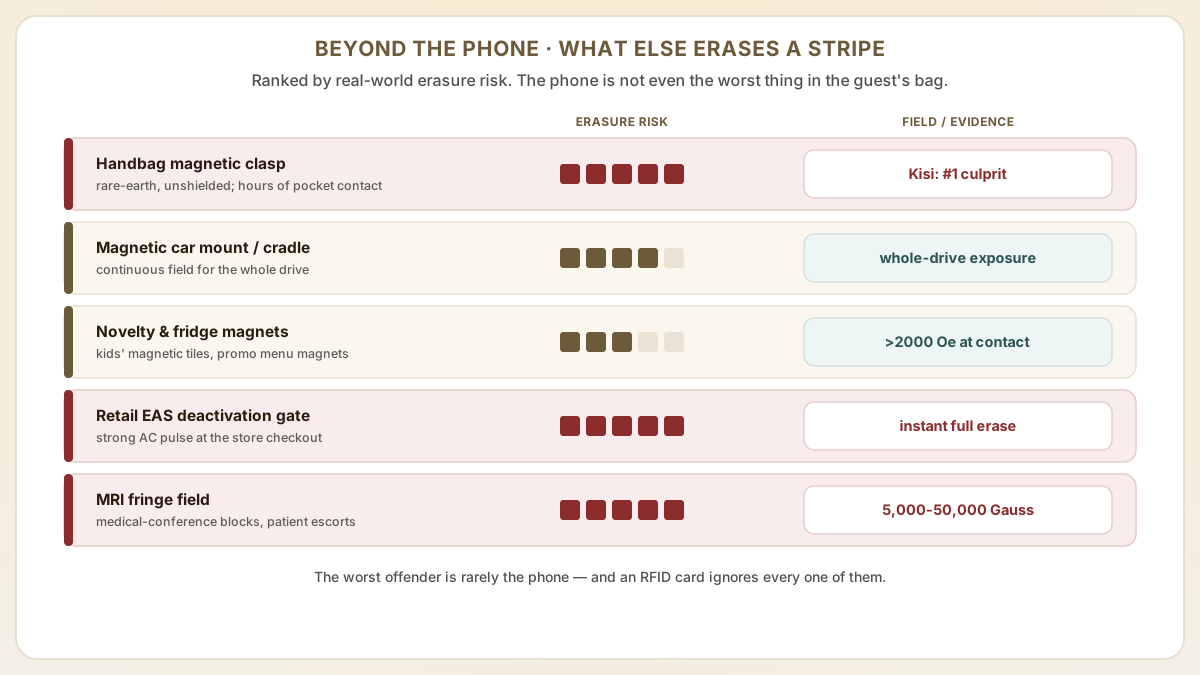
- Magnetic clasps on women's handbags and wallets: typically rare-earth neodymium with no shielding. Sustained pocket contact erases LoCo magstripe within hours and HiCo within days. The Kisi field study cites these as the #1 demagnetizer for badge-format access cards.
- Magnetic phone mounts and car cradles: dashboard-mounted MagSafe holders generate continuous fields. A keycard left on the passenger seat under a phone in the cradle is exposed for the entire drive — equivalent to a deliberate erasure pass.
- Decorative fridge magnets and toy magnetic tiles: unusually strong novelty magnets (children's Magna-Tiles, refrigerator promo magnets from delivery menus) routinely exceed 2000 Oe at surface contact. Guests who toss the keycard on the kitchen counter at home can degrade it for the next stay.
- EAS (electronic article surveillance) gates and AM-style security tags: the deactivation pad at retail checkout uses a strong AC magnetic pulse to deactivate hard tags. Hotel guests who walk a magstripe card through an active EAS gate see immediate full-card erasure, particularly common in airport duty-free and large department stores.
- MRI scans: medical-conference attendees and patient escorts walking near MRI suites with a magstripe card in pocket experience full erasure within seconds — MRI fringe fields exceed 5,000-50,000 Gauss at the bore. Properties hosting medical-conference room blocks should pre-emptively mention this at check-in.
- Card-in-wallet interference (RFID + RFID): when two contactless cards are stacked in the same wallet pocket, the reader sees both UIDs simultaneously and may pick neither, presenting as a 'card not working' fault that is actually anti-collision noise. Issuing the keycard in a separate paper sleeve at check-in eliminates this; some lock vendors enable 'first-card-wins' anti-collision algorithms in their reader firmware that further mitigates.
What can we do today, before the lock upgrade lands?
If your property is on a 12-24 month lock-replacement runway, you cannot wait for RFID to solve the magnet problem. Five interim mitigations that meaningfully reduce magstripe failures while you complete the upgrade — none of which beat removing the stripe, but all of which keep the front desk sane until you do.
- Specify HiCo (2750 Oe) magstripe stock instead of LoCo: HiCo costs $0.02-0.04 more per card but resists demagnetization from non-MagSafe phones and most wallet clasps. Roughly cuts the failure rate by 30-50% versus LoCo.
- Add a guest-facing card sleeve with the message 'keep separate from phone and credit cards': a 5-cent paper sleeve carries the warning at issue. AHLA member properties report 15-20% reduction in reported demagnetization complaints just from making the sleeve standard.
- Use dual-interface cards (RFID chip + magstripe in one card body) on doors that support both: properties mid-migration can issue one card stock that works on legacy magstripe rooms and new RFID rooms, eliminating the dual-inventory risk and giving guests a contactless path on whichever doors support it.
- Train front desk to issue a second card at check-in by default for stays of 3+ nights: a backup card, kept in the room safe by the guest, eliminates 90% of midnight-lockout escalations even when the primary card fails.
- Replace magstripe encoders running below ~80% encoding yield: encoders with worn write heads progressively damage the cards they touch. A 5-year-old front-desk encoder is past its service life. Budget $400-800 per encoder swap as part of the bridge plan to RFID.
Useful next pages
Use these linked product, guide and comparison pages to keep the next click specific and practical.
Demagnetization references
External card-industry research on the phone-magstripe interaction.
Hotel key card solutions
Explore RFID key card products and resources for hotel properties.
FAQ
Can I prevent magstripe deactivation without replacing our locks?
If your locks support RFID cards (most modern hotel locks do), you can simply switch your card supply from magstripe to RFID without replacing any lock hardware. If your locks are magstripe-only, you can mitigate (but not eliminate) deactivation by using HiCo cards and advising guests to keep cards away from phones, but this does not fully solve the problem.
Do RFID key cards cost more than magstripe cards?
RFID cards cost approximately 2-3 times more per unit than basic magstripe cards. However, reduced re-encoding labor, lower card replacement rates, and improved guest satisfaction typically offset the price difference within months. Hotels with high guest volumes often achieve net savings after switching to RFID.
Will RFID cards work in our existing card encoders?
If your front desk system uses a combined magstripe/RFID encoder (common in hotels using Assa Abloy, Dormakaba, or SALTO systems), it already supports RFID card encoding. If you only have a magstripe encoder, you will need an RFID-compatible encoder. Your lock vendor can provide one, or Proud Tek can recommend compatible options.
Are wireless chargers and power banks also a risk for magstripe cards?
Yes — and arguably more than the phone itself. Wireless charging coils generate sustained alternating magnetic fields strong enough to demagnetize even HiCo stripes, especially during the first few seconds of charging when the field is at peak. Magnetic power banks (MagSafe-compatible bricks) carry an array of neodymium magnets continuously and are a worse-case carrier than phones. The clean answer for guests is the same as for phones: keep RFID cards in any pocket; keep magstripe cards away from anything that wirelessly charges or magnetically attaches to a phone.
Will an RFID hotel keycard be safe in a wallet with my credit cards and other RFID badges?
Mostly yes, with one caveat. RFID/NFC keycards cannot be magnetically erased so the demagnetization risk is zero. The remaining risk is reader anti-collision: if the wallet contains two or more contactless cards (corporate access badge, transit card, contactless credit card), the lock reader sees multiple UIDs at once and may fail to pick a winner — presenting as 'card not working' even though all cards are functionally fine. Modern lock vendors implement ISO 14443 anti-collision and most hotel locks now handle 2-3 stacked cards correctly; older readers may not. Practical fix: check in by tapping the wallet (test for collision); if the lock pauses or fails, hand the keycard out separately. The Kisi access-control team confirms this is the most common 'phantom failure' on multi-card wallets.
Are credit cards in the same wallet at risk of demagnetization too?
The magstripe on credit cards is HiCo by industry standard, so it resists day-to-day phone exposure better than a typical hotel LoCo card. But MagSafe and rare-earth wallet magnets can still scramble credit card stripes — issuer surveys see a real but smaller demagnetization signal. The bigger reason most credit cards keep working: cards over the last 5 years have moved transactions to the EMV chip and contactless NFC interface; the magstripe is fallback only. Hotel locks rarely have that fallback. That is why a small phone field, well-tolerated by a credit card, can still take down a hotel room key.
Proud Tek is a Shenzhen-based RFID & NFC manufacturer supplying hotel chains, transit operators, event venues and retail brands worldwide. Every order includes free samples, RF testing and dedicated project support.
Get a Quick Quote
Tell us about your project and we'll respond within one business day. Fields marked (asterisk) are required.