
Access Control
RFID Elevator and Floor Access Control
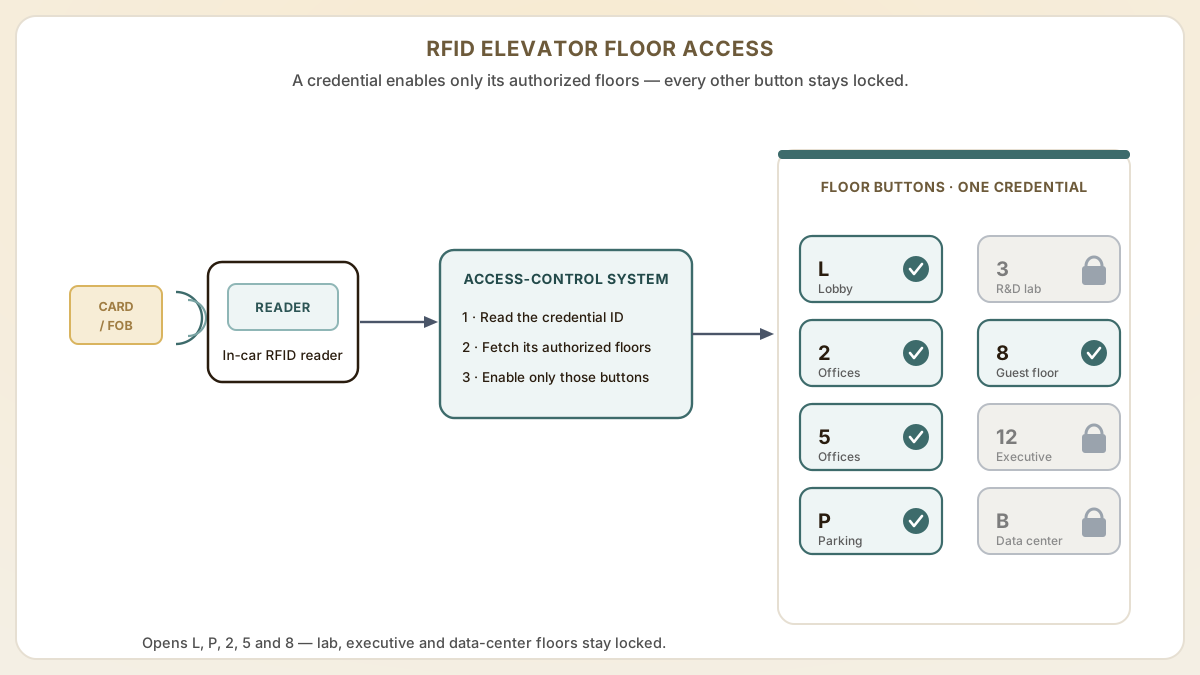
Quick answer
RFID elevator access control restricts each card or fob to authorized floors, and paired with destination dispatch it trims average wait time 25-40%. The stranger who clears the lobby still can't reach the executive suite, the data center or a residential floor that isn't theirs. This guide covers the three system architectures, credential-to-floor mapping, the major elevator-OEM integrations and code-compliant installation for hotels, corporate offices and multi-tenant buildings.
- RFID elevator access control restricts floor selection to authorized cardholders — so the stranger who breezes past the lobby desk still can't reach executive floors, data centers, residential levels or other restricted areas.
- Integration between elevator RFID readers and the building's access-control system (ACS) enables unified credential management. One card for doors, elevators and parking.
- Key fobs and cards with MIFARE Classic or DESFire chips provide the optimal balance of security, cost and compatibility with major elevator-control systems.
At a glance
Use these short answers to decide whether this page matches the project before moving into the detail.
Key takeaway
RFID elevator access control restricts floor selection to authorized cardholders — so the stranger who breezes past the lobby desk still can't reach executive floors, data centers, residential levels or other restricted areas.
Why RFID elevator access matters
Picture the lobby of a shiny new office tower: a wall of glass speed-gates, a guard checking every badge, the whole security-theater budget on proud display. Then a visi...
Next step
Ready to move forward? Start your inquiry to get specific answers for this project.
Get elevator access adviceWhy RFID elevator access matters
Picture the lobby of a shiny new office tower: a wall of glass speed-gates, a guard checking every badge, the whole security-theater budget on proud display. Then a visitor strolls through all of it, steps into the elevator, presses the button for the executive floor — and it works, because nobody thought to restrict it. In multi-tenant office buildings, hotels with restricted floors and residential high-rises, the elevator is the security layer everyone locks down last. Without floor restrictions, anyone who reaches the cab can reach any floor by pressing a button, and all that lobby hardware might as well be furniture.
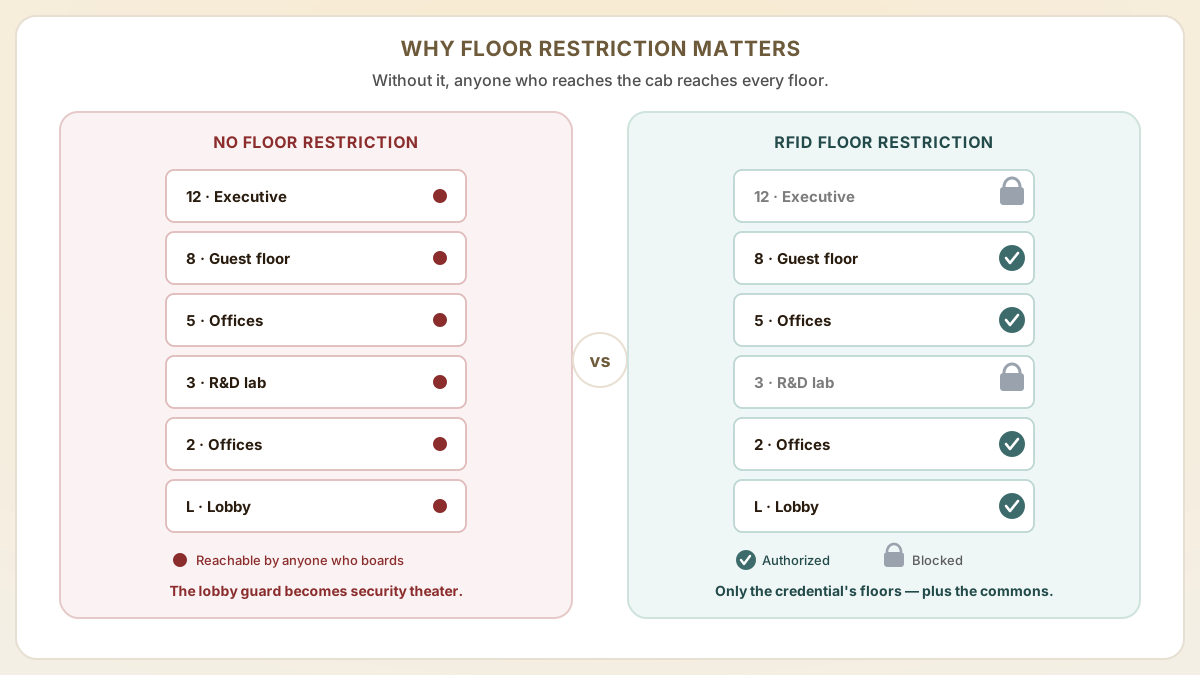
RFID elevator access control solves this by requiring card or fob authentication before the elevator accepts a floor-button press. Only floors authorized for the presented credential are enabled. This is implemented either by intercepting the elevator button-panel wiring (relay-based) or through native integration with the elevator manufacturer's destination-dispatch controller.
- Hotels use elevator RFID access to restrict guest floors. A guest's key card enables only their assigned floor plus common areas (lobby, restaurant, parking).
- Corporate offices restrict executive floors, server rooms and R&D labs to employees with appropriate clearance levels.
- Residential buildings assign floor access per unit. Residents reach their floor and common areas but not other residential levels.
- Audit trails record which credential accessed which floor and when, supporting security investigations and compliance reporting.
What system architecture options exist?
Three architectural approaches dominate RFID elevator access control, differing mainly in where the reader taps into the system — the button-panel wiring, the elevator controller, or a smart panel that replaces both. The diagram below shows how each one wires in; the table prices and compares them.
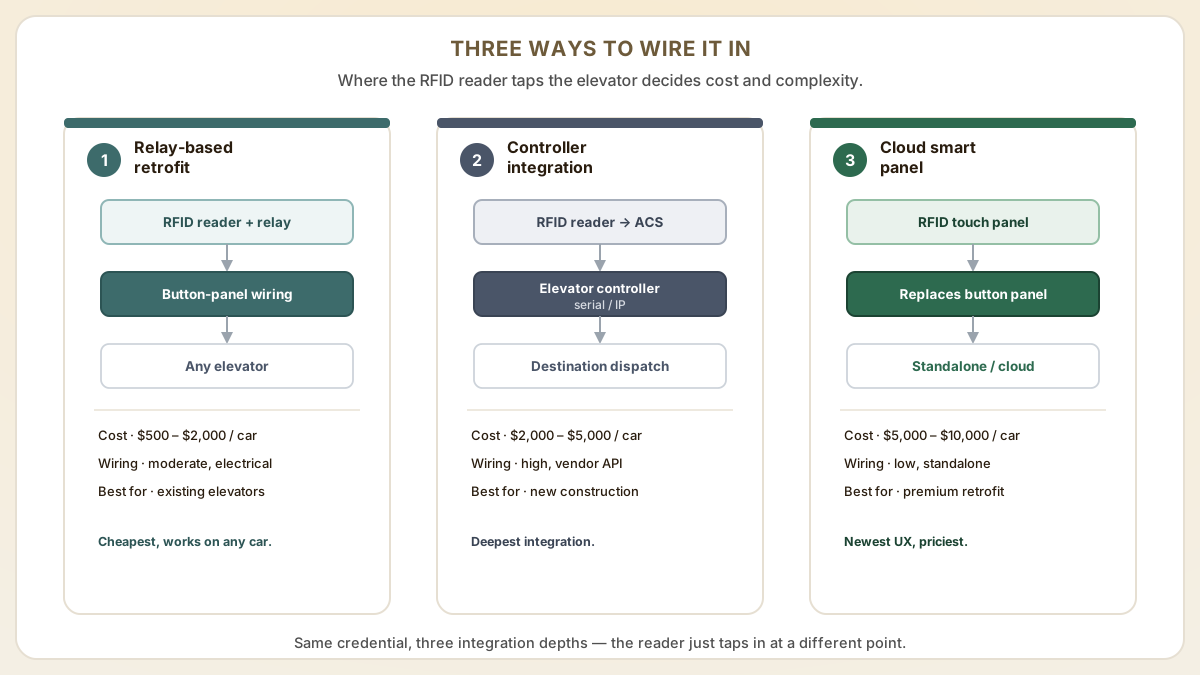
| Architecture | How it works | Cost | Integration complexity | Best for |
|---|---|---|---|---|
| Relay-based retrofit | RFID reader + relay board intercepts button-panel wiring | Low ($500–$2 000 per elevator) | Moderate: electrical work required | Existing elevators, budget projects |
| Elevator controller integration | ACS communicates with elevator controller via serial/IP | Medium ($2 000–$5 000 per elevator) | High: vendor API required | New construction, destination-dispatch |
| Cloud-managed smart panel | Replace button panel with RFID-enabled touch panel | High ($5 000–$10 000 per elevator) | Low: standalone system | Premium buildings, retrofit with modern UX |
How do credential and floor-mapping configuration work?
The access-control system maps each credential (card or fob) to a set of authorized floors. This mapping can be static (fixed per credential) or dynamic (time-based, role-based or event-driven). Because the same credential usually also opens the door locks on each authorized floor — the way a hotel's key-card system writes a guest's floor at check-in — the whole map lives in one place, and the diagram below traces how a card resolves to floors.
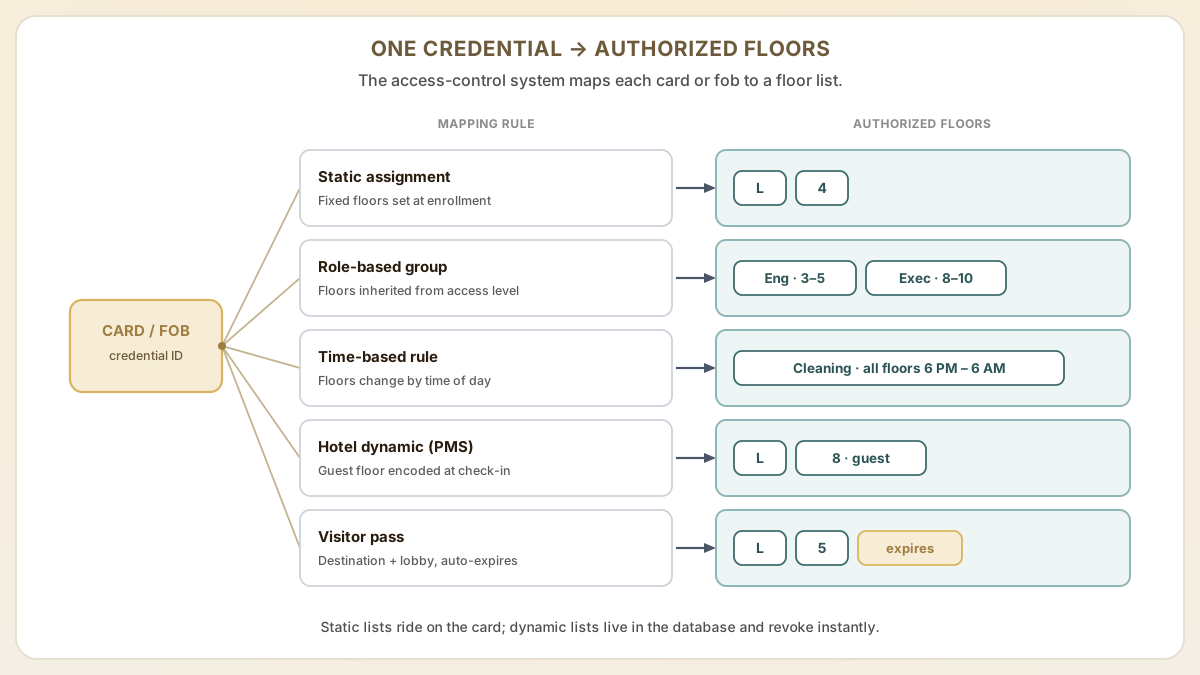
- Static floor assignment: Each card is assigned a fixed set of floors at enrollment time. Simple to configure, used for residential buildings and basic office setups.
- Role-based assignment: Floor access is defined per access-level group (e.g., 'Engineering' = floors 3–5, 'Executive' = floors 8–10, 'All-access' = all floors). Cards inherit floor permissions from their assigned group.
- Time-based rules: Cleaning staff cards may enable all floors during 6:00 PM – 6:00 AM and restrict to service areas during business hours.
- Hotel dynamic assignment: The PMS encodes the guest's floor on the key card at check-in; the elevator reader validates the floor encoding on each ride.
- Visitor credentials: Temporary cards or fobs issued at the lobby desk enable only the destination floor and lobby, then expire automatically when the scheduled visit ends — so the pass a visitor forgets to return becomes a worthless rectangle of plastic instead of a standing invitation to roam the building.
What are the key fob vs card form factors for elevator access?
Elevator access credentials are available in card and key-fob form factors. The choice depends on the building's use case, user demographics and whether the credential serves additional functions.
- Key fobs are preferred for residential buildings where residents carry the fob on a keyring alongside apartment keys. Compact, durable and always accessible.
- Cards are preferred for hotels and offices where the credential also serves as an ID badge or hotel key card with printed branding.
- Dual-function fobs with both RFID and a physical key backup provide redundancy for buildings with mechanical-lock fallback requirements.
- Fob durability exceeds cards in residential applications because fobs are molded ABS/epoxy and resist the mechanical stress of keyring carry better than thin PVC cards.
What installation and wiring considerations apply?
RFID elevator access installation requires coordination between the access-control integrator, the elevator maintenance company and the building's electrical contractor. It also carries one non-negotiable, shown in the diagram: the fire-service override, which must drop every floor restriction the instant the alarm sounds.
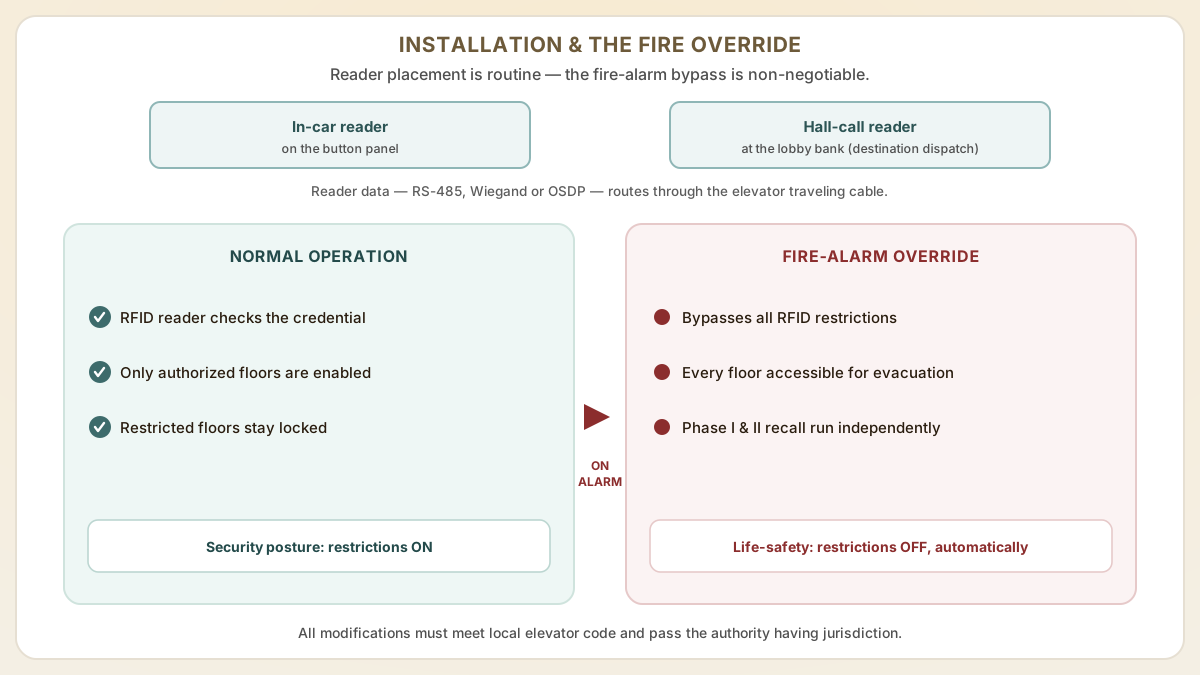
- Elevator code compliance: All elevator modifications must comply with local elevator codes (ASME A17.1, EN 81, etc.) and be inspected by the authority having jurisdiction.
- Fire-service override: RFID access restrictions must be automatically bypassed during fire-alarm activation to ensure all floors are accessible for evacuation and firefighter access.
- Emergency recall: Phase I and Phase II firefighter recall operations must function independently of the RFID access system.
- Reader placement: In-car readers are mounted on the button panel or an adjacent wall surface. Hall-call readers for destination-dispatch systems are mounted at the lobby elevator bank.
- Wiring: Reader data cables (RS-485, Wiegand or OSDP) route through the elevator hoistway using traveling cable or wireless bridge connections.
Destination dispatch integration with the major elevator OEMs
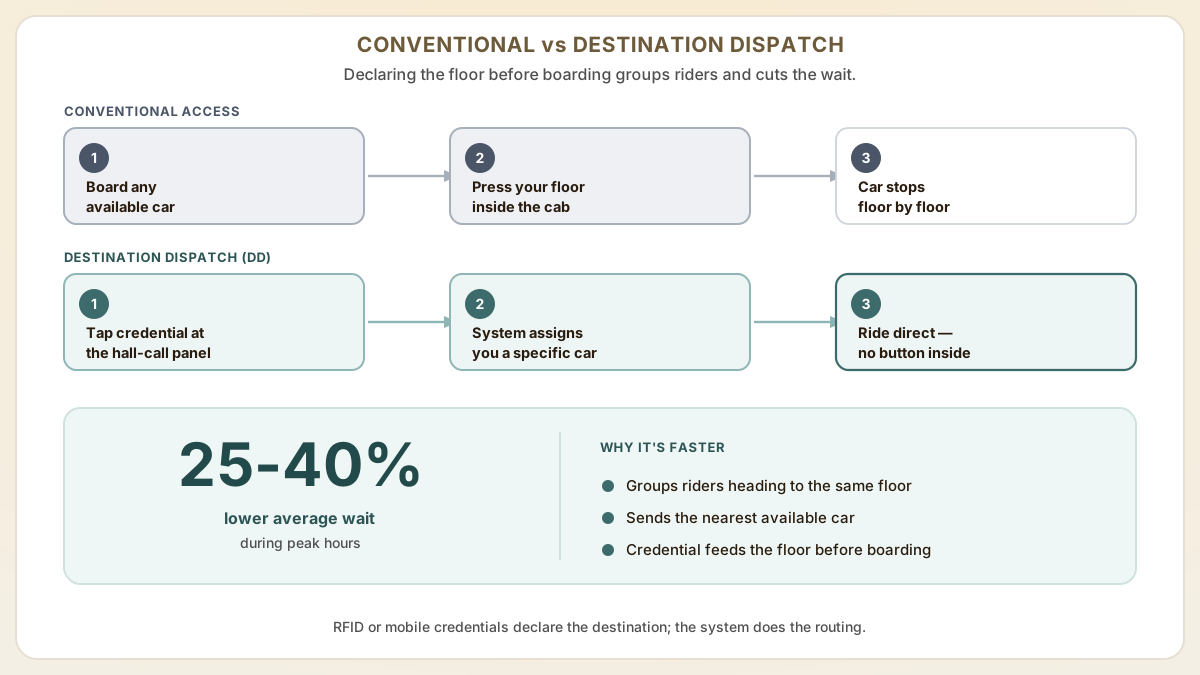
The biggest performance and capacity gain in elevator access is no longer about how fast the door opens — it is about destination dispatch (DD), where the system assigns each rider to a specific car based on their declared or credential-encoded floor before they step in. Pairing RFID or mobile credentials with DD typically cuts average wait time by 25-40% and shortens travel time by grouping riders going to the same floor. The summary below covers the common OEM control systems integrators encounter.
- Otis CompassPlus and Compass 360 (current-gen DD). Otis exposes a published API for credential-driven destination calls. Cards from HID Signo, ELATEC TWN4, Wavelynx Ethos, and similar multi-format readers send the credential ID via RS-485 or IP to the Otis e-Service interface, which routes the rider to a specific car. Best fit for new construction in towers above 12-15 floors where peak-hour throughput dominates the spec.
- KONE Polaris and KONE Access. KONE's Polaris destination control integrates with KONE Access for credential-based hall calls. Mobile credentials work over Bluetooth Low Energy through KONE Residential Flow and KONE Workplace apps. Polaris supports automatic elevator assignment from the credential without the user pressing any button — useful for accessibility (mobility-aid riders) and luxury residential lobbies.
- Schindler PORT 4D and myPORT. Schindler's PORT (Personal Occupant Routing Terminal) is an early DD system that has matured through several generations. Current PORT 4D supports HID iCLASS, MIFARE DESFire, and Schindler's own Bluetooth myPORT mobile credential. Schindler publishes integration guidance for major access-control platforms (Lenel OnGuard, Genetec Security Center, Software House C-CURE).
- TK Elevator (formerly thyssenkrupp) AGILE. TK's AGILE destination dispatch supports MIFARE DESFire EV2/EV3, HID Seos, and BLE mobile credentials through TK's IPM (Integrated Personal Manager) interface. Common pairing with Genea, Brivo, and OpenPath cloud access control for SaaS-managed multi-tenant office towers.
- Mitsubishi DOAS / Hitachi / Fujitec. The Asian-headquartered OEMs all offer destination dispatch options compatible with major access-control vendors via Wiegand emulation, RS-485, or BACnet integration. Specify the integration layer (which protocol, which firmware version) at the elevator design stage — retrofitting DD support after the cab is in service is significantly more expensive than including it in the initial elevator order.
Multi-credential strategy for hotels, residential, and mixed-use towers
A modern elevator-access program rarely runs on a single credential type. Hotels need to encode a guest floor for a 2-night stay, residential towers need a 25-year lifespan for owner credentials, and corporate floors need full audit logging — and they often share the same elevator bank. The strategy points below help spec a credential mix that doesn't end up with three incompatible reader heads on every car.
- Pick a multi-format reader head, not a single-frequency reader. ELATEC TWN4, HID Signo, Allegion Schlage MTB11, Wavelynx Ethos, and Identiv uTrust 4710F all read 125 kHz Prox, 13.56 MHz MIFARE Classic / DESFire / iCLASS / Seos / NTAG, plus BLE and NFC mobile credentials in a single device. Locking yourself into a single-frequency reader is the most expensive mistake in a multi-tenant elevator project — every credential change later requires reader replacement.
- Encode floor lists on the credential, not just in the database. For hotels using Salto, ASSA ABLOY VingCard Vision, dormakaba Saflok, or Onity HT24, the floor list is encoded onto the MIFARE Classic or DESFire card at check-in, so the elevator reader does not need a network round-trip per ride. For residential and corporate, the floor list is in the access control database, queried over IP each ride, which lets you revoke a fired employee or evicted tenant instantly without re-encoding the credential.
- Plan the credential lifecycle. Hotel guest cards: 1-7 days, MIFARE Classic 1K or DESFire EV2/EV3, $0.30-0.60 per card with custom print. Visitor passes: 4-24 hours, often time-bombed with an embedded expiry encoded on the chip. Residential owner credentials: 10-25 years, prefer DESFire EV3 fobs in molded ABS for keyring durability. Corporate employee badges: 3-5 years, usually DESFire EV3 or HID Seos plus mobile credential pair. Sizing inventory on these mixed cycles is what dictates encoder volume and card-bureau lead times.
- Mobile credentials change the user experience but not the security model. Apple Wallet keys, Google Wallet keys, HID Mobile Access, Aliro, and tenant-app credentials (Brivo Pass, Genea Mobile, OpenPath) are all overlays on the same AES key system used by the underlying card. They are valuable for visitor and short-term-stay populations because the credential is provisioned in seconds without anyone touching plastic, and revoked in seconds when the stay ends. Don't treat mobile as a replacement for plastic — most buildings will run both for several years.
- Cross-system audit trail. Tie the elevator credential events into the same SIEM or facility platform that ingests door, parking, and visitor events. Anomalies that look benign in one system (a credential entering at 3 AM) become obvious when correlated across door + elevator + parking + camera. Genetec Security Center, Lenel OnGuard, Brivo, Verkada, and Genea all expose elevator events via their event API; specify the integration during the access-control design rather than after the fact.
Useful next pages
Use these linked product, guide and comparison pages to keep the next click specific and practical.
RFID access cards
MIFARE Classic cards for elevator and door access control in multi-tenant buildings.
RFID key fobs
Compact RFID key fobs for residential elevator access and building entry.
Elevator and reader vendor references
Primary-source vendor documentation for destination dispatch and multi-format reader integration.
FAQ
Can one RFID card control both door locks and elevator access?
Yes. When the door-lock system and elevator-access system use the same RFID chip type (e.g., MIFARE Classic 1K or DESFire EV2), a single card serves as a unified credential for both. The access-control system manages floor and door permissions centrally.
What happens during a power outage. Are all floors accessible?
This depends on the system configuration and local code requirements. Most systems default to 'fail-safe' (all floors accessible) during power loss to ensure egress. Battery-backed RFID controllers can maintain access restrictions during brief outages. Fire-alarm activation always overrides RFID restrictions regardless of power state.
Can RFID elevator access be retrofitted to existing elevators?
Yes. Relay-based retrofit systems intercept the existing button-panel wiring without modifying the elevator controller. This approach works with any elevator manufacturer and does not require elevator-vendor involvement. Installation typically takes 4–8 hours per elevator.
What is the difference between conventional elevator access and destination dispatch?
Conventional access lets the rider enter any elevator and present a credential inside the cab to enable an authorized floor button. Destination dispatch (DD) flips the order — the rider declares a destination at a hall-call panel or via credential before boarding, and the system assigns a specific car. With RFID or mobile credentials feeding the DD system, the rider is sent directly to their authorized floor without pressing any button inside the cab. DD typically reduces average wait time by 25-40% during peak hours and improves traffic management in high-rises. Pair DD with multi-format readers (HID Signo, ELATEC TWN4, Wavelynx Ethos) to keep the credential strategy flexible across MIFARE DESFire, HID Seos, and mobile.
How do mobile credentials (Apple Wallet, Google Wallet, HID Mobile Access) work for elevator floor access?
Mobile credentials store the same access identity that would otherwise be encoded on a card or fob, but inside the phone's Secure Element rather than on plastic. The phone presents the credential over BLE or NFC to the elevator reader (or hall-call panel for destination dispatch), and the access control system processes the floor permissions exactly as it would for a card. Most current OEM elevator platforms — Otis CompassPlus, KONE Polaris/Access, Schindler PORT, TKE AGILE — and most reader heads (HID Signo, ELATEC TWN4, Allegion Schlage MTB11, Wavelynx Ethos) support mobile credentials alongside cards. Operationally, mobile credentials are issued and revoked instantly from the access management portal, which makes them well-suited to short-stay residents, hotel guests, and temporary visitors.
Sources & references
Primary standards, OEM datasheets and regulatory documents cited by this article. All URLs were verified on the access date shown below.
Proud Tek is a Shenzhen-based RFID & NFC manufacturer supplying hotel chains, transit operators, event venues and retail brands worldwide. Every order includes free samples, RF testing and dedicated project support.
Get a Quick Quote
Tell us about your project and we'll respond within one business day. Fields marked (asterisk) are required.