
⚖️ Compliance & Regulatory
8 guides — Compliance officer references for the eight regulations that touch every RFID program: Walmart's mandate, Target T2/T3, FDA DSCSA, EU Digital Product Passport (ESPR 2024/1781), CE / RoHS / REACH, California CCPA, and FSMA 204 food traceability.
 Walmart RFID Mandate Walmart RFID Tagging Mandate 2026 — Supplier Guide
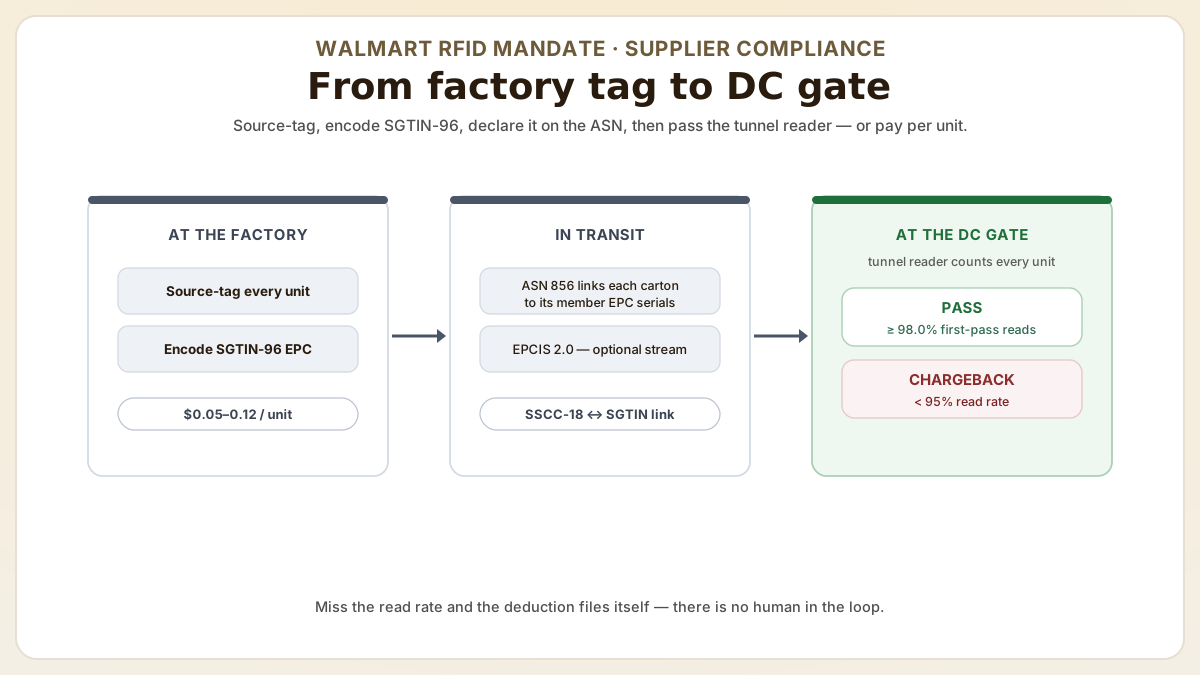
 Walmart's item-level RFID mandate now spans apparel (2022), home goods (2023), sporting goods and footwear (2024), toys (2025), and hard goods (2026). Every unit needs a GS1 SGTIN-96 EPC — Company Prefix + GTIN + unique 38-bit serial — verified by tunnel readers at DC receiving against Walmart's 98.0% first-pass read target. Non-compliance means automated per-unit chargebacks; source tagging at the factory runs $0.05-0.12 per tag versus $0.20-0.50 for DC tagging.
Read guide →
A cross-retailer compliance overview for suppliers handling item-level RFID mandates from Walmart, Target, Nordstrom, Macy's, Kohl's and the major European retailers. Covering where each retailer's requirements align around GS1 SGTIN-96 encoding, where they diverge (tag placement, ARC certification categories, ASN formats, verification cadence), the source-tagging operating model that covers multiple retailers simultaneously, inlay selection by product material, and the governance that keeps multi-retailer programmes from fragmenting.
Read guide →
A DSCSA compliance playbook for pharmaceutical manufacturers, repackagers, wholesale distributors and dispensers. Covering unit-level serialization requirements, the EPCIS transaction-data architecture that trading partners must exchange, how RFID and NFC accelerate saleable-returns verification, aggregation hierarchies from unit to case to pallet, NTAG 424 DNA cryptographic authentication, cold-chain pharmaceutical tag selection, and the stabilization-period enforcement context suppliers still operate under.
Read guide →
An FSMA Section 204 playbook for growers, packers, processors, distributors and retailers handling Food Traceability List items. Covering the rule scope after the FDA's 2028 compliance extension, the Key Data Elements and Critical Tracking Events that define electronic recordkeeping, how RFID case and pallet tags automate CTE capture without line-of-sight, GS1 SSCC-96 and SGTIN-96 encoding for food supply chains, cold-chain durability requirements, FDA 21 CFR food-contact material compliance, recall-speed economics and a structured supplier pilot methodology.
Read guide →
The EU Digital Product Passport arrives category by category: batteries first, with the battery passport mandatory from 18 February 2027. Textiles, electronics, furniture and construction follow through 2027-2030 via delegated acts under ESPR — Regulation (EU) 2024/1781. This guide covers NFC vs QR vs UHF carrier selection, NTAG 424 DNA and ICODE DNA chip choices, dual-technology NFC+UHF labels, and pre-2027 programme design.
Read guide →
CE marking for RFID in Europe runs on the Radio Equipment Directive 2014/53/EU, which covers every reader and active tag. Harmonized testing spans EN 300 330 (HF/LF), EN 302 208 (UHF), EN 301 489 (EMC) and EN 62368-1 (safety). Europe's 865-868 MHz UHF band allows 2W ERP with listen-before-talk, versus 4W EIRP in the US 902-928 MHz band. This guide also walks the Declaration of Conformity and technical-file package.
Read guide →
A material-compliance playbook for NFC and RFID products sold into the European market. Covering RoHS Directive 2011/65/EU with its RoHS 3 phthalate amendments, REACH Regulation (EC) 1907/2006's SVHC candidate-list obligations, how the IC chip, antenna, substrate, adhesive and ink stack are each tested and documented, PVC-versus-PVC-free substrate tradeoffs, the Declaration of Conformity and Safety Data Sheet packages that supplier documentation must deliver, and the enterprise procurement workflows that routinely require RoHS/REACH evidence alongside product specifications.
Read guide →
California RFID privacy law is a four-layer framework: Civil Code §§1798.79-1798.795, Labor Code §1024.5, CCPA/CPRA, and B&P Code §§22948-22949. Penalties range from up to one year in county jail plus a fine of up to $1,500 for covert remote reading of identity documents, to CCPA fines of up to $2,500 per violation and $7,500 per intentional violation. The guide maps privacy-by-design tag selection, PIA methodology and the deployer documentation package.
Read guide →