
Blood Bank RFID
UHF RFID Blood Bag Label
ISBT 128 Compatible

Quick answer
UHF RFID blood bag labels encode the ISBT 128 Donation Identification Number (DIN), product code and expiration date. Encoding automates inventory, crossmatch and bedside verification, preventing ABO-incompatible errors (1 in 38,000 fatalities) and cutting expiry waste from 5-10% to 2-3% via FEFO issuing. The cold-chain PET label meets ICCBBA TS-002 RFID placement, FDA 21 CFR 606 cGMP, AABB Standards and ISO/IEC 18000-63 UHF RAIN, and coexists with the mandatory printed ISBT 128 barcodes.
- Transfusion safety — automated RFID-based bedside verification confirms patient-blood compatibility, preventing ABO-incompatible transfusion errors (1 in 38,000 fatalities + 20-40 US deaths annually).
- Cold-chain rated — label withstands 2-6 °C refrigerated RBC storage, −30 °C frozen plasma, −65 °C frozen RBC + glycerol cryoprotectant + repeated freeze-thaw cycling. Substrate engineered against PVC plasticiser migration.
- Automated inventory — UHF RFID readers in blood bank refrigerators provide real-time unit-level inventory + FEFO issuing + expiry alerting. 400-600 units in single reader field, no read cascade failure.
Used in these industries
Deployments where this product is referenced on our industry landing pages.
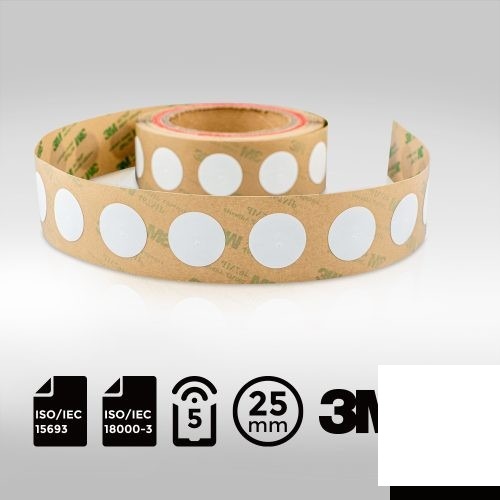

At a glance
Use these short answers to decide whether this page matches the project before moving into the detail.
Chip silicon
Impinj M730 (Monza R6) — memory-constrained ISBT 128 default Impinj M750 / M770 (Monza R6-P) — standard ISBT 128 + UHF EPC
Frequency + protocol
UHF 860-960 MHz RAIN per ISO/IEC 18000-63:2015 GS1 EPC TDS encoding standard
Next step
Ready to move forward? Start your inquiry to get specific answers for this project.
Request quote and samples- ISBT 128 data structure
-
- Donation Identification Number (DIN) — 13-char alphanumeric globally-unique
- Product code — blood group + component code + attributes
- Expiration date / time + collection facility
- ICCBBA ST-001 international standard reference
- ICCBBA TS-002 RFID placement specification
- Coexists with mandatory printed Code 128 + Data Matrix barcodes
- Cold-chain temperature performance
-
- 2-6 °C refrigerated RBC + apheresis platelet storage
- −30 °C frozen plasma + cryoprecipitate (FFP)
- −65 °C frozen RBC + CPD / glycerol cryoprotectant (10-year shelf life)
- Pressure-sensitive acrylic adhesive rated to −40 °C
- Repeated freeze-thaw cycling validated
- Substrate + adhesive engineering
-
- PET face stock (NOT paper) — moisture barrier
- Bonded overlaminate — antenna + barcode protection
- Pressure-sensitive acrylic adhesive + plasticiser-resistant
- Resists PVC plasticiser migration from blood-bag substrate
- Survives ice-crystal crush during freeze-thaw cycles
- Blood-bag manufacturer compatibility
-
- Fresenius Kabi CompoFlow
- Haemonetics ACD-A apheresis collection
- Terumo BCT Trima Accel
- MacoPharma blood-bag systems
- ICCBBA TS-002 Section 4 placement guidance
- Centrifuge-spin-axis + sampling-port clearance
- Product shelf-life support
-
- RBC AS-1 / AS-3 / AS-5 additive: 42 days at 2-6 °C
- Apheresis platelets: 5-7 days at 20-24 °C with agitation
- Frozen plasma: 1 year at −18 °C / 7 years at −65 °C
- Frozen RBC + glycerol: 10 years at −65 °C
- Cryoprecipitate: 1 year at −18 °C
- Bedside transfusion verification
-
- AABB Standard 5.27.2 — four-point identity verification
- Patient identity + blood unit type-and-screen + crossmatch + expiration
- Hard-stop on mismatch with second-clinician override
- Wrong-blood-to-wrong-patient error class prevented
- Patient RFID wristband + UHF blood-bag label dual-tap workflow
- BBIS + LIS integration
-
- Mediware HCLL + SCC Soft Computer SoftBank
- Haemonetics SafeTrace TX
- Cerner Millennium Blood Bank + Epic Beaker
- HL7 v2.x ORU + ORM + ADT messaging
- FHIR R4 BloodProduct + Patient + ServiceRequest resources
- Hemovigilance + adverse-event reporting
-
- UK SHOT (Serious Hazards of Transfusion) annual reporting
- FDA Biological Product Deviation Reporting (BPDR)
- Per-unit chain-of-custody from donor centre to bedside
- TRALI + TACO + FNHTR + acute hemolytic reaction root-cause analysis
- Audit-grade transit history + processing + storage + administration log
- Cellular therapy + tissue extension
-
- ISBT 128 + UHF RFID architecture scales to CAR-T autologous
- HSC autologous / allogeneic + mesenchymal stromal cells
- Tissue allografts under ICCBBA ST-001 + AATB Standards
- NTAG 424 DNA companion tag for cryptographic patient-specific authentication
- Wrong-patient autologous CAR-T administration prevention
- Procurement
-
- MOQ 5,000 labels (standard ISBT 128 format)
- Lead time 15-20 business days
- Pre-encoded ISBT 128 DIN + product code + expiration per BBIS
- Sample sets 100-200 labels for cold-chain qualification testing
- Per-blood-bag-manufacturer + per-BBIS test reports on request
- RoHS / REACH compliant materials
Commercial terms
- MOQ
- Varies by SKU — stock items from 100 pcs; custom production typically 200-1,000 pcs
- Lead time
- Production 2-3 weeks after artwork and encoding sign-off; reorders on a 3-4 week cycle
- Samples
- Free samples and RF test report with every order; courier at customer cost
- Payment
- 50% T/T deposit, 50% before shipment; Net 30/60 for established accounts; LC for large orders
- Shipping
- FOB Shenzhen / Yantian; DHL, FedEx or EMS air freight; sea LCL / FCL for volume
- Response
- Itemized quote within one business day, Mon-Fri (UTC+8)
Blood supply chain safety and inventory challenges
- ABO-incompatible blood transfusions (caused by patient or sample identification errors) are the leading cause of fatal transfusion reactions, occurring at a rate of approximately 1 in 38,000 transfusions and causing 20-40 fatalities annually in the United States alone.
- Manual blood bank inventory processes (visual counting, barcode scanning) in hospitals managing 5,000-50,000 units annually are labour-intensive and error-prone. Discrepancies between physical inventory and system records average 3-8%.
- Blood product waste from expiry averages 5-10% of collected units. At USD 200-300 per red-cell unit, a hospital transfusing 10,000 units annually loses USD 100,000-300,000 to preventable expiry waste.
- Crossmatch-to-transfusion ratios exceed 2:1 at many hospitals — blood units are reserved but not transfused, creating artificial shortages while reserved units approach expiry in crossmatch hold.
- Regulatory compliance with AABB standards, FDA 21 CFR 606 and ISBT 128 labelling requires complete chain-of-custody documentation for every blood unit. Manual paper records are incomplete and create audit findings.
How Proud Tek UHF RFID blood bag labels improve transfusion safety and reduce waste
Manual visual inventory + barcode scan + paper crossmatch + bedside visual check
- Manual inventory: 3-8% physical-vs-system discrepancy rate
- Crossmatch hold: 2:1 reserved-to-transfused ratio + artificial shortage
- Expiry waste: 5-10% of collected units → USD 100-300K/year/hospital
- Bedside visual check: 1 in 38,000 ABO-incompatible fatality rate
- Hemovigilance reaction RCA: days of manual record review per event
UHF RFID + ISBT 128 + bedside dual-tap verification + FEFO automation (this page)
- Real-time refrigerator-wall RFID inventory — 400-600 units no manual count
- FEFO auto-issuing: oldest compatible unit first → 30-50% waste reduction
- Bedside dual-tap (patient wristband + blood-bag label): hard-stop on mismatch
- AABB Standard 5.27.2 four-point identity automated + audited
- Hemovigilance RCA: complete unit transit history in minutes vs days
- RFID-enabled bedside verification — the nurse scans the patient's RFID wristband and the blood bag's RFID label; the system confirms ABO / Rh compatibility in real time, blocking incompatible transfusions before they reach the patient.
- Blood bank refrigerator RFID readers provide continuous unit-level inventory — real-time dashboards show every unit by blood type, component, expiry date and crossmatch status, eliminating manual counting and discrepancy investigations.
- Automated FEFO (first-expiry-first-out) issuing ensures the oldest compatible units are issued first — reducing expiry waste by 30-50% and improving crossmatch-to-transfusion ratios.
- Cold-chain rated adhesive and substrate maintain reliable bonding and readability at 2-6 °C (refrigerated RBC storage), −30 °C (frozen plasma) and during thawing / warming cycles without label lifting or read degradation.
- ISBT 128 compliant encoding stores donation identification number, blood type, component code, expiry date / time and special testing results. Compatible with all major blood bank information systems (Mediware HCLL, SoftBank, Haemonetics SafeTrace).
Per-tap data published from a Proud Tek UHF RFID blood bag label
- ISBT 128 DIN: 13-char alphanumeric globally-unique donation identifier on chip.
- Product code: blood group + component code + attributes (RBC / FFP / platelet).
- Expiration date / time: hard-stop trigger at bedside on expired unit.
- Bedside dual-tap: patient wristband + blood-bag label = AABB Std 5.27.2 four-point.
- Hemovigilance: per-unit chain-of-custody from donor to bedside transfusion.
ISBT 128 data structure, chip selection and label substrate engineering for blood-bag RFID
- ISBT 128 (ICCBBA ST-001) is the international standard for blood, cellular therapy and tissue product identification. The data structure includes the Donation Identification Number (DIN) — a 13-character alphanumeric globally-unique identifier — plus product-code data (blood group, component code, attributes), expiration date and collection facility. Proud Tek UHF RFID blood-bag labels encode the complete ISBT 128 data set per ICCBBA's Technical Specification for the Use of RFID on ISBT 128 Labeled Medical Products (TS-002), pairing the RFID tag with the mandatory printed linear barcodes and Data Matrix on the same label face.
- Chip selection defaults to Impinj M700 series (M730 for memory-constrained, M750 / M770 for standard ISBT 128 + UHF EPC) because the M700's sensitivity and per-tag anti-collision performance handles the dense tag population inside a blood-bank refrigerator (400-600 units within a single reader field) without read cascade failures. For cryoprecipitate and FFP at −30 °C freezer storage we specify chips and antennas qualified for continuous sub-zero operation; NXP UCODE 9xm and Alien Higgs-9 are also qualified options for memory-demanding deployments that also need cryo performance.
- Label substrate engineering addresses three simultaneous failure modes — (a) adhesive creep at −30 °C which causes corner lift and eventual peel, (b) ice-crystal crush damage to the antenna trace during freeze-thaw cycles, and (c) plasticiser migration from the flexible PVC blood-bag substrate which can compromise adhesion and printability. Qualified constructions use pressure-sensitive acrylic adhesive rated to −40 °C, PET face stock (not paper) for moisture resistance, and a bonded overlaminate protecting both the antenna trace and the printed ISBT 128 barcodes from handling abrasion.
- FDA 21 CFR Part 606 (current Good Manufacturing Practice for Blood and Blood Components) and AABB Standards for Blood Banks and Transfusion Services require label integrity through the full product shelf life — 42 days for RBC in AS-1 / AS-3 / AS-5 additive solution, 5 days for apheresis platelets, 1 year for frozen plasma at −18 °C, 10 years for frozen red cells at −65 °C with CPD / glycerol cryoprotectant. The label must remain legible, scannable and adherent across that entire window plus any transit and issuing handling.
- ICCBBA TS-002 placement guidance specifies RFID tag placement on the bag face opposite the sampling port and the centrifuge-spin axis, with sufficient clearance from the bag's port cluster to prevent antenna detuning from the sealed-port fluid path. The Proud Tek label geometry follows TS-002 Section 4 placement recommendations and is qualified for all major blood-bag manufacturers (Fresenius Kabi CompoFlow, Haemonetics ACD-A, Terumo BCT Trima Accel, MacoPharma).
Clinical integration — crossmatch, bedside transfusion verification and hemovigilance
- Hospital blood-bank information system (BBIS) integration is the highest-value deployment surface. Mediware HCLL, SCC Soft Computer SoftBank, Haemonetics SafeTrace TX, Cerner Millennium Blood Bank and Epic Beaker all support RFID-enabled workflows via HL7 v2.x ORU (observation result), ORM (order) and ADT (patient admission-discharge-transfer) messages, plus HL7 FHIR BloodProduct, Patient and ServiceRequest resources for modern interfaces. The RFID tap at refrigerator egress automatically generates the BBIS issue record; the bedside tap generates the transfusion-start record linked to the patient encounter.
- Bedside transfusion verification is the safety-critical clinical workflow. The nurse taps (a) the patient's RFID wristband or their barcode ID band, (b) the blood bag's RFID label, and the system verifies four points of identity per AABB Standard 5.27.2 — patient identity, blood unit compatibility with the patient's type-and-screen results, crossmatch record existence, and the expiration date / time. A mismatch or expired unit triggers a hard-stop that requires a second clinician override with documented reason, preventing the wrong-blood-to-wrong-patient error class that is the root cause of transfusion fatalities reported to the FDA Biological Product Deviation Reporting (BPDR) system.
- Hemovigilance and adverse-reaction reporting — the RFID-based administration log creates a per-unit chain of custody that materially improves adverse-reaction root-cause analysis. When a transfusion reaction occurs (TRALI, TACO, FNHTR, acute hemolytic reaction), the hemovigilance coordinator pulls the complete transit history of the unit (donor centre, processing lab, storage refrigerators, issue event, bedside verification, administration start / stop times) in minutes instead of days of manual record review. This supports SHOT (UK Serious Hazards of Transfusion) and BPDR mandatory reporting with complete audit-grade provenance data.
- Inventory analytics and supply-chain operations — real-time unit-level inventory across all bank refrigerators enables predictive ordering based on observed transfusion demand, FEFO (first-expiry-first-out) issuing discipline to reduce expiry waste from 5-10% to 2-3%, and cross-facility sharing between hospital campuses to balance type-specific shortages. The dashboard surface integrates with the National Blood Collection and Utilization Survey (NBCUS) reporting and the AABB National Blood Data Resource Center benchmarking.
- Cellular therapy and tissue extension — the same ISBT 128 + UHF RFID architecture scales to cellular therapy products (CAR-T, HSC autologous / allogeneic, mesenchymal stromal cells) and tissue allografts under ICCBBA ST-001 and AATB Standards. Patient-specific autologous cellular therapy products (where wrong-patient dispensing is catastrophic) especially benefit from cryptographic authentication layered on top of the ISBT 128 DIN — we pair the UHF RFID label with an NTAG 424 DNA companion tag on the cryo bag for per-bag cryptographic authentication at thaw-and-infuse.
UHF RFID blood-bag timeline — from manual paper logbook to ISBT 128 + bedside dual-tap
- 1994 — ICCBBA ISBT 128 standard ratified
ICCBBA publishes ISBT 128 (ST-001) — international standard for blood, cellular therapy and tissue product identification. 13-character DIN + product code + expiration becomes global blood-bank baseline.
- 2003 — Joint Commission NPSG.01.03.01 transfusion-safety goal
Joint Commission publishes National Patient Safety Goal NPSG.01.03.01 — eliminate transfusion errors related to patient misidentification. Sets framework for AABB Standard 5.27.2 four-point identity verification.
- 2008 — ICCBBA TS-002 RFID placement specification
ICCBBA publishes Technical Specification TS-002 — RFID placement guidance for ISBT 128 labelled medical products. Defines RFID tag placement on bag face opposite sampling port + centrifuge-spin axis.
- 2014-2018 — UHF RAIN RFID maturity + Impinj Monza R6
Impinj Monza R6 + R6-P chips reach blood-bank-compatible sensitivity; ISO/IEC 18000-63:2015 ratified internationally; refrigerator-wall RFID readers become deployable.
- 2018 — NTAG 424 DNA + cellular therapy CAR-T scale
NXP launches NTAG 424 DNA AES-128 SUN; first FDA-approved CAR-T therapies (Kymriah / Yescarta) drive demand for cryptographic patient-specific authentication on cellular therapy bags.
- 2020-2022 — COVID-19 + plasma-therapy blood-supply pressure
COVID-19 convalescent plasma + immune globulin therapy drives blood-supply pressure; FEFO + RFID inventory becomes critical to manage scarce O-negative + AB plasma + apheresis platelet supplies.
- 2024 — EU Reg 2024/1938 SoHO replaces Directive 2002/98/EC
EU Regulation 2024/1938 on Substances of Human Origin replaces Blood Directive 2002/98/EC + Tissues Directive 2004/23/EC — modernised framework with audit-grade chain-of-custody requirements.
- 2026 — Today: UHF RFID blood-bag standard practice
From buyer conversations across academic-medical-centre-blood-bank, regional-blood-collection-organisation, oncology-cellular-therapy-cryostorage, blood-supply-network and trauma-centre-massive-transfusion programmes converge on Impinj M700 + ISBT 128 DIN + bedside dual-tap + FEFO refrigerator-wall RFID + hemovigilance RCA as the default architecture.
Useful next pages
Use these linked product, guide and comparison pages to keep the next click specific and practical.
Related RFID label products
Other RFID solutions for healthcare and cold-chain tracking.
Industry applications
Industry deep-dives where this SKU is commonly specified.
FAQ
How does RFID prevent ABO-incompatible transfusions?
At the bedside, the nurse scans the patient's RFID wristband and then scans the blood bag's RFID label. The system automatically cross-references the patient's blood type with the unit's blood type and the crossmatch record. If there is any mismatch or the unit was not crossmatched for this patient, the system blocks the transfusion and alerts the nurse — preventing the error before it reaches the patient.
Does the RFID label work reliably at refrigerated and frozen temperatures?
Yes. Our blood bag labels use cold-chain rated adhesive and moisture-barrier substrate tested for continuous storage at 2-6 °C (red cells), −30 °C (frozen plasma / cryoprecipitate), and repeated temperature transitions between zones. Read performance is validated at all storage temperatures with standard UHF readers.
Is the label compatible with ISBT 128 and our blood bank information system?
Yes. The label encodes data in ISBT 128 format, the international standard for blood product identification. It is compatible with major blood bank information systems including Mediware HCLL, SoftBank, Haemonetics SafeTrace and Epic Beaker. We provide encoding specifications and integration support for your specific BBIS.
Does the RFID label coexist with the ISBT 128 printed barcodes, or does it replace them?
It coexists — ICCBBA TS-002 and FDA 21 CFR Part 606 require the printed linear barcodes and Data Matrix to remain on the label as the primary data carriers. The UHF RFID tag is a parallel read path that enables automated refrigerator inventory, batch verification and bedside workflows that visual barcode scanning cannot support efficiently. In practice every Proud Tek blood-bag label carries both the printed ISBT 128 barcodes (Code 128 and Data Matrix formats) and the UHF RFID tag encoding the same DIN + product code + expiration data. This redundancy is what the regulator expects and what the major BBIS vendors support — any scanner or any RFID reader in the workflow returns the same identifiers.
How does RFID blood-bag labelling compare with NFC or HF RFID for the same use case?
The choice is driven by read-range and throughput. HF (13.56 MHz ISO 15693 / NFC) gives 5-15 cm read range — suitable for hand-held bedside scanning (nurse taps the bag against a phone or workstation reader) but not suitable for bulk inventory in a refrigerator or box-level receiving. UHF RAIN (860-960 MHz ISO 18000-63) gives 1-5 m read range — suitable for refrigerator-wall readers that continuously inventory 400-600 units without opening the door, and for conveyor or dock-door reads during transit. Most modern deployments use UHF for the bulk-inventory and issuing workflows and add a separate HF / NFC tag for bedside cryptographic verification when the therapy is cellular or high-risk (e.g. autologous CAR-T, where wrong-patient administration is catastrophic). For standard red-cell and plasma transfusion the UHF label alone plus the patient RFID wristband is the dominant pattern.
Sources & references
Primary standards, OEM datasheets and regulatory documents cited by this article. All URLs were verified on the access date shown below.
- ICCBBA ISBT 128 Standard (ST-001) — international standard for the identification of blood, cellular therapy products and tissue allografts
ISBT 128 ST-001 — international standard. 13-char DIN + product code + expiration + collection facility = global blood-bank baseline data structure.
- ICCBBA TS-002 — Technical Specification for the Use of RFID on ISBT 128 Labeled Medical Products
TS-002 RFID placement guidance — bag face opposite sampling port + centrifuge-spin axis + port-cluster clearance for antenna-detune avoidance.
- FDA 21 CFR Part 606 — Current Good Manufacturing Practice for Blood and Blood Components
FDA 21 CFR Part 606 — cGMP for blood and blood components. Label integrity through full product shelf life requirement (42 days RBC / 5 days platelet / 1 year FFP / 10 years frozen RBC).
- AABB Standards for Blood Banks and Transfusion Services (current edition) — including bedside transfusion verification, labelling and chain-of-custody requirements
AABB Standards 33rd edition — Standard 5.27.2 four-point bedside identity verification (patient + blood unit + crossmatch + expiration).
- ISO/IEC 18000-63:2015 — RFID air interface standard for UHF RAIN tags (the UHF chip-level standard underlying blood-bag RFID labels)
UHF RAIN RFID 860-960 MHz air-interface standard — basis for Impinj Monza + NXP UCODE chip families used in blood-bag RFID labels.
- Impinj M700 series product page and datasheet (M730 / M750 / M770) — high-sensitivity RAIN RFID chip used in dense blood-bank tag populations
Impinj M700 series — sensitivity + per-tag anti-collision performance for dense 400-600-tag refrigerator population without read cascade failures.
- UK SHOT (Serious Hazards of Transfusion) — national hemovigilance scheme annual reports documenting wrong-blood-to-wrong-patient incidents
UK SHOT — national hemovigilance scheme; annual reports document wrong-blood-to-wrong-patient + TRALI + TACO + FNHTR + acute hemolytic reaction frequency + RCA findings.
- FDA Fatalities Reported to FDA Following Blood Collection and Transfusion — annual public reports on transfusion-related mortality causes
FDA Biological Product Deviation Reporting (BPDR) — 20-40 US transfusion-related fatalities annually reported. Wrong-blood ABO-incompatible misadministration leading cause.
- EU Regulation 2024/1938 on Substances of Human Origin (SoHO)
EU Reg 2024/1938 SoHO — replaces Directive 2002/98/EC (Blood) + 2004/23/EC (Tissues + Cells). Modernised audit-grade chain-of-custody requirements.
- Joint Commission NPSG.01.03.01 — Eliminate transfusion errors related to patient misidentification
Joint Commission NPSG.01.03.01 — transfusion-safety goal addressing patient misidentification. Sets framework for AABB Standard 5.27.2 four-point bedside verification.
Proud Tek is a Shenzhen-based RFID & NFC manufacturer supplying hotel chains, transit operators, event venues and retail brands worldwide. Every order includes free samples, RF testing and dedicated project support.
Get a Quick Quote
Tell us about your project and we'll respond within one business day. Fields marked (asterisk) are required.