
Jewelry RFID
UHF RFID Jewelry Label
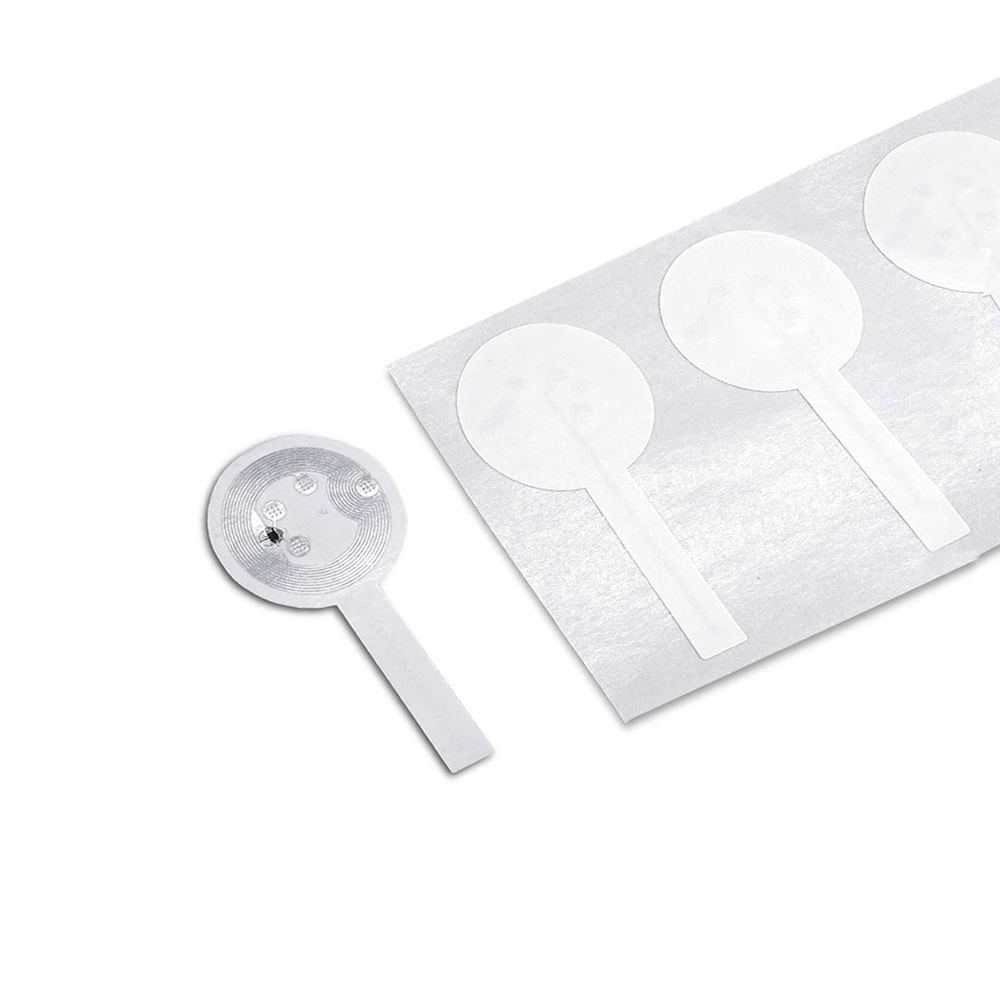
Barbell Inventory Tag

Quick answer
UHF RFID jewelry labels are ultra-compact 12×60 mm barbell tags that hang from rings, necklaces, bracelets and watches without obscuring the piece. They count 500+ pieces in under 60 seconds versus 2-4 hours manually, cut shrinkage 50-75% and drop omnichannel pick-failure from 15-20% to under 2% across 2,000-10,000 SKUs. An Impinj M730 chip reads 0.5-2 m through glass and coexists with Sensormatic AM 58 kHz, Checkpoint RF 8.2 MHz and Nedap EAS pedestals.
- Ultra-compact barbell form factor — 12×60 mm tag hangs from any jewelry item without obscuring the piece or affecting customer try-on experience.
- Sub-second item-level inventory — count an entire jewelry showcase of 500+ pieces in under 60 seconds versus 2-4 hours of manual counting. Daily cycle counts now feasible.
- Loss prevention — real-time tray-level monitoring alerts staff instantly when an item leaves the display case without authorisation. 50-75% shrinkage reduction documented in first-year deployments.
Used in these industries
Deployments where this product is referenced on our industry landing pages.
At a glance
Use these short answers to decide whether this page matches the project before moving into the detail.
Chip silicon
Impinj M730 (Monza R6) — entry-tier jewelry-tag standard Impinj M750 / M770 (Monza R6-P) — high-sensitivity option
Barbell form factor
12×60 mm barbell tag with reinforced string attachment Soft non-abrasive string loop — no scratching of metal / stone
Next step
Ready to move forward? Start your inquiry to get specific answers for this project.
Request quote and samples- Read distance + RF behaviour
-
- Handheld reader: 0.5-2 m through glass display case
- Showcase tray-level reader: <30 cm continuous monitoring
- Glass-pass attenuation: minimal (UHF transparent)
- Optimised antenna for compact dipole on jewelry attachment
- 500+ pieces scanned per second in dense tag environment
- EPC encoding + data model
-
- GS1 SGTIN-96 — serialised global trade item number
- Extended user memory: SKU + metal type + stone details
- Carat weight + price + consignment / memo status
- Kimberley Process certificate cross-reference
- OECD 3TG due-diligence chain-of-custody record
- Showcase + tray monitoring
-
- Tray-level RFID reader embedded in display case
- Real-time presence detection per item
- Try-on session timer + automated alert on return-failure
- Mobile notification + overhead indicator on associate device
- Continuous monitoring without door-open / case-unlock event
- EAS coexistence architecture
-
- Sensormatic AM (acousto-magnetic) 58 kHz — narrow-band detection
- Checkpoint RF (radio-frequency) 8.2 MHz — narrow-band
- UHF RFID 860-960 MHz — different physics + frequency, no interference
- Combined pedestals: Sensormatic Synergy + Nedap !D Top + Checkpoint EVOLVE
- EAS hard tag + RFID barbell → both deterrent + inventory
- Diamond + gemstone supply-chain certifications
-
- Kimberley Process Certification Scheme (KPCS) — 81 jurisdictions
- GIA + HRD + IGI grading reports cross-reference
- De Beers Tracr blockchain provenance
- Everledger + IBM Blockchain Transparent Supply
- Diamond Industry Blockchain integration
- Conflict minerals + due-diligence framework
-
- EU Conflict Minerals Regulation 2017/821 (in force Jan 2021)
- 3TG: tin, tungsten, tantalum, gold
- OECD Due Diligence Guidance Step 1-5
- Responsible Jewellery Council (RJC) Code of Practices
- RJC Chain-of-Custody Standard
- SCS-007 emerald standard for colored gemstones
- Inventory + omnichannel performance
-
- Daily inventory cycle: 4-8 hours → <15 min (>20x faster)
- Inventory accuracy: 95-97% → 99%+
- Shrinkage reduction: 50-75% in first year
- Omnichannel pick-failure: 15-20% → <2%
- Consignment / memo reconciliation: 80% time reduction
- Application verticals
-
- Independent jewelry retailers — 2,000-10,000 SKU operations
- Luxury watch boutiques — Rolex / Patek / Audemars Piguet retail
- Department-store jewelry counters — Macy's + Nordstrom
- Jewelry chains — Signet (Kay / Zales / Jared) + Pandora + Tiffany
- Wholesale + consignment — memo tracking + multi-store transfer
- Standards + compliance
-
- ISO/IEC 18000-63:2015 EPC Gen2v2 RAIN RFID
- GS1 EPC TDS 2.0 SGTIN-96 encoding
- Kimberley Process Certification Scheme
- EU Reg 2017/821 Conflict Minerals (3TG)
- OECD Due Diligence Guidance + RJC Code of Practices
- Sensormatic / Nedap / Checkpoint EAS coexistence verified
- Procurement
-
- MOQ 1,000 (standard barbell with chip)
- Lead time 12-15 business days
- Pre-encoded SGTIN-96 + per-tag data CSV
- Custom-printed face: price + item code + barcode
- Per-EAS-system compatibility test on request
- RoHS / REACH compliant materials
Commercial terms
- MOQ
- Varies by SKU — stock items from 100 pcs; custom production typically 200-1,000 pcs
- Lead time
- Production 2-3 weeks after artwork and encoding sign-off; reorders on a 3-4 week cycle
- Samples
- Free samples and RF test report with every order; courier at customer cost
- Payment
- 50% T/T deposit, 50% before shipment; Net 30/60 for established accounts; LC for large orders
- Shipping
- FOB Shenzhen / Yantian; DHL, FedEx or EMS air freight; sea LCL / FCL for volume
- Response
- Itemized quote within one business day, Mon-Fri (UTC+8)
Inventory and security challenges for jewelry retailers
- Jewelry stores carry 2,000-10,000 high-value SKUs across display cases, safes and back stock. Manual inventory counts take 4-8 hours, require closing the store, and produce error rates of 3-5% due to the small size and visual similarity of items.
- Inventory shrinkage in jewelry retail averages 1.5-3% of revenue. At an average price point of USD 500-5,000 per piece, even a small store can lose USD 50,000-200,000 annually to theft, employee diversion and administrative errors.
- Customer try-on sessions require removing 5-15 items from locked cases. Without real-time tracking, associates cannot confirm that every piece was returned after the customer departs, creating a window for sleight-of-hand theft.
- Omnichannel fulfilment (buy-online-pick-up-in-store, ship-from-store) requires exact real-time inventory visibility at the item level. Manual counts updated weekly or monthly produce 10-20% pick-failure rates for online orders.
- Multi-store transfers, consignment receiving and memo reconciliation rely on manual item-by-item verification against paper manifests. Errors in high-value consignment tracking can result in disputes worth USD 10,000-100,000 per shipment.
How Proud Tek UHF RFID jewelry labels solve high-value inventory challenges
Manual paper-count inventory + Sensormatic / Checkpoint EAS-only loss prevention
- 4-8 hour manual inventory cycles — store closure required
- 1.5-3% annual shrinkage at USD 500-5,000 average price = USD 50-200K loss
- Try-on sessions: 5-15 items removed without real-time tracking
- Omnichannel pick-failure 15-20% on weekly-updated inventory
- Consignment / memo reconciliation: hours of manual paper-manifest matching
Barbell UHF RFID + tray-level monitoring + EAS coexistence (this page)
- <15 min daily cycle counts — 500+ pieces in <60 sec via handheld
- 50-75% shrinkage reduction in first year (real-time tray monitoring)
- Try-on auto-timer + return-failure alert to associate mobile device
- Omnichannel pick-failure <2% on real-time per-item RFID inventory
- Consignment auto-receive + memo return verification — 80% time reduction
- Ultra-compact barbell tag (12×60 mm) with a reinforced string attachment hangs from rings, chains, clasps and watch bands without obscuring the jewelry piece. Customers can try on items with the tag still attached.
- Impinj M730 chip on a jewelry-optimised antenna delivers 0.5-2 m read range. A handheld reader counts an entire 500-piece showcase in under 60 seconds, replacing 2-4 hour manual counts with a daily 10-minute routine.
- Tray-level RFID readers embedded in display cases provide continuous monitoring. If a piece is removed and not returned within the configured time window, the system alerts the associate via mobile notification or overhead indicator.
- EPC encoding includes SKU, metal type, stone details, carat weight, price and consignment / memo status — enabling automated receiving, transfer reconciliation and memo return verification without manual item matching.
- Printable face on the barbell tag displays the price, item code and barcode — serving as the customer-facing price tag and the RFID inventory tag in a single unit.
Per-tap data published from a Proud Tek UHF RFID jewelry label
- Barbell tag: 12×60 mm + reinforced string + non-abrasive non-reactive surface.
- Read range: 0.5-2 m handheld through glass display case.
- Tray monitor: continuous presence detection + try-on auto-timer.
- EPC SGTIN-96: SKU + metal + stone + carat + price + consignment status.
- EAS coexistence: AM 58 kHz / RF 8.2 MHz / UHF 860-960 MHz — no cross-interference.
Results jewelry retailers report after RFID deployment
- Daily inventory cycle time drops from 4-8 hours to under 15 minutes — enabling daily or twice-daily counts that were previously impossible, keeping inventory accuracy above 99% at all times.
- Inventory shrinkage decreases by 50-75% in the first year of RFID deployment. The combination of real-time tray monitoring and frequent cycle counts creates a deterrent effect and enables rapid loss detection.
- Omnichannel pick-failure rates fall from 15-20% to under 2% — enabling profitable buy-online-pick-up-in-store and ship-from-store fulfilment for jewelry e-commerce.
- Consignment and memo reconciliation time drops by 80%. Automated RFID receiving and return verification eliminates manual item-by-item matching against paper manifests.
UHF RFID jewelry timeline — from manual paper-count to Kimberley Process integration
- 1990s — Manual paper-count + safe-locked baseline
Jewelry retailers manage inventory via manual visual count + paper logbook + safe-locked storage. 4-8 hour quarterly inventory + 1.5-3% annual shrinkage are tolerated industry baseline.
- 2003 — Kimberley Process Certification Scheme (KPCS)
Kimberley Process launches — 81 participating jurisdictions implement government-issued KP certificate per rough-diamond parcel. Establishes diamond-supply-chain provenance baseline that downstream RFID can cross-reference.
- 2010-2014 — Auburn ARC + UHF RAIN RFID maturity
Auburn University RFID Lab founded; ARC certification protocol; ISO/IEC 18000-63 ratified internationally. Impinj Monza R6 + NXP UCODE 8 chips reach jewelry-tag-compatible miniaturisation.
- 2017 — EU Conflict Minerals Regulation 2017/821
EU adopts Conflict Minerals Regulation 2017/821 — 3TG (tin, tungsten, tantalum, gold) due-diligence requirements for upstream importers. In force January 2021. Cross-references RJC Code of Practices.
- 2018-2019 — De Beers Tracr + Everledger blockchain
De Beers Tracr + Everledger + IBM Blockchain Transparent Supply launch diamond-supply-chain blockchain platforms. UHF RFID + GS1 Digital Link URI becomes the physical-to-digital binding for blockchain provenance.
- 2020-2022 — Sensormatic Synergy + Nedap !D Top + Checkpoint EVOLVE
Combined EAS + RFID pedestals (Sensormatic Synergy / Nedap !D Top / Checkpoint EVOLVE) launch — read both AM/RF EAS and UHF RFID at exit pedestal. Jewelry retailers add inventory layer without removing EAS deterrent.
- 2023-2024 — Omnichannel + RJC Chain-of-Custody scale
Buy-online-pick-up-in-store + ship-from-store jewelry e-commerce drives omnichannel pick-failure reduction case. Responsible Jewellery Council Chain-of-Custody Standard adoption + RFID as physical-to-digital anchor.
- 2026 — Today: UHF RFID jewelry standard practice
How experienced teams run independent-jewelry-retailer, luxury-watch-boutique, department-store-jewelry-counter, jewelry-chain-multi-store, wholesale-consignment-memo programmes converge on Impinj M730 + barbell form factor + tray-level monitoring + Kimberley Process / OECD 3TG / RJC cross-reference + Sensormatic combined-pedestal as the default architecture.
Useful next pages
Use these linked product, guide and comparison pages to keep the next click specific and practical.
Related RFID label products
Other RFID solutions for retail inventory management.
Chip-level technical reference
Deep-dive specifications and chip-family comparisons relevant to this SKU.
FAQ
Does the barbell tag damage or scratch delicate jewelry?
No. The barbell tag attaches via a soft, non-abrasive string loop that does not contact the metal or stone surfaces of the jewelry piece. The tag body is made of smooth, rounded plastic with no sharp edges. The string material is tested to be non-reactive with gold, silver, platinum and gemstone surfaces.
Can the RFID tag be read through glass display cases?
Yes. UHF RFID signals pass through glass with minimal attenuation. Our jewelry tags deliver reliable reads at 0.5-2 m through standard glass display cases. For continuous monitoring, small RFID reader antennas can be embedded in the display tray beneath the jewelry for real-time presence detection.
How does the system handle customer try-on sessions?
When an associate removes items from a case for a customer try-on, the tray reader detects the removal and starts a configurable timer. The associate's POS or mobile device shows which items are out on try-on. If all items are returned, the alert clears automatically. If an item is not returned within the time window, the system sends an immediate alert to the associate and store manager.
How does RFID jewelry inventory integrate with the Kimberley Process, supply-chain due-diligence frameworks and the EU Conflict Minerals Regulation?
Jewelry RFID is an inventory-accuracy layer, not a diamond-origin certification layer — but it can carry and cross-reference the origin-certification data that regulators require. The Kimberley Process Certification Scheme (KPCS, 81 participating jurisdictions) governs rough-diamond imports and requires a government-issued KP certificate per parcel; our RFID encoding supports a GS1 SGTIN-96 serial that resolves to the KP certificate, Diamond Industry Blockchain (De Beers Tracr, Everledger, IBM Blockchain Transparent Supply) and GIA / HRD / IGI grading reports. For colored gemstones and gold, the OECD Due Diligence Guidance for Responsible Supply Chains of Minerals from Conflict-Affected and High-Risk Areas (Step 1-5) and the EU Conflict Minerals Regulation 2017/821 (tin, tungsten, tantalum, gold — entry into force Jan 2021) apply to upstream importers; our RFID-tagged finished jewelry can link downstream to the upstream 3TG chain-of-custody record via GS1 Digital Link URI. The tag is the identity anchor; the underlying provenance is the customer's responsibility to verify with their supplier, mining certification (Responsible Jewellery Council, SCS-007 emerald standard) and third-party auditors.
Does the tag interfere with electronic article surveillance (EAS), and can jewelry RFID replace an existing Sensormatic / Nedap / Checkpoint EAS system?
EAS (electronic article surveillance) and UHF RFID are complementary, not substitutes. EAS at retail operates on three physics types: acousto-magnetic (AM, Sensormatic, 58 kHz), radio-frequency (RF, Checkpoint, 8.2 MHz) and electromagnetic (EM, legacy libraries) — all narrow-band detection-only technologies that trigger a gate alarm when an unpaid / armed tag passes the pedestal. UHF RFID (860-960 MHz, ISO/IEC 18000-63) carries a unique identifier per item and supports inventory accuracy, but the traditional EAS gate is tuned to a different frequency and physics, so the technologies do not interfere in the same installation. Modern 'EAS + RFID' combined pedestals (Sensormatic Synergy, Nedap !D Top, Checkpoint EVOLVE) read both signals and are increasingly specified for jewelry stores that want to keep the hard-tag EAS deterrent while adding item-level inventory. Our UHF RFID jewelry tag does not replace an AM / RF EAS hard tag — it is additional, and a jewelry store can (a) keep EAS and add RFID inventory (most common), (b) transition fully to RFID if the retailer is willing to rely on RFID read events at the exit pedestal as the loss-prevention trigger (newer deployments), or (c) use only RFID inventory and skip pedestal-based loss prevention entirely (uncommon for high-value jewelry).
Sources & references
Primary standards, OEM datasheets and regulatory documents cited by this article. All URLs were verified on the access date shown below.
- Kimberley Process Certification Scheme — rough diamond trade regulation
KPCS — 81 participating jurisdictions implement government-issued KP certificate per rough-diamond parcel. UHF RFID jewelry tag SGTIN-96 cross-references KP certificate.
- Regulation (EU) 2017/821 — Conflict Minerals Regulation (3TG due-diligence)
EU Conflict Minerals Regulation — 3TG (tin, tungsten, tantalum, gold) due-diligence for upstream importers. In force January 2021.
- OECD Due Diligence Guidance for Responsible Supply Chains of Minerals from Conflict-Affected and High-Risk Areas
OECD 5-step due-diligence framework for 3TG minerals — basis for EU Reg 2017/821 + RJC Chain-of-Custody Standard.
- Responsible Jewellery Council — Code of Practices and Chain-of-Custody Standard
RJC Code of Practices + Chain-of-Custody Standard — jewelry-industry sustainability + ethical-sourcing certification framework.
- GS1 EPC Tag Data Standard (TDS) — SGTIN-96 encoding
GS1 EPC TDS 2.0 SGTIN-96 — serialised global trade item number encoding for jewelry SKU + serial unique identifier.
- ISO/IEC 18000-63:2015 — RAIN RFID air interface (EPC Gen2v2)
UHF RAIN RFID 860-960 MHz air-interface standard — different physics from AM 58 kHz / RF 8.2 MHz EAS, no cross-interference.
- Impinj M700 series RAIN RFID tag chips
Impinj M730 / M750 / M770 — high-sensitivity small-antenna RAIN chip family for compact barbell jewelry tag.
- Sensormatic Synergy combined EAS/RFID pedestal product page
Sensormatic Synergy + Nedap !D Top + Checkpoint EVOLVE — combined EAS + RFID pedestals reading both AM/RF EAS and UHF RFID at exit.
- De Beers Tracr — diamond supply-chain blockchain platform
De Beers Tracr — diamond provenance blockchain platform. UHF RFID jewelry tag UID = physical-to-digital anchor for Tracr blockchain provenance record.
- GS1 Digital Link URI standard
GS1 Digital Link 1.3 — https://id.gs1.org/01/{GTIN}/21/{serial} URI links UHF RFID jewelry tag to KP certificate + GIA grading + RJC chain-of-custody.
Proud Tek is a Shenzhen-based RFID & NFC manufacturer supplying hotel chains, transit operators, event venues and retail brands worldwide. Every order includes free samples, RF testing and dedicated project support.
Get a Quick Quote
Tell us about your project and we'll respond within one business day. Fields marked (asterisk) are required.