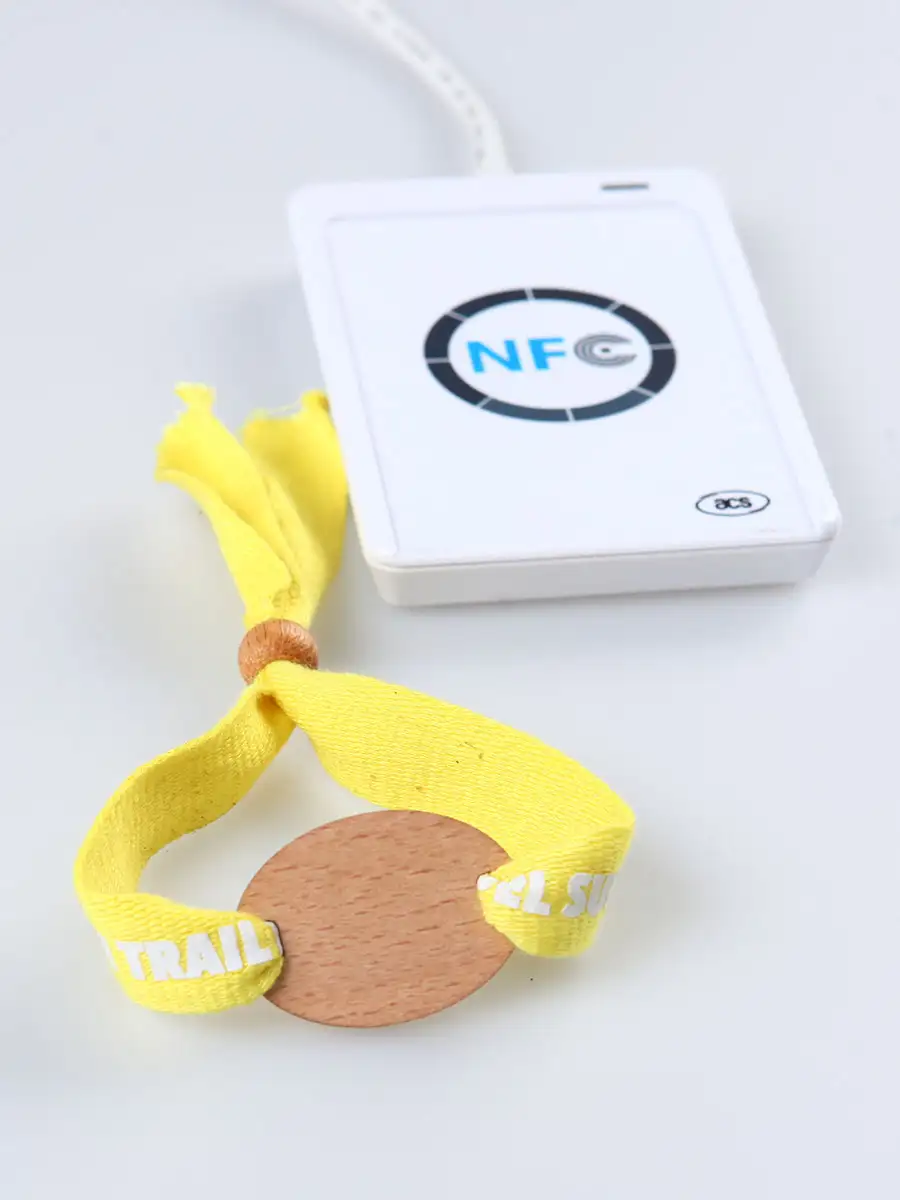
What a wristband does at an event
A wristband is a credential the guest cannot lose in a pocket. Once it is fastened with a one-way closure it stays on until it is cut off, which is why events use it for anything that must not be passed from person to person: entry, re-entry, age verification, backstage or VIP zones, camping areas and cashless spending.
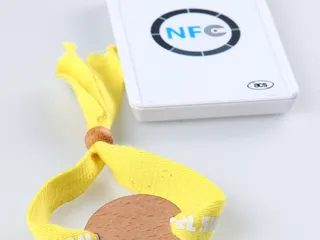
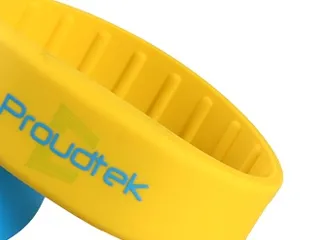
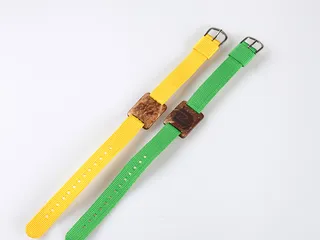
The chip carries either a unique serial number that the event system looks up, or a small record written at encoding. Readers at gates, bars and activations tap the band and ask the platform whether to allow the action. The band itself is a separate choice, made by event length and conditions: the RFID wristbands for events page compares Tyvek, woven fabric, silicone and natural-material bands with their closures, sizes and printing.
Access and cashless: what lives on the band and what lives on the platform
Cashless works as a closed loop. The guest tops up online or at a kiosk, the balance lives on the platform's server, and each tap at a bar or merchandise stand debits it after checking the band's identity. Refunds of unspent balances, per-vendor settlement and any deposit for the band are platform decisions, made before the band specification.
Access control uses the same tap against a permission list. Some platforms write value or tickets to the chip itself instead; that design needs a chip that authenticates the reader before data changes, such as MIFARE DESFire: its file types include a value file (NXP DESFire EV3 data sheet), and NXP lists closed-loop payments among its applications (NXP).
In the server-side design the split looks like this:
| Function | On the band | On the platform |
|---|---|---|
| Entry and re-entry | The identifier | The ticket, whether the guest is inside or outside, and re-entry rights |
| Cashless bars and merchandise | The identifier | Balance, top-ups, refunds and vendor settlement |
| Age check | Nothing | A flag set once at the first ID inspection and visible at every bar |
| VIP, backstage, crew and camping | The identifier; a tier colour or print as a visual backup | The permission list checked at each zone entrance |
| Lost band | Nothing of value | Deactivate the old identifier, link a spare, move the balance |
| Personal data | Nothing | Name, contact details and ticket history |
NFC or UHF: pick by how the band is read
Most event bands are NFC (ISO/IEC 14443 or 15693 at 13.56 MHz). The guest taps the band on a reader a few centimetres away, which is what you want for payment, entry and any action the guest must consent to. NFC readers are cheap, phones can read the bands, and the tap itself is the audit trail.
UHF bands (ISO/IEC 18000-63, 860–960 MHz) are read from several metres by a fixed antenna. They suit headcounts through a wide gate, dwell-time analytics in a zone or a crowd-flow study, and they can be read in bulk. They are wrong for payment because a reader cannot tell whose band it just saw among a crowd, and body moisture reduces range in a way that varies from person to person.
Some programmes use both: an NFC chip for the guest's transactions and a UHF inlay for the operator's counting. That doubles inlay cost and is only justified when the analytics have a buyer. On-body UHF range is shorter than any free-space catalogue figure and varies with the reader, antenna and weather, so confirm it on your own equipment. The same split, read point by read point:
| Read point | Frequency | Why |
|---|---|---|
| Entry and re-entry validation | NFC tap | The band is presented and checked against a permission list; the tap is the audit trail |
| Cashless bar, merchandise, top-up | NFC tap | Payment must debit one known band, and a distance read cannot tell whose band it saw |
| VIP, backstage and crew zones | NFC tap | Access is a per-person permission checked at the door |
| Wide-gate headcount and crowd flow | UHF distance read | A fixed antenna is designed to log each wrist that passes without anyone stopping; capture depends on antenna placement and on-body absorption |
| Zone dwell-time analytics | UHF distance read | Bulk reads of many bands measure occupancy, not transactions |
| Race and mass-start timing | UHF distance read | A whole field is read crossing a line where presenting a band is impossible; see RFID race timing |
Platform integration: what to get from your ticketing or cashless provider
The platform decides most of the band's specification, and a band that is well made but not on the platform's list is the most expensive mistake a wristband order can make. Before asking for a quote, get these answers from your event technology partner:
- Supported chips. The exact chip family and, for DESFire, the generation. A 13.56 MHz rating alone does not prove that a reader accepts a chip.
- What the reader uses. The UID only, and whether it expects 7 or 4 bytes (the EPC on UHF bands); an NDEF URL; or an application with its own files and keys.
- Key handling. Who creates the keys and whether they are loaded in production or on site; how keys are loaded is agreed per order.
- Import format. The columns the platform imports. Numbered bands ship with a file in Excel, CSV or XML that pairs each band's UID, or EPC on UHF bands, with its printed number.
- Offline behaviour. Whether readers queue transactions when the network drops, and how a queued tap is reconciled afterwards.
- Reader models. Gate, bar-terminal and handheld models, so the printed sample is tested on the same hardware.
Check-in and activation workflow
Work backwards from doors-open. Artwork approval, a printed sample tested on the real readers, production and encoding, and shipping run in series, and a custom-woven band adds the weaving set-up on top. Lock the chip, the platform's encoding format and the artwork early, because a missed production window cannot be recovered by paying more. The issue-to-activation flow then decides how smooth doors-open feels:
- Specify. The chip, the encoding format and the artwork follow the platform's band specification.
- Encode and number. Each band is written, read back and printed with a matching number or QR code. The encoded order ships with a data report and the ID list (encoding service).
- Import. The platform imports the ID list, so every band exists in the system before the gates open.
- Link. Bands are linked to tickets before they are posted to guests, at a registration desk away from the entry lane, or online by the guest where the platform offers it.
- Enter. The gate reader only looks the band up and checks the permission; nothing is written at the turnstile.
- Replace. A lost band is deactivated at the info desk, and a spare from the reserve stock is encoded, linked and given the balance.
How many guests per minute can an RFID gate lane handle?
The lane sets the rate, not the band. The chip exchange is the short part: NXP gives a typical ticketing transaction of under 35 ms for MIFARE Ultralight EV1 (NXP). The rest is people finding and presenting the band, the platform's lookup over the network, a cryptographic check where the chip needs one, and the turnstile or the steward's decision. That is why we publish no guests-per-minute figure.
Measure it before the event. Run a rehearsal lane with the real readers, network and staff, time a few hundred taps, then size the number of lanes from that rate and the arrival peak you expect. Repeat the test with the network disconnected to see the rate when readers fall back to offline mode.
Which chip for which security level
Decide the tier by what a cloned band would cost you. Free entry to a fun run is one thing; unlimited bar tabs at a three-day festival are another. A band whose only identity is a readable serial can be copied onto an emulator card: acceptable for a small conference, not for a cashless balance or a VIP area.
| Security need | Chip | What the platform checks | Limit |
|---|---|---|---|
| Low-value or one-day entry | NTAG213/215/216 or MIFARE Ultralight EV1 | The UID against the issued list; optionally NXP's originality signature | No challenge-response authentication, so the UID can be copied. NXP names day passes for events among Ultralight EV1 uses (NXP) |
| Verifiable taps against a server-held balance | NTAG 424 DNA | A new AES-128 Secure Unique NFC (SUN) message on each tap, when SUN messaging is enabled (NXP data sheet) | A captured, unused message can still pass (data sheet §9.3) |
| Stored value, several applications, platform-held keys | MIFARE DESFire EV3 | AES-128 mutual authentication between band and reader (NXP) | The platform must manage the keys; the generation and memory are confirmed in the quotation |
| A platform already built on it | NXP MIFARE Classic EV1 | Sector keys with Crypto-1 authentication | NXP refers security-relevant applications to its DESFire and MIFARE Plus families (NXP) |
How secure are RFID wristbands for event access control?
Security comes from layers: gates check each band against the platform's issued-ID list, a one-way closure keeps it on one wrist, and bands carrying money or VIP access are verified cryptographically on each tap. A serial check alone stops invented, cancelled or other-event bands, but not lending (the closure's job) or a copied ID. Your event technology partner's platform and gate readers run these checks; we supply the bands, encoded to its format. Two server-side rules add to them:
- One in, one out (needs exit readers): a band recorded inside cannot re-enter until recorded leaving, which also blocks a copy while the original is inside.
- Distance and time: a band read at two far-apart gates within minutes is flagged.
| Feature | What it stops | What it does not stop |
|---|---|---|
| Issued-ID list | Invented, other-event or deactivated bands | Lending, or a copy of a real band's ID |
| Cryptographic chip (NTAG 424 DNA, DESFire) | Copies, when the platform verifies each tap | Anything, if only the serial is read; see the replay limit in the chip table above |
| NTAG 21x originality signature | Non-NXP chips, with a certain confidence | A replayed copy: the signature is fixed at production (NTAG21x data sheet §8.9) |
| One-way closure | Lending, or passing a band back after entry | Counterfeit bands |
| Printed numbers, QR codes, tier colours | Wrong-day or wrong-tier bands at a glance; manual checks if readers fail | A good copy |
Single-use or reusable bands
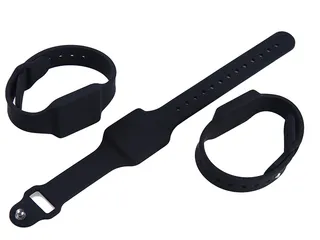
Decide who owns the band after the event. A single-use band belongs to one event: typically Tyvek or woven fabric with a one-way closure, cut off at exit or when the event ends. A reusable band is an asset the operator keeps: typically silicone with a reusable closure, collected at the end, cleaned and issued to the next guest.
Reuse changes the platform set-up more than the band. The band's identifier stays the same, so the platform unlinks it from the last guest and links it to the next; if the band's NDEF data was locked after writing, reuse keeps that data and changes only the link. Plan a returns point, a deposit if the platform supports one, cleaning between guests, and spares for bands that do not come back. Silicone wristbands cover the reusable styles and sizes.
Resorts and water parks run the reusable model all year, with the installed lock and point-of-sale system in place of an event platform: see RFID wristbands for hotels and the hospitality guide.
What makes RFID event wristbands cost more than standard wristbands?
An RFID band costs more than a standard band of the same material because it adds a chip, an antenna inlay and usually encoding. The gap depends on the specification, not a market average, so compare like-for-like quotes and ask for two chip options in one quote. Readers, the platform and on-site support are quoted separately by your event technology partner.
| Cost driver | What moves it |
|---|---|
| Chip | Basic (NTAG 21x, MIFARE Ultralight), cryptographic (NTAG 424 DNA, MIFARE DESFire), or NFC plus UHF: two inlays |
| Material | Tyvek costs least; woven adds a per-design set-up; silicone, wood and coconut shell are priced per style |
| Closure | Adhesive tab, one-way locking slider or reusable clasp |
| Printing and encoding | Print, woven logo, deboss or engraving; variable numbers, QR codes, encoded URLs or platform keys |
| Quantity and samples | A custom weave's set-up costs less per band on larger runs; standard samples are free, customised ones carry a set-up fee |
What to test before doors open
Most event-day problems are decided weeks earlier, in the specification and the rehearsal. Run these checks with the platform, the readers and a batch of printed sample bands:
- Every reader type, on a wrist. Tap the printed sample on the gate, bar terminal and handheld readers while it is worn, not held flat.
- The ID list import. The platform recognises every band in the file, and the printed numbers match the chips.
- Lane rate. Taps per minute on a rehearsal lane with the real staff and network.
- Offline mode. Disconnect a reader, take payments, reconnect and check that the queued transactions reconcile.
- Lost-band flow. Deactivate a band, issue a spare, move the balance, and confirm the old band is refused.
- The cryptographic check. Where the chip supports it, confirm the readers verify the SUN message or DESFire authentication, not just the UID.
- UHF capture rate, if used: bands worn by people walking through the real gate, not tags in free space.
- Removal and returns. Scissors at staffed exit points for locked bands, and a returns desk for reusable ones.
Which Proud Tek wristbands fit an event project
We make the bands in our Shenzhen factory: RFID wristbands for events in Tyvek, woven fabric and silicone; silicone wristbands for wet and reusable programmes; UHF wristbands for counting; and coconut-shell wristbands for premium events. Bands are encoded to the platform's specification, and samples are supplied for reader testing before the run. Readers and the cashless or ticketing platform come from your event technology partner.
Published 2026-09-09 · Updated 2026-09-28