
Event Technology
RFID Wristbands for Festivals and Events
Quick answer
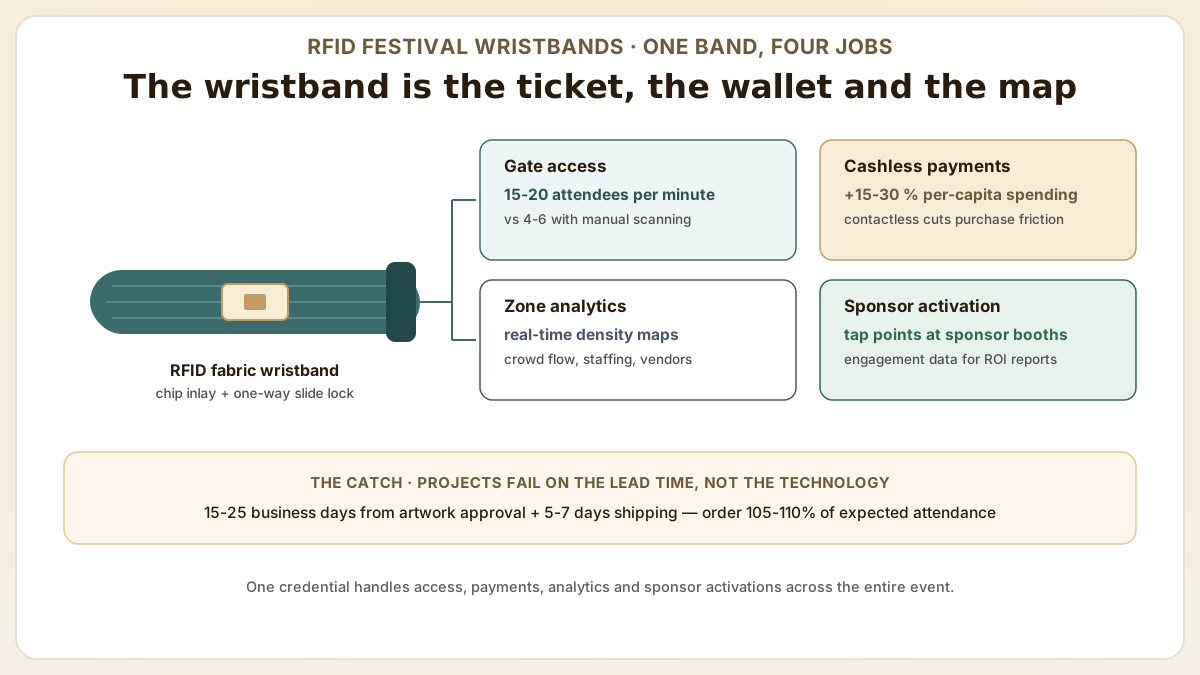
RFID wristbands move 15-20 attendees per minute through a festival gate versus 4-6 with manual scanning. This procurement guide to RFID event wristbands covers material types, chip options, anti-transfer security, cashless payment integration and setup planning — where projects fail on the lead time, not the technology.
- Material follows duration: Tyvek for single-day events ($0.15 – $0.35), fabric for multi-day festivals ($0.50 – $1.00), silicone for recurring venues ($0.80 – $1.50).
- Cashless payment integration requires UHF or NFC chip selection aligned with the payment platform provider — Glownet, PlayPass or Tappit will specify the chip before you order stock.
- Anti-transfer mechanisms (one-way slide locks, breakaway clasps, adhesive closures) are what turn a wristband from an accessory into a credential at multi-day festivals.
At a glance
Use these short answers to decide whether this page matches the project before moving into the detail.
Key takeaway
Material follows duration: Tyvek for single-day events ($0.15 – $0.35), fabric for multi-day festivals ($0.50 – $1.00), silicone for recurring venues ($0.80 – $1.50).
Why do events switch to RFID wristbands?
Doors open is the least forgiving hour in live events: a crowd that took months to sell tickets to arrives all at once, and every one of them expects the line to move. A...
Next step
Ready to move forward? Start your inquiry to get specific answers for this project.
Plan your event wristbandsWhy do events switch to RFID wristbands?
Doors open is the least forgiving hour in live events: a crowd that took months to sell tickets to arrives all at once, and every one of them expects the line to move. A visual ID check buys a staffer a few moments per person to squint at a screen and a printed ticket; a wristband gives a reader a fraction of a second and a gate that simply opens. Scaled across the whole arrival, that gap is the difference between an entrance and a bottleneck. RFID wristbands replace paper tickets, printed badges and manual ID checks with a single wearable credential that handles access control, cashless payments, social media integration and audience analytics across the entire event.
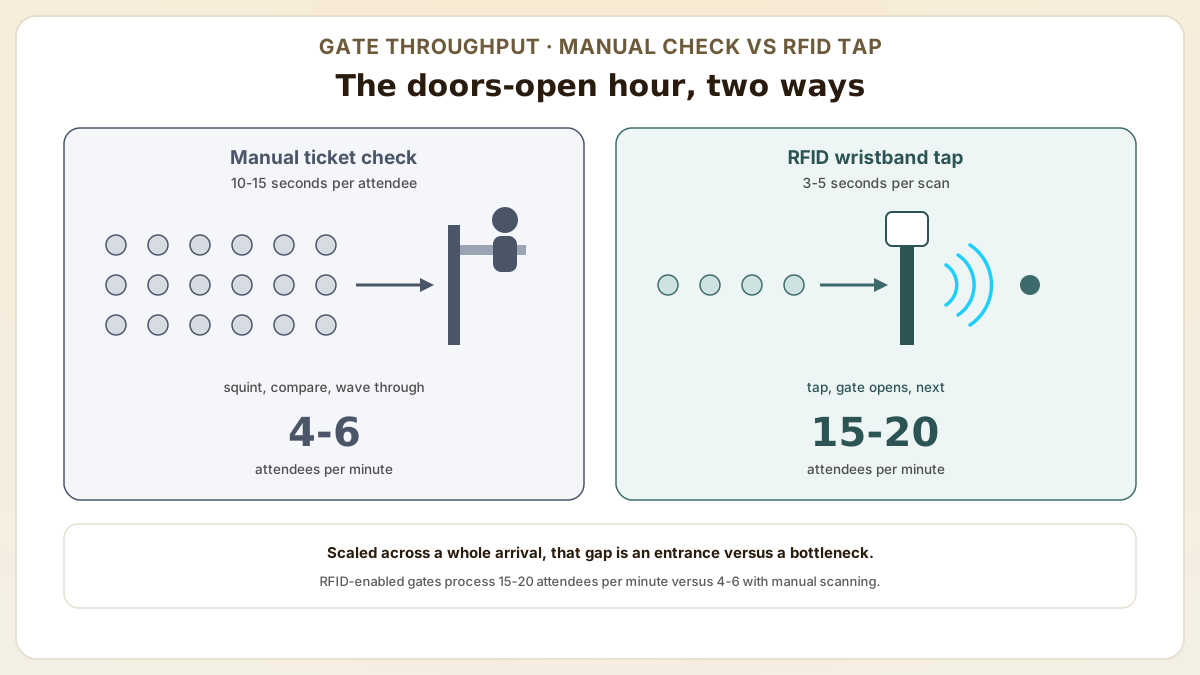
For event organizers, the shift from barcode or QR tickets to RFID wristbands delivers three measurable benefits: faster gate throughput (3-5 seconds per scan versus 10-15 seconds for visual ticket checks), elimination of counterfeit tickets, and real-time data on attendee flow across zones and stages.
- Gate throughput: RFID-enabled entry gates process 15-20 attendees per minute versus 4-6 with manual scanning.
- Fraud prevention: Each RFID chip has a unique, factory-programmed UID that cannot be duplicated, eliminating ticket counterfeiting.
- Cashless revenue uplift: Events deploying RFID cashless payments consistently report 15-30 % increases in per-capita spending because contactless transactions reduce friction. The full ROI math lives in our revenue-impact breakdown.
- Zone analytics: Real-time attendee density maps help operations teams manage crowd flow, security staffing and vendor placement.
- Sponsor activation: RFID tap points at sponsor booths capture engagement data for post-event reporting and ROI measurement.
Which wristband type should you choose — silicone, fabric, or Tyvek?
Match the material to the event, not the other way round: Tyvek for a single day, fabric for a festival weekend, silicone for anything that needs to survive a water park or a second season. The comparison below maps durability, closure and unit cost across all three — read the closure row twice, because the closure is also your anti-transfer mechanism.
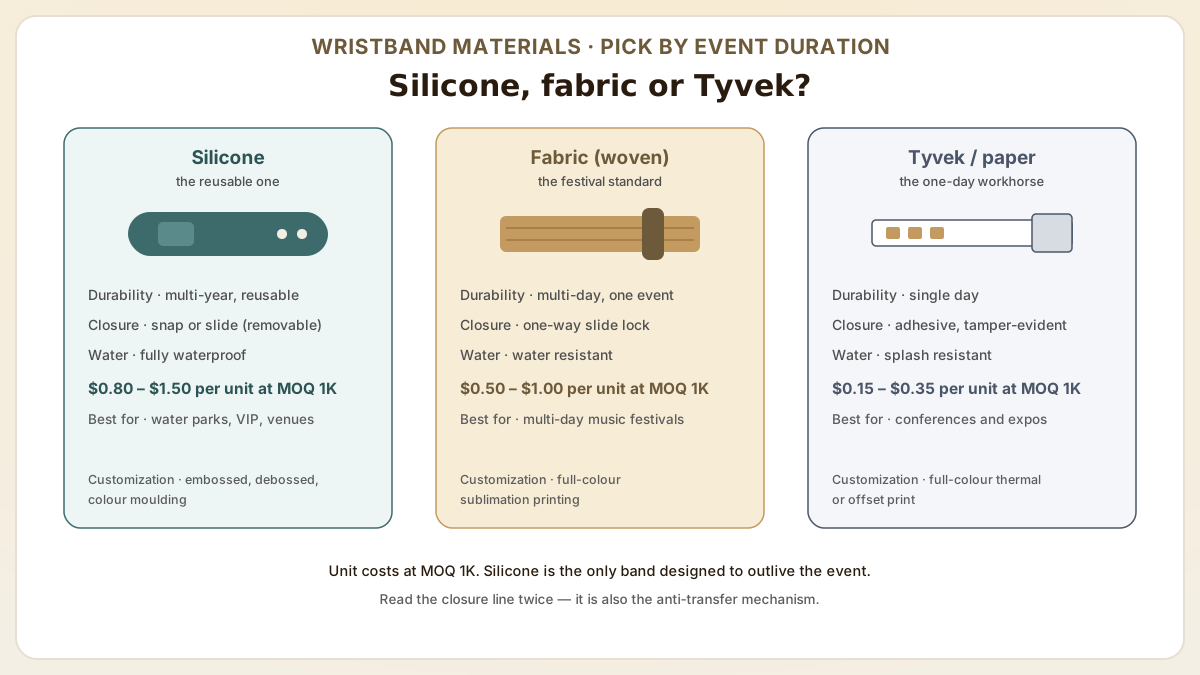
- Silicone wristbands: Moulded waterproof bands with embedded RFID chip. Adjustable snap or slide closure. Comfortable for multi-day wear. Reusable across events. Higher unit cost justified for recurring venues, water parks and VIP programs.
- Fabric (woven) wristbands: Polyester or nylon weave with an RFID tag sewn or heat-sealed into the band. One-time locking slide clasp prevents removal and transfer. The standard choice for multi-day music festivals. Customizable with full-colour sublimation printing.
- Tyvek/paper wristbands: Single-use adhesive-closure bands with a laminated RFID inlay. Lowest cost per unit. Ideal for single-day conferences, corporate events and exhibitions where reuse is not required.
| Feature | Silicone | Fabric | Tyvek/Paper |
|---|---|---|---|
| Durability | Multi-year reusable | Multi-day single event | Single day |
| Water resistance | Fully waterproof | Water resistant | Splash resistant |
| Closure type | Snap or slide (removable) | One-way slide lock (tamper-proof) | Adhesive (tamper-evident) |
| Customization | Embossed or debossed, colour moulding | Full-colour sublimation printing | Full-colour thermal or offset print |
| Comfort (multi-day) | Excellent | Very good | Fair |
| Unit cost (MOQ 1K) | $0.80 – $1.50 | $0.50 – $1.00 | $0.15 – $0.35 |
| Best for | Water parks, VIP, recurring venues | Music festivals, multi-day events | Conferences, corporate events, expos |
Which chip options work for event wristbands?
The chip decides what the wristband can do — phone taps, gate entry, vehicle-lane read range or encrypted payments — and it also decides less than buyers expect, because the platform decides first. Treat the four options below as a menu your cashless or access-control provider orders from, not one you order from yourself.
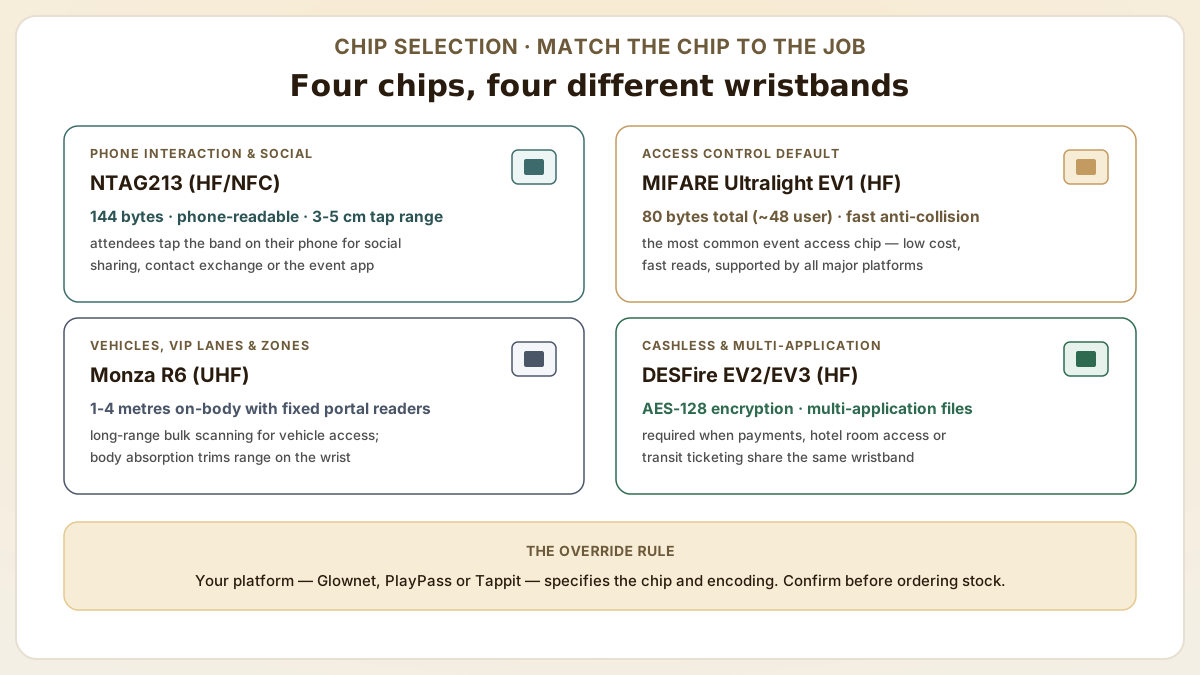
- NXP NTAG213 (HF/NFC) — 144 bytes, phone-readable. Ideal for events that want attendees to tap wristbands against phones for social sharing, contact exchange or app interaction. Short read range (3-5 cm) requires deliberate tap at gates.
- NXP MIFARE Ultralight EV1 (HF) — 80 bytes total memory (~48 bytes user-accessible), fast anti-collision. The most common chip for event access control. Low cost, fast read speed, supported by all major event RFID platforms (Glownet, PlayPass, Tappit).
- Impinj Monza R6 (UHF). Long-range bulk scanning for vehicle access, VIP lane management and zone-level crowd tracking. Read range 1-4 metres on-body with fixed portal readers (antenna size and body absorption reduce range versus standard label tags).
- NXP DESFire EV2/EV3 (HF). AES-128 encryption and multi-application file system. Required for events with integrated cashless payment, hotel room access or transit ticketing on the same wristband.
- Chip selection should be driven by the event technology vendor's platform requirements. Confirm compatibility before ordering wristband stock — 'the bands arrived and the platform can't read them' is a sentence nobody has ever said calmly.
How do anti-transfer security and tamper resistance work?
At a multi-day festival the wristband is the paid admission credential, which makes the closure a security control rather than a fashion detail: every mechanism below exists because somebody, at some point, tried to slip a band off and pass it over the fence. Hardware handles the first three attempts; software catches the clever fourth.
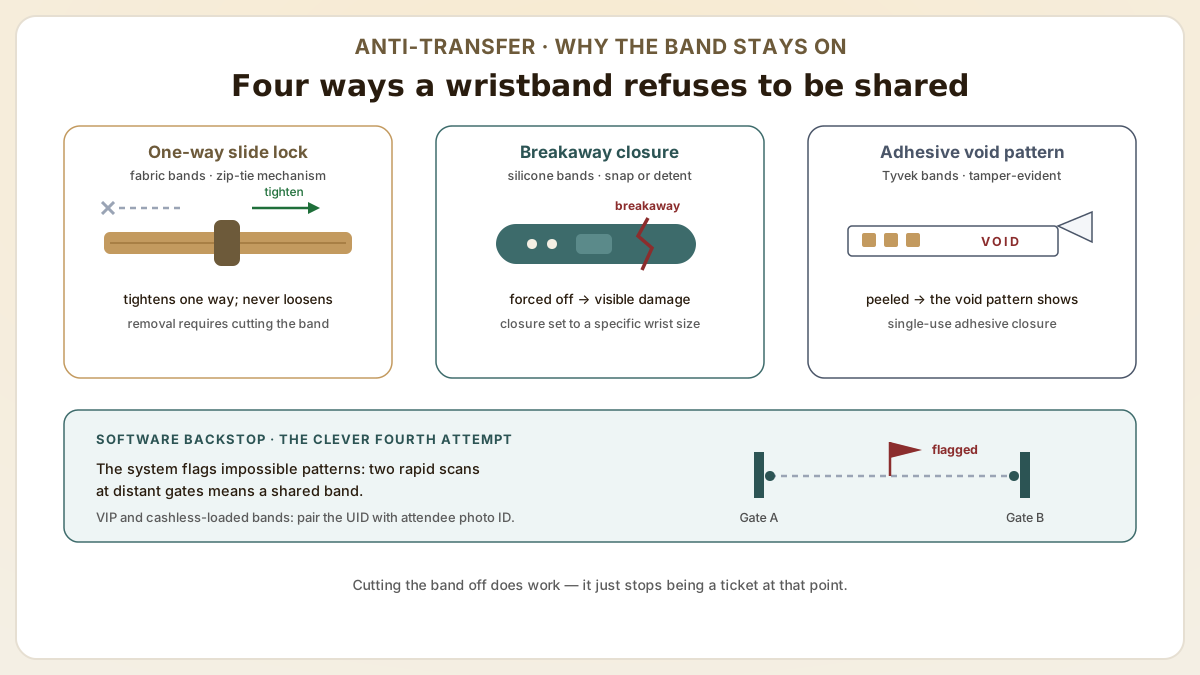
- Fabric wristbands use a one-way sliding lock (similar to a zip-tie mechanism) that tightens but cannot be loosened without cutting the band.
- Silicone wristbands use snap or detent closures that can be set to a specific wrist size; some models include a breakaway tab that visibly damages the band if forced off.
- Tyvek wristbands rely on adhesive closure with a void pattern that shows tampering when peeled.
- Software-level anti-transfer: the RFID system can flag unusual patterns such as two rapid scans at distant gates, indicating a shared wristband.
- For VIP and cashless-loaded wristbands, pair the RFID UID with attendee photo ID at registration to enable visual verification at high-security checkpoints.
How do cashless payments and setup work?
Cashless payment via RFID wristbands is the single largest revenue driver for event RFID adoption. Attendees pre-load funds onto their wristband (or link a credit card) and tap to pay at vendor stalls, bars and merchandise stands. A wristband is a remarkably effective device for separating a relaxed person from their money. This section covers the on-site setup; for closed-loop versus open-loop economics and refund mechanics in depth, see the cashless payment wristband guide.
- Choose a cashless platform provider (Glownet, PlayPass, Tappit or similar) early. They will specify the chip type, encoding format and reader hardware.
- Top-up stations (kiosks or mobile) should be distributed across the venue at a ratio of one station per 500-1,000 attendees.
- Settlement and refund workflows must be defined before the event. Most platforms support post-event online refunds for unused balances.
- PCI DSS compliance is handled by the cashless platform when credit cards are linked. The wristband itself never stores card data, only a tokenized account reference.
- Vendor POS hardware (handheld NFC readers, tablet mounts) should be tested with production wristbands at least two weeks before the event.
- Plan for a 15-30 % per-capita spending increase when budgeting vendor stock and cash-flow projections.
How do event setup and logistics planning work?
The technology is the easy half. What separates a quiet doors-open from an incident report is logistics: order timing, encoding strategy, reader placement, network redundancy and staff who touched the real hardware before the public did. Reader sizing and gate layout get their own deep dive in the access-control setup guide; the checklist below is the wristband-side plan.
- Order timeline: custom-printed RFID wristbands require 15-25 business days from artwork approval to delivery. Add 5-7 days for shipping to the venue.
- Encoding: wristbands can be pre-encoded at the factory (each band linked to a unique ticket ID) or encoded on-site during registration. Pre-encoding is faster for gate throughput; on-site encoding offers more flexibility for walk-up sales.
- Infrastructure: plan reader placements at entry gates, zone transitions, vendor points and top-up stations. A 10,000-capacity festival typically needs 8-12 entry lanes, 20-40 vendor POS units and 10-15 top-up kiosks.
- Connectivity: RFID readers require network access (wired Ethernet, Wi-Fi or cellular) to communicate with the cashless and access control servers. Redundant connectivity and offline-capable readers prevent downtime during network issues.
- Staff training: allocate 2-4 hours for gate staff, vendor operators and help-desk team to practice with the RFID system on production hardware before doors open.
What can mid-scale festivals learn from Coachella, Lollapalooza, Bonnaroo and Tomorrowland?
You do not need Coachella's budget to copy Coachella's homework. The four biggest RFID festivals publish enough operational detail through case studies and vendor pages to give 5K-50K attendee events a usable blueprint — and the pattern across all four reveals which decisions are non-negotiable.
- Tiered access encoded on the chip (VIP, GA, artist, crew): all four festivals run permission tiers on a single wristband family rather than separate physical bands per tier. Gate readers validate the tier in <300 ms; staff don't need to visually distinguish bands by color (though color-coding remains as a backup).
- Cashless first, access second, analytics third: industry case data points to a 12-18 month payback on the RFID infrastructure investment, weighted heavily toward the cashless revenue uplift. Mid-scale festivals that prioritize access without a cashless layer leave most of the ROI on the table.
- Standards-aligned chips with AES-128 encryption: Coachella, Lollapalooza, Bonnaroo and Tomorrowland all run wristbands compliant with ISO/IEC 18000-63 (UHF) or ISO/IEC 14443-A (HF). Specify these standards in your supplier RFP rather than letting a vendor pick a proprietary chip family that locks you in.
- Read-rate target ≥99.7% at peak ingress: this is the published benchmark across all four major festivals. Below 99% you start seeing visible 'tap-twice' delays that backup the line. Test against this benchmark with at least 200 production wristbands a week before doors.
- Coachella publicly invests >$2M annually on the RFID stack across 250K+ attendees over two weekends. Mid-scale events should benchmark per-attendee infrastructure cost ($8-15 per attendee for 25K-scale events is the typical range) rather than copy the absolute number.
What does an RFID festival deployment timeline actually look like?
Most RFID festival projects fail in the timeline, not the technology. Below is the realistic schedule buyers should plan against, working backwards from doors-open — the deadlines are unforgiving because encoding factories close their production windows whether or not your artwork is approved.
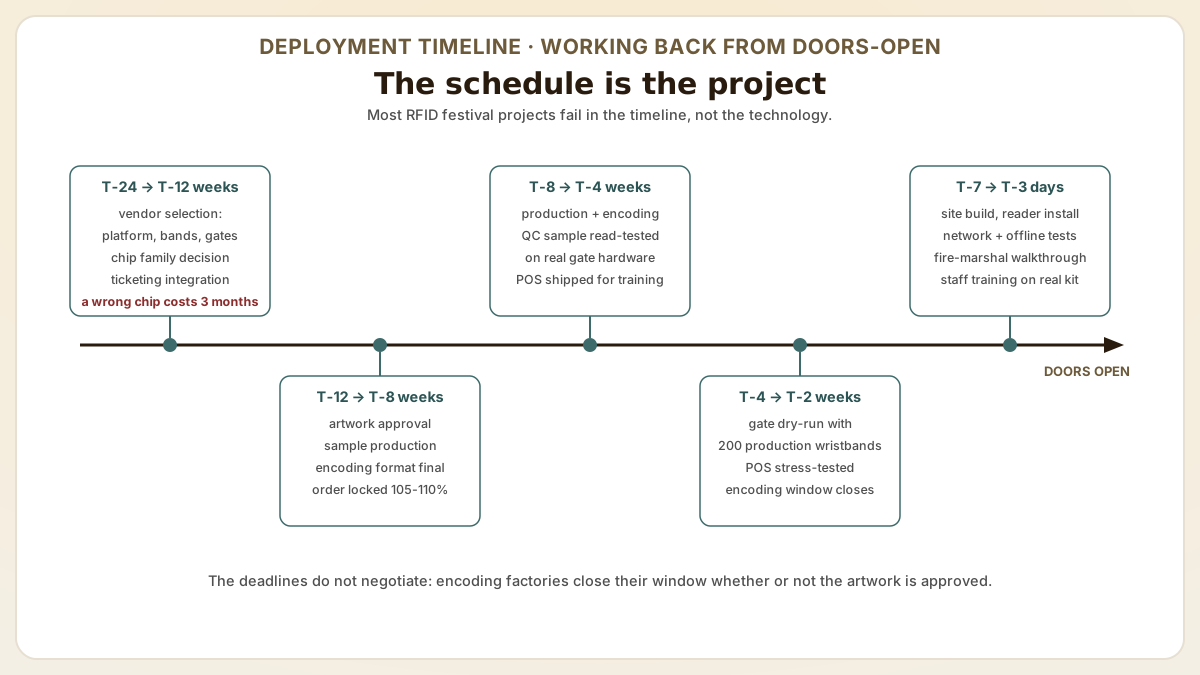
- T-12 to T-24 weeks before doors: vendor selection (cashless platform, wristband supplier, gate hardware), chip family decision, basic ticketing-system integration scope. This is where misaligned chip choices cost three months later.
- T-8 to T-12 weeks: wristband artwork approval, sample production, encoding format finalization. Order quantity locked at 105-110% of expected attendance to absorb day-of replacements and walk-up sales.
- T-4 to T-8 weeks: production and encoding at supplier; pre-shipment QC sample receives at organizer office for final read-test against actual gate hardware. Vendor cashless POS terminals shipped to the warehouse for staff training.
- T-2 to T-4 weeks: full gate dry-run with at least 200 production wristbands and the actual server stack. Vendor POS units stress-tested with production wristbands. Encoding factory closes its window for the event.
- T-3 to T-7 days: site-build, reader installation, network and offline-mode testing, fire-marshal walkthrough of zone-occupancy alert thresholds. Staff training on production hardware. Doors open.
What should buyers know about the 2026 season?
The playbook above is evergreen. These are the season-specific dates, benchmarks and named-source data points worth citing in 2026 budget and procurement meetings — a named vendor's published figure lands better in a CFO conversation than a number the internet remembers.
- Named cashless benchmarks: Glownet's published deployment data shows up to 30% higher revenue per guest across its festival client base, and Tappit's RFID deployments (Wireless, Parklife, BST Hyde Park, Taste Festivals) cite a 22% average increase in event takings — the named-source numbers behind the 15-30% planning range used on this page.
- Bonnaroo's 2025 cashless program offered $15 in spending credit on wristband registration with PayPal/Venmo — a mechanic that both pre-loads revenue and converts non-cashless attendees to the cashless flow before doors open.
- Lollapalooza launched 'Lolla Cashless' as one of the first US RFID festival cashless programs and engineered it for offline-mode operation given known venue connectivity issues; offline-capable architecture is now standard across the major US festival cashless platforms.
- 2026 calendar: the summer season runs June-September with peak weeks in July-August. Place orders by March-April to avoid peak-production capacity constraints; encoding factories close their window for July festivals around mid-June, and rush orders placed after mid-June hit hot-market pricing.
- 2026 lead-time quotes: suppliers (Proud Tek, ID&C, Nordic Wristbands, PDC) quote standard 4-6 week production for fabric, 3-4 weeks for Tyvek, and rush 2-3 week production at premium pricing. Size the order at 105-110% of expected attendance — the overage absorbs day-of replacements, walk-up sales and an expected 3-5% damage rate during distribution.
- The short version of this entire guide: order in March and the summer is logistics; order in June and the summer is apologies.
Useful next pages
Use these linked product, guide and comparison pages to keep the next click specific and practical.
Event wristband products
Browse the RFID wristband formats designed for festivals, conferences and recurring venue programs.
Related resources
Solution and comparison pages for event RFID technology planning.
FAQ
How far in advance should I order RFID wristbands for a festival?
Allow 6-8 weeks from initial design to delivery at the venue. This includes 1-2 weeks for artwork and sample approval, 3 weeks for production and encoding, and 1-2 weeks for international shipping. Rush orders are possible but incur surcharges and limit customization options.
Can attendees reuse RFID wristbands from a previous event?
Silicone wristbands with removable closures can be physically reused, but the RFID data is typically re-encoded for each event. Fabric and Tyvek wristbands are designed for single-event use due to their tamper-evident closures. Reusing UIDs across events is technically possible but requires the access control system to support UID re-registration.
What happens if an attendee's RFID wristband stops working?
Set up a help desk with spare wristbands and an encoding station. Staff can look up the attendee's account by ticket ID or registration email, deactivate the old wristband UID in the system, encode a new wristband and transfer the cashless balance. The entire process takes 2-3 minutes.
Are RFID wristbands waterproof?
Silicone wristbands are fully waterproof and rated for continuous immersion (IP67 or higher). Fabric wristbands are water-resistant and survive rain, sweat and brief splashes. Tyvek wristbands are splash-resistant but will degrade with prolonged water exposure. For water parks or beach festivals, silicone is the recommended material.
How do cashless refunds work after the event?
Most cashless platforms offer an online refund portal that opens 24-48 hours after the event closes. Attendees log in with their registration email, verify their remaining balance and request a refund to their original payment method or bank account. Refund processing typically takes 5-10 business days. Some platforms charge a small refund processing fee.
How do I size reader hardware for a 25K-attendee festival?
Industry rule of thumb: 1 HF tap lane per 1,500-2,000 attendees in the peak arrival hour, plus 50% buffer for reliability. A 25K festival arriving in a 3-hour window needs roughly 12-16 entry tap lanes; double that for re-entry capability. Add 1 vendor POS terminal per 200-300 attendees (so ~85-125 terminals across food, bar and merch), and 1 top-up kiosk per 500 attendees (~50 kiosks). Test the entire stack against a >99.7% read-rate target with production wristbands at least 7-10 days before doors.
Should I let a single vendor own RFID end-to-end, or pick best-of-breed?
End-to-end (one vendor for cashless platform + wristband supply + gate hardware) trades flexibility for simpler accountability. When something goes wrong on doors-open day, there is one number to call. Best-of-breed (separate cashless vendor, wristband supplier, gate-hardware vendor) is cheaper at scale and avoids vendor lock-in but requires the organizer to own the integration risk. Most first-time RFID festivals start end-to-end and migrate to best-of-breed over 2-3 years as their internal RFID expertise matures.
Proud Tek is a Shenzhen-based RFID & NFC manufacturer supplying hotel chains, transit operators, event venues and retail brands worldwide. Every order includes free samples, RF testing and dedicated project support.
Get a Quick Quote
Tell us about your project and we'll respond within one business day. Fields marked (asterisk) are required.