
Event Technology
RFID vs QR Codes for Event Management
Quick answer
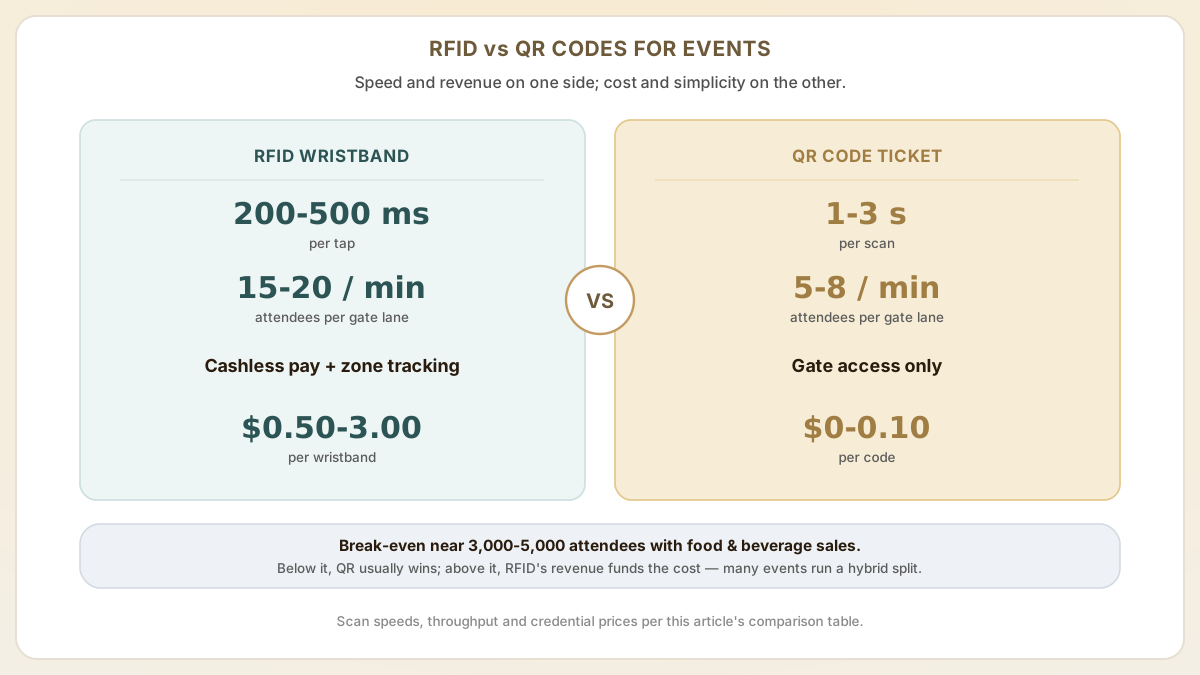
RFID clears event gates 3-5x faster than QR codes and adds cashless payment, while QR credentials cost 90 percent less — so RFID pays off above roughly 3,000-5,000 attendees with food and beverage sales, and QR wins below. A producer's guide to speed, cost, failure modes and hybrid deployment.
- RFID processes attendees 3-5x faster than QR codes at entry gates, making it essential for events with 5,000+ attendees and narrow arrival windows.
- QR codes cost 90 percent less per credential but cannot support cashless payment or real-time zone tracking that RFID enables.
- Hybrid deployments using RFID for VIP and QR for general admission optimize cost while delivering premium experiences where they matter most.
At a glance
Use these short answers to decide whether this page matches the project before moving into the detail.
Key takeaway
RFID processes attendees 3-5x faster than QR codes at entry gates, making it essential for events with 5,000+ attendees and narrow arrival windows.
How do these technologies compare at a glance?
Every event-tech debate eventually reaches the same fork, usually in a budget meeting: wristbands or QR codes. One camp points at the per-credential price; the other poi...
Next step
Ready to move forward? Start your inquiry to get specific answers for this project.
Get event technology adviceHow do these technologies compare at a glance?
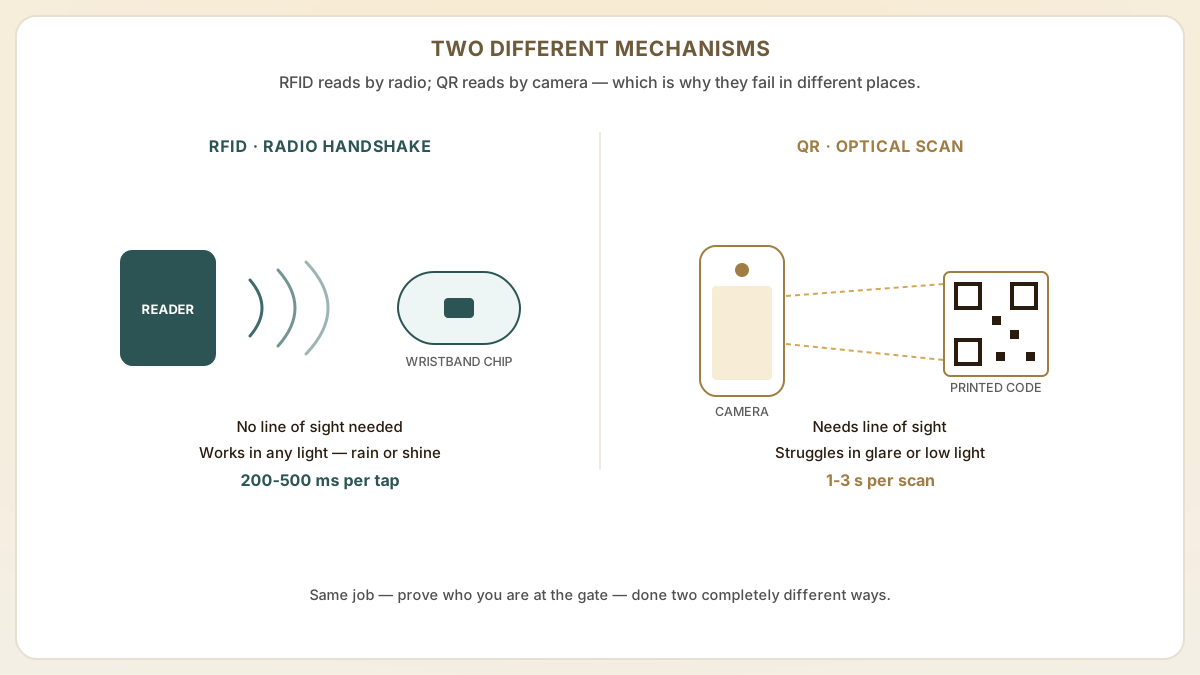
Every event-tech debate eventually reaches the same fork, usually in a budget meeting: wristbands or QR codes. One camp points at the per-credential price; the other points at the line snaking out of the gate on opening night. Both are right, which is what makes the call harder than it looks — the cheap option and the fast option are rarely the same option. RFID and QR codes are both identification technologies used for event credentialing, but they operate on fundamentally different principles. RFID uses radio frequency communication between a chip and a reader; QR codes use optical imaging of a printed pattern.
| Capability | RFID wristband | QR code (mobile/print) |
|---|---|---|
| Scan speed | 200 – 500 ms per tap | 1 – 3 seconds per scan |
| Gate throughput | 15 – 20 attendees/min/lane | 5 – 8 attendees/min/lane |
| Credential cost | $0.50 – $3.00 per wristband | $0.00 – $0.10 per code |
| Cashless payment | Yes (with compatible chip) | No |
| Real-time tracking | Yes (zone taps or UHF passive) | Limited (scan points only) |
| Transfer prevention | Locked to wristband on wrist | Can be screenshotted and shared |
| Offline operation | Yes (on-chip data) | Requires connectivity to validate |
| Hands-free operation | Yes (wrist tap or UHF detect) | No (must present screen/paper) |
| Infrastructure cost | High (readers, network, platform) | Low (phone cameras or basic scanners) |
| Setup complexity | Medium-high | Low |
When RFID is the right choice
RFID delivers the most value when event requirements go beyond basic gate access. The technology cost premium is justified when cashless payment, zone tracking, transfer prevention or high-speed throughput is a requirement.
- Multi-day festivals: RFID wristbands stay on the attendee for the entire event, eliminating the need to present credentials repeatedly. Cashless payment integration drives additional revenue.
- High-volume single-day events: When 10,000+ attendees must enter within a 60-90 minute window, RFID's 3-5x throughput advantage prevents dangerous queue buildup.
- Events with multiple access tiers: RFID encodes VIP, backstage, press and general admission permissions on the same wristband, enabling zone-level access control.
- Cashless venues: Any event planning cashless payment must use RFID (or NFC) wristbands. QR codes cannot store or transact payment credentials at the point of sale.
- Brand-experience events: The physical wristband becomes a branded keepsake that extends brand exposure beyond the event day.
When QR codes are the right choice
QR codes excel when cost, simplicity and speed-to-deploy are the primary constraints. For events where gate access is the only credential function, QR codes deliver adequate performance at a fraction of the RFID cost.
- Small to medium events (under 5,000 attendees): Gate throughput with QR scanners is sufficient when the arrival window is not compressed.
- Free or low-cost events: The zero-marginal-cost of digital QR codes eliminates credential spend entirely.
- Events with short planning timelines: QR codes require no hardware procurement or encoding. They can be generated and distributed digitally in hours.
- Virtual or hybrid events: QR codes serve as the digital entry ticket for both physical and virtual attendance tracks.
- Events where attendees keep their phones accessible: Conference-style events where attendees have phones in hand make QR presentation natural and fast.
What's the hybrid RFID + QR deployment strategy?
Many large events use a hybrid approach that deploys RFID where it delivers the most value and QR codes where it is sufficient, optimizing total system cost. The allocation below is a typical split.
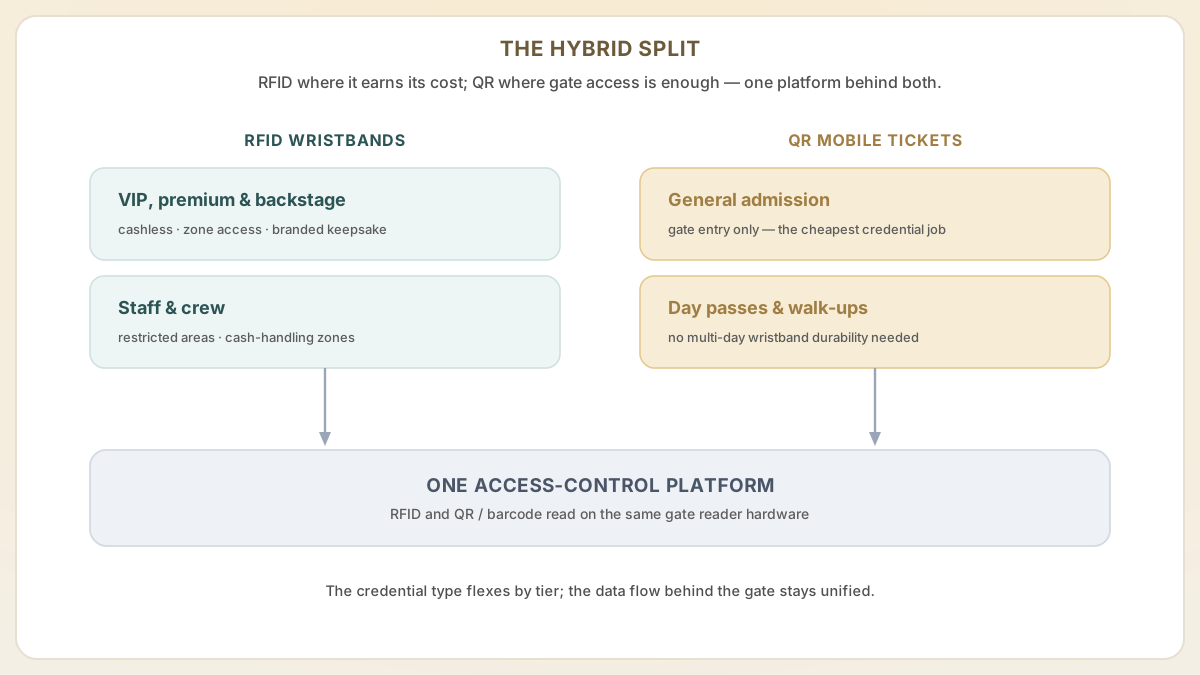
- VIP and premium tiers: Issue RFID wristbands to VIP, premium and backstage-pass holders for cashless payment, zone access and branded keepsake value.
- General admission: Use QR code mobile tickets for general admission where the only credential function is gate entry.
- Staff and crew: Issue RFID badges to staff for access to restricted operational areas, equipment rooms and cash-handling zones.
- Day passes and walk-ups: Provide QR code tickets for single-day and walk-up attendees who do not need multi-day wristband durability.
- Integration: Both credential types must work within the same access control platform. Most enterprise event tech providers support RFID and barcode/QR scanning on the same gate reader hardware.
How do total cost of ownership options compare?
The total cost comparison between RFID and QR codes must include hardware, credentials, software, staffing and operational savings — including the cashless-payment revenue RFID unlocks. Not just the per-unit credential cost.
- Credential cost at 10,000 attendees: RFID wristbands $5,000-$30,000 versus QR codes $0-$1,000.
- Reader hardware: RFID requires dedicated readers ($200-$800 per gate lane) versus QR which uses smartphone cameras or $50-$100 laser scanners.
- Software platform: Both technologies require a ticketing and access control platform, though RFID-capable platforms typically cost $0.50-$2.00 more per attendee.
- Staffing savings: RFID's faster throughput reduces the number of staffed gate lanes needed. A 20,000-attendee event might need 8 RFID lanes versus 20 QR scan lanes.
- Revenue generation: Cashless RFID payment generates 15-30 percent more per-capita spend. At $50 average spend, a 20 percent lift on 10,000 attendees equals $100,000 in additional revenue.
How do failure modes differ between RFID and QR in real venue conditions?
Choosing a credential isn't only about happy-path throughput — it's about what happens when conditions degrade. RFID and QR fail differently and the failure modes matter most at large or outdoor events. The five conditions below are where the gap shows.
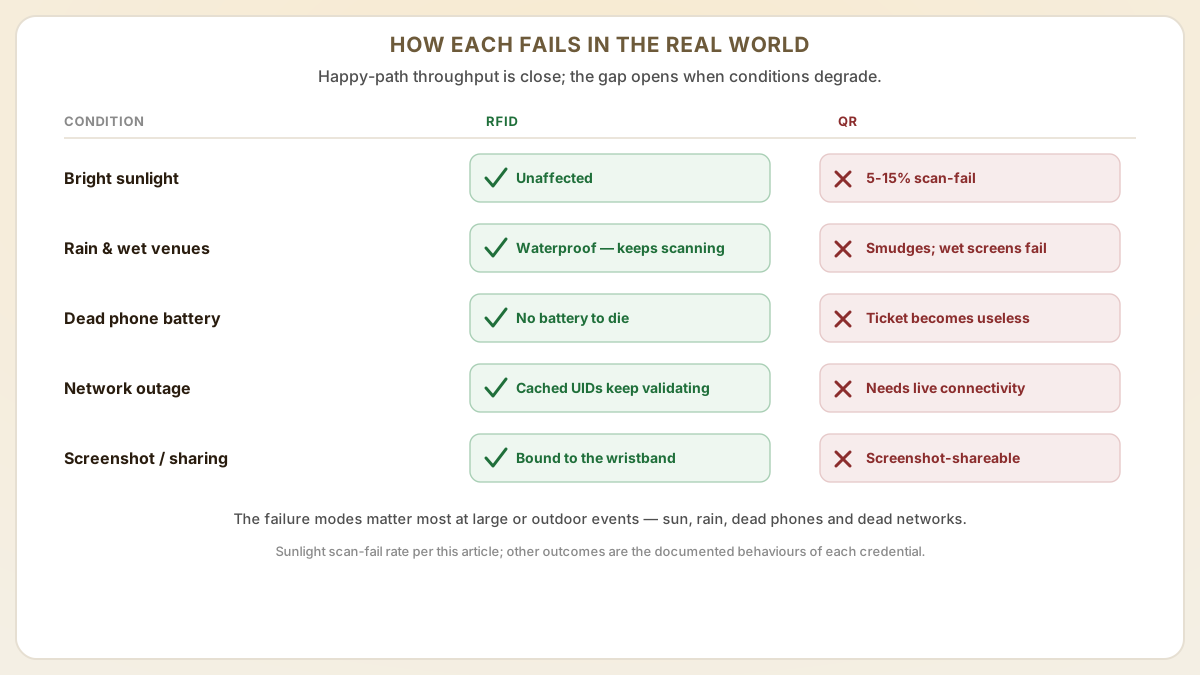
- Bright sunlight: QR scan reliability drops sharply when bright sun washes out the phone screen or printed code. Outdoor festivals at midday routinely report 5-15% scan-fail rates with QR. RFID is unaffected by ambient light.
- Rain and wet venues: QR codes printed on paper smudge and fail to scan; phone screens become unresponsive when wet. Waterproof RFID wristbands continue to scan reliably through rain.
- Dead phone batteries: QR ticket on the attendee's phone becomes useless if the phone dies. The standard mitigation (print a paper backup at home) increases pre-event support load and is rarely used by attendees. RFID wristbands have no battery.
- Network outages: QR systems generally need real-time connectivity to validate against the central database. RFID systems with on-chip stored permissions or locally-cached UID whitelists keep validating during multi-minute outages — Lollapalooza specifically engineered its RFID stack for offline operation given known connectivity issues at its venue.
- Counterfeit and screenshot sharing: a QR code is trivially screenshotted and shared. Dynamic / refreshing QR codes mitigate this but require an active app session, which then re-creates the dead-battery problem. RFID UIDs are physically bound to the wristband and cannot be screenshotted; cryptographic chips (NTAG 424 DNA) eliminate cloning risk entirely.
What does the cost-of-ownership equation actually look like at scale?
The 'QR is free, RFID is expensive' framing breaks down once you account for staffing, throughput buffer and revenue uplift. Here is a cleaner mental model for a 10K-attendee single-day event.
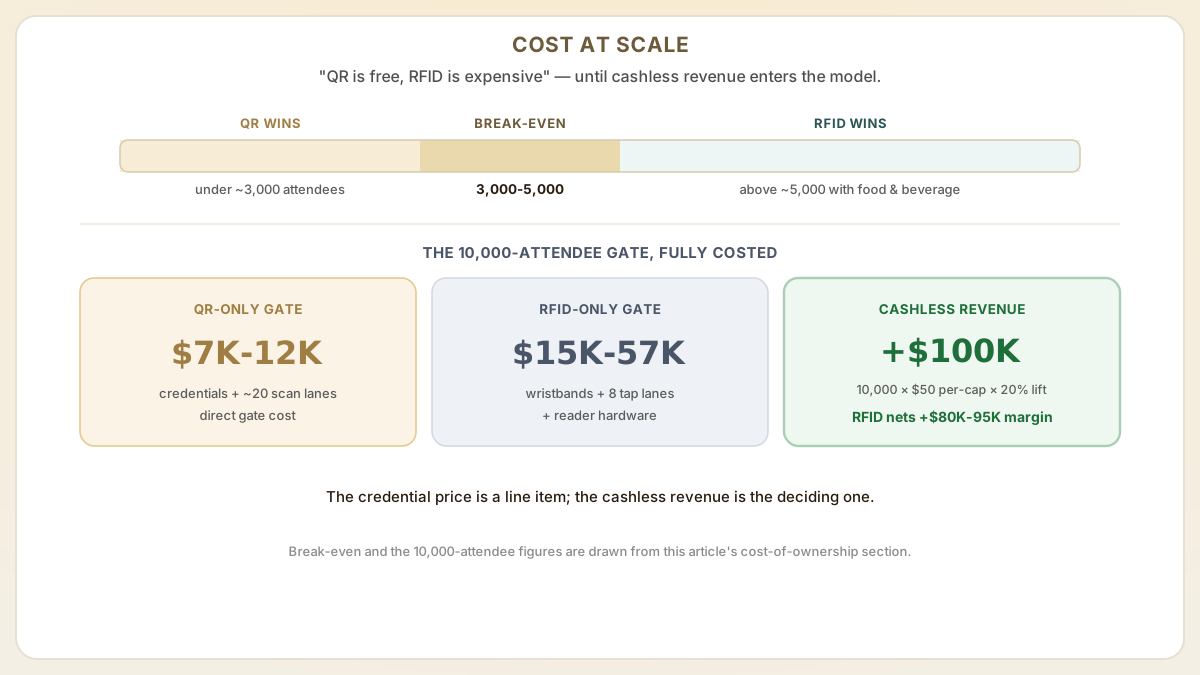
- QR-only gate cost: $0-$1,000 in credentials + 20 staffed scan lanes × 8 hours × $25/hr = $4,000 staff cost + $2,000-$5,000 platform fee + ~$500-$2,000 in scanner hardware = roughly $7K-$12K direct gate cost.
- RFID-only gate cost: $5K-$30K in wristbands + 8 staffed tap lanes × 8 hours × $25/hr = $1,600 staff cost + $5,000-$15,000 platform fee + ~$3K-$8K in reader hardware = roughly $15K-$57K direct gate cost.
- But add cashless revenue: 10,000 attendees × $50 per-cap × 20% RFID-cashless lift = $100,000 in incremental F&B revenue. Net of platform commission (~3%) and slightly higher refund processing, the RFID stack throws off ~$80K-$95K of incremental margin that the QR-only stack cannot.
- Hybrid stacks make the equation more attractive at lower scale: RFID for VIP / multi-day / cashless tiers, QR for general single-day admission. A 10K event with 1,000 RFID + 9,000 QR captures most of the cashless revenue uplift without bearing full RFID credential cost on the GA pool.
- The break-even point published in industry analyses sits around 3,000-5,000 attendees for events with active food and beverage sales. Below that scale, QR is usually the right answer; above it, RFID's revenue uplift consistently funds the higher credential cost.
Useful next pages
Use these linked product, guide and comparison pages to keep the next click specific and practical.
Event RFID products
RFID wristbands and badges for event access control and cashless payment.
NFC and RFID technology products
NFC stickers and readers that complement event RFID deployments.
FAQ
Can QR codes be used for cashless payment at events?
Not in the same way as RFID. QR codes can link to a mobile wallet or payment app, but the transaction requires the attendee to unlock their phone, open the app and present the code. A 10-15 second process versus 1-2 seconds for an RFID wristband tap. QR payment is feasible for low-volume transactions but impractical for high-throughput food and beverage lines.
How do I prevent QR code ticket sharing and fraud?
Dynamic QR codes that refresh every 30-60 seconds prevent screenshot sharing. Single-scan validation (the code is invalidated after first scan) prevents reuse. However, QR codes are inherently more vulnerable to transfer than RFID wristbands that are physically locked to the attendee's wrist.
What is the break-even point where RFID becomes more cost-effective than QR codes?
When cashless payment revenue uplift is factored in, RFID typically breaks even at 3,000-5,000 attendees for events with active food and beverage sales. For access-control-only events without cashless payment, QR codes are usually more cost-effective at any scale.
Can I upgrade from QR codes to RFID for future editions of my event?
Yes. Most event technology platforms support both credential types. You can start with QR codes in year one, learn your event's throughput and payment patterns, and upgrade to RFID for subsequent editions with data to justify the investment.
Do RFID readers need to be replaced if I migrate from QR to RFID?
Yes — QR scan stations (laser scanner, smartphone or basic camera tablet) cannot read RFID. Plan a parallel hardware track during the migration year: keep your QR scan lanes for backward compatibility (e.g., walk-up tickets) and add RFID tap lanes at primary entry. Most enterprise event platforms support both credential types on the same back-end, so the data flow stays unified even as the physical hardware diverges.
What's the right hybrid RFID + QR split for a mid-scale (5K-15K attendee) event?
A common balanced split: RFID wristbands for multi-day / VIP / cashless-active tiers (typically 30-50% of attendees), QR mobile tickets for single-day general admission and walk-up sales. Use RFID for cashless-required vendors (bars, food, merch) and accept QR + open-loop tap-to-pay at slower vendors. This captures most of the RFID revenue uplift while keeping the GA credential cost low.
Sources & references
Primary standards, OEM datasheets and regulatory documents cited by this article. All URLs were verified on the access date shown below.
- Tappit — Camp Bestival cashless RFID case study
Cashless RFID wristbands cut queues and boosted vendor sales at a major UK festival, with simple post-event online cash-out.
- Lolla Cashless — Lollapalooza RFID wristband guide
Documents Lollapalooza's RFID cashless wristbands processing transactions offline when festival networks drop.
Proud Tek is a Shenzhen-based RFID & NFC manufacturer supplying hotel chains, transit operators, event venues and retail brands worldwide. Every order includes free samples, RF testing and dedicated project support.
Get a Quick Quote
Tell us about your project and we'll respond within one business day. Fields marked (asterisk) are required.