
Event Technology
UHF RFID Wristbands for Long-Range Tracking
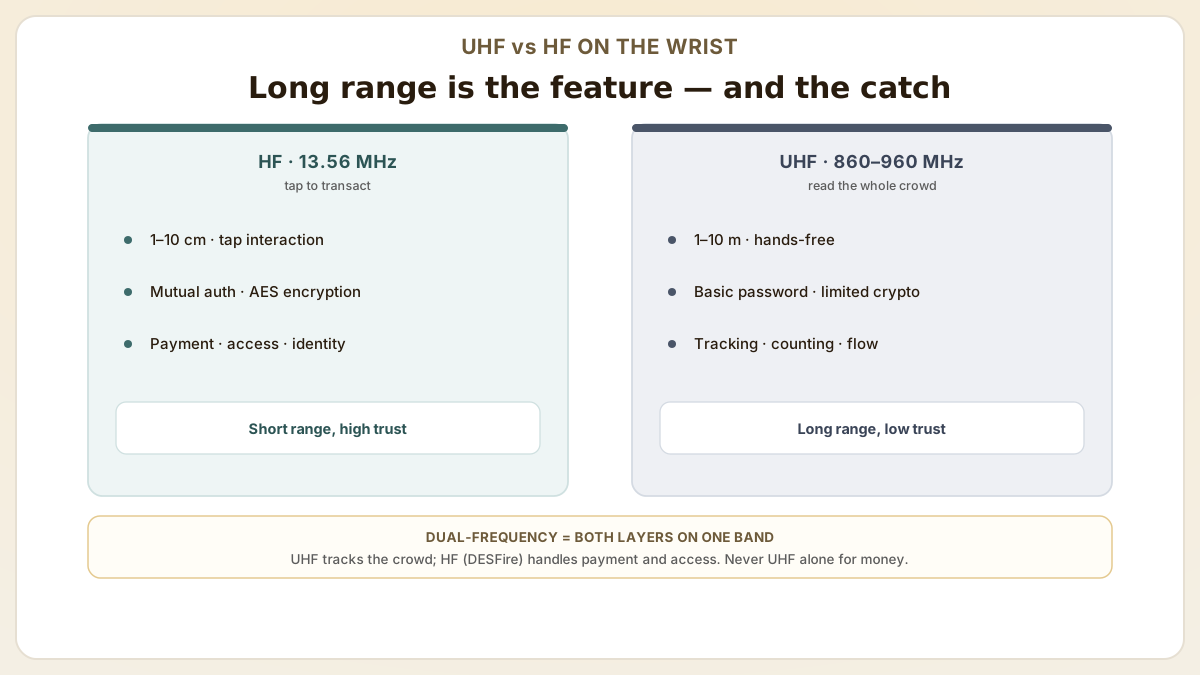
Quick answer
UHF RFID wristbands read hands-free at 2-5 m on a real wrist - not the 8-10 m catalogs promise - which makes them the proven engine of race timing and festival zone counting, and exactly the wrong tool for payment. A technical guide for venue operators: the honest range numbers, the body-physics behind them, portal throughput math, and a rollout checklist.
- Plan on 2-5 m, not 8-10 m. Catalog ranges come from free-space tests on flat foam; once the antenna couples to a wet human wrist among a crowd, published research and field portals agree the realistic figure collapses to a quarter of the brochure.
- UHF wins where nobody taps: overhead gate reads, zone-occupancy counts and marathon mats are the proven deployments (MYLAPS BibTag alone times the world's biggest marathons). Payment and high-security access stay HF territory - range and verification pull in opposite directions.
- Readers matter more than bands. Unlike HF's centimeter bubble, a UHF zone is drawn in the air with antenna gain, power and angle - the same wristband reads 6.6 m on an empty wrist and half that in a dense crowd.
At a glance
Use these short answers to decide whether this page matches the project before moving into the detail.
Key takeaway
Plan on 2-5 m, not 8-10 m. Catalog ranges come from free-space tests on flat foam; once the antenna couples to a wet human wrist among a crowd, published research and field portals agree the realistic figure collapses to a quarter of the brochure.
What UHF wristbands do that HF physically cannot
At a festival gate a steady crowd walks through without breaking stride, and an overhead reader quietly logs every wristband - no tapping, no queue, no outstretched arms...
Next step
Ready to move forward? Start your inquiry to get specific answers for this project.
Discuss UHF wristband deploymentWhat UHF wristbands do that HF physically cannot
At a festival gate a steady crowd walks through without breaking stride, and an overhead reader quietly logs every wristband - no tapping, no queue, no outstretched arms. That single capability - reading a band nobody presents - is the entire reason UHF exists in this market. Everything else is choosing between trade-offs.
UHF vs HF: choose by interaction model, not by range envy
Longer range sounds strictly better until you ask what verification means at each distance. The two bands answer different questions, and the fastest way to a failed rollout is buying range when you needed certainty.
| Parameter | HF / NFC (13.56 MHz) | UHF (860-960 MHz) |
|---|---|---|
| Read range | 1-10 cm, deliberate tap | 1-10 m catalog; 2-5 m on-body, passive |
| Verification semantics | tap = intent, suits payment and access | presence = detection, suits counting and timing |
| Multi-tag reading | one-at-a-time | hundreds simultaneously (anti-collision) |
| Body tolerance | excellent - HF is designed for wrist wear | hard-won - needs ground-plane antenna design against skin |
| Payment suitability | proven (closed-loop cashless) | wrong tool: no tap-intent proof, double-read risk |
Where the deployment is already proven - and where it keeps failing
UHF wristbands have a narrow but deep track record. The winning pattern is always the same: count or time things that move through a defined point without stopping. The failing pattern is also consistent: asking long range to do proximity verification's job.
- Proven - race timing: bib-mounted UHF is the standard at major marathons (MYLAPS BibTag, ChronoTrack); runners cross mats at speed and splits post live. The largest passive-UHF wearable deployment on earth.
- Proven - festival zone occupancy: fixed readers at zone boundaries count passing wristbands continuously, giving crowdfow dashboards HF cannot build.
- Proven - automated gate flow: overhead corridor readers replace tap-and-wait entry at waterparks and resorts.
- Fails - cashless payment: no tap-intent proof plus multi-read ambiguity equals double charges; every credible payment program stays HF.
- Fails - high-security access: a credential readable through a wall is not a credential you vault anything behind.
Reader infrastructure and zone-design arithmetic
With HF the tag is the product; with UHF the readers are. A zone has to be drawn in the air with antenna angle and radiated power, and the drawing obeys arithmetic worth doing before you rent hardware.
Worked example with stated assumptions: a two-panel portal flanking a 2 m walkway creates a usable read zone roughly 3 m deep. At festival walking pace (~1.2 m/s), each attendee spends ~2.5 s inside the zone - enough time for dozens of inventory rounds against a single wristband, which is why reads are reliable even in dense crowds. Throughput then caps on human flow, not reads: a 2 m-wide gate comfortably passes several thousand attendees per hour per lane pair, and the reader never becomes the constraint unless antenna siting forces re-reads.
- Portal pairs (two vertical panels): tightest zone definition; the default for gates, corridors and split points.
- Overhead downward beams: widest coverage for open entries, but spill beyond the intended area invites stray reads - shield or de-tune deliberately.
- Dense-crowd derating: bodies absorb and detune UHF; expect the effective zone to shrink at queue density - test with 20+ volunteers before opening day, not during.
- Power discipline: more EIRP reads farther but widens stray-read risk into adjacent zones; tune to the zone you drew, not the maximum the regulator allows.
Privacy: get ahead of the question before the local paper asks it
Continuous passive tracking is a privacy posture whether or not anyone mentions it at the gate. Operators who publish their answers first never face the hostile version of the question.
- Transparency: state on the ticket page and at entry that the band enables within-venue zone tracking, and say plainly what is NOT tracked (no off-site reads, no purchase linkage beyond what payment requires).
- Data minimization: aggregate to zone-level flow analytics; avoid building identifiable movement histories without a stated safety purpose.
- Retention and deletion: publish how long raw reads live (days, not years) and honor deletion requests through the registration system.
- Opt-out path: offer an HF-only or no-RFID alternative at guest services - the cost is trivial, the goodwill is not.
Rollout checklist before you sign anything
Five gates between a promising pilot and an opening-day incident. All five are cheap to clear early and expensive to fail late.
- Site survey with YOUR venue's metal, concrete and crowd profile - not the vendor's demo tent.
- Platform-certified bands: confirm the tracking/cashless platform's approved chip and form-factor list before ordering custom prints.
- Density dress rehearsal: run 20+ banded volunteers through the worst chokepoint at show density and validate read rate and zone edges.
- Privacy copy published: ticket page wording, signage at tracked zones, retention period, opt-out desk - all live before gates open.
- Fallback lane: one manual/tap lane staffed and tested, so a reader hiccup is a queue note, not a refund event.
Useful next pages
Use these linked product, guide and comparison pages to keep the next click specific and practical.
UHF RFID wristband products
UHF RFID wristbands designed for long-range detection and passive attendee tracking.
Related event RFID products
HF/NFC wristbands and readers for the access control and payment layers of your event system.
External UHF wristband references
Independent technical references for UHF wristband antenna design and read range.
FAQ
Can UHF wristbands be used for cashless payment?
UHF is not recommended for payment. The long read range means a reader could debit the wrong wristband, and UHF chips lack the strong encryption needed for financial transactions. Use HF/NFC chips for payment and combine with UHF on a dual-frequency wristband if you also need long-range tracking.
What read range can I expect from a UHF wristband on a human wrist?
Typically 2-5 meters with a standard fixed reader. This is significantly less than the 10+ meter range achievable with UHF tags on non-body-proximate applications because the human body absorbs UHF energy. Wristband-specific antenna designs with body-decoupling ground planes maximize range.
Can UHF readers distinguish between multiple wristbands in the same area?
Yes. UHF readers use anti-collision protocols (EPC Gen2 standard) that can identify 100+ tags per second. Each wristband's unique EPC code is read individually, even when dozens of wristbands are in the reader field simultaneously.
Do UHF wristbands work in rainy conditions?
Rain reduces UHF performance because water absorbs 900 MHz RF energy. Wet wristbands on wet skin may see read range reduced by 30-50 percent compared to dry conditions. Waterproof encapsulation protects the chip and antenna but does not prevent the RF absorption effect. Plan for reduced range in outdoor wet-weather events.
Should I deploy UHF on a fabric, silicone or PVC wristband?
Silicone is generally the best UHF wristband material because it can accommodate the thicker antenna stack and ground plane needed for body-decoupling without becoming uncomfortable. Fabric is possible but the rigid antenna module sewn into the band creates a noticeable bump. PVC works for short-duration applications where comfort is less critical. Tyvek is generally not recommended for UHF — the thin form factor cannot accommodate the antenna and ground plane needed for usable on-body read range.
How does UHF wristband design differ from a standard UHF asset tag?
Standard UHF asset tags are designed for free-space mounting on cardboard, plastic or pallet wrap — they assume no body or water nearby. Wristband-specific UHF designs add a thin metallic ground plane between the antenna and the skin to redirect radiation outward, plus thicker encapsulation to maintain antenna-to-skin spacing. Without this body-decoupling layer, a standard UHF inlay loses 50-80% of its read range when mounted against skin. Always source UHF wristbands from suppliers who publish on-body read range numbers, not just free-space numbers.
Can UHF wristbands track attendees outside the venue (privacy concern)?
Passive UHF wristbands can only be read by readers within 2-5 m on the wrist, so tracking outside the venue requires an attacker to install their own UHF reader infrastructure within that range. The privacy risk is real but bounded — it's not 'continuous global tracking.' Mitigations include (1) decommissioning the chip post-event by writing a kill code (UHF Gen2 supports this), (2) instructing attendees to remove the band at exit, (3) running the chip in a privacy mode that only responds to authenticated readers. GDPR / CCPA compliance is the binding requirement for any deployment with EU or California attendees.
Sources & references
Primary standards, OEM datasheets and regulatory documents cited by this article. All URLs were verified on the access date shown below.
- MYLAPS - RFID timing system for running (BibTag)
Largest production UHF wearable deployment: marathon bib timing at major races worldwide
- timingsense - Timing systems: starting lines, cycling and speed
Why UHF Gen2 dominates mass-start timing: bulk reads at speed without presentation
- IEEE J. Radio Frequency Identification - wearable UHF tag antenna research
Body-worn UHF tag antenna behavior underlying on-body range figures (free-space ~8 m on flexible substrates; strong on-body derating)
Proud Tek is a Shenzhen-based RFID & NFC manufacturer supplying hotel chains, transit operators, event venues and retail brands worldwide. Every order includes free samples, RF testing and dedicated project support.
Get a Quick Quote
Tell us about your project and we'll respond within one business day. Fields marked (asterisk) are required.