
Pharma Compliance
DSCSA Phase 3
Wholesaler Compliance for 2026
Quick answer
DSCSA Phase 3 enforcement is here, and it runs on a clock: pharmaceutical wholesalers must verify saleable returns and keep interoperable transaction data flowing, unit by unit. RFID/2D-barcode hybrid systems are now the operational standard for keeping up.
- DSCSA Phase 3 (effective November 2024 with 2025-2026 enforcement ramp) requires unit-level traceability across the pharmaceutical supply chain — every saleable unit, every transaction, every party.
- Wholesalers must verify saleable returns within 24 hours, requiring high-throughput scanning at receiving — RFID-equipped portals deliver this where 2D barcode alone cannot.
- Compliance failure exposes wholesalers to FDA inspection findings, FDA warning letters and loss of supplier relationships — making DSCSA the highest-priority compliance project for 2026.
At a glance
Use these short answers to decide whether this page matches the project before moving into the detail.
Key takeaway
DSCSA Phase 3 (effective November 2024 with 2025-2026 enforcement ramp) requires unit-level traceability across the pharmaceutical supply chain — every saleable unit, every transaction, every party.
What does DSCSA Phase 3 actually require?
Somewhere in a distribution center right now, a returned carton of medication is sitting on a dock while a 24-hour clock ticks quietly against it. Verify that unit again...
Next step
Ready to move forward? Start your inquiry to get specific answers for this project.
Get DSCSA-compliance RFID quoteWhat does DSCSA Phase 3 actually require?
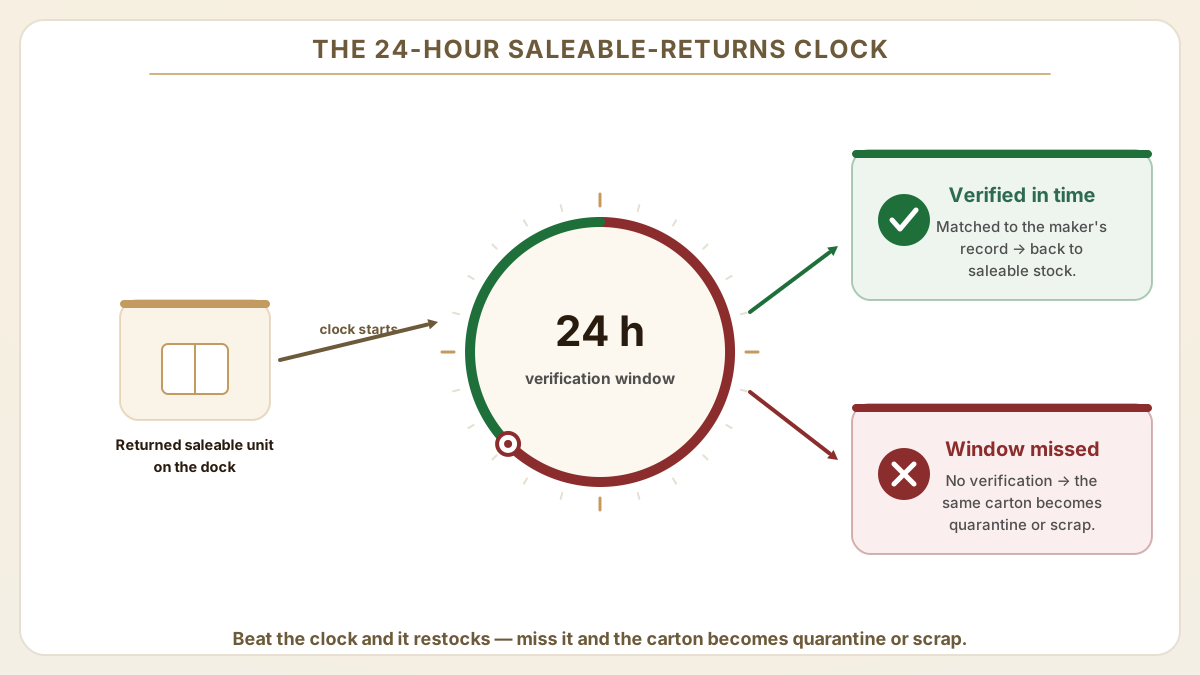
Somewhere in a distribution center right now, a returned carton of medication is sitting on a dock while a 24-hour clock ticks quietly against it. Verify that unit against the manufacturer's record before the clock runs out and it goes back into saleable stock; miss the window and the very same carton becomes quarantine — or scrap. Now multiply that one countdown by tens of thousands of units a day, and you have the operational reality DSCSA Phase 3 created. The Drug Supply Chain Security Act (DSCSA) became law in 2013 and then rolled out over a full decade of phased implementation. Phase 3 (2024-2026) is the operational endgame — full unit-level interoperable traceability. Knowing exactly what it requires is what separates the compliant wholesalers from the at-risk ones.
- Unit-level traceability: every saleable package carries a unique serial number (SGTIN-198 in GS1 EPC format) plus lot, expiry and NDC. Transaction history must follow the unit through the supply chain.
- Interoperable T3 data: trading partners exchange Transaction Information (TI), Transaction History (TH) and Transaction Statement (TS) electronically. Paper-based or PDF transfers no longer accepted.
- Saleable returns verification: returned product must be verified against the manufacturer's electronic record before resale. Verification window 24 hours; failure to verify means the return must be quarantined or destroyed.
- Suspect product investigation: when a product is suspected counterfeit/diverted, wholesalers must quarantine it within hours and complete an investigation within 6-7 days, reporting findings to FDA.
- Recordkeeping: 6 years from transaction date. Records must be searchable, exportable on FDA request and survive partner-system migrations.
What does Phase 3 mean for distribution operations?
For years a distribution center could think in pallets — big, forgiving units you can count on one hand. DSCSA Phase 3 quietly zooms the whole operation down to the individual saleable unit, and suddenly every carton has a name, a serial number and a history it must recite on demand. That shift from pallet-level handling to unit-level visibility is the whole game, and the five operational changes below are non-negotiable for compliant wholesalers.
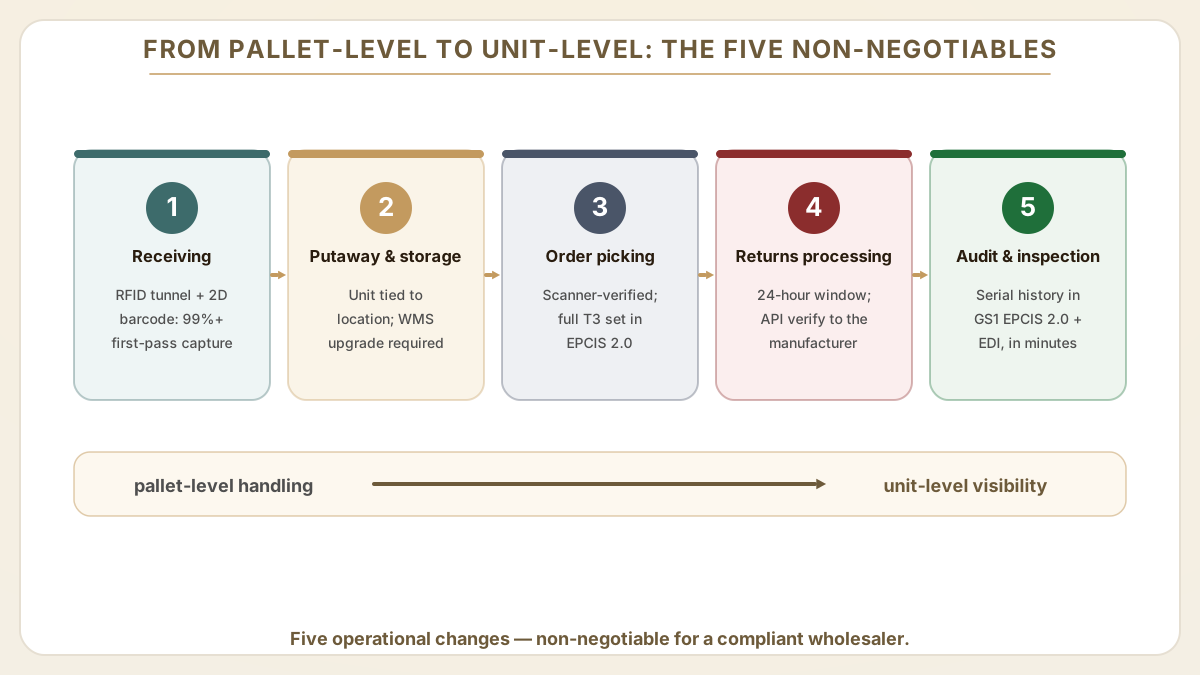
- Receiving: every incoming pallet scanned at unit level. Tunnel-style RFID readers + 2D barcode scanners in combination achieve 99%+ first-pass capture without bottleneck.
- Putaway and storage: unit-level data tied to physical location for fast retrieval during recall, returns and audit. WMS upgrade typically required.
- Order picking: scanner-verified pick at unit level. Each shipment outbound carries the full T3 data set in EPCIS 2.0 format.
- Returns processing: 24-hour verification window means automated return-receiving with API-based verification to manufacturer back-end. Manual workflow cannot keep pace at typical wholesaler volumes.
- Audit and inspection readiness: serial-level history exportable in standard formats (GS1 EPCIS 2.0 + EDI). FDA inspectors expect demo within minutes; multi-day data assembly is unacceptable.
How do RFID and 2D barcode complement each other?
Here is the plot twist that derails a lot of budget meetings: DSCSA does not actually require RFID. The letter of the law asks for a 2D barcode — a DataMatrix carrying a GS1 element string — and nothing more. So why do the big wholesalers keep bolting RFID on anyway? Because barcode alone is compliant but slow, and at receiving-dock volumes, slow has a price. RFID is not mandatory; it is the throughput and operational-efficiency layer that keeps a compliant operation from grinding to a crawl.
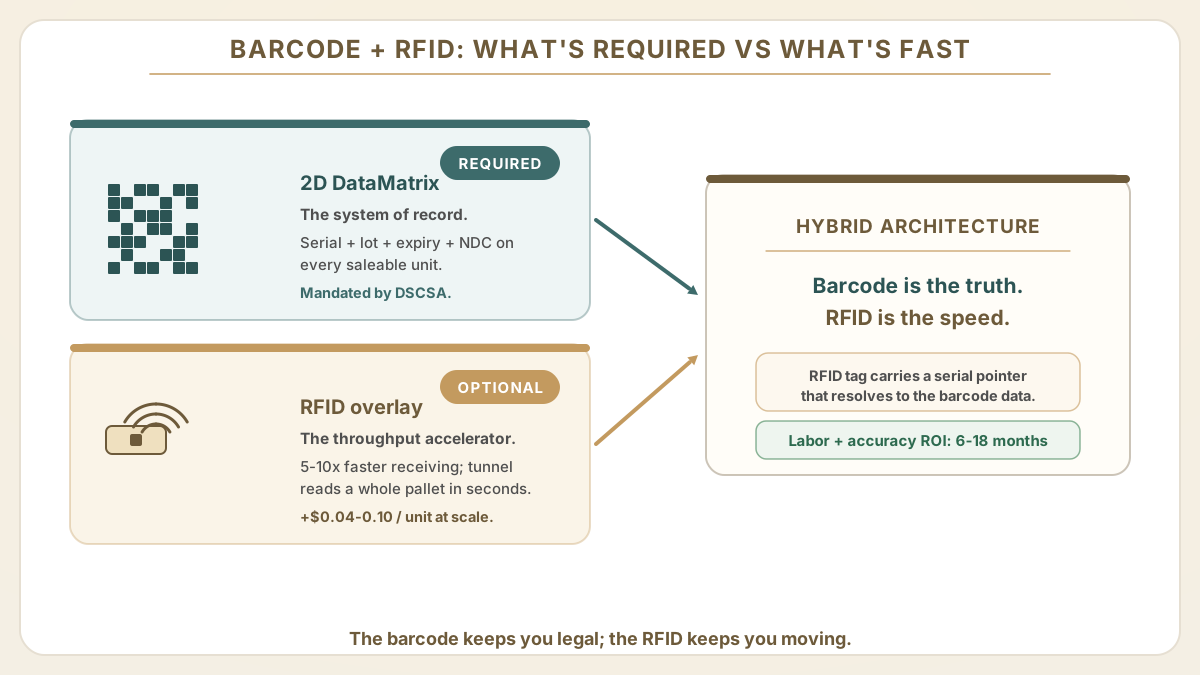
- 2D barcode: regulatory-mandated data carrier. Serial number + lot + expiry + NDC encoded in DataMatrix on every saleable unit. Required.
- RFID overlay: not required but speeds receiving 5-10× over barcode-only operations. Tunnel readers scan an entire pallet in seconds vs. minute-per-unit barcode scanning.
- Hybrid architecture: barcode is the system-of-record; RFID is the throughput accelerator. RFID tags carry a pointer (serial reference) that resolves to the barcode-encoded data set.
- Tag selection: HF (NFC, ISO 14443) for case-pack and pallet-level visibility; UHF (EPC Gen2) for high-throughput portal scanning. Most wholesalers use UHF on outer packaging.
- Costs: barcode is essentially free (printed on label); RFID adds $0.04-0.10 per unit at scale. ROI from labor reduction and accuracy typically 6-18 months.
What does DSCSA non-compliance cost?
Compliance budgets always look expensive — right up until you price out the alternative. DSCSA non-compliance bills you twice: once with regulatory consequences and once with commercial ones. So when wholesalers plan their compliance investment, the smart move is to put the cost of compliance and the cost of failure side by side on the same page — because the failure column is where the eye-watering numbers live.
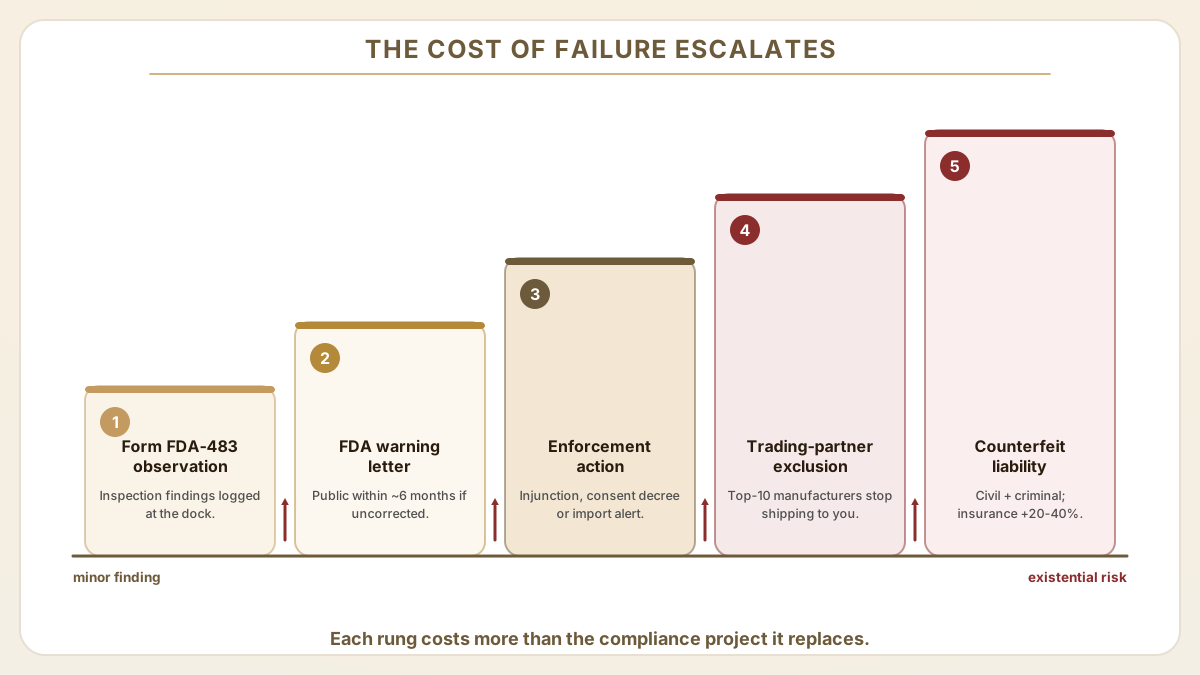
- FDA inspection findings: Form FDA-483 observations escalate to warning letters within 6 months if uncorrected. Public warning letters damage supplier and customer relationships.
- FDA enforcement actions: significant violations can result in injunction, consent decree, or import alert. These can shut down wholesaler operations for months.
- Trading partner exclusion: pharma manufacturers will not ship to wholesalers who cannot meet T3 interoperability. Top-10 manufacturers actively audit wholesaler compliance.
- Counterfeit liability: a wholesaler that ships counterfeit product carries civil and criminal liability. DSCSA-compliant operations have a defensible audit trail; non-compliant operations do not.
- Insurance premiums: liability insurers ask DSCSA compliance status. Non-compliant wholesalers face 20-40% premium increases or coverage exclusions.
Where does the post-2025 enforcement timeline actually sit?
If you were hoping for one clean, singular deadline, brace yourself. The 2023 statutory deadline, the 2024 stabilisation period and the October 9 2024 staggered exemptions have all now expired or are about to expire — and the result is a four-tier deadline calendar that wholesalers, manufacturers and dispensers must each track separately. Inmar's 2025 DSCSA enforcement summary, IntuitionLabs' April 2026 update, and the FDA Drug Supply Chain Security Act page remain the most cited public references for the current timeline.
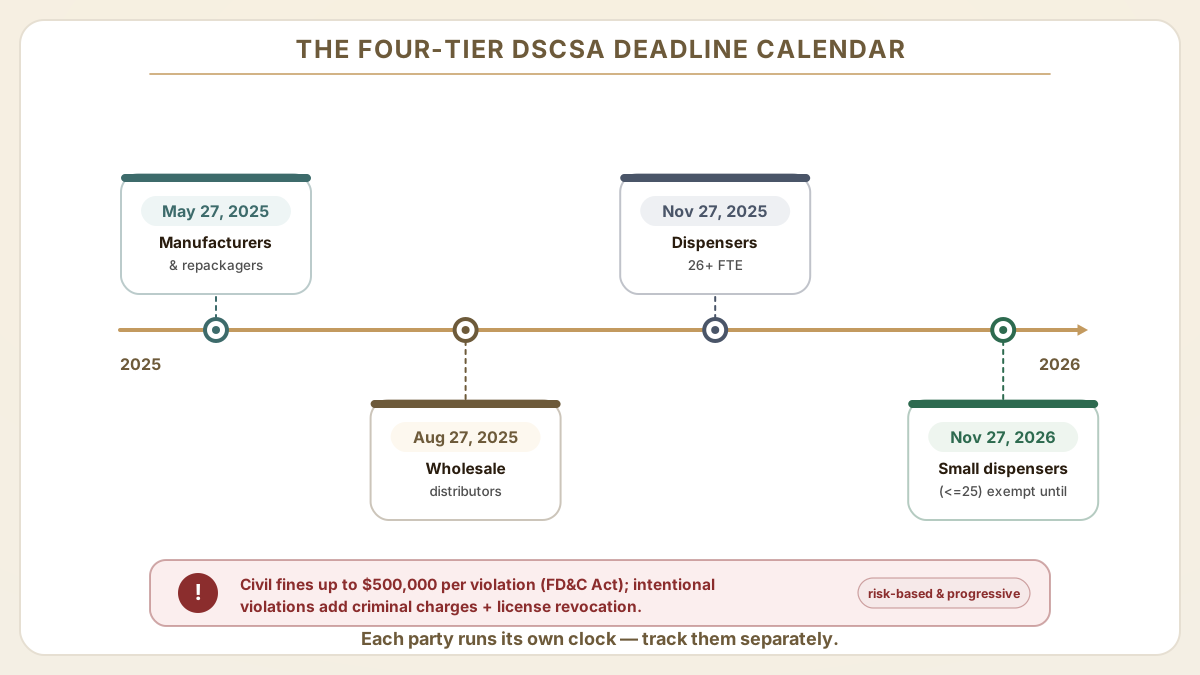
- Manufacturers and repackagers: deadline May 27, 2025 under the FDA October 9, 2024 exemption document. Inmar reports FDA officially began enforcing the law's final requirements as of that date, with non-compliant firms exposed to product quarantines, holds and warning letters.
- Wholesale distributors: deadline August 27, 2025. From that date, wholesalers receiving product without matching electronic transaction information (EPCIS-format TI/TS data) cannot legally accept and resell the units; manufacturers like AmerisourceBergen, McKesson and Cardinal Health have publicly issued letters reinforcing the cutoff.
- Dispensers with 26 or more full-time employees: deadline November 27, 2025. Larger pharmacy chains and health-system dispensers are inside the EDDS (enhanced drug distribution security) net; the wholesaler obligation is to ship verifiable serial-level data to those dispensers from this date.
- Small dispensers (≤25 licensed pharmacists/technicians): exempt until November 27, 2026 under the July 12, 2024 small business exemption. Wholesalers shipping into this segment must still maintain serialised data even though the dispenser-side scan obligation lags by a year.
- Penalties on the books: civil fines of up to $500,000 per violation under the FD&C Act; intentional violations expose individuals to criminal charges including imprisonment, plus revocation of manufacturer, wholesaler or dispenser licenses (Inmar 2025 summary). FDA enforcement during 2025-2026 is widely reported as 'risk-based and progressive' rather than punitive on day one.
Where do wholesalers actually fail Phase 3 audits in 2026?
Nobody fails a DSCSA audit on purpose — they fail it in the same handful of places everyone else does. Reading FDA inspection commentary, Healthcare Distribution Alliance member surveys cited by IntuitionLabs (2022 HDA report: more than half of manufacturers were not yet exchanging serialised data in production with distributors) and McKesson/Cardinal/AmerisourceBergen public posture, five failure modes account for the majority of post-2025 wholesaler issues.
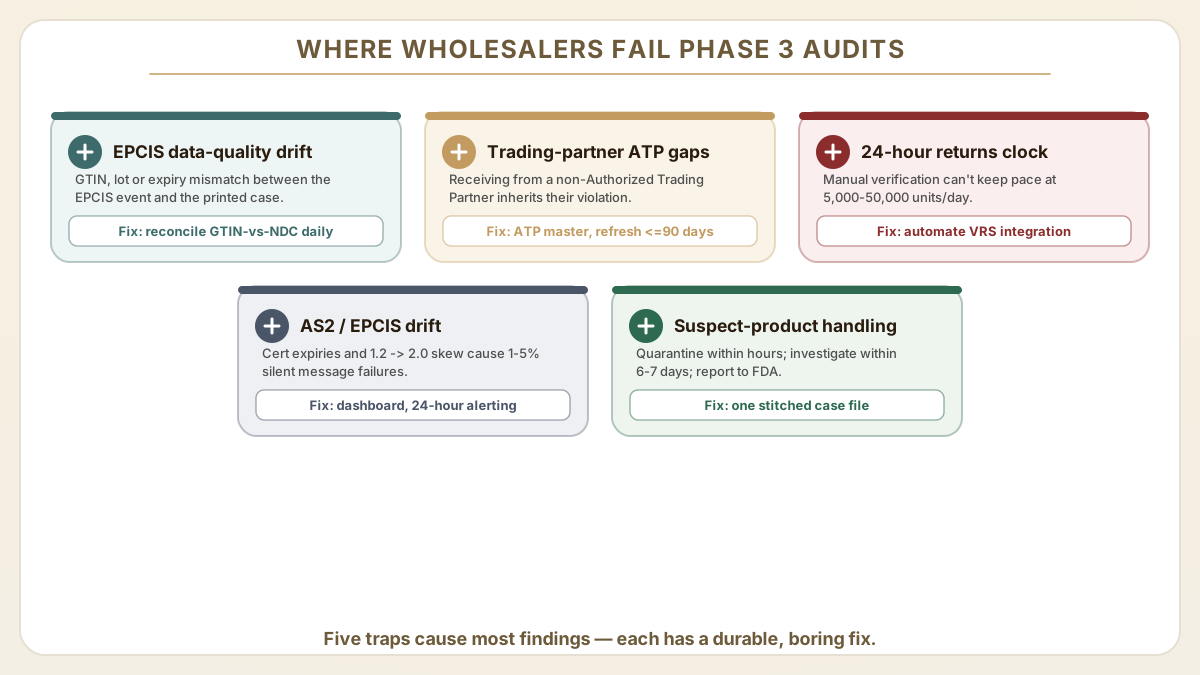
- EPCIS data quality drift: GTIN, lot or expiry mismatches between what the manufacturer's EPCIS event reports and what is physically printed on the case. IntuitionLabs notes integration testing for EPCIS 'requires extensive testing to ensure data integrity' — wholesalers should run automated GTIN-vs-NDC and lot-vs-printed-expiry reconciliation reports daily, not at audit.
- Trading-partner ATP gaps: every sender and receiver of a transaction must be an Authorized Trading Partner. Wholesalers receiving from a non-ATP source (e.g. a small repackager that lapsed its state license) inherit the violation. Maintain an in-house ATP master with refresh cadence ≤ 90 days and gate receiving on it.
- Saleable returns verification under the 24-hour clock: wholesalers cannot legally restock a return without verifying the unit's serial number against the manufacturer's record (typically via the Verification Router Service / VRS). Manual workflow at wholesaler-scale return volumes (5,000-50,000 units/day) misses the window — automated VRS integration is the only durable answer.
- AS2 / EPCIS connectivity drift: AS2 certificate expiries, EPCIS schema upgrades (1.2 → 2.0), and version-skew with trading partners produce silent message-failure rates of 1-5% if not monitored. Best-practice wholesalers run an EPCIS dashboard with 24-hour alerting on transmission-failure thresholds and reconcile with each major manufacturer monthly.
- Suspect / illegitimate product handling: DSCSA requires wholesalers to quarantine suspect product within hours and complete an investigation within 6-7 days, with findings reported to FDA via the Drug Supply Chain Security Hub. The most common audit finding is incomplete documentation of the investigation steps — the FDA expects to see a written quarantine timestamp, sender notification, partner-investigation correspondence and final disposition all stitched together.
Useful next pages
Use these linked product, guide and comparison pages to keep the next click specific and practical.
DSCSA-compliant pharmaceutical RFID
Receiving portal readers, RFID-NDC integration and FDA-compliant traceability platforms.
DSCSA authority references
Primary regulatory and industry sources to cite during procurement or audit.
FAQ
Does DSCSA require RFID or just barcode?
DSCSA requires a 2D barcode (DataMatrix) on saleable units. RFID is not mandatory but is widely deployed by wholesalers for throughput at receiving and outbound. Most large wholesalers run RFID + barcode hybrid; small wholesalers may rely on barcode alone but at slower throughput.
What's the deadline for full DSCSA Phase 3 compliance?
The November 27, 2023 statutory date was extended by FDA's 1-year stabilization period. Enforcement ramp is now active through 2024-2026. By late 2026 the FDA expects all trading partners to be operating fully interoperably.
How big is the typical DSCSA compliance investment?
Mid-sized wholesalers (1-3 DCs, $500M-2B revenue) typically invest $2-8M over 18-24 months for full Phase 3 compliance — covering serialization-aware WMS upgrade, RFID portal hardware, EPCIS integration and process redesign. Larger wholesalers spend $20-50M+.
What happens at saleable returns if I cannot verify in 24 hours?
Per DSCSA, unverified returns cannot be re-introduced into saleable inventory. Most wholesalers quarantine and re-attempt verification or destroy. Loss rate runs 0.5-3% of returned inventory pre-RFID; sub-0.5% post-RFID with API integration via the Verification Router Service (VRS) maintained by GS1 US and HDA.
How do EPCIS 1.2 and EPCIS 2.0 differ, and which version should we standardise on?
EPCIS 1.2 (the FDA guidance baseline cited by HDA and major distributors) supports XML; EPCIS 2.0 adds JSON serialisation, sensor data extension and improved error handling. Both are valid for DSCSA, but trading-partner inertia favours 1.2 today; most large wholesalers run dual-stack and let counterparties choose. IntuitionLabs explicitly notes FDA guidance identifies GS1 EPCIS 1.2 as the minimum standard version to support, so 1.2 is the floor rather than the ceiling.
What is the relationship between DSCSA and EU FMD for multi-region operators?
DSCSA is a transactional traceability model (electronic exchange of TI/TS/TH between trading partners) while EU FMD is a point-of-dispense verification model (pharmacist scans against a national hub before dispensing). Both demand 2D DataMatrix carriers with GS1 element strings (GTIN + serial + lot + expiry); the differences live in aggregation (mandatory in practice for US, voluntary in EU), tamper evidence (mandatory in EU, not specified in US) and records governance. See our [EU FMD vs DSCSA serialization](/blog/eu-fmd-vs-dscsa-pharmaceutical-serialization/) explainer for the side-by-side.
Proud Tek is a Shenzhen-based RFID & NFC manufacturer supplying hotel chains, transit operators, event venues and retail brands worldwide. Every order includes free samples, RF testing and dedicated project support.
Get a Quick Quote
Tell us about your project and we'll respond within one business day. Fields marked (asterisk) are required.