
Pharma Compliance
EU FMD vs DSCSA
Serialization Compared
Quick answer
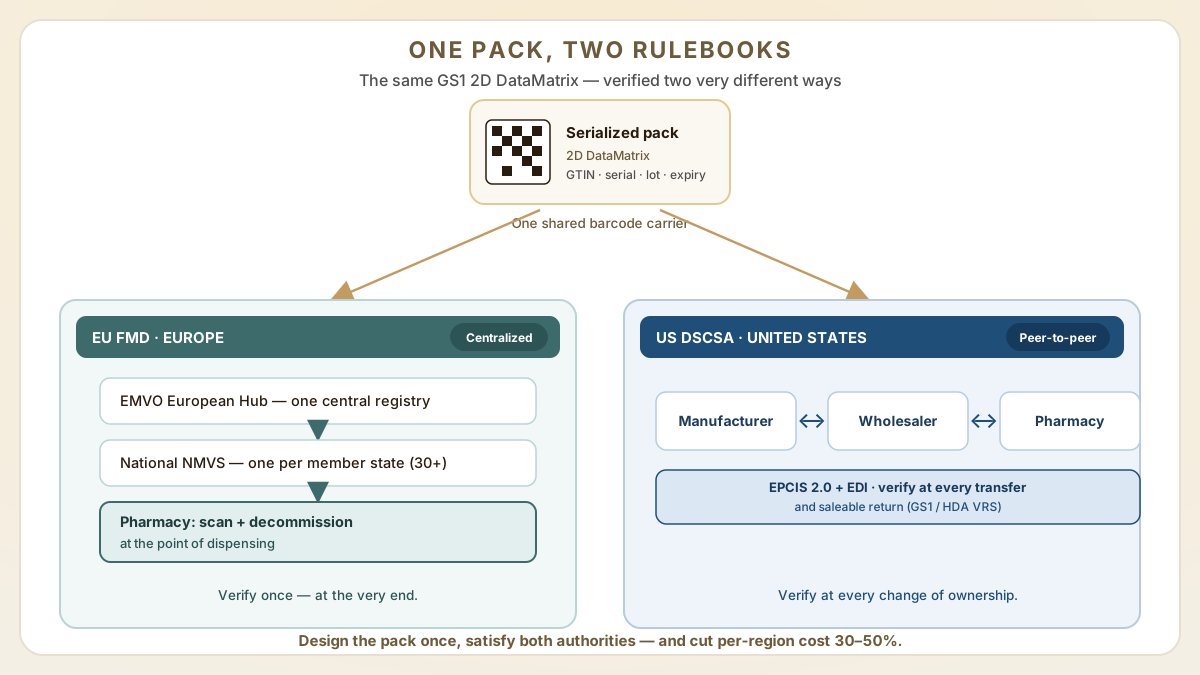
Sell medicine on both sides of the Atlantic and two serialization regimes apply at once: Europe's EU FMD (in force since 2019) and America's DSCSA (Phase 3 active). They chase the same goal — no counterfeits in the supply chain — and even share a barcode. Where they part ways is everything behind it: which database holds the data, when packs get scanned, and who files the paperwork.
- Two laws, one mission: EU FMD (Falsified Medicines Directive, in force 2019) and US DSCSA (Drug Supply Chain Security Act, Phase 3 active) both mandate pharmaceutical serialization — yet run on entirely separate rails.
- FMD funnels every pack through one central hub, the European Medicines Verification System (EMVS). DSCSA skips the hub and lets trading partners verify peer-to-peer over GS1 EPCIS 2.0.
- Design once, adapt per region: shared chips and a common barcode format cut per-region serialization cost 30–50% for multinational programs.
At a glance
Use these short answers to decide whether this page matches the project before moving into the detail.
Key takeaway
Two laws, one mission: EU FMD (Falsified Medicines Directive, in force 2019) and US DSCSA (Drug Supply Chain Security Act, Phase 3 active) both mandate pharmaceutical serialization — yet run on entirely separate rails.
What does EU FMD require?
Two regulators on two continents stared at the same problem — keep counterfeit medicine out of the supply chain — and landed on answers that agree on nearly everything e...
Next step
Ready to move forward? Start your inquiry to get specific answers for this project.
Get multi-region pharma quoteWhat does EU FMD require?
Two regulators on two continents stared at the same problem — keep counterfeit medicine out of the supply chain — and landed on answers that agree on nearly everything except how to actually do it. Same barcode symbology, same GS1 data, same goal; different databases, different scan moments, different paperwork. For a multinational manufacturer, that means engineering one pack that must quietly satisfy two authorities who have never fully agreed on the details. Europe moved first: the Falsified Medicines Directive entered force in February 2019, mandating serialization and verification across every EU prescription medicine. Compliance is mature now — but the operational fine-tuning never quite stops.
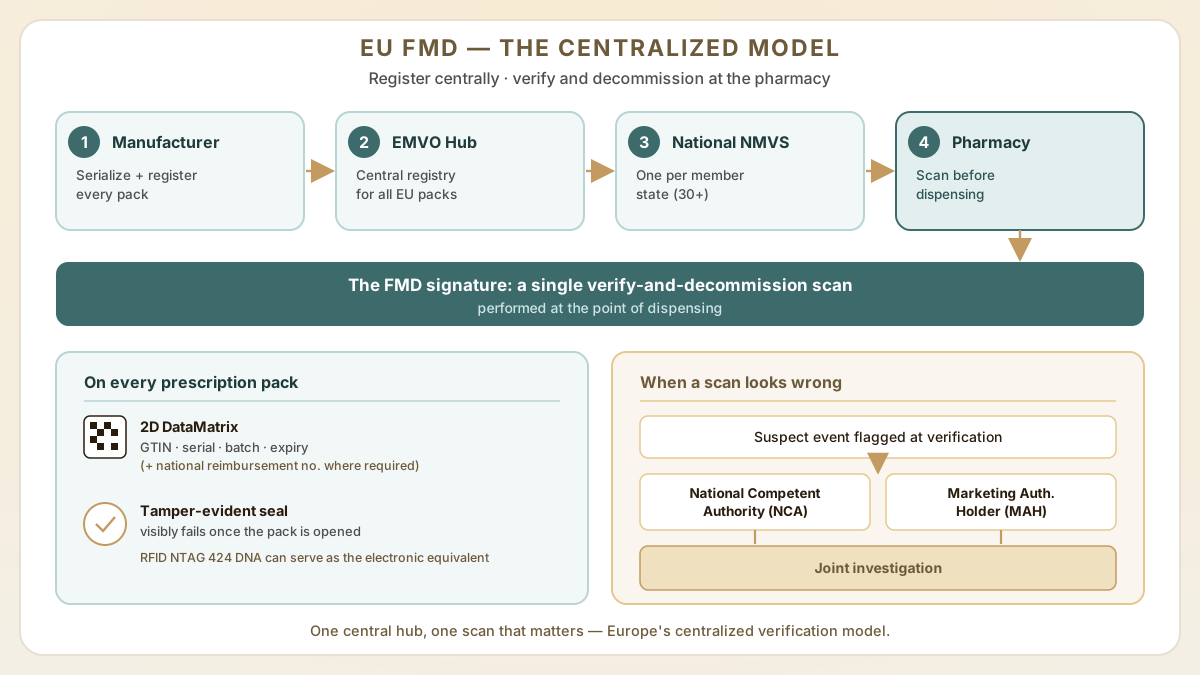
- Unique identifier: every prescription pack carries a 2D DataMatrix encoding GTIN, serial number, expiry, batch and — where a member state requires it — a national reimbursement number.
- Tamper-evident packaging: every saleable unit must have a tamper-evident seal that visibly fails if opened. RFID NTAG 424 DNA tamper-detect can serve as electronic equivalent.
- End-to-end verification: the pack is scanned and checked against EMVS at the point of dispensing (the pharmacy), and that same scan decommissions it.
- Repository network: each member state runs a National Medicines Verification System (NMVS) wired into the EU Hub, with EMVS coordinating cross-border traffic.
- Investigation workflow: an FMD-flagged suspect event triggers an investigation by the National Competent Authority (NCA) alongside the relevant marketing authorization holder.
How does DSCSA differ from FMD?
If FMD is a hub, DSCSA is a web. The US system throws out the central database entirely and asks trading partners to verify one another directly, hand to hand along the chain. Same mission — stop counterfeits before they reach a patient — but five very different mechanics. Here's where the two regimes part ways.
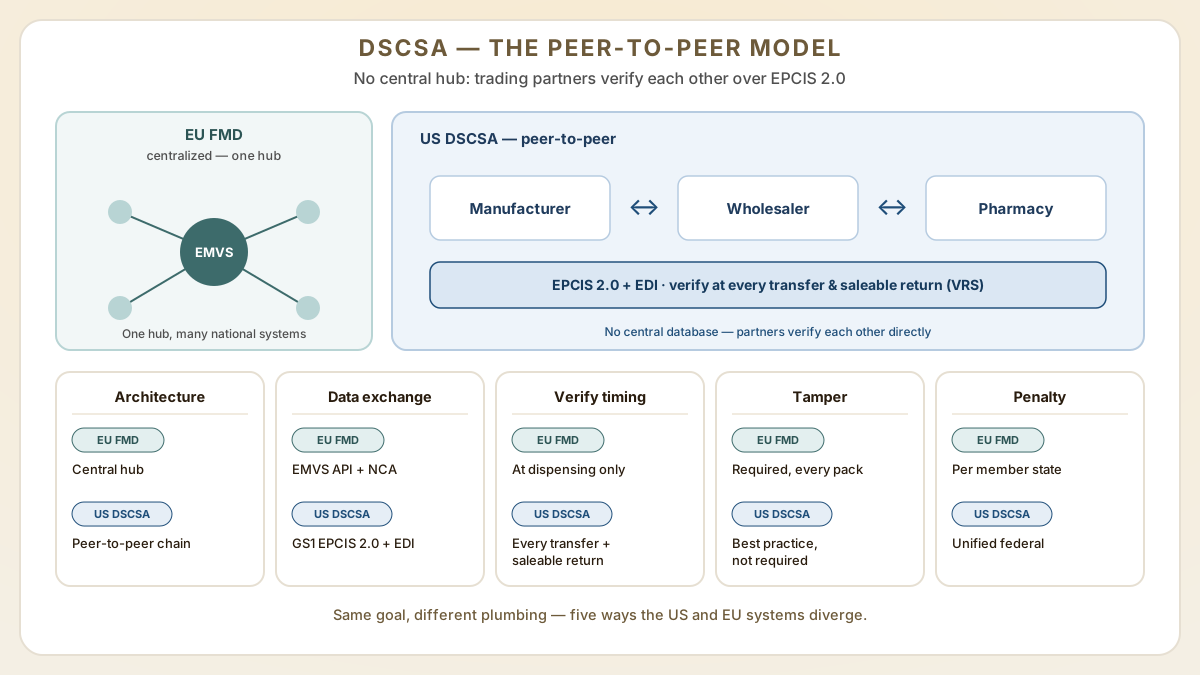
- Architecture: DSCSA is peer-to-peer (manufacturer ↔ wholesaler ↔ pharmacy via EPCIS 2.0); FMD is centralized (manufacturer → EMVS hub → pharmacy verification).
- Data exchange standard: DSCSA runs on GS1 EPCIS 2.0 + EDI between trading partners; FMD uses the EMVS API plus custom NCA interfaces.
- Verification timing: DSCSA verifies at every transfer and saleable return; FMD verifies at dispensing only. DSCSA is transactional, FMD is endpoint.
- Tamper-evident: explicitly required by FMD; under DSCSA it's best practice, not always mandatory.
- Penalty severity: FMD penalties vary by member state; DSCSA penalties are unified federal. Either regime can pull non-compliant product from the market.
How do you build a multi-region serialization program?
Running a separate serialization program for every country is how an operations team burns its budget and its weekends. Nobody does it twice. The winning approach is design-once, adapt-at-the-edge — and in practice it comes down to five moves.
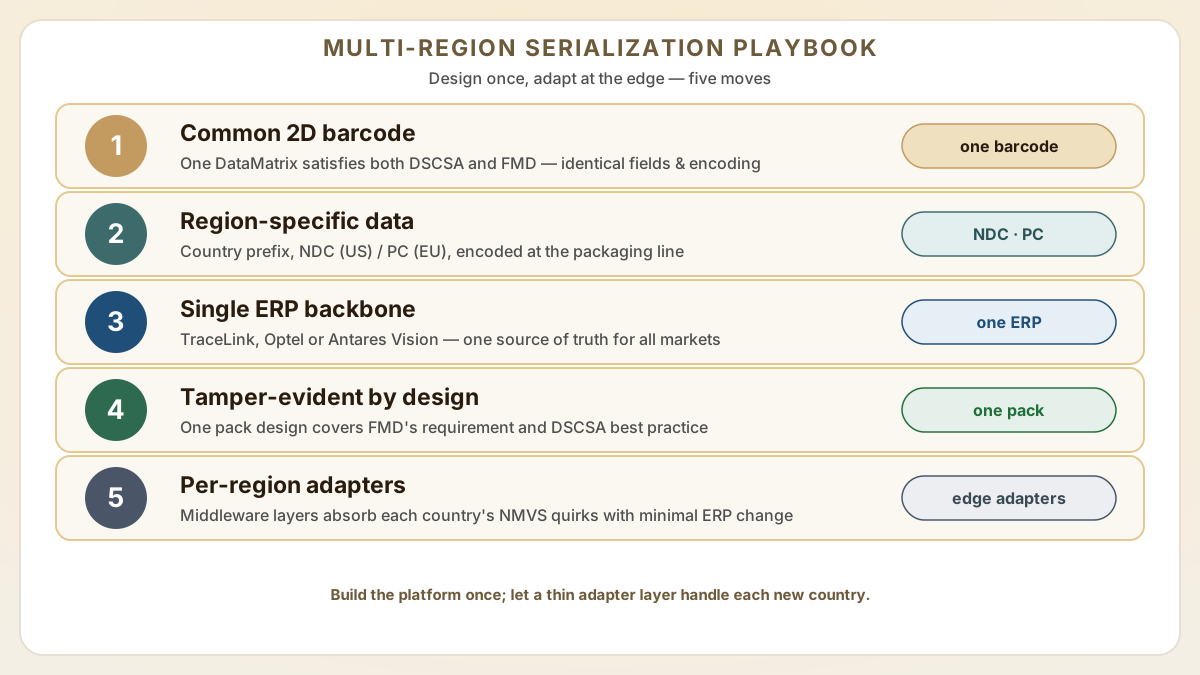
- Common 2D barcode format: a DataMatrix with a GS1 element string. The same physical barcode satisfies both DSCSA and FMD — identical data fields and encoding.
- Region-specific data: the GTIN structure carries a country prefix, NDC for the US, PC (Product Code) for the EU. Encode it at the packaging line based on the destination market.
- Single ERP backbone: serialization data lives in one system (typically TraceLink, Optel or Antares Vision) that publishes to DSCSA partners and the EMVS hub from the same source of truth.
- Tamper-evident packaging design: design once for FMD's requirement and the same pack covers DSCSA best practice. An optional NFC/RFID tamper-detect layer adds electronic verification.
- Per-region deviation handling: NMVS systems differ slightly country to country, so build region adapter layers in middleware to keep ERP changes minimal when onboarding a new market.
Where the two regimes actually diverge in 2026
The dust from the 2024–2025 DSCSA deadline scramble has finally settled. After the November 2024 stabilisation period and the October 9, 2024 staggered exemptions that expired through 2025, DSCSA and EU FMD have settled into a stable, side-by-side pattern. IntuitionLabs's April 2026 DSCSA-vs-EU FMD guide and EMVO's published EMVS connectivity figures remain the most-cited public references. Five concrete divergences still matter for global pharma operations leaders today.
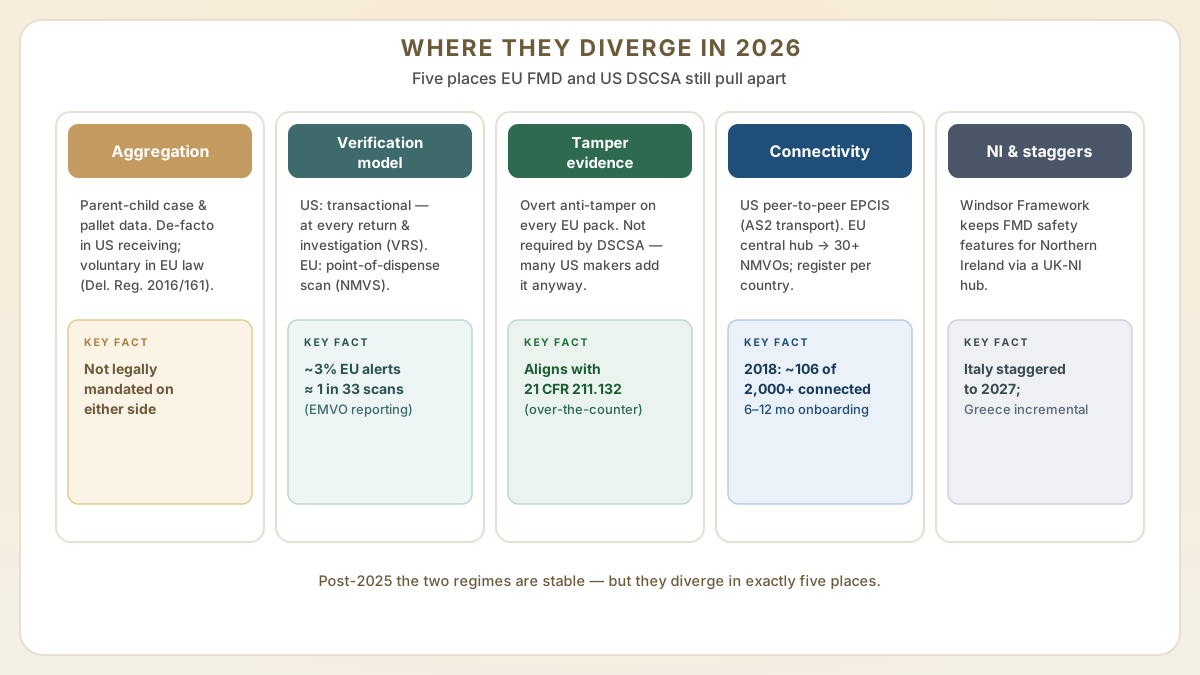
- Aggregation: in practice, DSCSA EPCIS event flows lean on parent-child case-pallet aggregation for receiving efficiency — even though the law does not legally mandate it. EU FMD deliberately left aggregation voluntary in Delegated Regulation 2016/161; many EU operators implement it internally for recall workflows, but it is not a regulatory deliverable.
- Verification model: DSCSA is transactional — the wholesaler verifies serial-level data on saleable returns and during suspect-product investigations, backed by the GS1/HDA Verification Router Service (VRS). EU FMD is point-of-dispense — the pharmacist scans against the National Medicines Verification System (NMVS) before handing the pack over, with EMVO reporting alert rates around 3% (roughly 1 in 33 scans) that need human follow-up.
- Tamper evidence: EU FMD requires an overt anti-tamper feature on every pack (foil seal, breakable cap, perforated film). DSCSA does not — though many US manufacturers add it anyway, since tamper evidence also aligns with 21 CFR 211.132 (over-the-counter) and FDA Quality Systems expectations for many product classes.
- Connectivity model: DSCSA uses peer-to-peer EPCIS exchanges (AS2 transport, EPCIS 1.2/2.0 messages) between trading partners. EU FMD uses a centralised hub (EMVO European Hub → 30+ NMVOs); manufacturers register their packs with every NMVO of the countries they distribute into. EMVO reported in 2018 that only ~106 of 2,000+ EU manufacturers were fully connected at the time — connectivity has matured since, but multi-country onboarding still eats 6-12 months for new entrants.
- Northern Ireland and member-state staggers: post-Brexit, the Windsor Framework keeps FMD safety features in place for packs supplied to Northern Ireland, with verification managed through UK-NI hub arrangements. Italy is still running a multi-year staggered FMD rollout (granted until 2027); Greece continues incremental adoption. Multinationals have to keep a per-country onboarding tracker rather than assume EU-wide uniformity.
Quick reference: side-by-side compliance comparison
Keep this one within reach. The comparison below lines up US DSCSA and EU FMD across the dimensions operations leaders ask about most — every data point aligned with public regulatory sources (the FDA DSCSA program page, EU Commission Delegated Regulation 2016/161, EMVO updates) and IntuitionLabs's 2026 multi-region serialization guide.
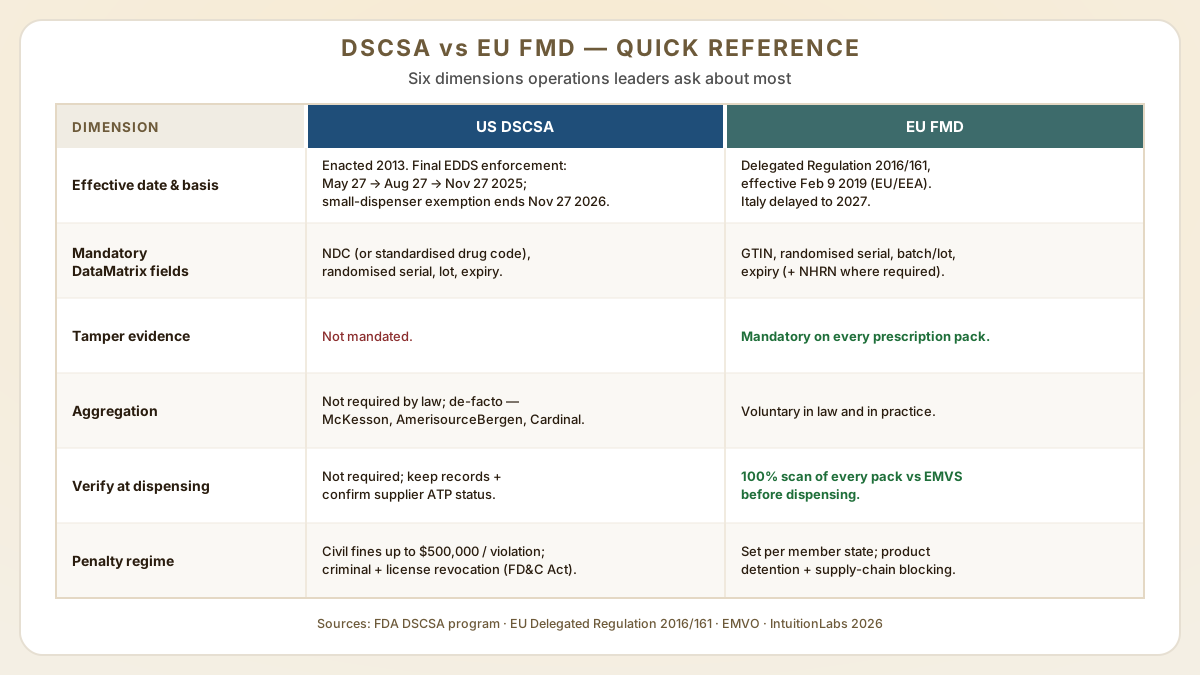
- Effective date and basis: DSCSA was enacted in 2013, with final EDDS-phase enforcement rolling out May 27 2025 (manufacturers / repackagers) → August 27 2025 (wholesalers) → November 27 2025 (dispensers with ≥26 full-time employees) → November 27 2026 (end of the small-dispenser exemption). EU FMD: Delegated Regulation 2016/161, effective Feb 9 2019 across the EU/EEA; Italy delayed to 2027.
- Mandatory DataMatrix fields: DSCSA — NDC (or other standardised drug code), randomised serial, lot, expiry. EU FMD — GTIN, randomised serial, batch/lot, expiry, plus an optional national reimbursement number (NHRN) where a member state requires it.
- Tamper evidence: DSCSA — not mandated. EU FMD — a mandatory anti-tamper feature on every prescription pack.
- Aggregation: DSCSA — not legally required, but adopted de facto because the largest US distributors (AmerisourceBergen, McKesson, Cardinal Health) demand parent-child data on receiving. EU FMD — voluntary in law, optional in practice.
- Verification at dispensing: DSCSA — not required; the dispenser keeps transaction records and must confirm each supplier's Authorized Trading Partner (ATP) status. EU FMD — a mandatory 100% scan of every pack at the pharmacy or hospital before dispensing, checked against the EMVS national repository.
- Penalty regime: DSCSA — civil fines up to $500,000 per violation, criminal charges for intentional violations, and license revocation under the FD&C Act. EU FMD — penalties set by each member state's national competent authority, with product detention and supply-chain blocking the most common enforcement levers in practice.
Useful next pages
Use these linked product, guide and comparison pages to keep the next click specific and practical.
Multi-region pharma serialization
DSCSA + FMD compatible serialization, RFID/2D barcode hybrid solutions and EPCIS-EMVS integration.
Authority references for serialization programs
Primary regulatory and industry sources for DSCSA / EU FMD project teams.
FAQ
Can the same barcode satisfy both DSCSA and FMD?
Yes — the GS1 DataMatrix with element string format works for both. Differences are in the data fields encoded (NDC for US, PC for EU) and back-end systems consuming the data. Single physical barcode, dual regulatory satisfaction.
Do I need different RFID tags for EU vs US?
No. UHF EPC Gen2 tags work in both regions when frequencies match (US 902-928 MHz, EU 866-868 MHz). Multi-region tags labeled 'global' or 'wide-band' work in both bands.
What's the cost difference between FMD-only and FMD+DSCSA?
Single-region serialization typically runs $5-15M for tier-2 manufacturers. Adding DSCSA on top of existing FMD adds $2-5M for EPCIS integration and distribution-partner workflow. Cost share favors multi-region from day 1.
Are EU FMD and DSCSA going to converge?
Some technical alignment over time (both use GS1 standards) but architectural difference (centralized vs peer-to-peer) is unlikely to merge. Multinationals plan for permanent dual compliance, with operational variance also for Brazil ANVISA, China NMPA, Russia Chestny Znak and the GCC track-and-trace programs.
How does Brexit affect serialization for the UK and Northern Ireland?
Great Britain (England, Scotland, Wales) left the EU EMVS at the end of the Brexit transition; UK regulators have not yet established a permanent replacement, so GB packs ship without active FMD verification at dispense (anti-tamper still required as a UK MHRA expectation). Northern Ireland continues under the Windsor Framework — FMD safety features apply and verification is coordinated through dedicated UK-NI hub arrangements (per IntuitionLabs's April 2026 update). Multinationals serving UK + EU run distinct artwork sets for GB vs NI vs EU as a result.
What about other regions besides US and EU?
Brazil's ANVISA serialization rollout completed major milestones in 2022-2023 with a national SNCM traceability system; China NMPA operates its own coding scheme via the National Drug Code Service; Russia's Chestny Znak crypto-code system is mandatory across virtually all retail product categories including pharmaceuticals; the GCC (Saudi Arabia and partners) operate Saudi DRC and equivalent. IntuitionLabs lists 78+ country mandates in its global serialization guide; multinationals typically converge on a single serialization platform (TraceLink, Optel, SEA Vision, Antares Vision) with country-specific gateways.
Proud Tek is a Shenzhen-based RFID & NFC manufacturer supplying hotel chains, transit operators, event venues and retail brands worldwide. Every order includes free samples, RF testing and dedicated project support.
Get a Quick Quote
Tell us about your project and we'll respond within one business day. Fields marked (asterisk) are required.