
RAIN RFID 2026
UHF RAIN RFID in 2026
Trends and Mandates
Quick answer
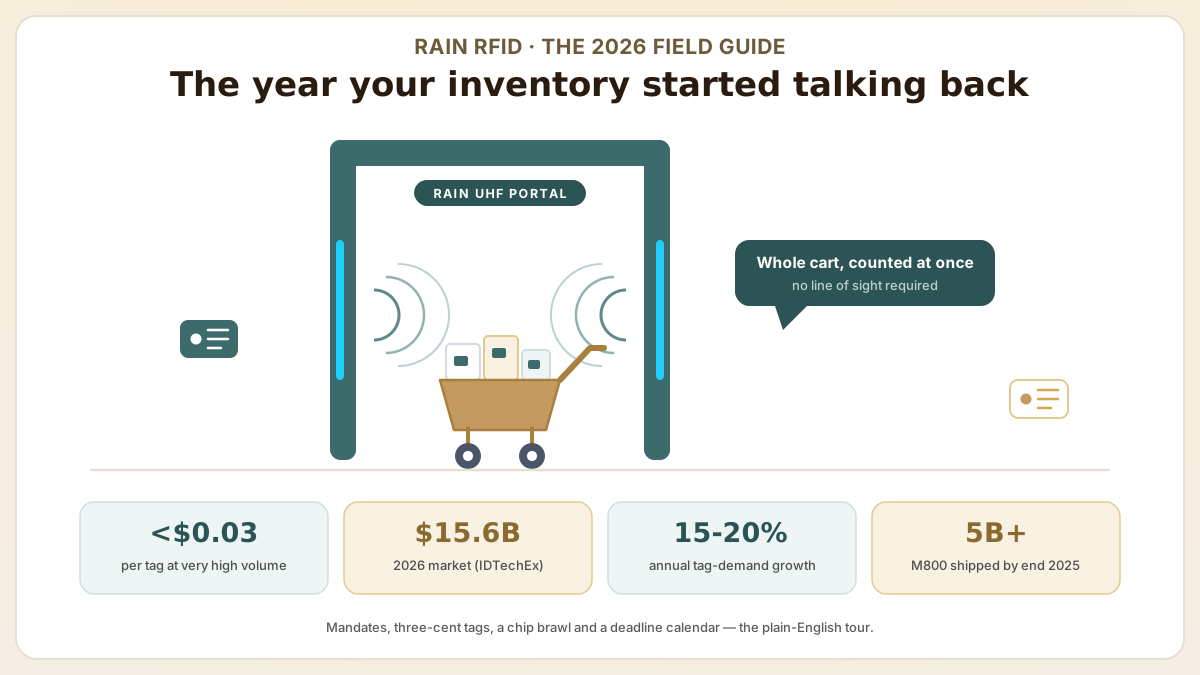
UHF RAIN RFID keeps accelerating in 2026: tags below $0.03 at volume, a $15.6B market, and retail mandates spreading well beyond apparel. Next-generation chips, the Gen2X protocol and the EU Digital Product Passport set the 2026-2028 agenda — here is the calendar, and what to lock in early.
- Mandates keep multiplying: after Walmart and Target drew first blood, more major retailers are demanding item-level RFID tags across more product categories in 2026 — resistance is, appropriately, being tracked.
- Tag costs below $0.03 — next-generation chips (Impinj M800, NXP UCODE 9) and larger production volumes drive UHF tag costs below $0.03 at very high volumes, enabling tagging of lower-value items.
- Sustainability got a job for RFID: RAIN now underpins circular-economy tracking, recycling verification and the EU Digital Product Passport — which is arriving whether brands finished their homework or not.
At a glance
Use these short answers to decide whether this page matches the project before moving into the detail.
Key takeaway
Mandates keep multiplying: after Walmart and Target drew first blood, more major retailers are demanding item-level RFID tags across more product categories in 2026 — resistance is, appropriately, being tracked.
What are the key RAIN RFID trends in 2026?
Every January, someone on a procurement team opens an email from a major retailer, scrolls down to the words 'item-level RFID,' and quietly reschedules their entire year...
Next step
Ready to move forward? Start your inquiry to get specific answers for this project.
Discuss your 2026 RFID needsWhat are the key RAIN RFID trends in 2026?
Every January, someone on a procurement team opens an email from a major retailer, scrolls down to the words 'item-level RFID,' and quietly reschedules their entire year. RAIN RFID is no longer a pilot you get to mull over by the coffee machine — it is a mandate calendar you get to survive. Here is what actually moved this year, and which of it belongs on your purchase order, as opposed to your anxiety list.
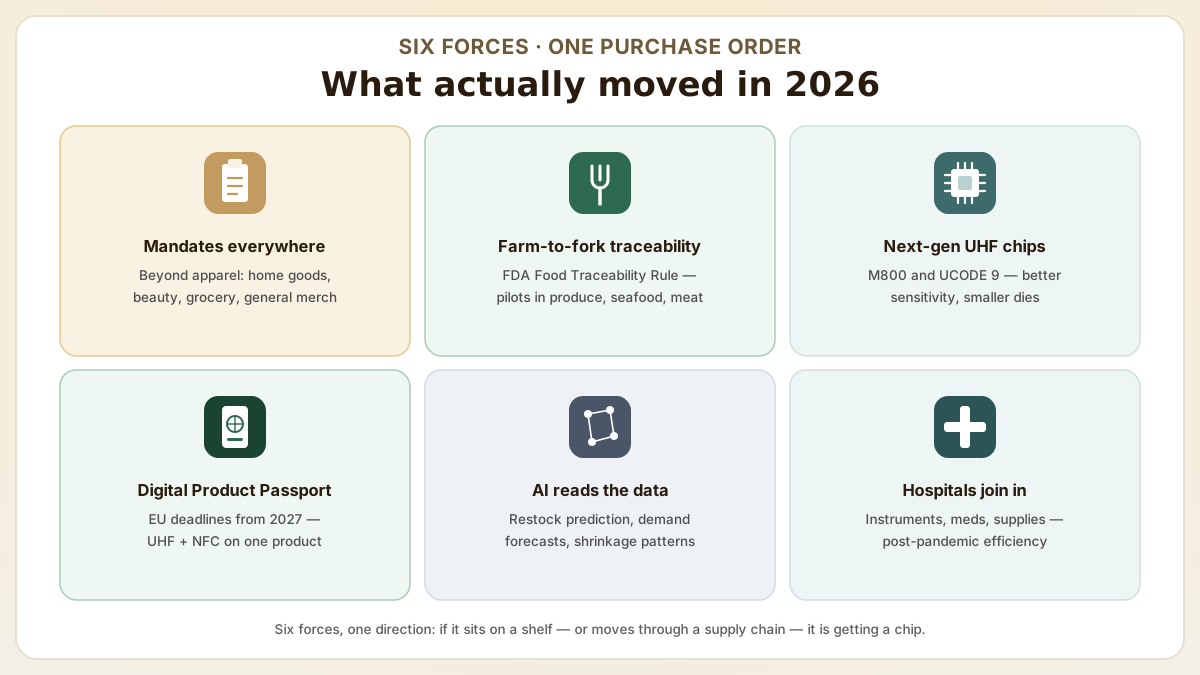
- Retail mandates keep multiplying: retailer RFID mandates are expanding beyond apparel into home goods, beauty, grocery and general merchandise categories, creating demand for billions of additional RFID tags annually. Translation: if it sits on a shelf, it is getting a chip.
- Item-level food traceability, now with receipts. The FDA Food Traceability Rule — plus shoppers who want to know their salmon's life story — is driving RFID pilots into fresh produce, seafood and meat supply chains. Your dinner now has a paper trail.
- Next-generation UHF chips. Impinj M800 and NXP UCODE 9 offer improved sensitivity, smaller die size and advanced features like authentication and enhanced user memory, enabling new application scenarios.
- Digital Product Passport readiness. Brands are wiring up RFID-based DPP ahead of 2027 EU deadlines, with dual-technology approaches (UHF for the supply chain + NFC for nosy shoppers) gaining traction. Two radios, one product.
- AI-powered RFID analytics. Machine learning applied to RFID data now predicts replenishment, forecasts demand, sniffs out shrinkage patterns and automates markdown optimization in retail. The tags gather the clues; the AI plays detective.
- Healthcare RFID growth: hospital RFID adoption for instrument tracking, medication management and supply chain automation accelerates as health systems claw back post-pandemic efficiency — because misplacing a surgical tray ruins everyone's afternoon.
What these trends mean for RFID tag buyers
None of this matters until it lands on your cost line, so here is the view from the purchase order. The pattern repeats every year with the reliability of a sitcom laugh track: the tags get cheaper, the encoding gets fussier, and the buyers who lock in capacity early are the ones not paying spot-market prices while everyone else refreshes their supplier's inbox in December.
- The volume commitments are coming: as more categories require RFID, tag volume commitments grow with them. Early supply agreements with manufacturers lock in pricing and production capacity. Future-you will send a thank-you card.
- Two radios beat one: demand for tags combining UHF (supply chain) and NFC (consumer interaction) keeps climbing. Dual-technology inlays and labels are becoming more common — and more cost-effective.
- Sustainability in tag materials. Brands increasingly require RFID tags made from recyclable or bio-based materials; paper-based UHF labels and tags without plastic components are quietly winning the RFQ beauty contest.
- Encoding grew a personality: as RFID applications expand beyond simple identification into authentication, DPP data and serialization, encoding requirements at the tag factory become more complex — and considerably more valuable than a plain EPC write.
- Mind who can actually deliver. With RFID tag demand growing 15-20% annually, a manufacturer with real production capacity is worth its weight in inlays — reliable supply is now a feature, not a footnote.
Which RAIN RFID applications grew fastest in 2026?
2026 is the year RAIN RFID escaped the retail sandbox and wandered into industries that historically ran on barcodes, clipboards or pure optimism. These five application categories drove the bulk of new tag volume.
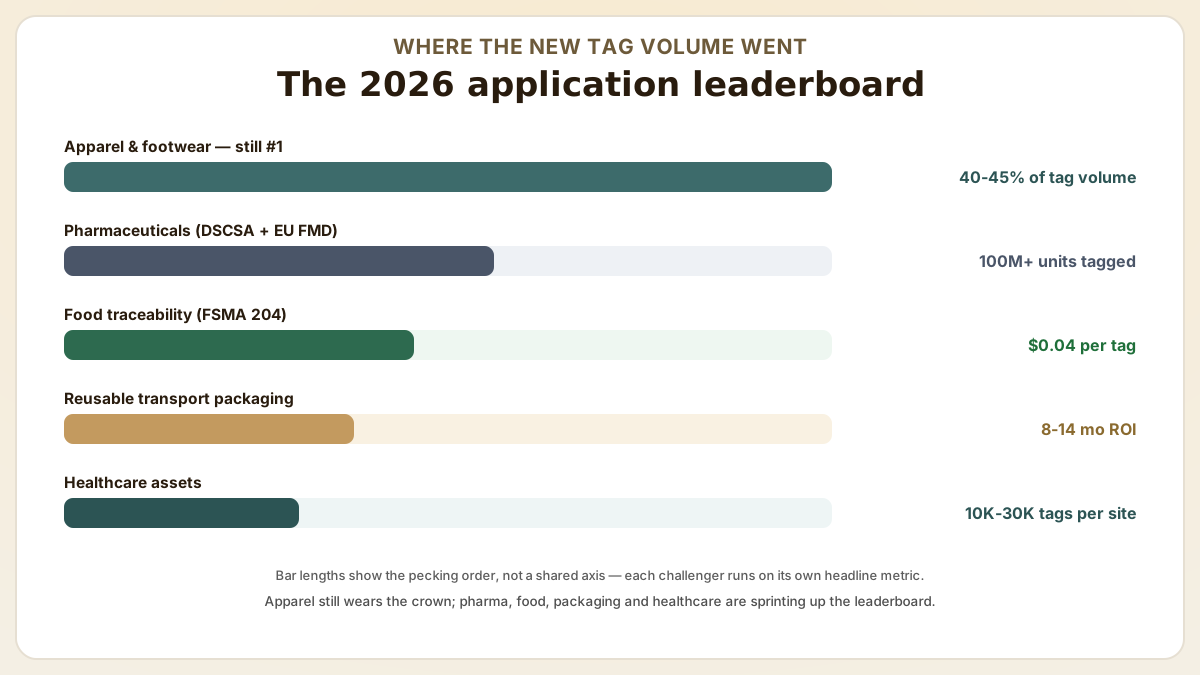
- Apparel and footwear: still the heavyweight champion at 40-45% of 2026 RAIN tag volume, driven by Walmart, Target and EU EPR (Extended Producer Responsibility) regulations forcing item-level tagging. The category that started it all is still eating the biggest slice.
- Pharmaceuticals: DSCSA enforcement deadlines in the US and EU FMD compliance expanded RFID into unit-level drug packaging, with major wholesalers (McKesson, Cardinal Health) tagging 100M+ units in 2026.
- Food traceability: FSMA Section 204 requirements went into effect, pushing produce and seafood operators to RAIN-tag pallets and cartons. Cost-per-tag dropped to $0.04 to make per-pallet tagging pencil out for low-margin commodities.
- Reusable transport packaging: pallet pools, beer kegs and reusable totes adopted RAIN at scale to track asset cycles and recover write-offs. ROI is typically 8-14 months when shrinkage runs above 5% annually — someone finally figured out where the kegs go.
- Healthcare assets: hospitals tagged surgical instruments, IV pumps and wheelchairs to fight loss-shrinkage and meet Joint Commission documentation requirements. Average hospital deployment hit 10K-30K tags — a lot of newly findable wheelchairs.
Chip-level competitive landscape — Impinj M800 vs NXP UCODE 9 / UCODE X in 2026
Chip selection is the single most consequential procurement decision for a RAIN program: it sets read sensitivity, ARC certification class, encoding feature set and supply-chain risk for the next 3-5 years — you are essentially picking a roommate for half a decade. The competitive landscape shifted hard in late 2025 / early 2026 as Impinj M800 hit volume and NXP fired back with UCODE X.
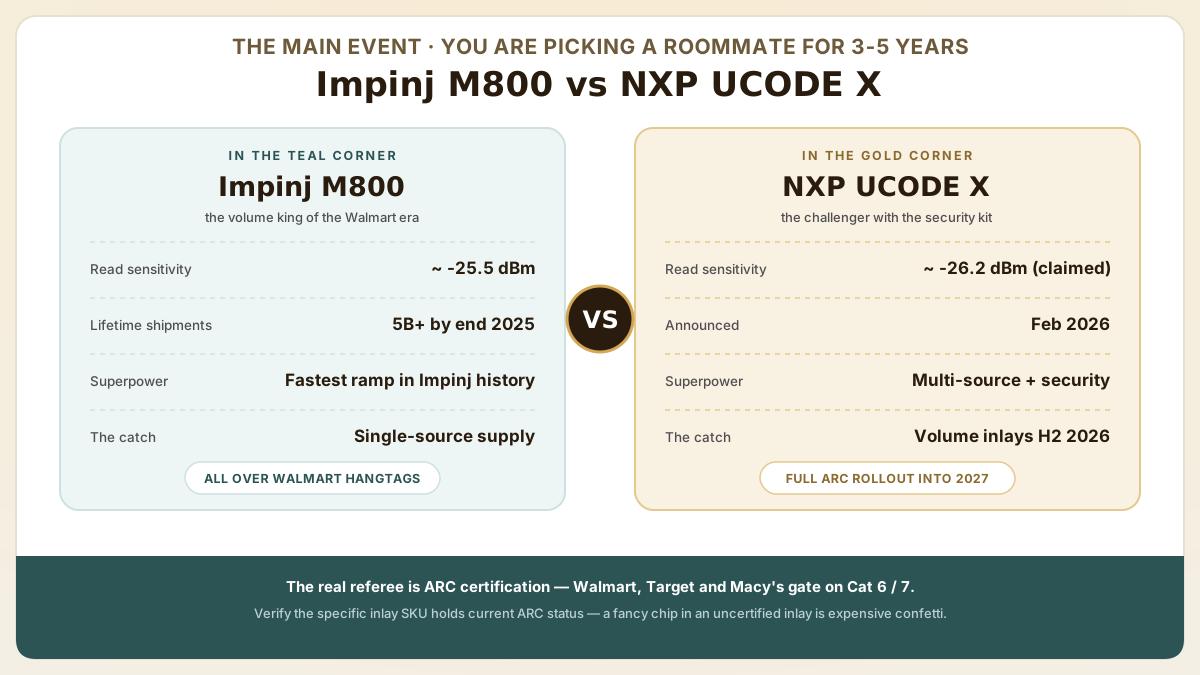
- Impinj M800 series: surpassed 5 billion lifetime shipments by end of 2025 — fastest-ramping product in Impinj history. Read sensitivity around -25.5 dBm sets a new mainstream benchmark; widely used for Walmart-mandate apparel hangtags and home-goods labels. Single-source supply risk is the trade-off vs NXP / Quanray multi-source positions.
- NXP UCODE 9: long-running incumbent with strong security feature set (TID lock, AES Auth on certain variants). Trails the M800 series on raw sensitivity but remains a default for vendors who prioritize multi-source supply or anti-counterfeit chip options. Used in many EU DPP and Macy's vendor-approved inlay families.
- NXP UCODE X (announced Feb 2026 per public NXP / industry coverage): -26.2 dBm read sensitivity, billed as the new industry benchmark. Targeted at high-volume retail, pharma and logistics; expect production-volume inlays through the second half of 2026 with full ARC certification rollout into 2027.
- ARC certification matters more than the chip badge: Walmart, Target and Macy's all gate on ARC category (typically Cat 6 / 7 for apparel and home goods) — the chip family is necessary but not sufficient. Always verify the specific inlay SKU holds current ARC status before committing volume; a fancy chip in an uncertified inlay is just expensive confetti.
- Multi-source is now standard: tier-1 retailers and tier-1 brands increasingly require dual-source qualification — one Impinj M-series inlay and one NXP UCODE-series inlay qualified for the same SKU. This insulates the program from a single-vendor allocation event and is now standard procurement practice for 10M+ unit programs.
Gen2X protocol expansion and battery-free sensing — what changed in late 2025
Between November 2025 and early 2026 the RAIN industry hit two protocol-level plot twists that will shape 2026-2028 deployments — both out of the RAIN Alliance and Impinj coordination work. Procurement teams scoping new readers and inlays should know what these features actually unlock, beyond sounding impressive in a status meeting.
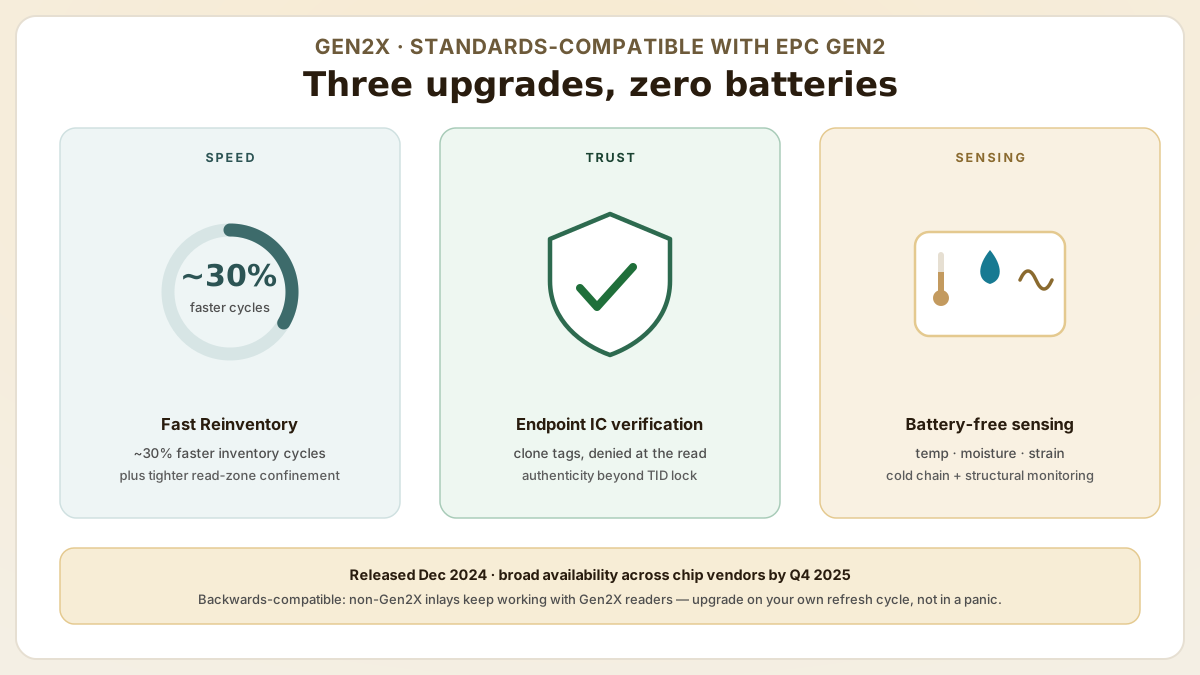
- Gen2X full ramp-up: released December 2024, Gen2X is a standards-compatible enhancement to the EPC Gen2 air-interface protocol, and by Q4 2025 it had reached widespread industry availability across multiple chip vendors. It delivers ~30% faster inventory cycles via Fast Reinventory, improved reader sensitivity and read-zone confinement, plus endpoint IC verification that helps swat fraudulent tags.
- Impinj M770/M780 Gen2X support (November 2025): Impinj added Gen2X to its M770 and M780 endpoint-IC families, expanding Gen2X reach into logistics, manufacturing, automotive and healthcare beyond initial retail focus.
- Anti-counterfeit at the protocol layer: Gen2X's endpoint IC verification adds a layer of tag authenticity beyond TID lock. For brands fighting clone tags entering the supply chain (counterfeit luxury, pharma diversion), it folds what previously required separate authentication systems into the read itself.
- Avery Dennison + Impinj M800 integration (late 2025): Avery Dennison fully integrated Impinj M800 and Gen2X across its global product lineup — effectively guaranteeing massive M800 volume for 2026 and locking in Gen2X compatibility across one of the largest converter footprints worldwide.
- Battery-free sensing — tags that can feel things: the RAIN Alliance's 2026 working agenda promotes battery-free sensing chips that report temperature, moisture or strain via the same passive UHF interface. Early production-ready sensing inlays target cold chain (pharma, perishables) and structural monitoring; full production volumes expected late 2026 / 2027.
Which retail mandates and regulatory deadlines drive 2026-2027 demand?
Retail mandates are the gravitational center of RAIN demand. Know the calendar of category and regional roll-outs, and your supply-chain team can pre-position tag capacity instead of paying spot-market ransom. Here is the 2026-2027 gauntlet — mind the chargebacks.
- 2025-2026 · Walmart Phase 3
Electronics, consumer health, sporting goods and baby gear join the mandated category list, with read-rate scorecards going live and chargebacks $2-5/unit for missed reads. The scorecard is watching.
- 2025-2027 · Target T3 rollout
Small electronics, toys and seasonal goods phased into a 95% threshold through 2027; chargebacks $1.50-3.50/unit. Same chip family interoperable with the Walmart program.
- 2025-2027 · Macy's Wave 3 / 4
Home soft goods active now, home hardlines pilot in 2026, enforcement 2027. Macy's expense offset $0.75/non-functioning unit (effective July 2023, see Macy's Vendor Standards).
- 2027 → 2028 · EU ESPR / DPP for textiles
A 2027 delegated act plus an 18-month transition lands enforcement in 2028 — driving dual-tech (UHF + NFC) and consumer-facing data-carrier requirements on top of supply-chain RFID.
- Jan 2026 · FSMA 204 (US food traceability)
January 2026 enforcement put produce, seafood and high-risk fresh items under traceability requirements; RAIN at pallet/case level emerged as the cost-effective compliance tool given $0.04-0.07 per UHF label.
- In effect · DSCSA (US pharma serialization)
Unit-level serialization is in effect; aggregation requirements push wholesalers and 3PLs toward RAIN reads at receiving and dispense — with unit-of-use RAIN pilots emerging, driven by recall efficiency.
Useful next pages
Use these linked product, guide and comparison pages to keep the next click specific and practical.
Latest RAIN RFID tag products
Next-generation UHF RFID tags and inlays.
Gen2X and battery-free sensing references
Industry coverage of the late-2025/2026 protocol and platform shifts driving deployments.
RAIN RFID standards and benchmarks
Authoritative external sources for RAIN performance, certification and trade data.
FAQ
Which retailers are mandating RFID in 2026?
Walmart keeps expanding its RFID mandate to categories beyond apparel. Target, Macy's, Kohl's, Nike, Zara (Inditex), H&M, UNIQLO, Marks & Spencer and other major retailers run active RFID programs with widening category coverage. In 2026, home goods, beauty and grocery categories are seeing new pilot mandates. Check with your specific retail partners for their current tagging requirements — the list only grows.
How low will UHF RFID tag prices go?
At very high volumes (100+ million tags), UHF RFID paper labels are approaching $0.02-$0.03 per tag in 2026. The cost floor is determined by chip die cost, antenna material and converting. Next-generation smaller-die chips (M800, UCODE 9) and improved manufacturing efficiency continue driving costs down, but the floor for a functional UHF tag with chip, antenna and label material is approximately $0.015-$0.02 at the current technology level.
Should we start RFID implementation now or wait for further cost reductions?
Start now. The ROI from improved inventory accuracy, reduced labor and decreased shrinkage is already strong at current tag prices, and waiting for marginal further cost reductions just delays those benefits. Many retailers are imposing RFID compliance deadlines anyway, and early implementation builds internal expertise. The recommended play: pilot one category, then expand.
How should I choose between Impinj M800 and NXP UCODE for a retail mandate?
For mainstream retail apparel and home goods both work — both M800 family and NXP UCODE 9 / X have ARC-certified inlay options qualified for Walmart, Target and Macy's. Decide on three axes: (1) read sensitivity headroom (M800 ~-25.5 dBm, UCODE X ~-26.2 dBm — meaningful in dense-rack apparel scans); (2) supply-chain risk (Impinj is single-source chip vendor whereas NXP customers can multi-source through partners); (3) inlay availability and ARC status with your incumbent label converter. Tier-1 programs at 10M+ units typically dual-qualify one chip family from each vendor as procurement insurance.
Should we wait for Gen2X-enabled inlays before rolling out a new RFID program?
No, but plan for it. Gen2X is backwards-compatible with the standard EPC Gen2 protocol — readers and tags interoperate even if only one side is Gen2X-enabled, falling back to standard Gen2 behavior. So a 2026 deployment using non-Gen2X inlays still works with future Gen2X readers. The reasons to deliberately specify Gen2X-enabled inlays today: 30% faster inventory cycles (matters at high tag-density apparel and warehouse), endpoint IC verification (anti-counterfeit), and improved read-zone confinement (matters for adjacent-zone read-leakage in dense store layouts). For new programs in 2026 the modest premium for Gen2X-enabled inlays (Impinj M770/M780/M800 family + Avery Dennison converted) is worth specifying as default; for legacy programs already running on M730 / UCODE 8, the upgrade can wait for the next inlay refresh cycle.
How does ARC certification at Auburn RFID Lab fit into retail mandates?
ARC (Auburn RFID certified inlay categories) is the test framework Walmart, Target, Macy's and most other US retail mandates rely on for inlay performance. Categories (Cat 1-9) describe the use case — apparel, home goods, electronics, on-metal — and each retailer publishes which categories satisfy which product type. The chip is necessary but not sufficient: the specific assembled inlay SKU must hold current ARC status. Verify the exact SKU you actually buy before committing to volume; the chip badge alone won't cut it.
Proud Tek is a Shenzhen-based RFID & NFC manufacturer supplying hotel chains, transit operators, event venues and retail brands worldwide. Every order includes free samples, RF testing and dedicated project support.
Get a Quick Quote
Tell us about your project and we'll respond within one business day. Fields marked (asterisk) are required.