
Industrial RFID
RFID LED Tags for Warehouse Item Location
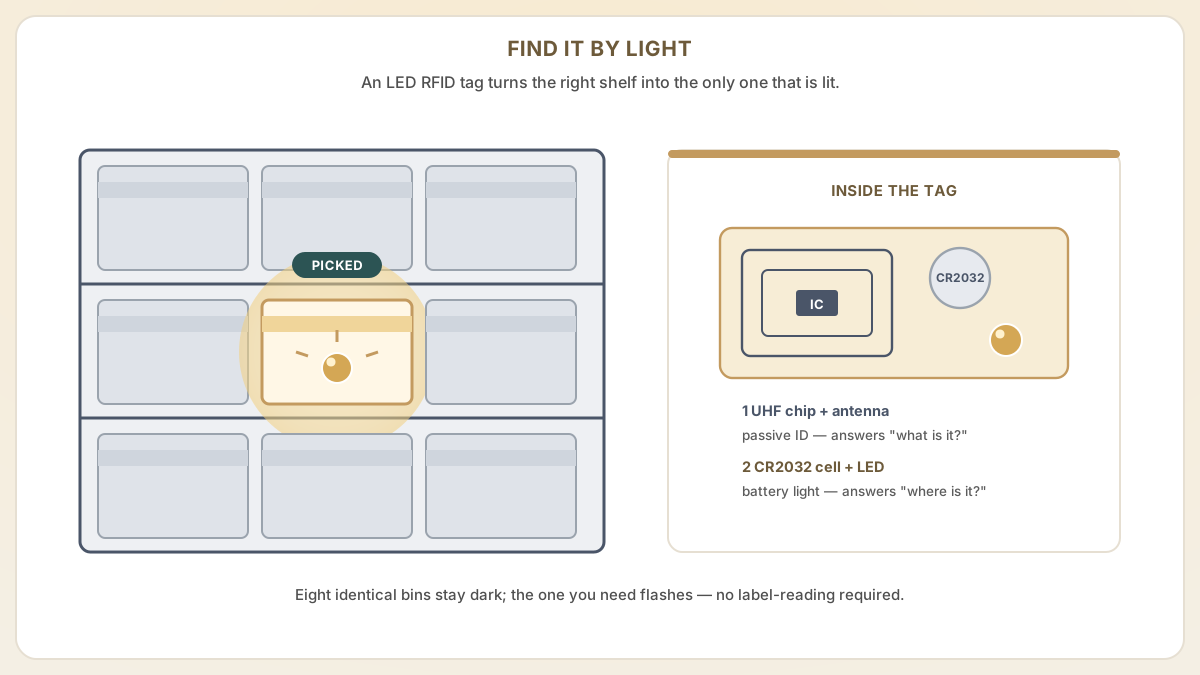
Quick answer
LED RFID tags cut warehouse item-search time by 70-90 percent by flashing a light on the exact shelf the picker needs. This deep-dive covers how the battery-assisted UHF LED tag works, pick-to-light integration with your WMS, battery-life and maintenance planning, deployment steps, and when ceiling-mounted RTLS beats per-item tags — for operations teams evaluating visual-location RFID solutions.
- LED RFID tags reduce item search time by 70-90 percent by providing a visible flashing indicator at the exact storage location.
- Pick-to-light integration with WMS automates LED activation during order picking, eliminating label-reading search in dense racking.
- Battery-assisted LED tags operate for 2-4 years with typical activation patterns, keeping maintenance overhead low.
At a glance
Use these short answers to decide whether this page matches the project before moving into the detail.
Key takeaway
LED RFID tags reduce item search time by 70-90 percent by providing a visible flashing indicator at the exact storage location.
What is the warehouse search problem?
A picker gets an order, walks into an aisle that looks exactly like every other aisle, and starts reading shelf labels one by one, like someone hunting for a single name...
Next step
Ready to move forward? Start your inquiry to get specific answers for this project.
Request LED tag samplesWhat is the warehouse search problem?
A picker gets an order, walks into an aisle that looks exactly like every other aisle, and starts reading shelf labels one by one, like someone hunting for a single name in a phone book the size of a building. The walking and the squinting are the hidden tax on every order that ships. LED RFID tags attack that tax with a fix so literal it sounds like cheating: make the correct shelf light up. In a warehouse with thousands of storage locations, finding a specific item or container is a significant time cost. Operators walk aisles reading location labels and item identifiers, a process that accounts for 30-50 percent of total picking time in dense storage environments.
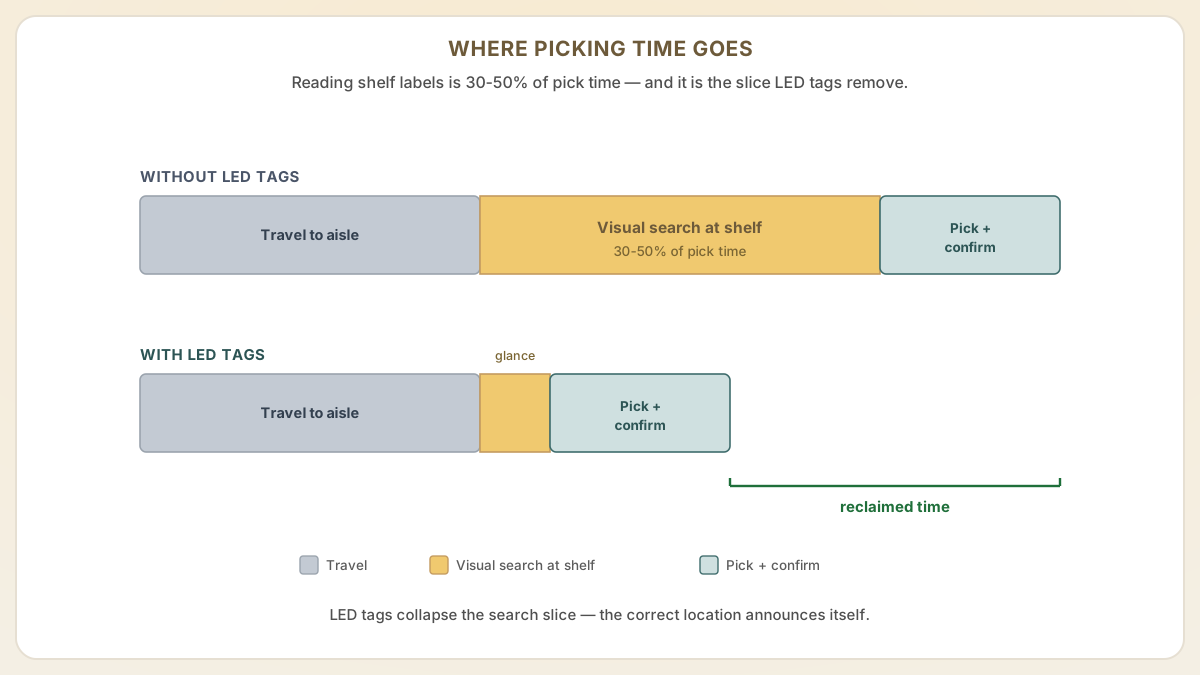
Traditional approaches to reduce search time include optimized slotting, zone picking and voice-directed systems, most of which still depend on barcode labels that peel or fade at the shelf face. These help but do not eliminate the visual search at the shelf face. An operator still needs to identify the correct bin, shelf position or container among dozens of similar-looking items. LED-enabled RFID tags solve this last-meter problem by making the target item visually self-identifying.
How LED RFID tags work
An LED RFID tag combines a standard UHF RFID chip and antenna with a small coin-cell battery and one or more LEDs. The tag operates in two modes: passive RFID for identification, and battery-assisted LED for visual indication — one piece of plastic leading a quiet double life. The anatomy below shows how the same tag answers both 'what is it?' and 'where is it?'.
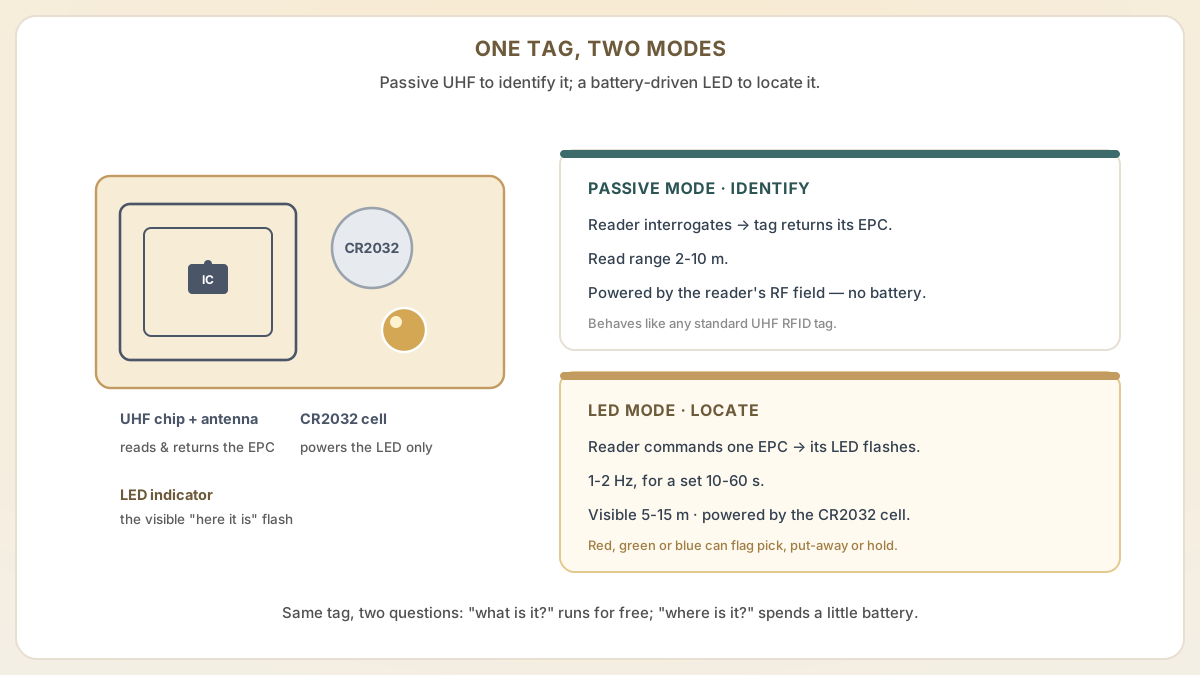
- In passive mode, the tag behaves like any UHF RFID tag. It responds to reader interrogation with its EPC identifier at read ranges of 2-10 meters.
- In LED mode, the reader sends a proprietary command to a specific tag EPC. The tag's microcontroller activates the LED, which flashes at a visible rate (typically 1-2 Hz) for a configurable duration (10-60 seconds).
- Some tags support multiple LED colors (red, green, blue) to indicate different statuses: pick, put-away, exception, quality hold.
- The LED draws power from the onboard coin-cell battery (CR2032 or similar), not from the reader's RF field, enabling bright visibility at distances of 5-15 meters in warehouse lighting.
- Tag form factors include adhesive labels (80 x 30 mm), hang tags with zip-tie attachment, and rigid-mount tags for shelving and racking.
How does pick-to-light workflow integration work?
The highest-value application of LED RFID tags is pick-to-light integration with the warehouse management system, where the WMS automatically activates the LED on the next item to pick as the operator moves through the warehouse. The operator stops navigating by location code and starts navigating by follow-the-blinking-light. The five-step loop below traces a single pick from list to confirmation and back.
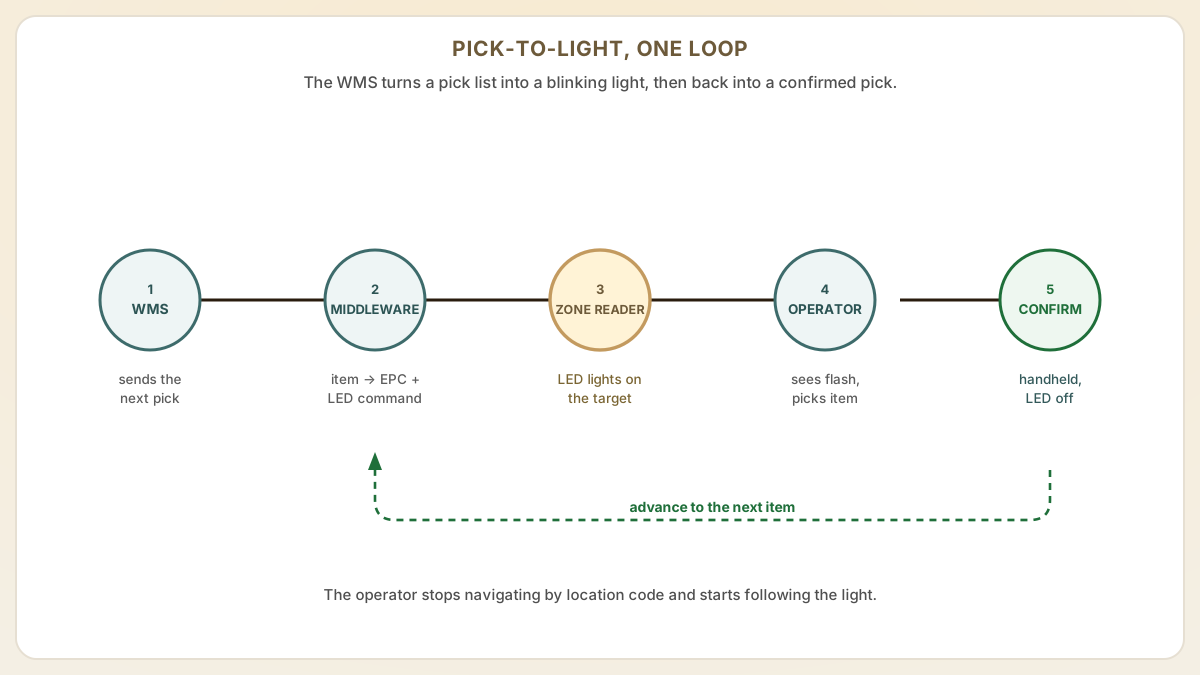
The workflow operates as follows: the WMS sends a pick list to the RFID middleware, which translates each pick-list item into a tag EPC and LED-activation command. As the operator enters a zone, the zone reader activates the LED on the target item. The operator sees the flashing light, picks the item, confirms the pick via handheld scanner, and the system deactivates the LED and activates the next target.
| Workflow Step | Without LED Tags | With LED Tags |
|---|---|---|
| Receive pick instruction | Read paper list or RF terminal screen | WMS sends pick to middleware automatically |
| Navigate to location | Walk to aisle and bay by location code | Walk to aisle; LED visible from aisle entry |
| Identify target item | Read shelf labels, match to pick list | LED flashing on target item/bin |
| Pick item | Pull item, verify by scanning barcode | Pull item, confirm pick via handheld |
| Average time per pick | 25-45 seconds | 10-20 seconds |
| Error rate | 1-3% mispicks | < 0.5% mispicks |
How do battery life and maintenance planning work?
Battery management is the primary maintenance consideration for LED RFID tags — boring right up until a whole facility's worth of cells comes due in the same month. Understanding battery consumption patterns enables accurate lifecycle planning and replacement scheduling. The curve below maps activation frequency to expected battery life.
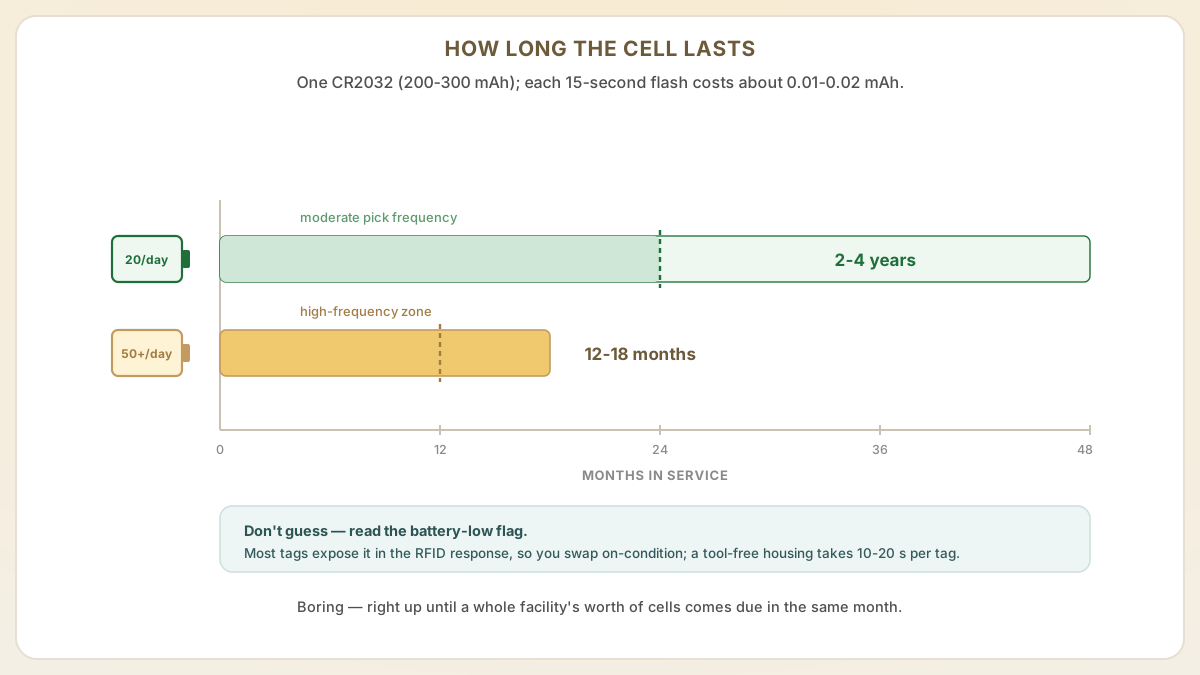
- A CR2032 coin-cell battery provides approximately 200-300 mAh capacity. Each LED activation of 15 seconds duration consumes approximately 0.01-0.02 mAh.
- At 20 LED activations per day (a moderate pick-frequency environment), battery life is approximately 2-4 years.
- High-frequency environments (50+ activations per day) may reduce battery life to 12-18 months.
- Battery-low indicators: most LED RFID tags include a battery-status flag in the RFID response that the middleware can read during normal inventory cycles to identify tags approaching end-of-battery-life.
- Replacement strategy: replace batteries on a scheduled basis (annually or bi-annually) during a planned maintenance window, or use the battery-low flag to replace on-condition. Battery replacement takes 10-20 seconds per tag with a tool-free snap-open housing.
What deployment considerations apply?
Deploying LED RFID tags in a warehouse requires planning for tag placement, reader infrastructure, middleware configuration and operator training.
- Tag placement: mount tags on the front face of bins, shelves or containers at operator eye level. Ensure the LED is visible from the aisle approach direction, not obstructed by adjacent items.
- Reader infrastructure: zone-level fixed readers (1-2 per aisle) or handheld readers with LED-command capability. Fixed readers enable automated pick-to-light; handhelds enable ad-hoc visual search.
- Middleware configuration: map each tag EPC to a WMS storage location and item identifier. Configure LED flash duration, color coding and zone-based activation rules.
- Operator training: 1-2 hours of floor training covering pick-to-light workflow, handheld search procedure and battery-replacement process. Operators typically reach full proficiency within one shift.
- Pilot recommendation: deploy LED tags in one high-density zone (200-500 locations) for a 30-day pilot to validate time savings and operator acceptance before facility-wide rollout.
How do LED RFID tags compare with overhead RTLS readers for the same job?
Pick-to-light is one solution to the visual-search problem; overhead real-time location systems (RTLS) are another. Both eliminate visual search at the shelf face — they just do it from opposite ends of the read path. Understanding the trade-offs helps you choose the right architecture for your facility's density, asset population and labor profile. The cost curve below marks the crossover where ceiling readers overtake per-item tags.
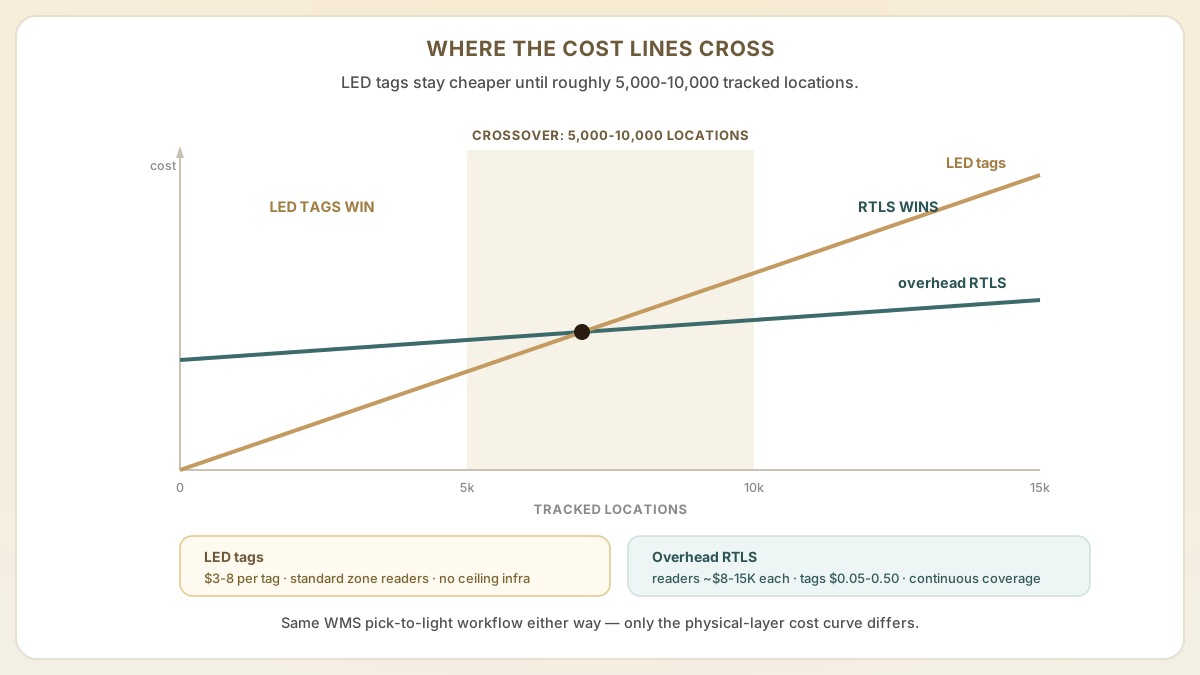
- LED tags (this article's focus): the indicator is on the asset itself. Cost concentrates in tag procurement (typically $3-8 per LED tag, plus battery replacement every 2-4 years per the CR2032 capacity math above). No ceiling infrastructure required beyond standard zone readers; the operator's eyes are the 'display' — works in any lighting where the LED is visible at 5-15m.
- Zebra ATR7000 ceiling RTLS: electronically steered beam-forming reader that processes hundreds of narrow flashlight-style beams simultaneously, delivering asset location accuracy within 2 ft / 0.6 m or less. Cost concentrates in ceiling readers (~$8-15K each in published list pricing) and antenna structure; tags are standard passive UHF inlays at $0.05-0.50.
- Impinj xArray Gateway: ceiling-mounted RTLS reader covering a 40-foot diameter when ceiling-mounted at 15 feet, distinguishing 52 distinct antenna beams. Same cost profile as ATR7000 — capex up front, low per-asset variable cost — and best fit for dense item-level applications in retail, healthcare and manufacturing.
- Cost crossover: LED tags win economically below ~5,000-10,000 tracked locations; overhead RTLS wins above that population because the per-tag cost stays at standard UHF prices instead of climbing to LED-tag prices. Both architectures support the same WMS pick-to-light workflow — just with different physical-layer cost structures.
- Hybrid pattern: many high-density warehouses run overhead RTLS for the asset population and reserve LED tags for the highest-value or most-frequently-picked SKUs where shelf-face visual indication adds the largest pick-time saving. The two architectures share the same EPC, middleware and WMS layers, so adding LED tags later is a software-config change, not a re-architecture.
What pick-to-light economics actually hold up under audit?
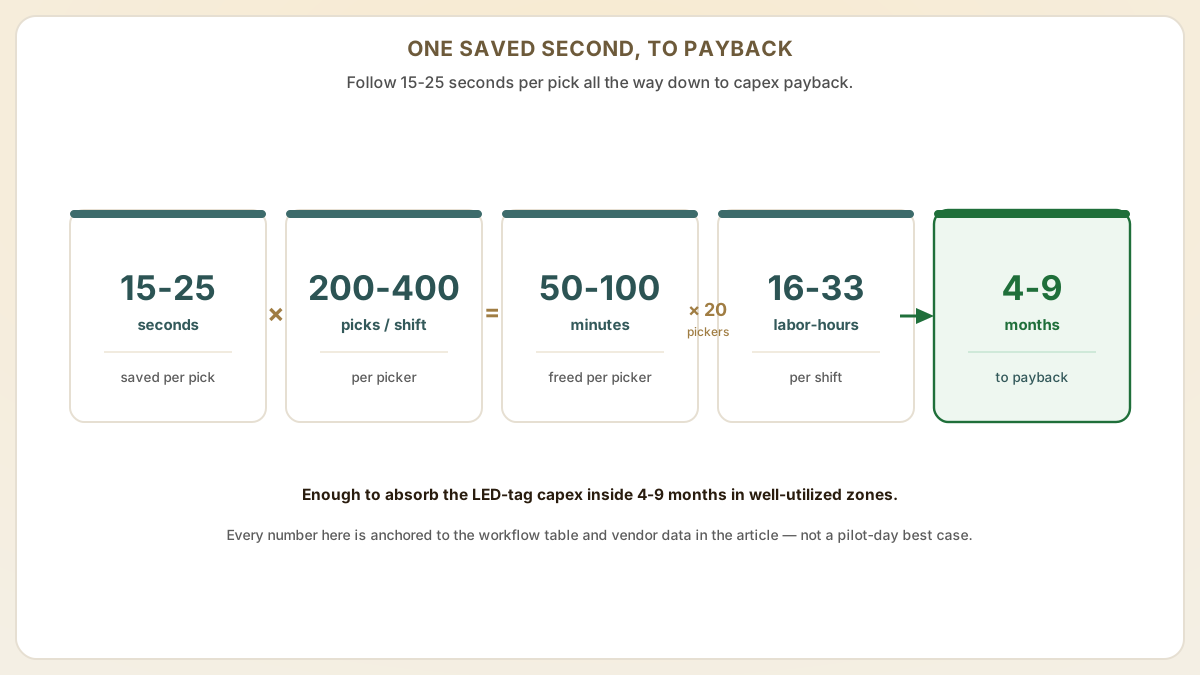
Vendor brochures show dramatic before/after pick-time numbers in pilot conditions. The list below is the economics that survive a finance review — the numbers still standing after someone in finance has poked each one — with each anchored to either the published vendor data or the industry benchmarks cited in the rfidtaghy and CPCON RFID guides. The cascade below traces one saved second all the way to payback.
- Per-pick time saving: the workflow table in the previous section shows 25-45 seconds (without LED) vs. 10-20 seconds (with LED) — a 50-65% reduction. Use 50% in conservative models because the actual mix of long-walk and short-walk picks varies by zone density.
- Pick-error reduction: 1-3% mispicks (manual / barcode) vs. less than 0.5% with LED-guided pick. Each prevented mispick saves $10-50 per incident in return processing, restocking and customer-service labor — a number consistent with the rfidtaghy 99.9% accuracy framework's observation that error correction labor often exceeds the original pick labor.
- Per-tag cost: $3-8 per LED tag at the published wholesale tier (this article), vs. $15-50 per position for traditional fixed pick-to-light modules with extensive wiring infrastructure (this article's existing FAQ comparison). The 60-80% per-position cost saving makes pick-to-light economically viable in dense storage zones that could not justify the wired alternative.
- Battery TCO: at 20 LED activations/day with a CR2032 cell, battery life is 2-4 years. Plan a planned-maintenance battery-swap window every 24-36 months, or use the battery-low flag in the RFID response (most LED tags expose this) for on-condition replacement during normal cycle counts. Tool-free snap-open housings hold replacement to 10-20 seconds per tag.
- Throughput-based ROI: in a high-velocity DC where pickers handle 200-400 picks per shift, saving 15-25 seconds per pick frees 50-100 minutes of operator time per shift per picker. Across a 20-picker shift, that is 16-33 reclaimed labor hours per shift — typically enough to absorb the LED-tag capex inside 4-9 months in well-utilized zones.
Useful next pages
Use these linked product, guide and comparison pages to keep the next click specific and practical.
RFID tags with LED light
Battery-assisted UHF RFID tags with LED visual indicators for warehouse location.
Related warehouse RFID resources
Guides and solutions for warehouse RFID deployment.
Independent overhead RTLS reader references
Authoritative product pages for the ceiling-mounted RTLS readers compared in this article.
FAQ
How far away can I see the LED on an RFID tag?
In typical warehouse lighting conditions, a high-brightness LED on an RFID tag is visible from 5-15 meters. Visibility depends on LED brightness (measured in millicandelas), ambient light level and viewing angle. Tags designed for warehouse use typically use high-brightness LEDs (50-100 mcd) that are clearly visible under fluorescent and LED warehouse lighting.
Do LED RFID tags work on metal shelving?
LED RFID tags require on-metal compatible design when mounted directly on metal shelving. These tags include a spacer or shielding layer that prevents the metal from detuning the UHF antenna. On-metal LED tags are available but typically cost $1-$3 more than standard versions. Alternatively, mount tags on the item itself rather than the metal shelf to avoid the metal-interference issue.
Can I use LED RFID tags for put-away confirmation?
Yes. The WMS can activate the LED on the target storage location during put-away to guide the operator to the correct bin. When the operator places the item and scans confirmation, the LED deactivates. This is particularly valuable in warehouse reorganization or when temporary staff unfamiliar with the facility layout are handling put-away.
What happens when the battery dies on an LED RFID tag?
When the battery is depleted, the LED function stops but the passive UHF RFID function continues to work normally. The tag still responds to reader interrogation and provides its EPC identifier. Only the visual LED indication is lost. Replace the battery to restore LED functionality. Most tags report battery status via a flag in the RFID data, allowing proactive replacement before failure.
How do LED RFID tags compare to traditional pick-to-light systems?
Traditional pick-to-light systems use wired LED modules permanently mounted at each shelf location, costing $15-$50 per position with extensive wiring infrastructure. LED RFID tags cost $3-$8 per tag, require no wiring, and move with the item or container rather than being fixed to the shelf. RFID-based pick-to-light is more flexible and 60-80 percent lower cost per location, though traditional systems offer higher LED brightness and display capabilities.
When should I choose LED tags vs. ceiling-mounted RTLS like Zebra ATR7000 or Impinj xArray?
LED tags win economically below ~5,000-10,000 tracked locations and when the search problem is at the shelf face — the LED is on the asset itself, no ceiling infrastructure needed, and the operator's eyes are the display. Ceiling RTLS (Zebra ATR7000 with sub-2-foot accuracy, Impinj xArray covering a 40-foot diameter at 15-foot mounting height with 52 antenna beams) wins above ~10,000 locations because per-tag cost stays at standard UHF prices ($0.05-0.50) instead of climbing to LED-tag prices, and because the read coverage is continuous rather than per-zone. Many high-density warehouses run a hybrid: ceiling RTLS across the population, LED tags reserved for the highest-velocity SKUs where shelf-face visual indication adds the largest pick-time saving.
Will LED RFID tag batteries become a maintenance burden in a large deployment?
Battery management is the single biggest operational consideration. At a typical 20 LED activations/day with a CR2032 cell, battery life is 2-4 years; high-frequency zones (50+ activations/day) compress that to 12-18 months. Two practical strategies prevent battery management from becoming a burden: (1) scheduled bulk replacement on a 24-month cycle, batched into a planned maintenance window — tool-free snap-open housings hold replacement to 10-20 seconds per tag, so a single technician can swap 200-300 tags per shift; or (2) on-condition replacement using the battery-low flag exposed by most LED RFID tags in the standard RFID response, picked up during normal cycle counts and triggering a work order. The on-condition approach minimizes tag downtime but requires the WMS exception queue to be actively monitored. Most large deployments use a hybrid: scheduled bulk for high-density zones, on-condition for outlying zones.
Sources & references
Primary standards, OEM datasheets and regulatory documents cited by this article. All URLs were verified on the access date shown below.
- Impinj xArray Gateway RFID Reader — product page & specifications
Ceiling-mounted RTLS reader: 40-foot diameter coverage at 15-foot mounting height, 52 dual-polarized antenna beams.
- Zebra ATR7000 Overhead RFID Reader
Official product page for the overhead beam-steering RTLS reader referenced in the RTLS comparison.
Proud Tek is a Shenzhen-based RFID & NFC manufacturer supplying hotel chains, transit operators, event venues and retail brands worldwide. Every order includes free samples, RF testing and dedicated project support.
Get a Quick Quote
Tell us about your project and we'll respond within one business day. Fields marked (asterisk) are required.