
Case study · Pharmaceutical
DSCSA UHF Labels at 380M Units/Year
Pharma

Quick answer
A US specialty-pharmacy distributor deployed item-level UHF RFID labels on 380 million prescription bottle and carton SKUs per year to satisfy the FDA's DSCSA (Drug Supply Chain Security Act) interoperable traceability requirements. Proud Tek shipped NXP UCODE 9 inlays in a 50 × 30 mm paper label form factor with thermal-transfer overprint of the GS1 SGTIN-96 + lot + expiry data fields.
- Customer profile — US specialty-pharmacy distributor, 380 M item-level units / year, 14,000 prescriber accounts.
- Chip selected — NXP UCODE 9, UHF RAIN, 96-bit EPC, 64-bit TID, ISO/IEC 18000-63.
- Form factor — 50 × 30 mm thermal-transfer-printable paper label with GS1 SGTIN-96 + lot + expiry overprint.
At a glance
Use these short answers to decide whether this page matches the project before moving into the detail.
Customer profile
US specialty-pharmacy distributor, 380 M item-level units / year, ~14,000 prescriber accounts (oncology, rare disease, transplant). Customer name withheld; HIPAA / DSCSA...
Chip & form factor
NXP UCODE 9 — UHF RAIN, 96-bit EPC, 64-bit TID, ISO/IEC 18000-63, EPC Gen2v2. 50 × 30 mm paper label, thermal-transfer-printable, glassine release liner.
Next step
Ready to move forward? Start your inquiry to get specific answers for this project.
Request a pharmaceutical label sample pack- Measured results (post-DSCSA enforcement date)
-
- DSCSA interoperable verification rate: 99.96% (vs FDA-required 99% threshold).
- Suspect-product investigation time: 22 hours (vs DSCSA's 24-hour requirement).
- Saleable returns processing time: 18 min / pallet (vs 4 hours pre-RFID).
- Item-level lot recall span: 4 hours from FDA recall notice to full chain-of-custody report (down from 5 days).
Why RFID (and not 2-D barcode only) for DSCSA
DSCSA permits either 2-D Data Matrix barcode or RFID for the unique product identifier (SGTIN). Most distributors started with barcode because it is cheaper per label. This customer chose RFID specifically because the unit-level read speed at the receipt portal — 2,000+ items / minute on a pallet — is incompatible with line-of-sight barcode scanning.
- Receipt portal throughput — 2,000+ items / minute on a UHF RFID pallet portal vs 25–45 items / minute on a hand-held barcode scan.
- Saleable returns — sealed cartons cannot be opened to barcode-scan each unit. UHF RAIN reads through the carton.
- Suspect-product investigation — the EPC chain-of-custody is queriable directly from the WMS without manually opening cartons.
- Cost — UHF RFID label is $0.04–0.09 / unit at the customer's volume; 2-D Data Matrix print is $0.002 / unit. The labour delta at receipt + returns more than offsets the label-cost delta.
How DSCSA verification works on the chip
DSCSA requires that distributors verify the SGTIN of suspect product against the manufacturer's authoritative source. Proud Tek's UCODE 9 chip stores the SGTIN on the EPC field; the manufacturer's authoritative source is queried via the GS1 EPCIS Lightweight Verification Service over HTTPS at receipt time.
- Receipt portal reads each item's EPC.
- WMS submits each EPC to the manufacturer's EPCIS lightweight verification endpoint.
- Manufacturer responds within 90 seconds (DSCSA SLA) with VERIFIED / NOT_VERIFIED / SUSPECT.
- NOT_VERIFIED or SUSPECT triggers automatic quarantine and a 24-hour investigation workflow.
- The 99.96% verification rate reflects 99.96% of items returning VERIFIED on first query; the remaining 0.04% surface manufacturer-side data errors that are resolved within the SLA window.
Production & supply-chain economics
380 M item-level labels / year places this customer in the top tier of US pharmaceutical RFID volume. The customer runs four packaging-line shifts across two facilities, with each line consuming 6,000–8,000 labels / hour.
- Label unit cost (FOB Shenzhen, 100 M MOQ): $0.04–0.09 / label depending on antenna and overprint.
- Lead time: 28 days ocean freight Shenzhen-to-Long-Beach + 5 days inland to the customer's DC.
- Safety stock: 60 days of label inventory at every packaging line.
- QA: 100% chip-presence test inline at Proud Tek (Mühlbauer ICT2) + 0.5% destructive lot sample for chip-antenna bond + 100% EPC encoding verification at the customer's packaging line.
Operational results after first full year under DSCSA enforcement
The customer's compliance team reported zero DSCSA findings in their first annual FDA audit post-enforcement, citing the RFID-driven verification rate as the primary mitigation against the most common DSCSA failure mode (slow verification on suspect product). The procurement team reported the RFID programme is now considered table-stakes; the question internally has shifted from 'should we use RFID' to 'how do we standardise the chip family across all distributor partners'.
How the programme was built — chip, encoding and QA
The programme was a small set of deliberate choices: a UHF chip for read-through-carton throughput, an SGTIN-96 encoding to satisfy DSCSA, and a QA regime tight enough for a regulated packaging line.
- Chip and encoding: UCODE 9 carrying a GS1 SGTIN-96 on the 96-bit EPC, encoded at the customer's packaging line, with lot and expiry thermal-transfer-printed beside the barcode.
- QA: 100% chip-presence test inline at Proud Tek (Mühlbauer ICT2), a 0.5% destructive lot sample for the chip-antenna bond, and 100% EPC encoding verification at the customer's line.
- Line scale: four packaging-line shifts across two facilities, each line consuming 6,000–8,000 labels / hour.
- Logistics: 28 days ocean freight Shenzhen-to-Long-Beach plus 5 days inland, with 60 days of label safety stock at every line.
How DSCSA verification runs at the receipt portal
DSCSA requires a distributor to verify the SGTIN of suspect product against the manufacturer's authoritative source. This is how that runs at the receipt portal at the customer's volume.
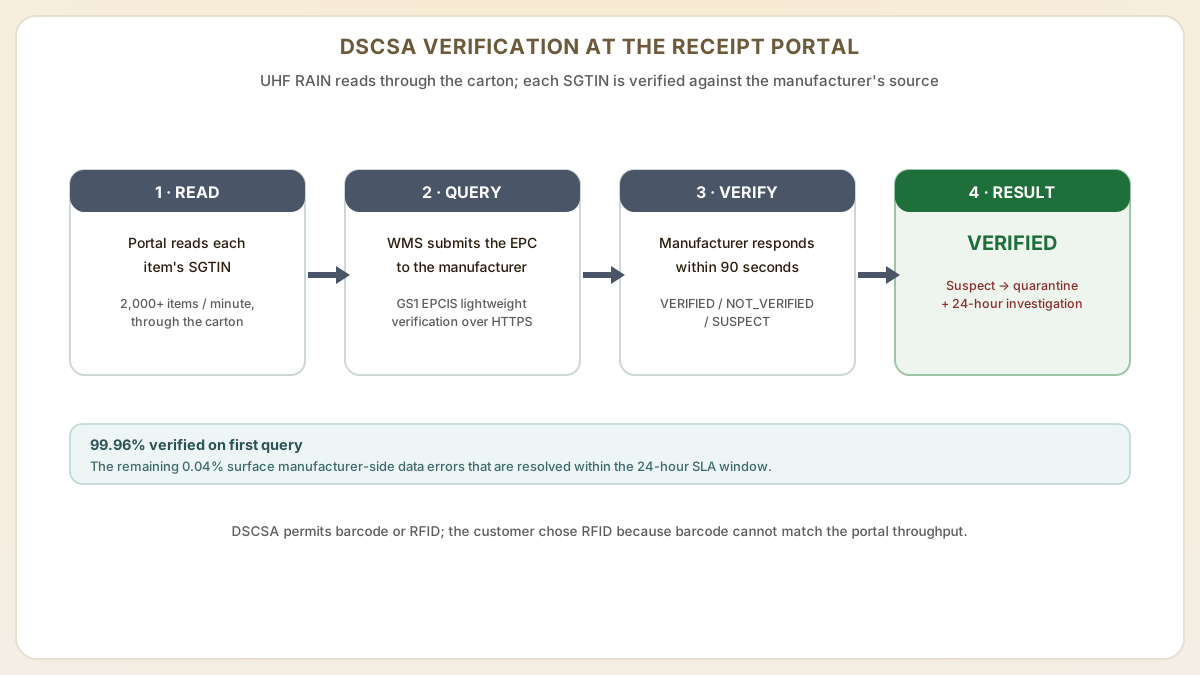
- The receipt portal reads each item's SGTIN at 2,000+ items / minute — UHF RAIN reads through the sealed carton, which barcode cannot.
- The WMS submits each EPC to the manufacturer's GS1 EPCIS lightweight verification endpoint over HTTPS.
- The manufacturer responds within the 90-second SLA with VERIFIED, NOT_VERIFIED or SUSPECT; a suspect item is quarantined into a 24-hour investigation.
- 99.96% of items return VERIFIED on first query; the remaining 0.04% surface manufacturer-side data errors resolved within the SLA window.
First-year results against the DSCSA requirements
The results are stated against their requirements, so the margin is visible. Every figure is the customer's own measured value from the first full year under enforcement.
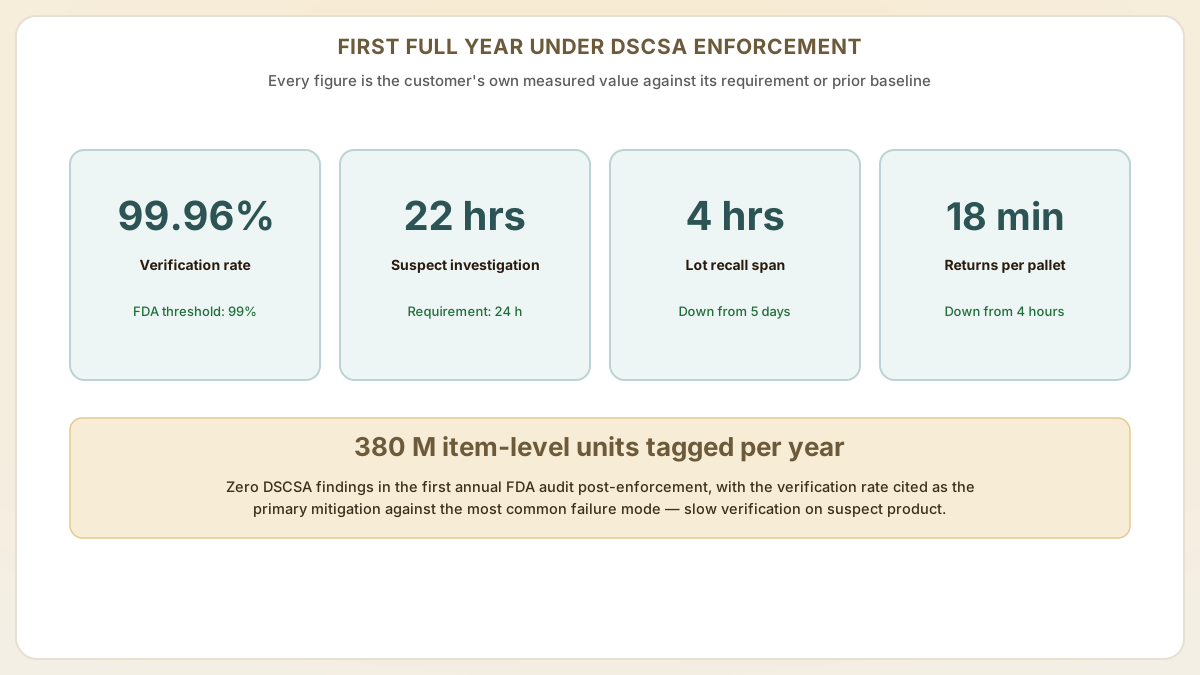
- Verification rate 99.96% against the FDA's 99% threshold; suspect-product investigation 22 hrs against the 24-hour requirement.
- Item-level lot recall span 4 hrs from FDA recall notice to a full chain-of-custody report, down from 5 days.
- Saleable returns processing 18 min / pallet, down from 4 hours pre-RFID.
- Zero DSCSA findings in the first annual FDA audit post-enforcement, at 380 M item-level units tagged per year.
The deployment at a glance — chip, form factor and results
The specification and the measured results in one place; nothing here is modelled.
| Attribute | Value | Notes |
|---|---|---|
| Chip | UCODE 9 — UHF RAIN, ISO/IEC 18000-63, EPC Gen2v2 | 96-bit EPC + 64-bit TID |
| Form factor | 50 × 30 mm thermal-transfer paper label | GS1 SGTIN-96 + lot + expiry overprint |
| Verification rate | 99.96% | FDA DSCSA threshold: 99% |
| Suspect investigation | 22 hrs | DSCSA requirement: 24-hour |
| Lot recall span | 4 hrs | Down from 5 days |
| Saleable returns | 18 min / pallet | Down from 4 hours pre-RFID |
| Receipt throughput | 2,000+ items / minute | vs 25–45 items / minute on a hand-held barcode |
| Label cost / MOQ | $0.04–0.09 / label (FOB Shenzhen, 100 M MOQ) | 28 days ocean + 5 days inland |
| Scale | 380 M item-level units / year | ~14,000 prescriber accounts, 2 facilities |
What transfers — where this pattern fits
The deciding factors here — sealed-carton verification and receipt-portal throughput — recur across regulated distribution. The pharmaceutical industry guide and the FDA RFID tracking guide cover the compliance frame.
- Wholesale drug distribution — the same receipt-portal throughput and saleable-returns problem at any DSCSA-regulated distributor.
- Hospital and health-system pharmacy — item-level verification at receiving docks where sealed cartons cannot be opened to scan each unit.
- Any regulated supply chain where sealed-carton verification throughput beats line-of-sight barcode scanning.
Useful next pages
Use these linked product, guide and comparison pages to keep the next click specific and practical.
Pharmaceutical RFID resources
The compliance + chip background behind this deployment.
Compare the UHF chip choice
Why UCODE 9 vs Monza R6 vs Higgs-9 for pharma.
FAQ
Is RFID required by DSCSA, or only one of the options?
DSCSA permits either 2-D Data Matrix barcode or RFID for the unique product identifier. RFID is not mandated. However, distributors handling saleable returns at scale and operating receipt portals find RFID is the only practical option for the throughput required. The FDA's enforcement focus is on verification capability, not on the chosen data carrier.
How does the SGTIN field on the chip interact with the lot + expiry overprint?
The SGTIN field on the chip uniquely identifies the item; the lot and expiry are printed beside the SGTIN as human-readable + 2-D Data Matrix data for redundancy. DSCSA verification queries the SGTIN; the lot and expiry are used by pharmacy systems for inventory management and recall scoping. Both the chip and the printed data must be present for compliance.
Does UHF read reliably through liquid prescription bottles?
Yes, when the antenna geometry accounts for the substrate. UCODE 9 has Autotune that adjusts for the dielectric loading from the bottle contents. The customer's receipt-portal antennas are circular-polarised, positioned at 1.2 m and 1.8 m height to read tags on both sides of a pallet. Empirical read rate is 99.96%+ on full pallets including filled prescription bottles.
What is the audit-trail retention for DSCSA?
DSCSA requires 6 years of transaction-history retention. The customer's WMS retains the full EPCIS event chain — receipt, repackaging, dispensing — for 7 years to provide a one-year margin over the regulation. Proud Tek's role ends at the label SKU; the customer's WMS owns the chain-of-custody record.
Sources & references
Primary standards, OEM datasheets and regulatory documents cited by this article. All URLs were verified on the access date shown below.
- NXP UCODE 9 (SL3S1206) UHF RAIN RFID IC — data sheet
Chip-level reference for the UCODE 9 96-bit EPC, 64-bit TID and EPC Gen2v2 air interface.
- ISO/IEC 18000-63:2015 — UHF RFID Type C air interface
UHF RAIN air-interface standard for the through-carton portal reads described.
- FDA — Drug Supply Chain Security Act (DSCSA)
DSCSA framework — unique product identifier (SGTIN), verification and interoperable traceability.
- GS1 EPCIS and Core Business Vocabulary — supply-chain event standard
Event-data standard behind the EPCIS lightweight verification queried at receipt.
Proud Tek is a Shenzhen-based RFID & NFC manufacturer supplying hotel chains, transit operators, event venues and retail brands worldwide. Every order includes free samples, RF testing and dedicated project support.
Get a Quick Quote
Tell us about your project and we'll respond within one business day. Fields marked (asterisk) are required.