
Ultralight C Disposable NFC
MIFARE Ultralight C Cards
3DES Disposable NFC

Quick answer
NXP MIFARE Ultralight C (MF0ICU2) is the disposable-tier NFC card chip: 192 bytes of user memory, 3DES mutual authentication (112-bit key), ISO/IEC 14443-3 Type A, NFC Forum Type 2 Tag. It is the default credential for single-use transit tickets, event wristband cards, ski day-passes, short-stay hotel keys, and one-time-use loyalty claims — any programme where the per-card cost must sit near disposable economics but Crypto-1 cloning risk is unacceptable. Proud Tek ships Ultralight C blanks and custom-printed cards with per-card 3DES key diversification per NXP AN11136, a pre-shipment UID-to-diversified-key manifest, and NXP chip-authenticity certificates on every batch.
- 3DES mutual authentication (NIST SP 800-67 TDEA, 112-bit effective key) at a per-card cost 40-60% below DESFire EV3 — the reason Ultralight C is the default silicon for disposable transit, event, and ski programmes where Crypto-1 cloning risk is unacceptable.
- 192 bytes organised as 48 × 4-byte pages with 144 free user bytes — enough for a fare payload + counter, a signed access token, or an NDEF URI + loyalty record; NFC Forum Type 2 Tag so any modern smartphone reads public pages without authentication.
- Per-card key diversification (NXP AN11136) + UID-to-diversified-key CSV manifest + NXP chip-authenticity certificate on every Proud Tek batch — the three artefacts that separate a procurement-grade Ultralight C supply from a commodity one.
Used in these industries
Deployments where this product is referenced on our industry landing pages.

At a glance
Use these short answers to decide whether this page matches the project before moving into the detail.
Chip family and silicon
NXP MIFARE Ultralight C (MF0ICU2) — the only Ultralight-family variant with 3DES mutual authentication; positioned between Ultralight EV1 (password-only) and DESFire EV3...
Air interface and NFC Forum classification
13.56 MHz, ISO/IEC 14443-3 Type A — read by every standard contactless reader, turnstile, terminal, and NFC-enabled smartphone (iPhone XS and later, any modern Android)....
Next step
Ready to move forward? Start your inquiry to get specific answers for this project.
Request Ultralight C card quote- Typical pricing
-
USD 0.30–0.50 /pc @ 5k–50k (typical FOB Shenzhen range) — firm quote in one business day.
Commercial terms
- MOQ
- Varies by SKU — stock items from 100 pcs; custom production typically 200-1,000 pcs
- Lead time
- Production 2-3 weeks after artwork and encoding sign-off; reorders on a 3-4 week cycle
- Samples
- Free samples and RF test report with every order; courier at customer cost
- Payment
- 50% T/T deposit, 50% before shipment; Net 30/60 for established accounts; LC for large orders
- Shipping
- FOB Shenzhen / Yantian; DHL, FedEx or EMS air freight; sea LCL / FCL for volume
- Response
- Itemized quote within one business day, Mon-Fri (UTC+8)
The disposable-ticketing sweet spot — 3DES at Ultralight economics
- Ultralight C occupies the gap between Ultralight EV1 (password-only — fine for a URL, not for a fare) and DESFire EV3 (AES-128 — overkill for single-use).
- The programme-economics calculation is simple: if the card does not come back and the clone-risk tolerance is non-zero, 3DES at disposable cost is the right silicon.
- When stored value or multi-application use is in scope, the answer is DESFire — Ultralight C is the single-purpose, one-lifecycle credential.
The cheapest card that still asks for ID
Triple-DES (TDEA, NIST SP 800-67) mutual authentication with a 112-bit effective key — both card and reader must prove knowledge of the shared secret before the reader can access authenticated pages or increment the decrement counter. With per-card key diversification (NXP AN11136) the master key never leaves the issuer; compromising one card reveals nothing about any other card in the batch, which is what makes Ultralight C acceptable at disposable-volume deployment.
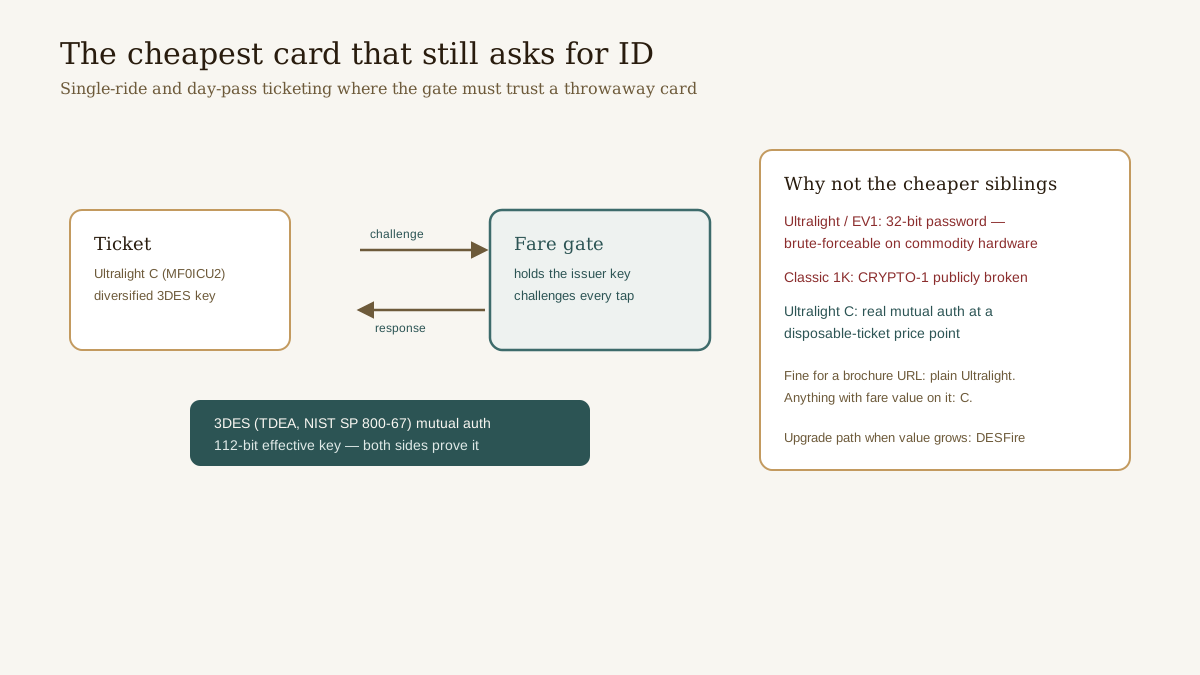
- Ultralight / Ultralight EV1 use a 32-bit password — brute-forceable on commodity hardware; fine for a brochure URL, not for a fare or a pass. MIFARE Classic 1K uses Crypto-1, publicly broken since Nohl/Plötz 2008; one European metro publicly estimated €2-5M / year in fare-evasion loss from Crypto-1 cloning on legacy stock. DESFire EV3 (AES-128) is the right answer for multi-application credentials and stored value, but 2-3× the silicon cost — overkill for single-use disposable economics.
Ultralight C vs neighbouring MIFARE tiers
Ultralight / Ultralight EV1 — entry cost, no real security
- MIFARE Ultralight (MF0ICU1): 64 bytes, no authentication beyond a 32-bit password
- Ultralight EV1 (MF0ULx1): 48-128 bytes, password-only authentication
- Brute-forceable on commodity hardware — acceptable only for a brochure URL or static record
- Lowest chip cost in the family
- Not acceptable where fare, access, or pass cloning would produce measurable loss
Ultralight C — 3DES at disposable cost (this page) / DESFire EV3 — AES when stored-value is in scope
- Ultralight C (MF0ICU2): 192 bytes, 3DES mutual authentication (NIST SP 800-67 TDEA) — this page
- DESFire EV3 (MF3DHx2/3): 2-32 KB, AES-128 + per-card diversification (NXP AN10922)
- Ultralight C: 40-60% below DESFire per-card at matched volumes — disposable economics retained
- DESFire EV3: right answer when the credential must be reused, hold value, or run multi-application logic
- Crossover typically at ~12-18 months of expected card lifecycle
192 bytes, 144 usable — why the memory map matters
192 bytes organised as 48 pages × 4 bytes. Pages 0-1 hold the 7-byte UID; pages 2-3 internal configuration + OTP + lock bits; pages 4-39 user memory (144 bytes free); pages 40-43 3DES key slots; pages 44-47 counter + lock. 144 free bytes are enough for: one NDEF URI + 16-byte fare payload; or transit operator ID + product code + validity window + ride counter + transaction log; or a 64-byte loyalty payload + counter; or a signed access token.
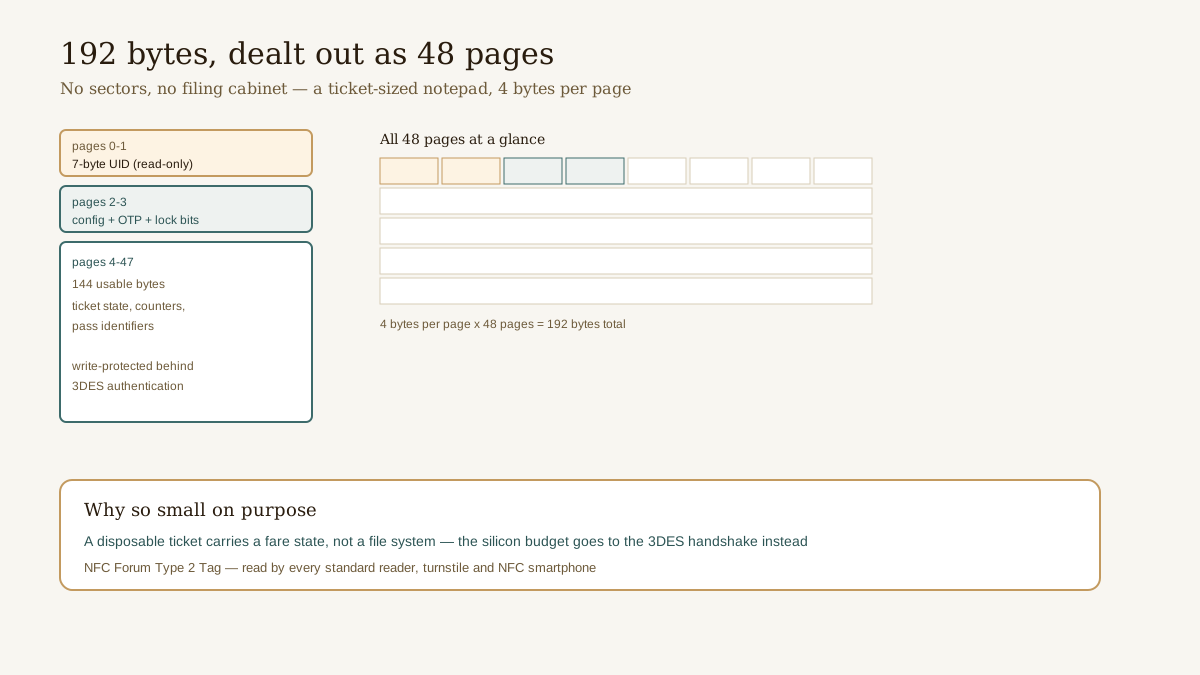
- Pages 4-39 (144 bytes): application payload — fare record, counter backup, loyalty stamp history, access token.
- Page 41 counter (optional): monotonic decrement, tear-off-style ride / punch tracking.
- Pages 40, 42, 43 (16 bytes 3DES key slots): write-only after personalisation.
- Pages 2-3 lock bits + OTP: lock user memory or individual pages permanently once personalised.
From Crypto-1 break 2008 to Ultralight C as default disposable silicon
- 2001-2004
MIFARE Ultralight (MF0ICU1) arrives as the low-cost, password-only NFC chip for single-use applications; fine for brochures, insufficient for fare or access.
- 2008
Nohl / Plötz publish the academic break of Crypto-1 on MIFARE Classic. One European metro later publicly estimates €2-5 M / year in fare-evasion losses attributable to Crypto-1 cloning.
- 2009
NXP releases MIFARE Ultralight C (MF0ICU2) with 3DES mutual authentication — security hardened to TDEA (NIST SP 800-67) at a price point that makes disposable programmes viable.
- 2012-2015
NFC Forum Type 2 Tag specification matures; Ultralight C public pages become NDEF-readable by any smartphone, opening consumer-tap marketing and loyalty flows on top of the authenticated gate logic.
- 2016
NXP AN11136 publishes the recommended 3DES key-diversification scheme for Ultralight C — the pattern every procurement-grade supplier now follows.
- 2020-2024
DESFire EV3 (AES-128) displaces Ultralight C on reusable and stored-value credentials; Ultralight C consolidates into the true disposable tier (single-ride, day-pass, festival wristband, short-stay hotel).
- 2026 Today
From buyer conversations across events-venue-single-use, transit-single-ride, hotel-disposable-key, conference-badge, and one-time-visitor programmes converge on Ultralight C + 3DES diversified key + UID manifest + NXP chip-authenticity certificate — the four-artefact spec that separates a procurement-ready disposable card from a commodity one.
Applications
- Public transit: single-ride, day-pass, and multi-ride disposable tickets with 3DES gate authentication + monotonic counter.
- Events: festival wristband cards, concert / sports / exhibition day-pass tickets — gate throughput lifts from ~600-800 / hr (barcode) to ~1,200-1,800 / hr (RFID tap).
- Ski lift passes: day and multi-day passes with diversified-key 3DES; dramatic drop in verified clone incidents after migration from magstripe.
- Short-stay hospitality: 1-3 night room credentials where card recovery is not expected and DESFire economics are not justified.
- Loyalty one-time claims: tap-to-redeem promotion cards where 3DES blocks replay of single-use tokens (<0.1% fraudulent redemption vs 1.5-3% on QR / barcode equivalents).
- Libraries / kiosks: patron ID with a short borrow record on authenticated user pages.
Bulk-procurement failure modes Proud Tek eliminates
- Transport-key left as factory default: Proud Tek diversifies the 3DES key per card using the issuer's master + UID per AN11136 and ships the UID-to-diversified-key CSV before the batch leaves.
- OTP / lock bits pre-set by the supplier: every user page is verified unlocked pre-shipment; lock-bit configuration is done only after application data is written, at the issuer's instruction.
- Counterfeit or mis-shipped chips (Ultralight vs Ultralight C): NXP chip-authenticity certificate + spot-check 3DES-response log ships with every batch.
- No UID manifest: comma-separated UID list (hex + decimal) emailed before shipment for database seeding.
- Dimensional drift: 100% ISO/IEC 7810 ID-1 tolerance inspection so magstripe encoders, lamination presses, and turnstile dispensers do not jam.
The reference facts, at a glance
Card body + slot geometry
ISO/IEC 7810 ID-1 (85.60 × 53.98 × 0.76 mm) standard; ISO/IEC 10373-1 durability methodology. Thin 0.3 mm PET option for turnstile slot-accept gates used in public transit. Paper / Tyvek inlay option laminates the Ultralight C chip into a paper or non-woven ticket body for the lowest possible per-credential cost, common on festival wristbands and single-ride fare tickets.
Factory pre-encoding + manifests
3DES key diversification per card using the issuer's master key + UID (TDEA-CMAC per AN11136 or a custom algorithm the issuer specifies); UID-to-diversified-key mapping CSV ships before the batch leaves the factory. NDEF payload (URL RTD, Smart Poster, vCard, custom) pre-written; lock-bits set after encoding, never before, so OTP pages are not accidentally locked against the application data.
QC on every bulk run
Genuine NXP MF0ICU2 chip-authenticity certificate ships with the batch; a spot-check 3DES authentication log confirms the feature is present and responding on every sampled card. Dimensional tolerance to ISO/IEC 7810 is 100% inspected so magnetic-stripe encoders, lamination presses, and turnstile card dispensers do not jam on mixed-tolerance stock.
Print + personalisation
Full-colour CMYK offset (≥1,000 units, ISO 12647-2 process control) or UV digital (short runs, 600-1,200 dpi). Pantone spot colour, spot UV, hot foil, embossed numbering, signature panel, HiCo / LoCo magstripe overlay. Variable data — sequential card numbers, QR / 1D barcodes for visual fallback, sponsor logos — inline with the factory print step.
Procurement realities
MOQ 500 blank / 1,000 printed; lead time 10-15 business days for custom printed batches, 2-3 business days for blank stock. Per-card cost at 50k-500k volume lands roughly 40-60% below a DESFire EV3 equivalent while delivering genuine 3DES (not password) security — which is what makes the chip the default for disposable economics.
Compliance + end-of-life
Applicable card-side standards: ISO/IEC 14443-3/-4, ISO/IEC 7810, ISO/IEC 10373-1; NFC Forum Type 2 Tag. Reader-side radio compliance (FCC 47 CFR Part 15, EN 300 330) sits with the gate / terminal supplier. Paper / Tyvek inlay variants route to standard paper-recycling streams; PVC cards are collected at the gate or venue exit and routed to local PVC recycling where streams accept them; r-PET / PLA substrate options on request for ESG-reporting programmes.
Useful next pages
Use these linked product, guide and comparison pages to keep the next click specific and practical.
Related card products
Where Ultralight C sits in the MIFARE chip hierarchy, plus the reusable-credential upgrade path.
FAQ
Is Ultralight C secure enough for transit?
Yes — Ultralight C runs 3DES mutual authentication (TDEA per NIST SP 800-67, 112-bit effective key), which has no published practical break. With per-card key diversification per NXP AN11136 the master key never leaves the issuer, so compromising one card reveals nothing about any other card in the batch. That is why Ultralight C is the default for disposable fare. When the credential is reusable or carries stored value, DESFire EV3 with AES-128 is the right answer instead.
What is the difference between MIFARE Ultralight, Ultralight EV1, and Ultralight C?
Ultralight (MF0ICU1, 64 bytes) and Ultralight EV1 (MF0ULx1, 48-128 bytes) use only a 32-bit password — brute-forceable, acceptable only for static NDEF records like a brochure URL. Ultralight C (MF0ICU2, 192 bytes) adds 3DES mutual authentication with a 112-bit key, making card cloning and replay significantly harder. For any programme with a security requirement — fare, access, ticket, pass — Ultralight C is the Ultralight-family choice.
Can Ultralight C store monetary value?
For low-value disposable use (single-ride fare, day pass, one-time loyalty claim) — yes. The 3DES-authenticated decrement counter and authenticated user pages support tear-off-style value tracking. For higher-value reusable stored-value (transit purses, campus cashless payment, loyalty wallets), DESFire EV3 with AES-128 and the on-chip transaction MAC is the right tier — its higher per-card cost is absorbed by the reusable lifecycle.
Can a standard smartphone read Ultralight C cards?
Yes — any NFC-enabled iPhone (XS or later) or modern Android reads public pages and NDEF records without authentication, because Ultralight C is ISO/IEC 14443-3 Type A + NFC Forum Type 2 Tag compliant. The 3DES authentication is used by the reader infrastructure — gates, terminals, turnstiles — to verify the card is genuine before reading authenticated pages. Consumers only tap; the cryptography stays in the reader.
What MOQ and lead time should we plan around?
MOQ 500 for blank white Ultralight C; 1,000 for custom-printed stock. Lead time is 10-15 business days for custom printed batches and 2-3 business days for blank stock from Proud Tek's factory inventory. Per-card key diversification, UID manifests, NDEF pre-encoding, thin 0.3 mm PET, and paper / Tyvek inlay variants are all available without MOQ uplift.
Do you supply NXP chip-authenticity certificates with the order?
Yes. Every Proud Tek Ultralight C batch ships with the NXP chip-authenticity certificate and a spot-check 3DES-authentication log confirming the feature is present and responding on every sampled card — specifically to address the documented failure mode where another supplier substituted non-authenticated Ultralight (no "C") into a bulk order.
Sources & references
Primary standards, OEM datasheets and regulatory documents cited by this article. All URLs were verified on the access date shown below.
- NXP MIFARE Ultralight C (MF0ICU2) short-form specification
Canonical product data sheet — 192 B memory layout, 3DES authentication flow, page-level access control.
- NXP Application Note AN11136 — Ultralight C 3DES key diversification
Reference diversification scheme used by every procurement-grade Ultralight C deployment.
- NIST SP 800-67 Rev. 2 — Recommendation for the Triple Data Encryption Algorithm (TDEA)
The standard that defines the 3DES block cipher used inside Ultralight C mutual authentication.
- ISO/IEC 14443-3 — Identification cards — Contactless integrated circuit cards — Proximity cards — Part 3: Initialization and anticollision
The Type A air-interface layer Ultralight C operates on.
- NFC Forum Type 2 Tag Operation Specification
NDEF-readable behaviour of Ultralight C public pages on consumer smartphones.
Proud Tek is a Shenzhen-based RFID & NFC manufacturer supplying hotel chains, transit operators, event venues and retail brands worldwide. Every order includes free samples, RF testing and dedicated project support.
Get a Quick Quote
Tell us about your project and we'll respond within one business day. Fields marked (asterisk) are required.