
Secure NFC Fobs
MIFARE DESFire Keyfob
AES-128 Secure NFC Fob

Quick answer
MIFARE DESFire keyfobs deliver the same AES-128 authentication, Common Criteria EAL5+ silicon, ISO/IEC 14443-3/4 air-interface, ISO/IEC 7816-4 APDU stack and NXP AN10922 diversified-key personalisation as DESFire smart cards in a keychain form factor. The specification envelope covers EV2 and EV3 chips (2 / 4 / 8 KB), multi-application partitioning for access + transit + parking + cashless on a single credential, Transaction MAC and Secure Unique NFC (SUN) anti-replay, NIST SP 800-38B CMAC per-command framing, BSI TR-02102-1 cipher-suite alignment and NIST FIPS 201-3 / PIV-aligned FASC-N issuance for federal-adjacent deployments.
- AES-128 encryption on Common Criteria EAL5+ silicon (NIST FIPS 197 + NIST SP 800-38B CMAC) — the same DESFire EV3 security target shipped on the card form factor, in a keyring-carry housing.
- Multi-application architecture per ISO/IEC 7816-4 (unlimited applications on EV2/EV3) — partition one fob into access + transit + parking + cashless + loyalty with independent key sets and key ceremonies.
- Compact keychain form factor eliminates the 8-15 % forgotten-badge incident rate that plagues card-based access — the fob rides with the user's house and car keys so the credential is present whenever the user is.
Used in these industries
Deployments where this product is referenced on our industry landing pages.

At a glance
Use these short answers to decide whether this page matches the project before moving into the detail.
Chip family
NXP MIFARE DESFire EV2 (legacy / migration) or DESFire EV3 (greenfield 2026 default) Memory options 2 KB / 4 KB / 8 KB EEPROM, application-partitioned
Air interface
ISO/IEC 14443-3 Type A anticollision at 13.56 MHz ISO/IEC 14443-4 T=CL block-framing with Transaction MAC / commit-counter (EV2/EV3)
Next step
Ready to move forward? Start your inquiry to get specific answers for this project.
Request quote and samples- Typical pricing
-
USD 0.80–2.00 /pc @ 5k+ (typical FOB Shenzhen range) — firm quote in one business day.
Commercial terms
- MOQ
- Varies by SKU — stock items from 100 pcs; custom production typically 200-1,000 pcs
- Lead time
- Production 2-3 weeks after artwork and encoding sign-off; reorders on a 3-4 week cycle
- Samples
- Free samples and RF test report with every order; courier at customer cost
- Payment
- 50% T/T deposit, 50% before shipment; Net 30/60 for established accounts; LC for large orders
- Shipping
- FOB Shenzhen / Yantian; DHL, FedEx or EMS air freight; sea LCL / FCL for volume
- Response
- Itemized quote within one business day, Mon-Fri (UTC+8)
DESFire keyfob at a glance
The whole smartcard stack, hanging on a keyring
ISO/IEC 14443-3 Type A anticollision at 13.56 MHz ISO/IEC 14443-4 T=CL block-framing with Transaction MAC / commit-counter (EV2/EV3) NFC Forum Type 4 Tag — NDEF access profile for SUN tap-to-URL
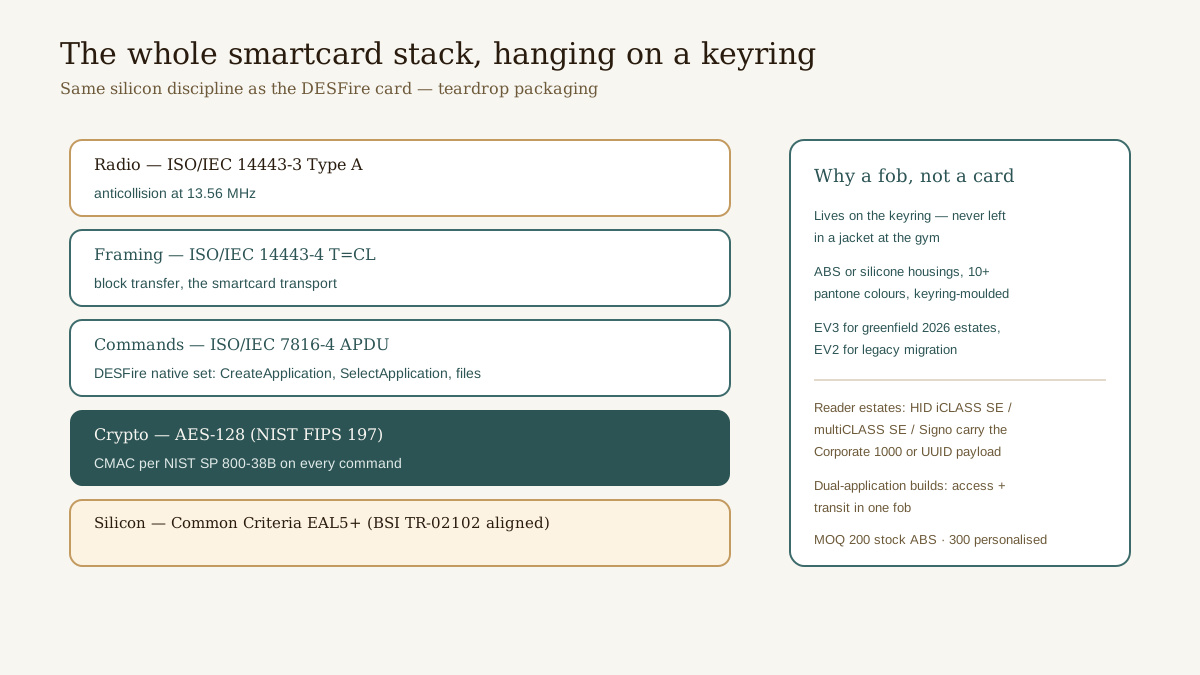
- ISO/IEC 7816-4 APDU command framework DESFire native command set (CreateApplication, SelectApplication, AuthenticateAES, ReadData, WriteData, CommitTransaction) NXP AN12343 Transaction MAC + Secure Unique NFC (SUN) / Secure Dynamic Messaging (SDM) on EV3
- AES-128 block cipher per NIST FIPS 197 CMAC authentication per NIST SP 800-38B on every command (EV3) 3DES / 2K3DES supported only for legacy compatibility — disabled in greenfield Proud Tek builds
- Common Criteria EAL5+ hardware security evaluation on DESFire EV2/EV3 silicon BSI TR-02102-1 cipher-suite-recommendations alignment (AES-128 + CMAC) ISO/IEC 27001 Annex A.9 access-control control-family mapping for the issuance programme
Every fob gets its own key — and a paper trail
NXP AN10922 AES-128 CMAC key-diversification procedure Per-fob Application Keys derived from UID + customer AES-128 master secret Master-key ceremony inside a FIPS 140-3 Level 3 HSM — master secret never exposed in the clear
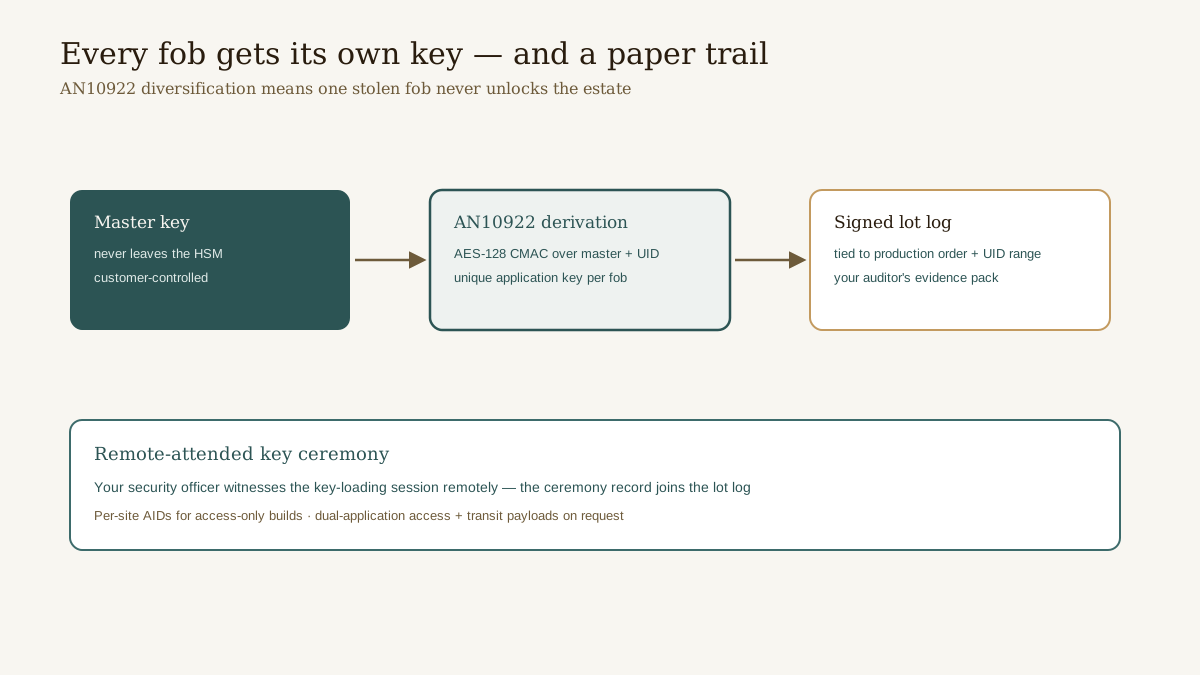
- Signed per-lot key-derivation log tied to production order and UID range Remote-attended key ceremony (encrypted screen-share) with customer security officer ISO/IEC 27001 A.9 evidence pack (access-control policy, key-lifecycle log, role-separation sign-off)
DESFire EV1, EV2 and EV3 at a glance
The three DESFire generations share the AES-128 authentication architecture and ISO/IEC 7816-4 APDU layer, so a fob specified today in EV3 is source-compatible with existing EV1 / EV2 reader code. The differences are in feature set, certification vintage and performance ceilings.
DESFire EV1 (legacy issuance)
- Max 28 applications per PICC
- ISO CMAC on authentication only, not per-command
- No Transaction MAC counter — replay of a prior successful transaction is not distinguishable from a fresh one
- No Secure Unique NFC (SUN) — tap-to-URL cannot be cryptographically anchored
- Common Criteria EAL4+ (older evaluation vintage)
- Not recommended for any new 2026 issuance — migration target, not greenfield
DESFire EV3 (2026 default)
- Unlimited applications via delegated-application issuance (transit + parking consortium friendly)
- CMAC per command per NIST SP 800-38B — every exchange is integrity-protected
- Transaction MAC + commit counter (NXP AN12343) for anti-replay on cashless / fare balance
- Secure Unique NFC (SUN) + Secure Dynamic Messaging (SDM) — URL-based dynamic NDEF with rolling MAC validated server-side
- Common Criteria EAL5+ hardware certification on DESFire EV3 silicon
- Greenfield default for 2026; EV2 offers a subset and is acceptable when SUN is not required
Quantified field evidence for the keyfob form factor
Migration roadmap — CRYPTO-1 Classic to DESFire EV3
Most DESFire keyfob orders land at customers migrating from MIFARE Classic 1K / 4K; CRYPTO-1 has been published since Garcia et al. 2008 and NXP has recommended AES-128 for over a decade. Proud Tek supports three crossover modes sequenced to minimise reader-firmware disruption.
- Month 0-3 · Mode A audit — CSN + DESFire application
Reader reads the 7-byte UID (CSN) as an interim identifier while the back-end finishes rolling out DESFire application authentication. CSN mode is not itself secure but provides a zero-change issuance path while the reader firmware is patched. Key ceremony happens in parallel in an HSM — no field exposure.
- Month 3-18 · Mode B rollout — dual-technology fobs
A single housing carries a legacy T5577 / HID Prox LF chip and a DESFire EV3 HF chip. Old readers see the Prox number on 125 kHz, new readers authenticate against DESFire on 13.56 MHz. Mode B is the bulk of the migration window and lasts until the reader fleet is >95 % HF-capable. See the dual-frequency-key-fob page for the hardware recipe.
- Month 12-24 · Mode C interim — MIFARE Plus SE security-level transition
When the reader fleet expects Classic-mapped memory but supports a firmware upgrade path to AES, Plus SE runs in security level 1 (Classic-compatible) now and is upgraded to security level 3 (AES-128 authenticated) later without reissuing credentials. Plus EV2 is the direct predecessor path — side-by-side on /compare/mifare-plus-ev2-vs-desfire-ev3/.
- Month 18-30 · Reader firmware cut-over + LF retirement
Readers are upgraded to DESFire-only authentication, the LF chip inside the dual-technology housing is decommissioned (but remains physically present) and the site transitions to an AES-128-only posture. Transaction MAC is enabled for any cashless / fare-balance applications per NXP AN12343.
- Month 30+ · Operational steady state — greenfield DESFire EV3 issuance
Vertical context spans enterprise-access, transit-consortium, campus multi-application, PIV-aligned federal-contractor and high-security-residential DESFire-keyfob programmes; each carries its own review cycle, refresh trigger and supplier-onboarding pattern referenced here. AES-128 master keys rotate on the customer's audit schedule, NXP AN10922 diversification keeps each fob individually compromised-proof, and the NIST FIPS 201-3 / ISO/IEC 27001 A.9 evidence pack closes the annual security audit.
Common pitfalls integrators avoid
- Shipping DESFire fobs with the factory default key (AES all-zero). Any off-the-shelf DESFire reader can then authenticate and read the application; always change the PICC Master Key and every Application Key during personalisation, with the change logged in the key ceremony evidence.
- Using the UID as the authenticator in a high-security context. The 7-byte UID is readable without authentication — DESFire EV2/EV3 support a random 4-byte UID regenerated per session (ISO/IEC 14443-3); rely on Application Master Key authentication, not the UID.
- Ordering keyfobs without specifying the target reader brand and AID. An HID iCLASS SE multiCLASS reader and a LEGIC advant reader both support DESFire but use different Application Identifiers and key-derivation profiles; the fob must be pre-programmed for the exact reader platform.
- Skipping the Transaction MAC (EV2/EV3) on cashless / fare applications. Without Transaction MAC a reader cannot distinguish a replayed transaction from a fresh one; always enable Transaction MAC + commit counter per NXP AN12343 when the fob carries a balance.
- Deploying DESFire EV1 for a new 2026 project. EV1 lacks Transaction MAC, SUN and SDM and sits on an older EAL4+ evaluation; EV3 is the forward-compatible default for any greenfield install and is already byte-compatible with EV1 reader code for the access-control subset.
The reference facts, at a glance
Reader-platform compatibility
HID iCLASS SE / multiCLASS SE / Signo — Corporate 1000 or UUID payload in the DESFire application SALTO XS4 / KS / NEOXX — SALTO DESFire profile with per-customer AID ASSA ABLOY Aperio / SMARTair, dormakaba evolo / community, Nedap AEOS, LenelS2 OnGuard — tested during acceptance
Housing
ABS (standard, 10+ pantone colours, keyring-moulded) Silicone (platinum-cured, IP68 wet-handling, Shore A 60) Epoxy drop (seamless, outdoor / ATEX passive-equipment) — all with 304 / 316 stainless split ring
Personalisation payload options
Access-only AES-128 application with per-site AID Dual-application: access + transit (ITSO / Calypso-adjacent AID, separate key set) PIV-aligned FASC-N / UUID payload per NIST FIPS 201-3 for federal-contractor issuance
Logistics
MOQ 200 stock ABS / 300 pre-personalised + printed Lead time 12-15 business days stock / 15-18 business days custom personalisation Every order includes signed UID list + AES-128 application-key derivation evidence
Useful next pages
Use these linked product, guide and comparison pages to keep the next click specific and practical.
Related DESFire & AES-128 credentials
DESFire and AES-128 Plus credentials in adjacent form factors plus the direct chip-to-chip comparison.
FAQ
Is a DESFire keyfob interchangeable with a DESFire card on the same system?
Yes. The access control system communicates with the DESFire chip, not the physical form factor. A DESFire keyfob with the same application structure and keys as a DESFire card is treated identically by the reader. Users can choose their preferred form factor (card or keyfob) without any backend configuration difference.
What is the read range of a DESFire keyfob versus a card?
Keyfobs typically have a slightly smaller antenna than cards (due to the compact housing), resulting in a read range of 2-4 cm versus 3-5 cm for a full-size card on the same reader. This difference is negligible for tap access. Users hold the keyfob against the reader and the transaction completes in under 100 ms.
What is the MOQ and lead time?
DESFire keyfobs in ABS housing: MOQ 200, lead time 12-15 business days. With custom color, logo printing and pre-personalized application structures: MOQ 300, lead time 15-18 business days. Silicone waterproof housing: MOQ 200, lead time 15-18 business days. Encoding and UID lists included with every order.
Why DESFire EV3 and not MIFARE Plus EV2 for a new deployment?
Both are AES-128 and both are correct choices. DESFire EV3 is recommended when the deployment needs independent applications (access + transit + cashless + loyalty on one credential), Secure Unique NFC (SUN) for tap-to-URL authentication, or the hardened Transaction MAC with per-command CMAC. MIFARE Plus EV2 in security level 3 is recommended when the deployment is pure access control that must remain byte-compatible with Classic-mapped reader firmware for a transitional period; Plus EV2 supports the same Classic 1K/4K sector memory model so existing readers continue to work. The full side-by-side is on [Plus EV2 vs DESFire EV3](/compare/mifare-plus-ev2-vs-desfire-ev3/).
Can my phone read a DESFire keyfob?
The phone can read the chip UID without authentication (any iPhone 7+ or NFC-enabled Android with an NFC diagnostics app like NXP TagInfo can retrieve the 7-byte UID), but it cannot authenticate into an application without the AES key. For consumer tap-to-URL using DESFire EV3's Secure Unique NFC (SUN) feature, the application URL embeds a per-tap rolling MAC that the back-end validates server-side; the phone tap works like any NDEF URL tap and no app is required. For access control authentication the phone is not involved; only the physical reader holds the application keys.
Sources & references
Primary standards, OEM datasheets and regulatory documents cited by this article. All URLs were verified on the access date shown below.
- ISO/IEC 14443-3:2018 — Identification cards — Contactless integrated circuit cards — Proximity cards — Part 3: Initialization and anticollision
HF 13.56 MHz anticollision layer underneath MIFARE DESFire EV1/EV2/EV3 and MIFARE Plus keyfobs.
- ISO/IEC 14443-4:2018 — Identification cards — Contactless integrated circuit cards — Proximity cards — Part 4: Transmission protocol
Block-framing and Transaction MAC / commit-counter layer exploited by DESFire EV2/EV3 anti-replay.
- ISO/IEC 7816-4:2020 — Identification cards — Integrated circuit cards — Part 4: Organization, security and commands for interchange
APDU command framework used by DESFire EV2/EV3 application / file commands.
- NFC Forum Type 4 Tag Specification
NDEF access profile DESFire implements for tap-to-URL and SUN authentication.
- NIST FIPS 197 — Advanced Encryption Standard (AES)
Federal specification for the AES-128 block cipher that underpins DESFire authentication.
- NIST SP 800-38B — Recommendation for Block Cipher Modes of Operation: the CMAC Mode for Authentication
CMAC authentication mode used per-command on DESFire EV3 under NXP AN12343.
- NXP AN10922 — Symmetric key diversifications
AES-128 CMAC key-diversification procedure used in Proud Tek DESFire personalisation.
- NXP AN12343 — Transaction MAC and Secure Unique NFC (SUN) on MIFARE DESFire EV3
Vendor reference for EV3 Transaction MAC and SUN features cited in the migration-playbook section.
- NXP MIFARE Classic security bulletin — CRYPTO-1 vulnerability
Vendor-issued guidance underpinning the Classic → DESFire migration recommendation.
- BSI TR-02102-1 — Cryptographic Mechanisms: Recommendations and Key Lengths
German federal cipher-suite recommendations aligning AES-128 + CMAC with the DESFire EV3 authentication profile.
- ISO/IEC 27001:2022 — Information security, cybersecurity and privacy protection — Information security management systems — Requirements (Annex A.9 Access Control)
Access-control control-family mapped by the DESFire keyfob issuance programme for audit closure.
- NIST FIPS 201-3 — Personal Identity Verification (PIV) of Federal Employees and Contractors
Reference standard for FASC-N / UUID payload encoding when DESFire is used in PIV-aligned issuance.
Proud Tek is a Shenzhen-based RFID & NFC manufacturer supplying hotel chains, transit operators, event venues and retail brands worldwide. Every order includes free samples, RF testing and dedicated project support.
Get a Quick Quote
Tell us about your project and we'll respond within one business day. Fields marked (asterisk) are required.