
ABS-Housing Keyfob
ABS RFID Keyfob
IP68 Ultrasonic-Welded Credential

Quick answer
ABS RFID keyfobs house a 125 kHz LF or 13.56 MHz HF chip in two injection-moulded shells, ultrasonically welded to an IP68 ingress rating. The chip library spans EM4200 / EM4305 / T5577, MIFARE Classic 1K, DESFire EV3, NTAG 424 DNA and I-CODE SLIX2. The halogen-free housing has a UL 94 V-0 option and RoHS 3 + REACH clearance for building-access, campus, fleet, hospitality and student-ID programmes.
- Ultrasonic-welded ABS shell rated IP68 per IEC 60529, UL 94 V-0 flammability option, RoHS 3 + REACH cleared — the workhorse physical format for enterprise access control.
- Chip library spans LF 125 kHz (EM4200 / EM4305 / T5577 / HID-compatible) and HF 13.56 MHz (MIFARE Classic 1K / Plus SE / DESFire EV3 / NTAG 213-216 / NTAG 424 DNA / I-CODE SLIX2) on one housing SKU.
- Wiegand 26 / 34 / 37 + OSDP v2.2 Secure Channel + NTAG 424 DNA SUN bridge legacy HID estates to modern AES-128 OSDP and mobile-ready deployments on the same credential.
Used in these industries
Deployments where this product is referenced on our industry landing pages.
At a glance
Use these short answers to decide whether this page matches the project before moving into the detail.
Form factor
Standard teardrop / rectangle / oval ABS fob 30-50 mm × 20-30 mm × 4-8 mm; 5-12 g mass; Ø 4-6 mm key-ring hole. Two-piece injection-moulded ABS (halogen-free 94HB or UL...
Air-interface envelope
125 kHz LF — EM4200 / EM4305 / T5577 / HID ProxCard II-compatible clones for legacy reader estates. 13.56 MHz HF — MIFARE Classic 1K, MIFARE Plus SE, MIFARE DESFire EV3...
Next step
Ready to move forward? Start your inquiry to get specific answers for this project.
Request ABS keyfob quote- Typical pricing
-
USD 0.20–0.45 /pc @ 5k+ (typical FOB Shenzhen range) — firm quote in one business day.
Commercial terms
- MOQ
- Varies by SKU — stock items from 100 pcs; custom production typically 200-1,000 pcs
- Lead time
- Production 2-3 weeks after artwork and encoding sign-off; reorders on a 3-4 week cycle
- Samples
- Free samples and RF test report with every order; courier at customer cost
- Payment
- 50% T/T deposit, 50% before shipment; Net 30/60 for established accounts; LC for large orders
- Shipping
- FOB Shenzhen / Yantian; DHL, FedEx or EMS air freight; sea LCL / FCL for volume
- Response
- Itemized quote within one business day, Mon-Fri (UTC+8)
Why ABS is still the default housing for access-control keyfobs
- Injection-moulded ABS holds tight dimensional tolerance (±0.1 mm) on the 30-50 mm teardrop / rectangle footprint that office / facility readers have been tuned against for two decades; no antenna retuning is needed to swap a chip.
- Ultrasonic welding at 20-35 kHz seals two shells to IP68 per IEC 60529 in < 0.5 s of weld time — faster cycle than epoxy pot, cheaper than metal over-moulding, and leaves a clean internal cavity around the antenna.
- UL 94 V-0 grade ABS is available at modest cost premium for fleet / server-room use; standard grade 94HB is acceptable for most enterprise office environments.
- Halogen-free ABS + RoHS 3 + REACH SVHC screen close out the consumer chemistry audit without pushing the fob into a specialty material stream.
- Pad-print, thermal-transfer, UV-inkjet or laser-under-surface decoration covers branded-building / site-ID / student-ID / hospitality use cases with the same tooling.
LF, HF, hybrid — which chip inside the same ABS shell
Plain PVC card / printed badge
- PVC card bends, cracks and delaminates; typical 12-24 month field life under daily carry.
- IP-rating is not meaningful on a laminated card; water / sweat / lanyard wear degrade reads over 6-12 months.
- Limited chip choice on card form; rarely sees NTAG 424 DNA or DESFire EV3 at card retail price.
- Consumer-scale disposal / shred is the only end-of-life option; PVC recycling is poor.
ABS RFID keyfob
- Ultrasonic-welded ABS survives 5-10 years of daily carry; IP68 tolerates sweat, IPA wipe-down, brief immersion.
- IP68 per IEC 60529 validated on every SKU; 1.5 m drop test on IEC 60068-2-32 Ea without weld break.
- Full chip library: LF EM / T5577 legacy clones through HF DESFire EV3 + NTAG 424 DNA in the same housing.
- Cut-retire renders chip inoperative per NIST SP 800-88; ABS stream separated and recycled per WEEE.
- 125 kHz LF EM4200 / EM4305 / T5577 — drop-in for legacy HID ProxCard II / indala / AWID reader estates that are still in 50-60 % of North-American enterprise buildings.
- 13.56 MHz HF MIFARE Classic 1K — baseline HF access credential for campus and transport; CRYPTO-1 is cryptographically weak and should migrate to MIFARE Plus SE or DESFire EV3.
- 13.56 MHz HF MIFARE DESFire EV3 — AES-128 mutual authentication, OSDP v2.2 Secure Channel compatible, and the default for ISO/IEC 27001-aligned enterprise estates.
- 13.56 MHz HF NTAG 424 DNA — SUN message with CMAC for 1-tap consumer / visitor / BYOD credential; pairs with mobile-wallet emulation on iOS / Android.
- Dual-frequency LF + HF fob exists in the same ABS shell for mixed-estate (legacy + modern) migration; expect a modest read-range trade-off on each frequency.
Where ABS keyfobs earn their place in the catalogue
- Enterprise building access — badge-printing office HQ issues 5,000-50,000 ABS fobs across multi-site estate; PACS uses Wiegand 26 / 34 / 37 or OSDP v2.2 Secure Channel; ISO/IEC 27001 A.11.1 / SOC 2 CC6 audit coverage.
- University and campus — student + staff credential covers building, parking, library, dining, vending and laundry; typically dual-application HF (MIFARE DESFire EV3 + MIFARE Plus SE or NTAG 424 DNA) on the same fob.
- Fleet and vehicle — driver-ID fob paired with fleet-management reader; UL 94 V-0 ABS grade keeps flammability posture clean when clipped inside a heavy-vehicle cabin.
- Hospitality — guest-room keyfob where the property specifically wants a non-card credential for VIP / long-stay; laser-engraved under-surface property logo.
- Residential estate + gated community — home-owner credential for perimeter reader; 125 kHz LF for legacy gate controllers, or HF MIFARE for modern IP-connected reader estates.
- Visitor / contractor credential — short-term HF DESFire EV3 or NTAG 424 DNA issue, revoked at PACS on return; ABS shell recycled once returned to the badge desk.
How to roll out an ABS keyfob programme without fragmenting the access-control estate
- Week 1 — PACS survey and chip matrix
Inventory the existing reader estate (125 kHz LF vs 13.56 MHz HF; Wiegand vs OSDP; HID-compatible vs MIFARE), pick the target chip per site, and freeze the fob housing SKU (teardrop / rectangle / oval) for estate-wide consistency.
- Weeks 2-3 — encode + issue workflow
Stand up the encode bench tied into HRIS / ITAM / visitor-management; issue the first pilot batch; validate PACS recognition at every reader; dry-run revocation and re-issue cycles against an HRIS termination event.
- Weeks 4-6 — pilot site rollout
Deploy 500-5,000 fobs across a pilot building; audit PACS logs for successful read rates, failed authentications and revocation latency; capture user experience feedback on key-ring ergonomics.
- Weeks 7-10 — estate rollout
Scale to 50,000+ fobs across the full estate; integrate with mobile-credential (NTAG 424 DNA / DESFire EV3) for BYOD sites; retire legacy cards and log each replacement in HRIS / ITAM.
- Month 4+ — audit cadence and sustainability reporting
Programme references draw from enterprise / campus / hospitality / fleet keyfob estates, with periodic compliance reviews, refresh-cycle planning and supplier-onboarding gates customised per vertical. wire fob-issue / revoke / retirement events into ISO/IEC 27001 A.11.1 + SOC 2 CC6 + HIPAA 164.310 + PCI DSS v4.0 Req. 9 evidence feeds; layer CDP / Higg Index disclosure on the halogen-free / recycled-content grade.
- Decide LF / HF / dual at the PACS level first — ABS shell is the same; only the antenna and chip change. This keeps the HRIS / ITAM / visitor-management workflow identical across the estate.
- Pick the chip per security posture: EM4200 / T5577 for legacy HID-compatible; MIFARE DESFire EV3 for ISO/IEC 27001-aligned AES-128 estates; NTAG 424 DNA for consumer / visitor / BYOD tap; dual MIFARE + NTAG on high-value credentials.
- Wire OSDP v2.2 Secure Channel with AES-128 between reader and PACS head-end for any new deployment; leave Wiegand 26 / 34 / 37 only where an existing reader estate cannot be updated.
- Revocation workflow should be < 10 seconds from HRIS termination event to PACS denial — this is the actual security control, not the fob itself.
- Retirement and disposal — cut or pulverise the fob to render chip inoperative per NIST SP 800-88 media-sanitisation guidance; separate ABS shell for WEEE-stream recycling; log the disposal against the HRIS record.
- Sustainability posture — halogen-free resin, RoHS 3 + REACH evidence pack, and optional recycled-content grade fit corporate CDP / Higg Index reporting.
Same shell, two radios — the chip decision at a glance
The ABS shell does not care what it carries; your readers do. The whole decision collapses to a single question — which reader estate is this credential walking up to — and the map below answers it without a spec sheet. Low frequency is the drop-in for legacy panels; high frequency is where authentication actually lives. If a site runs both, read the 125 kHz vs 13.56 MHz split before you commit, and note that a single-chip EM4305 keyfob or a MIFARE DESFire keyfob already covers the two ends of this range.
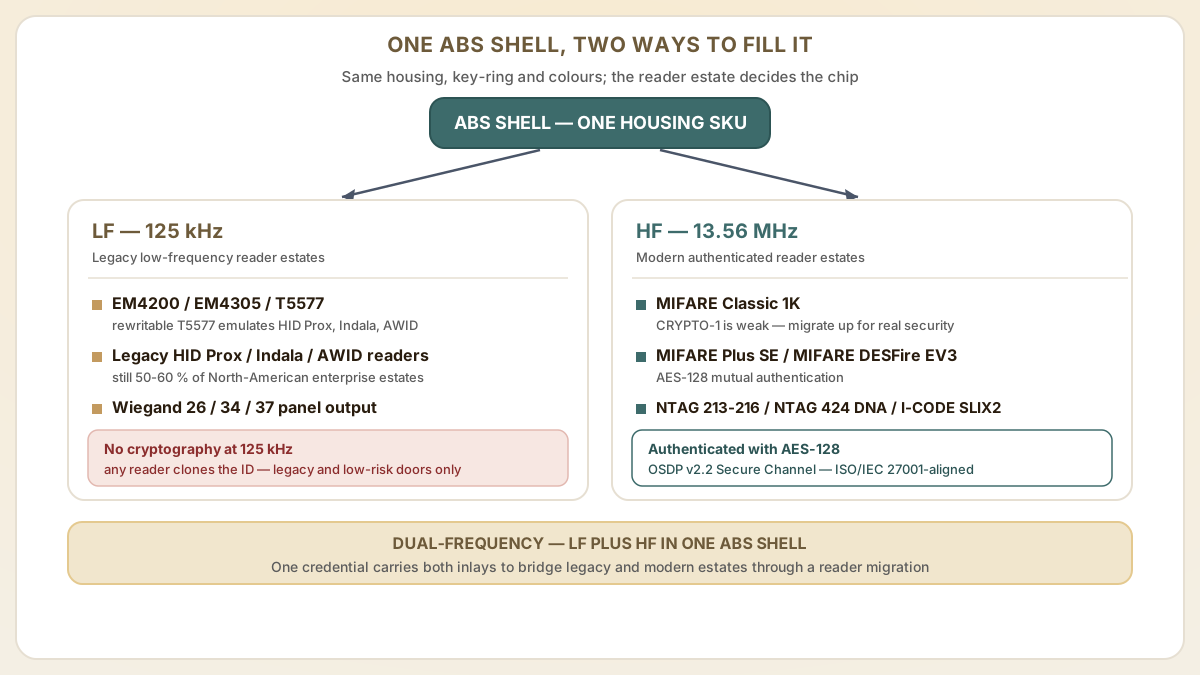
- LF 125 kHz — EM4200 / EM4305 / T5577 drop into legacy HID Prox, Indala and AWID panels; the ID carries no cryptography, so it is right for legacy and low-risk doors, not high-security ones.
- HF 13.56 MHz — MIFARE DESFire EV3 and MIFARE Plus SE bring AES-128 mutual authentication; NTAG 424 DNA adds a SUN message for tap-to-verify; MIFARE Classic 1K stays only where CRYPTO-1's weakness is understood.
- Output format follows the estate — Wiegand 26 / 34 / 37 for legacy panels, OSDP v2.2 Secure Channel for AES-128 head-ends.
- Dual-frequency LF plus HF lives in the same welded shell, so one credential can bridge legacy and modern readers through a multi-year migration.
Inside the weld — how an ABS fob is actually built
Pull an ABS fob apart — carefully, because the ultrasonic weld has no intention of giving it back — and there is almost nothing to it: two injection-moulded shells, an inlay of copper coil plus chip, and a stainless split ring absorbing all the key-ring abuse. That simplicity is the whole point; the housing is cheap, colourful and repeatable, and every rugged upgrade is a shell swap rather than a redesign. When the environment turns mean, the epoxy keyfob and the metal keyfob reuse the same inlay, and the silicone keyfob takes the wash-down and food-contact duty.
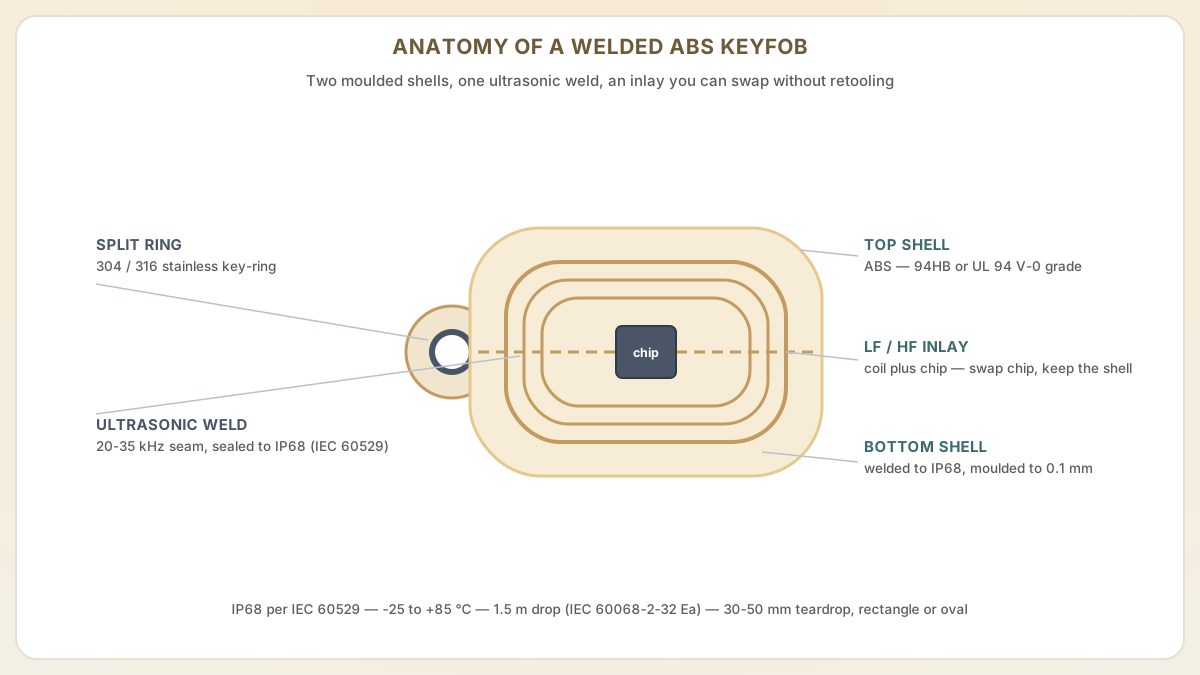
- Two-piece ABS shell — injection-moulded to ±0.1 mm on the 30-50 mm teardrop, rectangle or oval footprint, in a 10 Pantone-shade standard library.
- Ultrasonic weld at 20-35 kHz fuses the shells in under half a second and seals the cavity to IP68 per IEC 60529 — no epoxy pot, no cure oven.
- LF / HF inlay — a copper coil tuned to 125 kHz or 13.56 MHz plus the chip; swapping the chip never touches the housing tooling.
- 304 / 316 stainless split ring — the part that fails first on a busy key-ring, and the cheapest place to over-specify.
- Rated -25 °C to +85 °C with a 1.5 m drop test (IEC 60068-2-32 Ea) and a 5-10 year field life under daily carry.
The reference facts, at a glance
Flammability + safety
UL 94 V-0 flammability rating available on demand (standard grade is 94HB) for fleet-vehicle and server-room key carriers. IEC 62368-1 audio / video and ICT equipment safety compliance for the fob as an accessory of a safety-certified reader.
Ingress + durability
IP68 per IEC 60529 after ultrasonic weld; -25 °C to +85 °C service; 1.5 m drop test (IEC 60068-2-32 Ea). Solvent resistance — typical office / facility cleaners (IPA, quat ammonia, dilute bleach); not rated for continuous hydrocarbon / acid exposure (use epoxy variant).
Chemistry + disclosure
RoHS 3 (EU 2015/863) + REACH SVHC screen on the ABS resin, pigments and weld-additive system. Halogen-free resin grade on request; California Proposition 65 compliance for consumer-facing fob SKUs.
Radio conformity
FCC Part 15.225 (13.56 MHz) and §15.209 general emission (125 kHz passive) — the fob is a passive transponder and the reader carries FCC ID. RED 2014/53/EU conformity through the paired reader; ISED RSS-210 / RSS-GEN.
Surface decoration
Pad-printing, thermal-transfer, UV inkjet logo + serial number; laser-engraving under surface on special-order SKUs. Standard colour library: 10 Pantone-matched shades with 20,000+ piece MOQ for bespoke Pantone.
Access-control integration
Wiegand 26 / 34 / 37 formats for legacy HID ProxCard estates; OSDP v2.2 Secure Channel for modern AES-128 estates. NTAG 424 DNA SUN URL or MIFARE DESFire EV3 AES session keys for mobile-ready open-supervised reader estates.
Enterprise / compliance use case
ISO/IEC 27001 A.11.1 physical / environmental security controls — credential issue / revoke / audit logged through PACS. SOC 2 Common Criteria CC6 physical access control; HIPAA §164.310(a)(2) physical safeguards; PCI DSS v4.0 Req. 9.
Operational lifecycle
5-10 year field life under daily carry; retirement by cutting fob body to render the chip inoperative per SP 800-88 media-sanitisation guidance. Lost / stolen credentials revoked at PACS within seconds; physical fob issue / return logged in HRIS + ITAM.
Disposal + sustainability
ABS resin is recyclable under WEEE Directive 2012/19/EU when separated from the chip / antenna; bulk-recycling streams accept ABS. Halogen-free and recycled-content grades available for corporate sustainability programmes (Higg Index / CDP reporting).
Useful next pages
Use these linked product, guide and comparison pages to keep the next click specific and practical.
Related keyfob and access-credential tags
Other keyfob housings, chip families and access-credential adjacents in the catalogue.
FAQ
Does the ABS shell carry a UL 94 flammability rating?
Standard grade is UL 94 94HB, which is fine for office and campus environments. A UL 94 V-0 grade option is available for fleet-vehicle cabins, server-room carriers and specific regulatory sites where a self-extinguishing rating is required; expect a modest cost premium and a confirmed RoHS 3 + REACH SVHC evidence pack on the specific resin lot.
Can a single ABS keyfob SKU cover both LF 125 kHz and HF 13.56 MHz reader estates?
Yes — the same two-piece ABS shell houses an LF-only, HF-only or dual-frequency LF + HF inlay. The LF-only inlay covers EM4200 / EM4305 / T5577 for HID-compatible legacy estates; the HF-only inlay covers MIFARE Classic / Plus / DESFire / NTAG 424 DNA / I-CODE SLIX2 for modern AES-128 estates; the dual-frequency inlay serves mixed-estate migration. The housing SKU, key-ring hole, colour library and laser / pad-print decoration stay identical; only the antenna and chip change inside.
How does fob retirement work for a terminated employee?
The actual security control is PACS revocation at the head-end — revocation should complete within 10 seconds of the HRIS termination event, regardless of whether the physical fob is recovered. On physical return, the ABS shell is cut or pulverised to render the chip inoperative per NIST SP 800-88 media-sanitisation guidance; the shell enters the WEEE recycling stream and the disposal is logged against the HRIS record. This closes the ISO/IEC 27001 A.11.1 physical-security control cleanly.
Can ABS keyfobs be produced in our brand colour with a logo and serial number?
Yes. The standard ABS library is 10 Pantone-matched shades, decorated by pad-printing, thermal-transfer or UV inkjet with a logo and a sequential serial number; laser-engraving under the surface is available on special-order SKUs. A fully bespoke Pantone colour match is available at a 20,000+ piece MOQ, while the 10-shade standard library carries no colour surcharge.
Do ABS keyfobs ship pre-encoded, or are they programmed on site?
Either. The LF inlay (EM4200 / EM4305 / T5577) can be pre-encoded to a HID-compatible facility code and card-number range for legacy Prox estates; HF inlays are keyed to your scheme — MIFARE DESFire EV3 with AES-128 mutual authentication, or NTAG 424 DNA with a SUN URL. Output matches the panel: Wiegand 26 / 34 / 37 for legacy readers, OSDP v2.2 Secure Channel for AES-128 head-ends. On-site encoding runs off a standard 125 kHz or 13.56 MHz bench writer tied into the HRIS / ITAM workflow.
How durable is the welded ABS shell in daily carry and outdoor use?
The ultrasonically welded ABS shell is rated IP68 per IEC 60529, survives a 1.5 m drop test (IEC 60068-2-32 Ea) without weld break, and holds a 5-10 year field life under daily carry across a -25 °C to +85 °C service range. It tolerates common facility cleaners — IPA, quaternary ammonia and dilute bleach — but is not rated for continuous hydrocarbon or acid exposure; specify the epoxy variant for those environments.
What are the MOQ, sample options and lead time for ABS keyfobs?
A fully bespoke Pantone colour match carries a 20,000+ piece MOQ; the 10-shade standard library carries no colour surcharge. Standard MOQ, production lead time and paid-sample availability are set per programme and are not published on this page. Request them with your target chip, housing shape and annual volume for a firm quote.
Sources & references
Primary standards, OEM datasheets and regulatory documents cited by this article. All URLs were verified on the access date shown below.
- UL 94 — Tests for Flammability of Plastic Materials for Parts in Devices and Appliances
Flammability rating framework used to classify 94HB (standard) and V-0 (option) ABS grades for keyfob housings.
- IEC 60529 — Degrees of protection provided by enclosures (IP Code)
Ingress-protection reference behind the IP68 rating validated on the ultrasonically welded ABS shell.
- IEC 62368-1 — Audio/video, information and communication technology equipment — Safety requirements
Product-safety standard covering the keyfob as an accessory of a safety-certified reader.
- Directive 2015/863/EU (RoHS 3) — Restriction of Hazardous Substances
Restriction-of-hazardous-substances regime for the ABS resin, pigments, weld additives and inlay.
- Regulation (EC) 1907/2006 (REACH) — Substances of Very High Concern
SVHC candidate-list reference for the keyfob materials audit.
- 47 CFR Part 15 — Radio Frequency Devices
§15.225 (13.56 MHz) and §15.209 (125 kHz passive) cover the reader emitter paired with the fob transponder.
- Directive 2014/53/EU — Radio Equipment Directive (RED)
CE conformity framework for the paired reader in EU access-control deployments.
- SIA OSDP v2.2 — Open Supervised Device Protocol Specification
Modern Secure Channel AES-128 reader-to-PACS protocol replacing Wiegand on new deployments.
- ISO/IEC 27001 — Information security management systems — Requirements
Information-security management framework whose Annex A.11 physical / environmental security controls the keyfob programme maps into.
- NIST SP 800-88 Revision 1 — Guidelines for Media Sanitization
Retirement / destroy guidance applied to the cut-or-pulverise end-of-life step for RFID keyfobs.
- Atmel / Microchip T5577 125 kHz Read/Write Passive RFID Chip — product page
Vendor product page for the programmable 125 kHz T5577 LF chip named in the LF chip option and emulation notes.
Proud Tek is a Shenzhen-based RFID & NFC manufacturer supplying hotel chains, transit operators, event venues and retail brands worldwide. Every order includes free samples, RF testing and dedicated project support.
Get a Quick Quote
Tell us about your project and we'll respond within one business day. Fields marked (asterisk) are required.