
Universal LF Fobs
T5577 Keyfob
Multi-Protocol 125 kHz RFID Fob

Quick answer
The T5577 keyfob is a rewritable 125 kHz LF credential — one Atmel / Microchip ATA5577 chip emulates ≥ 30 protocol profiles. Its 330-bit EEPROM, seven data blocks and Manchester / Biphase / FSK / PSK modulation cover EM4100, EM4200, HID Prox H10301, Indala, AWID, Kantech, Pyramid, Farpointe, Viking, Keri and Nexwatch. It is the integrator, locksmith and authorised red-team medium, shipped with documented commercial-use-case validation and a signed orderer-authorisation record.
- 30+ protocol emulation from a single chip — the widest 125 kHz envelope Proud Tek supplies. EM, HID Prox, Indala, AWID, Kantech, Pyramid, Viking, Keri, Nexwatch all configurable via the T5577 block-0 configuration word.
- 330-bit rewritable EEPROM across 7 data blocks (Microchip ATA5577 datasheet) with 32-bit password lock + independent configuration-block lock — the integrator can seal the modulation profile while leaving the ID field rewritable.
- Industry-standard medium for locksmiths, security integrators, commissioning teams and authorised red-team audits — Proud Tek validates every order against a legitimate commercial use-case envelope and records the orderer-site authorisation in the order file.
Used in these industries
Deployments where this product is referenced on our industry landing pages.
At a glance
Use these short answers to decide whether this page matches the project before moving into the detail.
Chip
Microchip / Atmel ATA5577 LF transponder 330-bit EEPROM across 7 user data blocks (224-bit user payload, config block, traceability)
Air interface
ISO/IEC 18000-2:2009 Type A — 125-134.2 kHz LF Data rate RF/8 to RF/128 configurable per emulated format
Next step
Ready to move forward? Start your inquiry to get specific answers for this project.
Request quote and samples- Typical pricing
-
USD 0.20–0.45 /pc @ 5k+ (typical FOB Shenzhen range) — firm quote in one business day.
Commercial terms
- MOQ
- Varies by SKU — stock items from 100 pcs; custom production typically 200-1,000 pcs
- Lead time
- Production 2-3 weeks after artwork and encoding sign-off; reorders on a 3-4 week cycle
- Samples
- Free samples and RF test report with every order; courier at customer cost
- Payment
- 50% T/T deposit, 50% before shipment; Net 30/60 for established accounts; LC for large orders
- Shipping
- FOB Shenzhen / Yantian; DHL, FedEx or EMS air freight; sea LCL / FCL for volume
- Response
- Itemized quote within one business day, Mon-Fri (UTC+8)
T5577 keyfob at a glance
T5577 vs EM4305 — when to specify which
Both are rewritable LF 125 kHz chips, both sit under ISO/IEC 18000-2, both carry a 32-bit password lock. The practical difference is the emulation envelope — which drives the decision for integrators servicing multiple reader fleets.
EM4305 (tenant-reuse / OSDP retrofit)
- 512-bit EEPROM; narrower block layout than T5577
- Emulates EM4100, HID Prox H10301, basic Indala / AWID — ~6-8 protocols
- 32-bit password write-lock; no independent configuration-block lock
- Typical fit: single-site multi-tenant residential, storage facility, OSDP v2.2 retrofit of a Wiegand panel
- Integrator stocks EM4305 when the client portfolio is LF-homogeneous (all HID Prox, or all EM4100)
- Slightly lower unit cost than T5577 at 100-500 qty
T5577 (universal integrator / locksmith inventory)
- 330-bit EEPROM across 7 blocks with finer-grained lock bits
- Emulates ≥ 30 formats — EM, HID, Indala, AWID, Kantech, Pyramid, Viking, Keri, Nexwatch
- 32-bit password + independent configuration-block lock (seal the modulation, leave the ID mutable)
- Typical fit: locksmith duplication, security integrator covering 40+ heterogeneous-reader sites, commissioning inventory, authorised red-team audits
- Integrator stocks T5577 when any of the client portfolio uses anything beyond the EM / basic-HID envelope
- Unit cost parity with EM4305 in bulk — no pricing premium for the broader emulation envelope
Quantified inventory-consolidation case for T5577
An integrator who inherits forty-plus buildings inherits forty-plus reader decisions made by other people over twenty years — an HID Prox head in the lobby, an Indala reader on the parking gate, an AWID panel at the loading dock nobody has a spare fob for anymore. The read-only way to serve that estate is a shelf of format-specific blanks and a prayer that stock matches the next call-out. The T5577 way is one blank that becomes whichever credential the reader in front of it expects. Here is where the money actually moves. The narrower rewritable envelope lives on the EM4305 keyfob; before betting a high-security door on any 125 kHz chip, walk the 125 kHz vs 13.56 MHz line first.
| Ops / cost driver | Shelf of format-specific blanks | One T5577 SKU |
|---|---|---|
| Blanks stocked for commissioning | 8-10 format-specific SKUs held in depth | One T5577 blank, programmed on site to the installed reader |
| A new client's reader is unknown until you arrive | Order the matching format, wait for stock, return later | Program the T5577 on the bench in seconds — no reorder, no second visit |
| Legacy reader whose credential is discontinued | No first-party fob exists; the reader itself has to be replaced | T5577 emulates the retired format and keeps the door working |
| Inventory capital across 40+ client sites | Highest — every format carried in depth | Drops 60-80 % against a format-specific library |
| Getting started | One MOQ for every format you choose to stock | MOQ 100 in ABS covers every 125 kHz reader you are likely to meet |
| Audit trail | Which blank shipped where is a spreadsheet exercise | One SKU, one signed UID-to-card-number list per order |
T5577 lifecycle — legitimate commercial envelopes
T5577 is the same chip hobbyist tools (Proxmark 3, ChameleonMini, Flipper Zero) use to demonstrate 125 kHz cloning. That is not a bug in the chip — it is exactly why integrators, locksmiths and authorised red-team teams need it. Proud Tek stages the fob against the five envelopes below and records the orderer authorisation in every order file.
- Envelope 1 · Legacy-site retrofit
A building still running a 1998 HID ProxPoint reader has no first-party replacement fobs available. T5577 programmed to HID H10301 with the site's facility code closes the gap until the reader fleet is modernised. Orderer is the integrator of record for the building.
- Envelope 2 · Multi-vendor integrator consolidation
A security integrator responsible for 40+ client sites holds a single T5577 SKU and programs on-site to whichever reader is installed. The order file names the integrator account and the client portfolio is summarised in the annual re-validation review.
- Envelope 3 · Commissioning + test inventory
A reader-install team programs T5577 fobs to the expected production protocol, tests every reader on the new install, then re-uses the same fobs for the next commissioning job. Order line explicitly identifies 'commissioning inventory' and the fobs do not ship to end-users.
- Envelope 4 · Locksmith key-duplication service
Locksmiths offering RFID fob copying for residential common-area doors, storage-unit lockers and gym lockers use T5577 as the blank medium. Proud Tek accepts these orders from locksmith accounts with a written commercial-registration; the service is legitimate when the customer owns the door and the protocol is 125 kHz LF.
- Envelope 5 · Authorised red-team / audit engagement
Reference deployments span multi-vendor-legacy, locksmith-duplication, reader-commissioning, red-team-audit and 30-protocol integrator-inventory T5577-keyfob programmes — quarterly audit cadence, annual hardware refresh and ongoing chip-family migration tracked across each vertical. red-team engagements require a signed statement naming the authorising customer, the outcome typically recommends migration to HF AES-128 (DESFire EV3 / Plus SE / iCLASS SE), and the T5577 fobs used in the exercise are retained in the engagement-evidence package rather than distributed.
One blank, thirty-plus credentials your readers already trust
The reason locksmiths and integrators standardise on the T5577 is gloriously boring: one rewritable chip answers to the entire 125 kHz zoo. Program the block-0 configuration word on a bench writer and the same fob presents as an EM read-only ID to one panel, an HID Prox credential to the next, an Indala or AWID number to the one after that — no per-format SKU, no guessing which decade the building's reader shipped in. It is still low-frequency, so the security posture below is not a footnote. For the read-only baseline it so cheerfully impersonates, see the EM4100 RFID card.
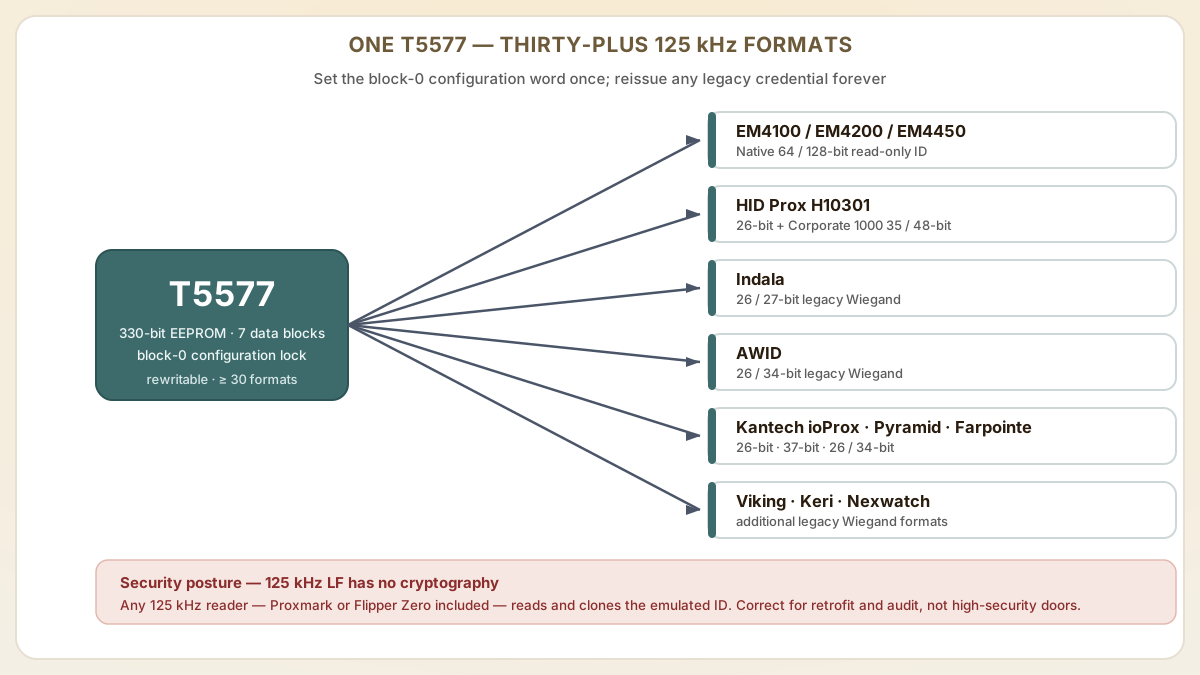
- Native EM read-only ID: the EM4100 / EM4200 / EM4450 64 or 128-bit number every legacy LF panel already accepts, no configuration beyond the ID itself.
- HID Prox: program the H10301 26-bit facility code and card number — or the wider Corporate 1000 35 / 48-bit format — and the fob answers HID ProxPoint readers directly.
- Indala, AWID and Kantech ioProx: the other legacy Wiegand dialects, 26 to 34-bit, covered from the same blank.
- Pyramid 37-bit, Farpointe 26 / 34-bit, Viking, Keri and Nexwatch round out the 30-plus envelope — the widest 125 kHz coverage Proud Tek supplies.
- The block-0 configuration lock seals the chosen modulation while leaving the ID rewritable: set the format once, reissue identities forever.
Inside the fob — coil, T5577 die, and the shell that survives a keyring
Electrically a 125 kHz fob is almost nothing to look at: a many-turn copper coil, the T5577 die, and potting that seals the two together. The engineering decision that actually reaches the buyer is the shell. ABS is cheap and comes in ten-plus colours; platinum-cured silicone takes an IP68 wash-down rating; epoxy gives a seamless outdoor drop; and an LWG Gold-tannery leather fob exists for the concierge desk that resents moulded plastic. All of them terminate in a 304 or 316 stainless split ring — the part that statistically fails first. Running two frequencies through one shell instead? The dual-frequency keyfob carries an LF chip and an HF chip in the same body.
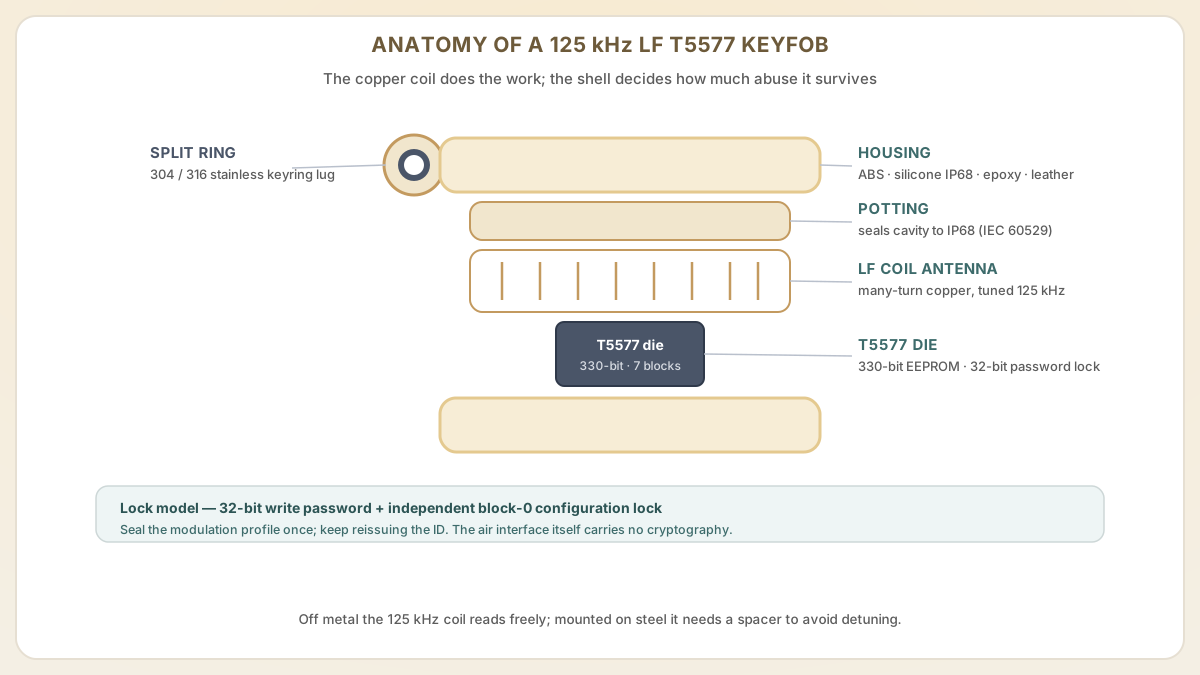
- Housing: ABS in ten-plus pantone colours, platinum-cured silicone rated IP68 (IEC 60529, Shore A 60), a seamless epoxy drop for outdoor duty, or an LWG Gold-tannery leather fob for premium issuance.
- LF coil antenna: a many-turn copper coil tuned to 125 kHz does all the energy harvesting — the fob carries no battery and never needs one.
- T5577 die: a 330-bit EEPROM across 7 data blocks (224-bit user payload plus configuration and traceability), bonded to the coil and sealed in potting.
- Lock model: a 32-bit password gates every write, and an independent block-0 lock freezes the modulation profile while the ID stays rewritable.
- Split ring: 304 or 316 stainless steel — mundane, load-bearing, and the first component to wear through on a busy keyring.
T5577 keyfob — full specification
Everything a reader-commissioning team or a procurement reviewer needs to size the order, in one block. Chip, memory, modulation, protection and housing are the T5577's own specifications; encoding, MOQ and lead time are how Proud Tek ships it. For the full form-factor menu, the RFID keyfob range lists every housing and frequency option.
| Attribute | Value | Notes |
|---|---|---|
| Chip | Microchip / Atmel ATA5577 (T5577) | 125 kHz LF read/write transponder, field-reprogrammable |
| EEPROM | 330-bit across 7 data blocks | 224-bit user payload plus configuration block and factory traceability |
| Modulation | Manchester, Biphase, FSK, PSK1 / PSK2 / PSK3, Direct | Selected in the block-0 configuration word |
| Data rate | RF/8 to RF/128 | Configurable to match each emulated format |
| Air interface | ISO/IEC 18000-2:2009 Type A, 125-134.2 kHz | Physical layer shared by every format the chip emulates |
| Read range | 3-8 cm | Depends on reader antenna and fob position |
| Protocol envelope | 30-plus 125 kHz formats | EM, HID Prox, Indala, AWID, Kantech, Pyramid, Farpointe, Viking, Keri, Nexwatch |
| Write protection | 32-bit password write-lock | Must be presented before the chip accepts any write |
| Configuration lock | Independent block-0 lock | Seals the modulation profile while the ID stays rewritable |
| Partitioning | Per-block lock bits | Fine-grained read-only / read-write control per data block |
| Housing | ABS, silicone, epoxy, leather | ABS 10+ pantone; silicone IP68 (IEC 60529, Shore A 60); LWG Gold leather |
| Split ring | 304 / 316 stainless steel | Standard keyring lug |
| Encoding tooling | Proxmark, ACR122L, HID Omnikey 5427 | CSV-driven bulk issuance with a signed UID-to-card-number map |
| MOQ | 100 ABS / 200-500 silicone, leather, custom | By housing type |
| Lead time | 3-5 days stock / 5-7 pre-configured / 10-15 custom | Business days from order confirmation |
| Compliance | RoHS 3 (Directive EU 2015/863); IP68 per IEC 60529 | Housing materials; note the LF air interface carries no cryptography |
The reference facts, at a glance
Protocol emulation envelope
EM4100 / EM4200 / EM4450 64/128-bit ID HID Prox H10301 26-bit, H10302 37-bit, H10304 37-bit + parity, Corporate 1000 35-bit / 48-bit Indala 26 / 27-bit, AWID 26 / 34-bit, Kantech ioProx 26-bit, Pyramid 37-bit, Farpointe 26 / 34-bit, Viking, Keri, Nexwatch
Write protection
32-bit password write-lock on the EEPROM Independent configuration-block lock (block-0) — seals modulation profile while leaving ID rewritable Per-block lock bits for fine-grained read-only / read-write partitioning
Tooling ecosystem
Production RFID writers (Proxmark, ACR122L, HID Omnikey 5427) for bulk issuance CSV-driven encoding workflow with signed UID ↔ card-number mapping Hobbyist tools (Flipper Zero, ChameleonMini) work against the same chip but are not used in Proud Tek production — auditability difference
Commercial-use-case validation
Order intake records the orderer's site / domain / integrator authorisation Locksmith / integrator accounts reviewed on first order and re-validated annually Red-team / penetration-test orders require a signed engagement statement naming the authorising customer
Housing
ABS (standard, 10+ pantone colours, keyring-moulded) Silicone (platinum-cured, IP68 per IEC 60529, Shore A 60) and epoxy drop Leather (LWG Gold tannery, 40 × 30 × 5 mm rectangle) for premium service-provider issuance
Security posture
No cryptography at the air-interface layer; RF emission is readable by any 125 kHz reader Password-lock defends EEPROM write-access, NOT RF-layer eavesdropping BSI TR-02102-1 cipher-suite recommendations explicitly do not endorse 125 kHz LF — HF AES-128 is the forward path
Multi-vendor consolidation
One T5577 SKU replaces 8-10 format-specific SKUs across an integrator's 40+ client sites On-site programming matches whichever reader is installed (HID / Indala / AWID / Kantech / Farpointe) Inventory investment drops by 60-80 % for integrators servicing heterogeneous-reader portfolios
Red-team / audit use
Authorised penetration testing of 125 kHz reader fleets Deliverable typically recommends HF AES-128 migration (DESFire EV3 / Plus SE / iCLASS SE) Engagement paperwork retained in the Proud Tek order file
Logistics
MOQ 100 stock ABS / 200-500 silicone / leather / custom shape Lead time 3-5 business days stock / 5-7 pre-configured / 10-15 custom housing Every order includes signed UID list + protocol-configuration evidence
Useful next pages
Use these linked product, guide and comparison pages to keep the next click specific and practical.
Related 125 kHz & LF-to-HF migration
Adjacent LF credentials plus the recommended AES-128 upgrade path.
FAQ
What is the difference between T5577 and EM4305?
Both are rewritable 125 kHz chips, but T5577 supports more modulation formats and protocol emulations than EM4305. T5577 can emulate virtually every 125 kHz protocol including HID Prox, Indala, AWID and Kantech, while EM4305 supports fewer formats. T5577 is the preferred choice when you need maximum protocol flexibility; EM4305 is adequate when you only need EM4100 emulation or basic HID Prox emulation.
Can T5577 fobs be locked to prevent tampering?
Yes. T5577 supports a 32-bit write password that must be presented before the chip accepts any write commands. Additionally, the configuration block can be locked separately, preventing changes to the modulation format while still allowing data block updates. For maximum security, apply both the write password and configuration lock.
What is the MOQ and lead time?
T5577 keyfobs in standard ABS housing: MOQ 100, lead time 3-5 business days from stock. Pre-programmed with your protocol configuration and facility code: MOQ 100, lead time 5-7 business days. Custom housing (silicone, leather, custom shape): MOQ 200-500 depending on housing type, lead time 10-15 business days.
Is it legal to order T5577 keyfobs that emulate HID Prox?
Yes, for the sites and credentials the orderer is authorised to administer. T5577 itself is a generic ISO/IEC 18000-2 chip and HID Prox H10301 is a published 26-bit format widely implemented by third-party vendors. Proud Tek validates orders against legitimate commercial use cases — residential buildings the orderer manages, client sites where the orderer is the integrator of record, locksmith key-duplication services, audit and penetration-testing engagements, or migration programmes where T5577 bridges a legacy reader fleet. Proud Tek does not knowingly supply cloned credentials for third-party sites the orderer does not administer.
How does T5577 compare to a Flipper Zero or Proxmark 3?
Flipper Zero and Proxmark 3 are reader/writer tools used to read an existing 125 kHz credential and write the captured data into a T5577 chip. T5577 is the storage medium, not the reader tool. For bulk-issuance workflows — where Proud Tek is programming hundreds or thousands of fobs with a defined facility code and a sequential card-number range — a production-grade RFID writer driven by CSV input is faster and more auditable than a hobbyist tool. Proud Tek delivers pre-programmed T5577 fobs with a signed UID-to-card-number mapping so the customer never needs the hobbyist tool in production.
Can T5577 keyfobs be pre-programmed to our facility code and laser-marked with our logo before shipping?
Yes. Proud Tek pre-programs T5577 fobs to the format your readers expect — an EM read-only ID with sequential numbers, or an HID Prox credential with your facility code and card-number range — driven from a CSV so the run is repeatable and auditable. Every order ships with a signed UID-to-card-number list, and fobs can be sorted into labelled bags by tenant, floor or site. ABS housings take a pad-printed or laser-marked logo and a human-readable serial in 10+ pantone colours. Standard ABS carries a 3-5 business day lead from stock; pre-configured fobs programmed to your format ship in 5-7 business days.
Is a T5577 keyfob secure enough for our building, or should we plan to migrate?
Be honest about the threat model. The 125 kHz LF air interface has no cryptography: the emulated ID is broadcast in the clear and any 125 kHz reader — including a Proxmark or Flipper Zero — can read and copy it. The 32-bit password protects the chip from being rewritten; it does nothing to stop the ID being eavesdropped. That trade-off is correct for the T5577's job — legacy-reader retrofit, locksmith duplication, integrator commissioning inventory and authorised red-team work — where universal compatibility and rewritability are the whole point. When a door genuinely needs anti-cloning protection, migrate that opening to HF 13.56 MHz with AES-128 (DESFire EV3 or HID iCLASS SE / Seos); a dual-frequency fob can carry both while the reader fleet transitions.
Can we get samples before committing to a production run?
Yes. The quote request on this page covers samples — ask for an evaluation batch programmed to the format your readers use, so your commissioning team can test the T5577 fob against the panels actually on site before ordering volume. Evaluation fobs ship in the standard ABS housing; custom silicone, epoxy or leather housings follow the production MOQ of 200-500 by housing type.
Sources & references
Primary standards, OEM datasheets and regulatory documents cited by this article. All URLs were verified on the access date shown below.
- ISO/IEC 18000-2:2009 — Parameters for air interface communications below 135 kHz
Physical-layer standard for LF 125 kHz, applicable to T5577 and every protocol T5577 emulates.
- Microchip / Atmel ATA5577 125 kHz Read/Write Passive RFID Chip — product page
Vendor reference for the T5577 chip — 330-bit EEPROM, configurable modulation (Manchester, Biphase, FSK, PSK), 32-bit password and configuration-block lock cited in this SKU.
- HID Global 125 kHz Prox Card Format Reference (H10301 26-bit Prox, Corporate 1000)
Reference for the HID Prox H10301 26-bit and Corporate 1000 formats T5577 is programmed to emulate in integrator retrofit scenarios.
- SIA OSDP v2.2 — Open Supervised Device Protocol specification
Replacement for the legacy Wiegand 5-wire reader-to-panel interface — relevant to LF retrofit scenarios where T5577 keeps the credential envelope constant while the reader-to-panel link is upgraded.
- BSI TR-02102-1 — Cryptographic Mechanisms: Recommendations and Key Lengths
German federal cipher-suite recommendations explicitly favour AES-128 HF over unauthenticated LF — the migration pressure that caps T5577's security envelope.
- IEC 60529:2013 — Degrees of protection provided by enclosures (IP Code)
IP rating basis for silicone / epoxy waterproof T5577 housing variants.
- Directive (EU) 2015/863 amending Annex II to Directive 2011/65/EU (RoHS 3)
EU RoHS 3 restriction-of-hazardous-substances compliance for housing materials.
- EM4305 chip datasheet
Vendor datasheet for the EM4305 rewritable LF chip — the narrower-envelope rewritable sibling compared against T5577 in this SKU.
- EM4100 chip datasheet
Vendor datasheet for the read-only EM4100 / EM4200 LF ID chip that T5577 emulates natively.
Proud Tek is a Shenzhen-based RFID & NFC manufacturer supplying hotel chains, transit operators, event venues and retail brands worldwide. Every order includes free samples, RF testing and dedicated project support.
Get a Quick Quote
Tell us about your project and we'll respond within one business day. Fields marked (asterisk) are required.